
In the intricate world of business finance, understanding the true cost of producing a product or delivering a service is paramount to a company’s success and longevity. Among the various cost classifications that financial professionals and business owners grapple with, “prime cost” stands out as a foundational metric, offering a direct lens into the most immediate and critical expenditures of production. At its core, prime cost represents the direct expenses attributable to the creation of a product, making it an indispensable tool for pricing strategies, profitability analysis, and operational efficiency improvements. For any business involved in manufacturing or production, mastering the concept and calculation of prime cost is not merely an accounting exercise but a strategic imperative that directly influences competitive advantage and long-term financial health.

Prime cost acts as a key indicator of a company’s production efficiency and its ability to manage the direct inputs required to generate its goods. By isolating these essential costs from broader operational expenses, businesses can gain clearer insights into their cost structure, identify areas for optimization, and make more informed decisions regarding everything from supply chain management to labor practices. This article will delve deep into the components of prime cost, explore its immense significance in various business functions, provide a practical guide to its calculation, and outline effective strategies for its management and optimization.
The Anatomy of Prime Cost: Direct Materials and Direct Labor
To truly grasp prime cost, one must first dissect its two fundamental components: direct materials and direct labor. These are the expenses that can be directly and unambiguously traced to the production of a specific product or service, forming the bedrock of its intrinsic value.
Direct Materials: The Tangible Inputs
Direct materials are the raw goods, components, or parts that become an integral part of the finished product. These are the physical inputs that are directly consumed in the manufacturing process and are easily identifiable as part of the final item. The cost of direct materials includes not only the purchase price of these items but also any freight-in charges, import duties, or other costs directly associated with bringing the materials to the production facility and making them ready for use.
For example, in a furniture manufacturing company, the wood, fabric, screws, and glue used to build a chair would be considered direct materials. In a bakery, flour, sugar, eggs, and butter are direct materials for making a cake. The key characteristic is that these materials are physically incorporated into the finished product and their cost can be directly assigned to that product. Accurate tracking of direct material costs is crucial, as fluctuations in commodity prices, supplier relationships, and waste during production can significantly impact the overall prime cost. Minimizing waste, optimizing procurement processes, and negotiating favorable terms with suppliers are critical strategies for managing this component.
Direct Labor: The Hands-On Workforce
Direct labor refers to the wages, salaries, and associated benefits paid to employees who are directly involved in the manufacturing or production process. These are the individuals whose work can be directly traced to the conversion of raw materials into finished goods. Their efforts are essential and directly contribute to the creation of the product.
Examples include assembly line workers, machine operators, carpenters in a furniture factory, or bakers in a bakery. The cost of direct labor typically includes their hourly wages, overtime pay, and sometimes directly attributable benefits. It is important to distinguish direct labor from indirect labor, which includes wages paid to supervisory staff, maintenance personnel, or quality control inspectors. While these roles are vital to operations, their efforts cannot be directly attributed to the production of a single unit and are therefore classified as manufacturing overhead rather than direct labor. Efficient management of direct labor involves optimizing productivity, ensuring proper training, and making strategic decisions about automation versus manual labor.
Why Prime Cost is a Critical Metric for Businesses
Understanding and meticulously tracking prime cost is not just an accounting formality; it is a strategic necessity that underpins numerous critical business decisions and significantly impacts a company’s financial health and competitiveness.
Informing Pricing Strategies and Profitability Analysis
Perhaps the most immediate and impactful application of prime cost is in setting appropriate sales prices and analyzing profitability. Knowing the direct cost of producing an item provides a crucial baseline. A company must at least cover its prime cost for each unit sold to remain viable, as selling below this figure means losing money on every single unit produced before even considering indirect costs like rent or marketing.
Prime cost allows businesses to calculate gross profit margins with greater precision. By subtracting prime cost from the selling price, companies can gauge the profitability of individual products or product lines, identify which items are most lucrative, and adjust pricing strategies accordingly. It helps determine the minimum viable selling price and guides decisions on discounts, promotions, and competitive positioning. Without a solid understanding of prime cost, pricing could be arbitrary, leading to either lost sales due to overpricing or unsustainable losses due to underpricing.
Driving Cost Control and Operational Efficiency
Prime cost serves as a powerful diagnostic tool for identifying inefficiencies and driving cost control initiatives within production processes. By analyzing the direct material and direct labor components, managers can pinpoint areas where costs are escalating or resources are being wasted.
For instance, a sudden spike in direct material costs might prompt an investigation into supply chain disruptions, material wastage on the factory floor, or changes in supplier pricing. Similarly, an increase in direct labor costs per unit could signal a decline in labor productivity, excessive overtime, or the need for better training or automation. By focusing on prime cost, businesses can implement targeted interventions—such as negotiating better deals with suppliers, optimizing production layouts to reduce material handling, or investing in new technology to enhance labor efficiency—thereby improving operational efficiency and reducing overall production expenses.
Strategic Decision-Making and Resource Allocation
Beyond pricing and cost control, prime cost plays a pivotal role in strategic decision-making. It informs critical choices such as whether to “make or buy” components, evaluate the viability of new product lines, or assess the impact of changes in production volume.
For instance, if a company is considering manufacturing a component in-house versus purchasing it from an external supplier, comparing the prime cost of in-house production with the supplier’s price is a fundamental step in the decision. Similarly, when evaluating potential expansion or investment in new machinery, understanding how these changes will affect direct material and labor costs can project the financial impact on future prime costs and overall profitability. Prime cost analysis aids in resource allocation by highlighting which products or processes are most cost-effective and deserve further investment, ensuring that capital is deployed where it can generate the greatest returns.
Calculating Prime Cost: Formula and Practical Application
The calculation of prime cost is straightforward, yet its simplicity belies the profound insights it offers into a company’s core production expenditures.
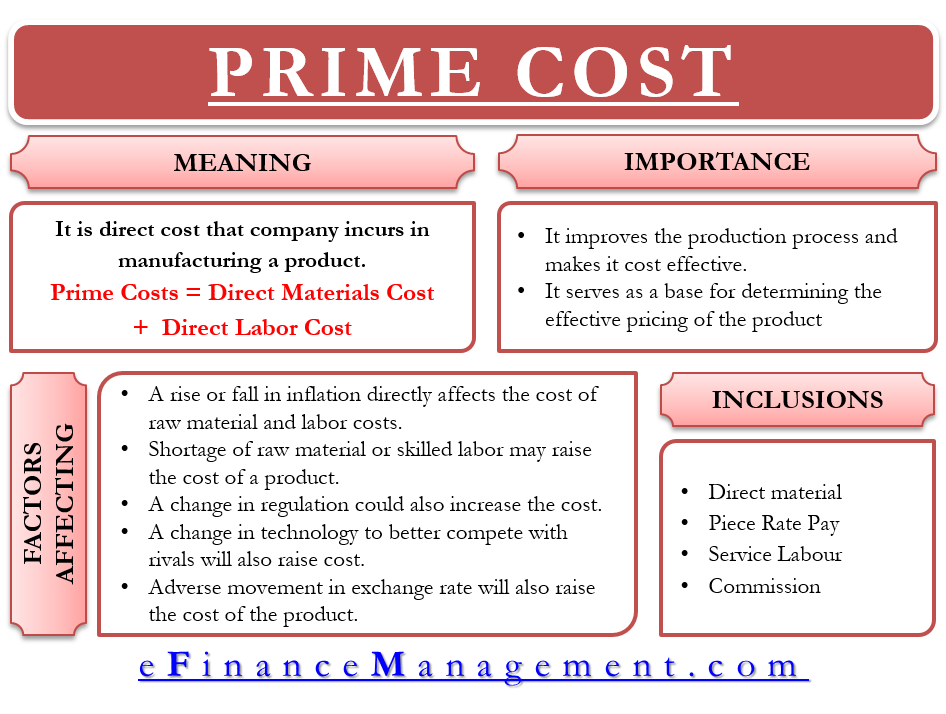
The Fundamental Formula
The formula for prime cost is elegantly simple:
Prime Cost = Direct Materials + Direct Labor
This equation consolidates the two core elements that directly contribute to the creation of a product, providing a clear and concise figure representing the minimum cost incurred to bring a unit into existence.
A Step-by-Step Example
Let’s consider a hypothetical company, “Artisan Furniture Co.,” which manufactures custom wooden tables. For one month, their production data is as follows:
-
Direct Materials:
- Cost of wood purchased and used: $15,000
- Cost of hardware (screws, brackets, etc.) used: $2,000
- Cost of glue and finishes used: $1,000
- Total Direct Materials = $15,000 + $2,000 + $1,000 = $18,000
-
Direct Labor:
- Wages paid to carpenters directly assembling tables: $10,000
- Wages paid to wood cutters: $5,000
- Total Direct Labor = $10,000 + $5,000 = $15,000
Using the prime cost formula:
Prime Cost = Total Direct Materials + Total Direct Labor
Prime Cost = $18,000 + $15,000 = $33,000
If Artisan Furniture Co. produced 100 tables that month, the prime cost per table would be $33,000 / 100 tables = $330 per table. This $330 represents the direct cost incurred for materials and labor for each table produced, forming the essential base for pricing and profitability calculations.
Differentiating Prime Cost from Other Cost Concepts
While prime cost focuses solely on direct materials and direct labor, it’s crucial to understand how it relates to, and differs from, other common cost concepts in manufacturing accounting:
- Conversion Cost: This includes direct labor + manufacturing overhead. Conversion cost represents the cost of converting raw materials into finished products. It focuses on the labor and overhead involved in the transformation process.
- Manufacturing Overhead: These are all indirect costs associated with the manufacturing process that cannot be directly traced to specific products. Examples include indirect labor (supervisors’ salaries, quality control), indirect materials (lubricants, cleaning supplies), factory rent, utilities, depreciation of factory equipment, and factory insurance.
- Total Manufacturing Cost: This is the sum of direct materials + direct labor + manufacturing overhead. It represents the total cost incurred to produce goods during a period.
- Cost of Goods Sold (COGS): This is the direct costs attributable to the production of the goods sold by a company during a period. While prime cost is a component of manufacturing costs, COGS also accounts for changes in inventory (beginning inventory + total manufacturing cost – ending inventory).
Understanding these distinctions ensures that prime cost is used appropriately in financial analysis and decision-making, providing a clear picture of the core expenses without conflating them with indirect or overall operational costs.
Strategies for Managing and Optimizing Prime Cost
Effective management of prime cost is a continuous endeavor that can significantly enhance a company’s profitability and competitive edge. Businesses must proactively identify opportunities to optimize both direct material and direct labor expenses without compromising quality or production capabilities.
Supply Chain Management and Procurement
Optimizing direct material costs largely hinges on efficient supply chain management and astute procurement strategies. Businesses should foster strong relationships with suppliers, exploring opportunities for bulk discounts, long-term contracts, or negotiating favorable payment terms. Implementing just-in-time (JIT) inventory systems can minimize holding costs and reduce waste, while rigorous quality control for incoming materials prevents costly reworks or scrap. Diversifying suppliers can also mitigate risks associated with price volatility or supply disruptions, ensuring a steady and cost-effective flow of raw materials. Leveraging technology for demand forecasting and inventory management can further enhance efficiency and reduce material waste.
Enhancing Labor Productivity and Efficiency
Managing direct labor costs effectively requires a focus on productivity, training, and process optimization. Investing in employee training and development can lead to a more skilled and efficient workforce, reducing errors and increasing output per hour. Implementing lean manufacturing principles, such as reducing non-value-added activities and optimizing workstation layouts, can streamline production processes and minimize wasted labor time. Automation and robotics represent a significant long-term strategy for reducing direct labor costs, particularly for repetitive or hazardous tasks. While initial investments can be substantial, the long-term savings in wages, benefits, and increased production capacity often justify the expenditure. Performance incentives can also motivate employees to achieve higher levels of productivity.
Leveraging Technology and Innovation
Technology plays an increasingly vital role in optimizing prime cost. Modern machinery and equipment can operate with greater precision, speed, and less material waste, directly impacting direct material usage and labor time. Production planning software and enterprise resource planning (ERP) systems can provide real-time data on material consumption and labor utilization, enabling managers to identify bottlenecks and inefficiencies more quickly. Innovations in materials science can lead to the development of cheaper, more durable, or easier-to-process direct materials, while advanced manufacturing techniques like additive manufacturing (3D printing) can reduce waste and customize production, potentially altering the entire prime cost structure.

Continuous Monitoring and Analysis
Finally, effective prime cost management necessitates continuous monitoring and analysis. Regular variance analysis, comparing actual prime costs against budgeted or standard costs, helps identify deviations and their root causes. Implementing robust cost accounting systems ensures accurate data collection for both direct materials and direct labor. Regular reporting allows management to track trends, assess the impact of optimization strategies, and make timely adjustments. Benchmarking prime cost against industry averages or competitors, where possible, can also provide valuable insights into a company’s relative efficiency and highlight areas for improvement. This cyclical process of measurement, analysis, and adjustment is key to sustaining a healthy and optimized prime cost structure.
In conclusion, prime cost is far more than just an accounting term; it is a vital financial metric that offers deep insights into a company’s production efficiency and profitability. By meticulously understanding, calculating, and managing direct materials and direct labor, businesses can lay a strong financial foundation, make informed strategic decisions, and maintain a competitive edge in today’s dynamic market landscape.
aViewFromTheCave is a participant in the Amazon Services LLC Associates Program, an affiliate advertising program designed to provide a means for sites to earn advertising fees by advertising and linking to Amazon.com. Amazon, the Amazon logo, AmazonSupply, and the AmazonSupply logo are trademarks of Amazon.com, Inc. or its affiliates. As an Amazon Associate we earn affiliate commissions from qualifying purchases.