
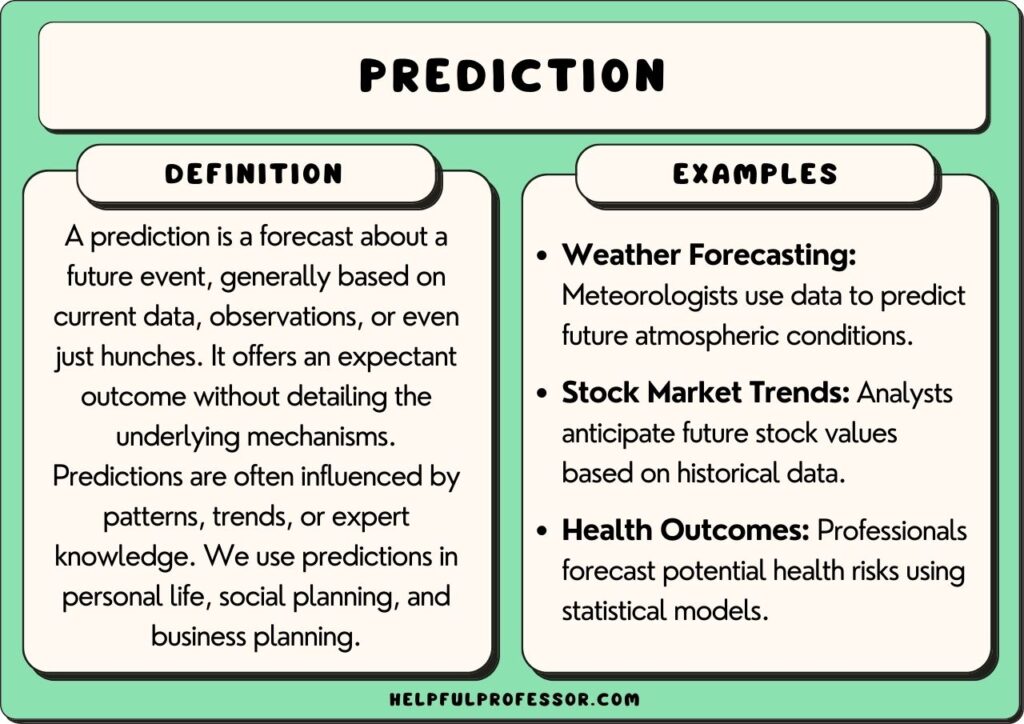
Prediction is the bedrock upon which scientific understanding and progress are built. At its core, it is the act of foreseeing future events or unknown outcomes based on current knowledge, observed patterns, and established principles. From ancient astronomers predicting eclipses to modern epidemiologists forecasting disease outbreaks, the ability to anticipate has always been a hallmark of robust scientific inquiry. However, in the 21st century, the very nature and scope of prediction in science have been revolutionized, largely thanks to a symbiotic relationship with technology.
Today, “predicting in science” is less about gazing into a crystal ball and more about meticulously constructing sophisticated computational models, leveraging vast datasets, and deploying advanced algorithms – especially those powered by artificial intelligence and machine learning. This technological pivot has not only expanded the horizons of what can be predicted but has also enhanced the precision, speed, and reliability of these forecasts across virtually every scientific discipline. This article delves into the technological underpinnings that define modern scientific prediction, exploring the tools, techniques, and challenges inherent in this fascinating and critical endeavor.
The Technological Backbone of Scientific Prediction
The journey from raw data to robust scientific prediction is paved with technological innovation. Without the infrastructure to collect, process, and analyze information at scale, many of today’s most significant predictive breakthroughs would remain theoretical impossibilities. The sheer volume and complexity of data generated by scientific research necessitate an equally sophisticated technological framework.
Data Acquisition and Management: From Sensors to Big Data
The initial step in any predictive endeavor is data. Modern science generates unprecedented amounts of information, from high-resolution images captured by space telescopes and molecular structures unveiled by powerful microscopes, to real-time readings from environmental sensors and genomic sequences from biological samples. This explosion of data is directly attributable to advanced sensor technologies, automated laboratory equipment, and global monitoring networks (e.g., weather stations, seismic sensors).
Managing this “big data” is a monumental task that requires robust technological solutions. Cloud computing platforms provide scalable storage and processing power, allowing researchers to handle petabytes of information without the need for prohibitively expensive on-premise infrastructure. Distributed computing frameworks, such as Apache Hadoop and Spark, enable parallel processing of vast datasets, dramatically reducing analysis times. Furthermore, specialized databases (e.g., graph databases for biological networks, time-series databases for climate data) are optimized to store and query specific types of scientific information efficiently. Without these foundational technologies, the raw material for prediction – data – would remain inaccessible and unusable.
Computational Power and Modeling: Simulating the Future
Once data is acquired and managed, the next crucial step is to build models that can extract insights and make predictions. This is where computational power becomes paramount. Complex scientific phenomena – from the intricate folding of proteins to the chaotic dynamics of global weather systems – often defy simple analytical solutions. Instead, they require sophisticated simulations that can only be performed by high-performance computing (HPC) systems, including supercomputers and GPU clusters.
These powerful machines execute complex algorithms that represent scientific theories and relationships. For instance, climate models involve millions of equations describing atmospheric physics, ocean currents, and land interactions. Material science researchers use quantum mechanical simulations to predict the properties of novel compounds before they are ever synthesized. In astrophysics, N-body simulations can model the evolution of galaxies over billions of years. These computational models are essentially virtual laboratories where scientists can run “what-if” scenarios, test hypotheses, and predict outcomes under varying conditions. The ability to simulate complex systems with increasing fidelity is a direct testament to advancements in processor technology, parallel processing techniques, and numerical algorithms, transforming science from purely observational to highly predictive and experimental within a digital realm.
AI and Machine Learning: Revolutionizing Predictive Capabilities
While traditional computational modeling has been instrumental, the advent of Artificial Intelligence (AI) and Machine Learning (ML) has ushered in a new era of predictive capabilities, fundamentally altering how scientists approach discovery and forecasting. These technologies excel at identifying hidden patterns, making sense of noisy data, and automating complex decision-making processes, often surpassing human capabilities in specific tasks.
Pattern Recognition and Hypothesis Generation
One of the most profound impacts of AI/ML in scientific prediction lies in its ability to autonomously identify subtle patterns and correlations within massive, multi-dimensional datasets that might be invisible to human observers. Techniques like deep learning, neural networks, and random forests can sift through gigabytes of genomic data to predict disease susceptibility, analyze astronomical images to discover new celestial objects, or scour chemical libraries to pinpoint potential drug candidates.
Crucially, AI doesn’t just make predictions; it can also assist in hypothesis generation. By identifying unexpected correlations or anomalies, ML algorithms can prompt scientists to formulate new hypotheses, design novel experiments, and explore previously overlooked avenues of research. For example, an AI might predict a novel interaction between two proteins, leading biologists to test this interaction in the lab, thus accelerating the pace of discovery. This shift from purely human-driven hypothesis generation to an AI-augmented process is a game-changer for scientific exploration.
Predictive Analytics Across Disciplines
The versatility of AI/ML makes it applicable across virtually every scientific domain, driving predictive analytics to new heights.
- Climate Science: Machine learning enhances traditional climate models by improving the representation of complex processes, predicting extreme weather events with greater accuracy, and forecasting the localized impacts of climate change. For instance, ML can downscale global climate projections to fine-grained regional forecasts, crucial for policymaking.
- Medicine and Healthcare: AI-powered diagnostics predict disease onset (e.g., identifying risk factors for diabetes or heart disease years in advance), personalize treatment plans based on an individual’s genetic makeup and lifestyle, and predict patient responses to specific drugs. It also plays a critical role in predicting the spread of infectious diseases, aiding in public health interventions.
- Materials Science: ML algorithms accelerate the discovery of new materials with desired properties (e.g., superconductors, catalysts, battery components) by predicting their characteristics based on their atomic structure, reducing the need for laborious and expensive experimental trial-and-error.
- Astronomy and Space Exploration: AI analyzes vast amounts of telescope data to identify exoplanets, predict asteroid trajectories, and classify galaxies, pushing the boundaries of our understanding of the universe.
- Physics: Machine learning is used in particle physics to sift through immense datasets from colliders, identifying rare events and particles that could unlock new fundamental laws of the universe.
Challenges and Ethical Considerations in Tech-Driven Prediction

While technology has undeniably supercharged scientific prediction, its reliance also introduces significant challenges and ethical considerations that must be carefully navigated. The push for more accurate and comprehensive predictions must be balanced with considerations of fairness, transparency, and accountability.
Data Bias and Model Robustness
The principle of “garbage in, garbage out” is particularly poignant in AI-driven prediction. If the data used to train predictive models is biased – reflecting historical inequities, incomplete observations, or measurement errors – then the predictions generated will perpetuate and even amplify those biases. For example, medical AI trained predominantly on data from one demographic group might perform poorly or provide incorrect diagnoses for others. Ensuring data quality, diversity, and representativeness is a continuous and complex challenge.
Furthermore, model robustness is critical. A predictive model must not only perform well on the data it was trained on but also generalize accurately to new, unseen data. Overfitting, where a model memorizes the training data rather than learning generalizable patterns, is a common pitfall. Scientists must employ rigorous validation techniques to ensure their models are robust and reliable under real-world conditions, not just in controlled training environments.
Explainability and Trust in AI Predictions
Many advanced AI models, particularly deep learning networks, operate as “black boxes.” They can make highly accurate predictions, but the internal logic or the specific features that led to a particular prediction are often opaque, even to the developers. This lack of explainability (often referred to as the XAI problem – Explainable AI) poses a significant challenge in scientific contexts.
Scientists don’t just want to know what will happen; they also need to understand why. Understanding the underlying mechanisms and causal relationships is crucial for generating new hypotheses, validating theories, and building trust in the predictions. If an AI predicts a certain drug will be effective, but cannot explain why it predicts that, it hinders further scientific investigation and adoption. Developing AI models that are inherently more interpretable or creating tools that can shed light on the internal workings of black-box models is an active and essential area of research. Without explainability, trust in AI-driven scientific prediction remains limited, especially when high-stakes decisions are involved.
The Human Element: Interpretation and Innovation
Despite the increasing sophistication of technological tools, the human element remains irreplaceable in scientific prediction. Technology serves as a powerful amplifier for human intellect, not a substitute. Scientists are crucial for formulating the initial research questions, designing experiments, selecting and curating data, interpreting the output of complex models, and critically evaluating the validity and implications of predictions.
Human intuition, creativity, and domain expertise are essential for identifying anomalies that AI might miss, questioning assumptions, and translating abstract data patterns into meaningful scientific insights. Furthermore, the ethical oversight, societal impact assessment, and responsible deployment of predictive technologies ultimately rest with human researchers and policymakers. The most successful predictive endeavors in science will always be those that foster a strong collaboration between advanced technology and brilliant human minds.
The Future Landscape of Scientific Prediction
The trajectory of scientific prediction is one of accelerating innovation, driven by breakthroughs in computing and data science. The future promises even more profound capabilities, further blurring the lines between observation, simulation, and real-time foresight.
Quantum Computing and Advanced Simulations
Quantum computing stands on the horizon as a potential game-changer for scientific prediction. Unlike classical computers that process information as bits (0s or 1s), quantum computers use qubits, which can represent both 0 and 1 simultaneously, enabling them to tackle problems currently intractable for even the most powerful supercomputers. This could revolutionize complex simulations in fields like materials science (predicting molecular interactions with unprecedented accuracy), drug discovery (modeling drug-protein binding), and fundamental physics (simulating quantum systems). The ability to model complex systems at a quantum level could unlock entirely new predictive capabilities, leading to discoveries currently unimaginable.
Hyper-Personalized and Real-Time Predictions
With the proliferation of IoT devices, wearable sensors, and continuous data streams, the future will see a move towards hyper-personalized and real-time predictions. In healthcare, this could mean continuous monitoring predicting an individual’s health risks moments before they manifest, enabling proactive interventions. In environmental science, real-time sensor networks coupled with AI could provide immediate, localized forecasts of air quality or flood risks. Smart cities could leverage real-time traffic data, weather patterns, and social behavior to predict and manage urban dynamics, optimizing resource allocation and improving quality of life. The ability to make dynamic, adaptive predictions based on ever-evolving data will transform how we interact with and understand our complex world.
Interdisciplinary Fusion and Holistic Models
The future of scientific prediction will increasingly involve the fusion of multiple disciplines. Instead of siloed predictions, we will see holistic models that integrate environmental, social, economic, and technological factors to create more comprehensive and accurate forecasts. Predicting the impact of climate change, for example, will not only involve atmospheric physics but also socio-economic models, public health analytics, and resource management predictions. This interdisciplinary approach, facilitated by advanced data integration and multi-modal AI, will enable scientists to address complex global challenges with a more unified and predictive understanding.
Conclusion
Prediction in science has evolved dramatically, transforming from theoretical extrapolation to a sophisticated, technologically-driven enterprise. Enabled by robust data management systems, immense computational power, and the transformative capabilities of AI and machine learning, scientists can now foresee outcomes, discover patterns, and test hypotheses with unprecedented precision and scale. While challenges related to data bias, model explainability, and ethical deployment persist, the symbiotic relationship between science and technology continues to push the boundaries of what is knowable and predictable. As we venture further into the age of quantum computing and hyper-connected data, the future of scientific prediction promises to unlock deeper insights into the universe, accelerate solutions to global challenges, and fundamentally reshape our understanding of reality.
aViewFromTheCave is a participant in the Amazon Services LLC Associates Program, an affiliate advertising program designed to provide a means for sites to earn advertising fees by advertising and linking to Amazon.com. Amazon, the Amazon logo, AmazonSupply, and the AmazonSupply logo are trademarks of Amazon.com, Inc. or its affiliates. As an Amazon Associate we earn affiliate commissions from qualifying purchases.