
In the intricate world of technology, where data reigns supreme and algorithms drive innovation, the ability to process and manipulate mathematical expressions efficiently is paramount. From machine learning models to advanced graphics rendering, the underlying principles often trace back to fundamental algebraic concepts. Among these, the “polynomial standard form” stands out as a critical organizational structure that enables clarity, efficiency, and comparability in computational systems. Far from being a mere academic exercise, understanding this standard is foundational for anyone delving into software development, data science, or computational engineering.
The Foundation of Polynomials in Computing
At its core, a polynomial is an algebraic expression consisting of variables and coefficients, involving only the operations of addition, subtraction, multiplication, and non-negative integer exponents. While seemingly straightforward, their versatility makes them indispensable tools across numerous technological domains. However, for computers to effectively work with these expressions, a consistent and unambiguous representation is essential. This is precisely where standard form becomes invaluable.

Defining Polynomials: A Digital Perspective
From a computational standpoint, a polynomial like $3x^2 + 2x – 5$ is not just a string of characters; it’s a structured piece of data that can be evaluated, differentiated, integrated, or solved by an algorithm. Each term—$3x^2$, $2x$, and $-5$—consists of a coefficient (3, 2, -5) and a variable raised to a non-negative integer power (2, 1, 0 for the constant term). When a software program needs to perform operations on polynomials, it relies on a consistent internal representation. Without a standard way to organize these terms, comparing two polynomials, performing arithmetic operations, or even accurately evaluating them would become a complex and error-prone task, demanding significant computational overhead.
The Importance of Order: Why Standard Form Matters
Imagine trying to compare two lists of ingredients for a recipe if the ingredients were listed in completely random orders each time. It would be inefficient and difficult to determine if they were the same. Similarly, for polynomials, an unstructured representation can obscure commonalities and complicate processing. For example, $2x + 5x^2 – 7$ and $-7 + 5x^2 + 2x$ are the same polynomial, but their differing appearance could fool a naive algorithm.
Standard form addresses this by providing a universal convention. By arranging terms in a predictable order, typically by descending powers of the variable, it allows algorithms to:
- Identify equality: Quickly determine if two seemingly different polynomial expressions are indeed identical.
- Simplify operations: Perform addition, subtraction, multiplication, and division more efficiently by aligning like terms.
- Optimize evaluation: Facilitate faster computation of polynomial values by following a consistent structure.
- Streamline analysis: Aid in the analysis of polynomial behavior, such as finding roots or determining the degree, which are crucial in numerical methods and scientific computing.
- Improve human readability: Make polynomials easier for developers and analysts to understand and debug.
Unpacking Standard Form: Rules and Representation
The standard form of a polynomial is not arbitrary; it follows specific rules designed for mathematical rigor and computational efficiency. Adhering to these rules ensures that every polynomial has a unique and canonical representation, simplifying its manipulation in digital environments.
Descending Order of Exponents
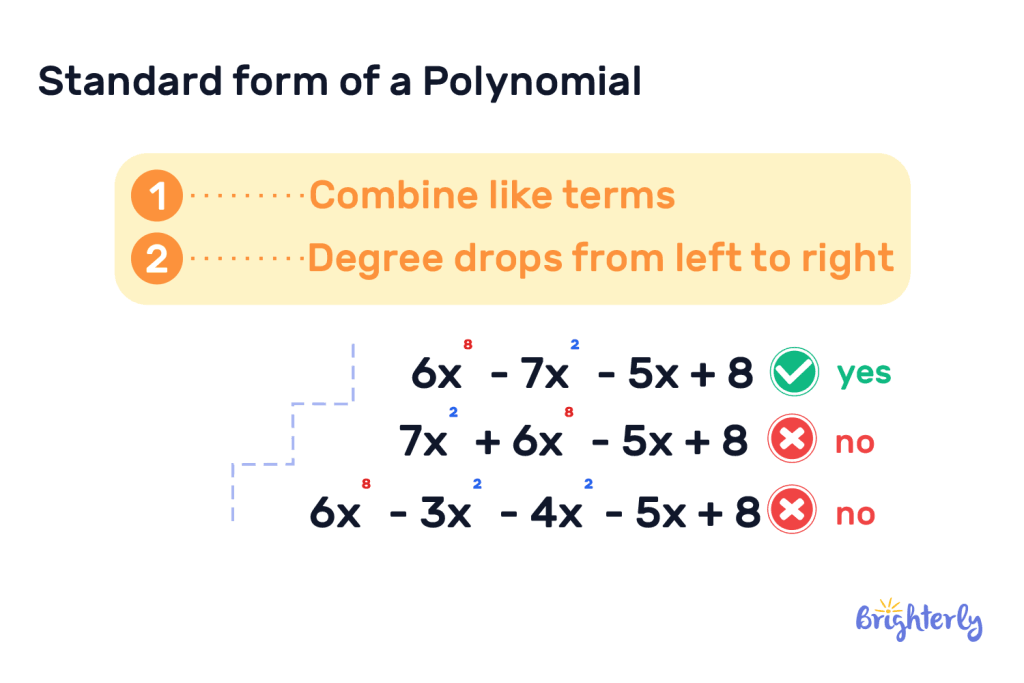
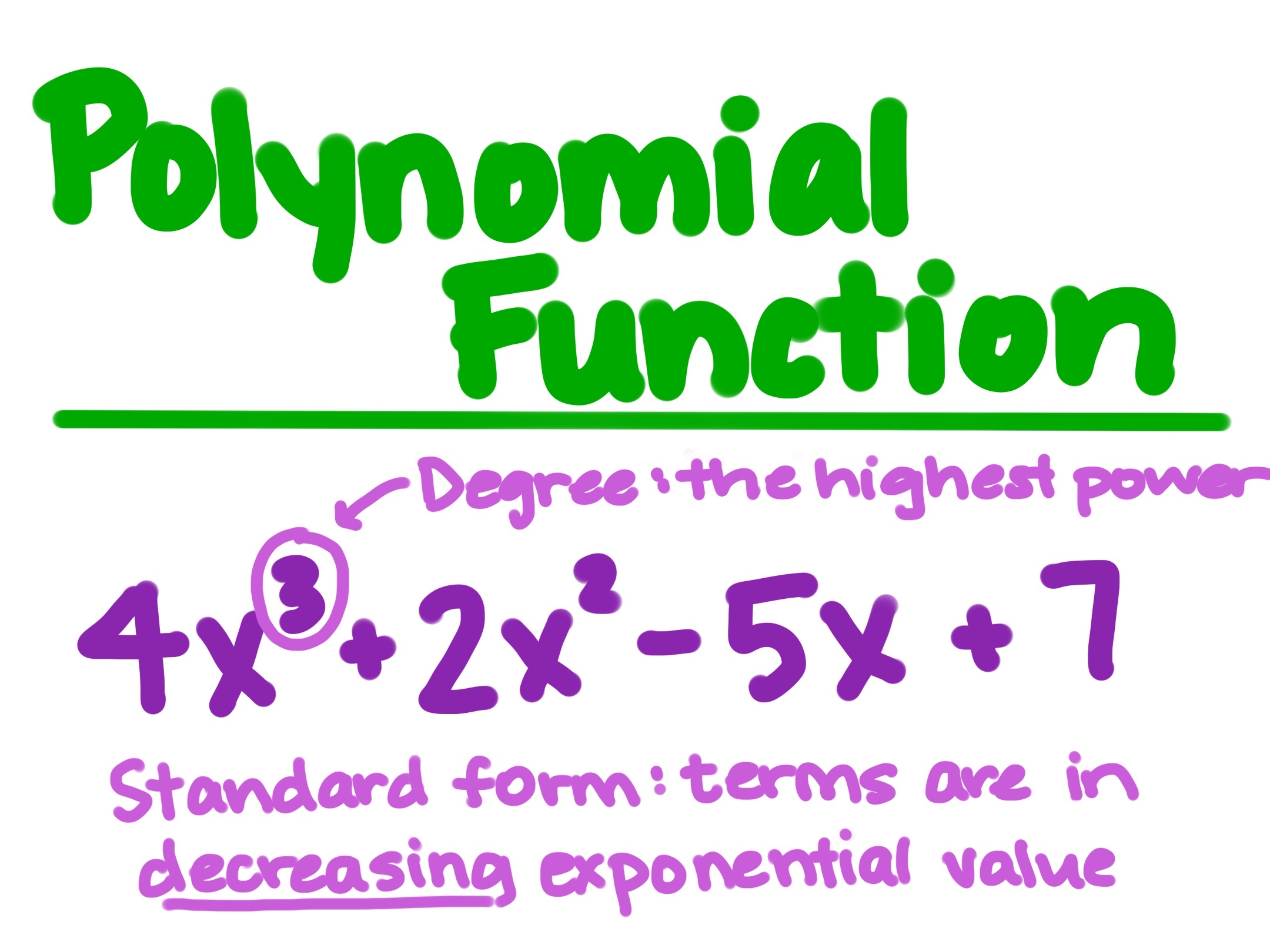
The primary rule for standard form is to arrange the terms in descending order of the exponents of the variable. For instance, in a polynomial with a single variable x, terms with x^5 would come before terms with x^3, which in turn would precede terms with x^1 (simply x), and finally, the constant term (which can be thought of as x^0).
Consider the polynomial $5x – 2 + 3x^4 – 7x^2$. To write this in standard form, we identify the highest exponent first, which is $x^4$.
- Term with $x^4$: $3x^4$
- Term with $x^2$: $-7x^2$ (note the coefficient includes the sign)
- Term with $x^1$: $5x$
- Constant term ($x^0$): $-2$
Thus, the standard form is $3x^4 – 7x^2 + 5x – 2$. This consistent ordering makes it straightforward for parsing algorithms or numerical solvers to iterate through the terms.
Combining Like Terms
Before arranging terms, an essential preliminary step is to combine any “like terms.” Like terms are those that have the same variable raised to the same power. For example, $4x^3$ and $-2x^3$ are like terms, and they should be combined to form $(4-2)x^3 = 2x^3$. This simplification reduces the number of terms and ensures that each power of the variable appears only once.
If we had $2x^2 + 3x – 5 + x^2 – x$, we would first combine:
- $2x^2 + x^2 = 3x^2$
- $3x – x = 2x$
Resulting in $3x^2 + 2x – 5$. Only after combining like terms can the polynomial be accurately represented in descending order of exponents.
The Role of Coefficients and Variables
In standard form, each term consists of a coefficient and a variable raised to a power. The coefficient is the numerical factor multiplying the variable part. It can be any real number (positive, negative, integer, fraction, or decimal). The variable is typically represented by a letter (e.g., $x$, $y$, $t$), and its exponent must be a non-negative integer. The constant term, which has no visible variable, is simply its coefficient (e.g., -5), implicitly associated with the variable raised to the power of zero ($x^0 = 1$). A polynomial’s degree is the highest exponent present in its standard form, which is a key characteristic used in algorithms for classification and analysis.
Polynomial Standard Form in Software Development and Algorithms
The practical implications of polynomial standard form extend deeply into various branches of software development and computational algorithms. Its methodical structure simplifies complex calculations and underpins the reliability of many digital systems.
Data Analysis and Machine Learning
In data science, polynomials are critical in regression analysis, particularly polynomial regression, where a non-linear relationship between variables is modeled using a polynomial function. For example, fitting a curve to data points often involves finding the coefficients of a polynomial that best approximates the trend. When a machine learning library like scikit-learn or TensorFlow processes polynomial features, it implicitly relies on the standard form for efficient matrix operations and model evaluation. The consistent ordering ensures that features (e.g., $x$, $x^2$, $x^3$) are always presented in the same sequence, making the training and prediction phases robust.
Computer Graphics and Game Development
Polynomials are fundamental to computer graphics for defining curves and surfaces. Bézier curves, widely used in vector graphics, animation, and game development (e.g., for character paths, camera movements, or terrain generation), are defined by polynomial equations. When a graphics engine renders a curve or calculates interpolated positions, the underlying polynomial computations are performed with expressions consistently maintained in standard form. This consistency is vital for real-time rendering performance, ensuring that calculations for thousands of vertices and frames per second are executed with minimal overhead.
Cryptography and Digital Security
While often hidden from view, polynomials play a role in advanced cryptographic algorithms, particularly those based on elliptic curves or finite fields. Public-key cryptography often involves modular arithmetic with polynomials. Ensuring that these polynomials are in a consistent standard form is crucial for the correctness and efficiency of cryptographic operations, such as encryption, decryption, and key generation. The ordered structure helps in performing rapid polynomial multiplication and reduction modulo an irreducible polynomial, which are core operations in many modern security protocols.
Optimization Problems and Scientific Computing
Many scientific and engineering problems involve optimization, where the goal is to find the maximum or minimum value of a function. Often, these objective functions can be approximated or are inherently polynomial in nature. Numerical methods, such as Newton’s method or gradient descent variants, rely on accurately evaluating the function and its derivatives, which are also polynomials. Maintaining polynomials in standard form is essential for the stability and convergence of these iterative algorithms in fields ranging from aerospace engineering simulations to financial modeling.
Implementing and Manipulating Polynomials Programmatically
For developers, understanding polynomial standard form is not just theoretical; it directly influences how polynomial objects are designed and how operations are implemented in code.
Representing Polynomials in Code
In programming languages, polynomials can be represented in various ways, but all typically aim to reflect the standard form’s structure. Common representations include:
- Arrays or Lists of Coefficients: The most common method. An array
[a_n, a_{n-1}, ..., a_1, a_0]can represent the polynomial $anx^n + a{n-1}x^{n-1} + … + a1x + a0$. The index of the array often corresponds to the exponent. For instance,poly_coeffs[i]would be the coefficient for $x^i$. This implicitly maintains standard form due to array indexing. - Hash Maps/Dictionaries: For sparse polynomials (many zero coefficients), a dictionary
{exponent: coefficient}can be more memory-efficient, storing only non-zero terms. When processing, these would typically be sorted by exponent to simulate standard form behavior. - Objects/Classes: A
Polynomialclass might encapsulate a list of terms, eachTermobject havingcoefficientandexponentproperties. The class methods would then manage sorting terms into standard form after any modification.
Automated Conversion to Standard Form
When a user or another part of the program provides a polynomial in a non-standard arrangement, the first step for a robust polynomial library is often to convert it to standard form. This involves:
- Parsing: Breaking down the input string or expression into individual terms.
- Canonicalization: For each term, identifying its coefficient and exponent.
- Combination: Iterating through the terms and combining those with identical exponents by adding their coefficients.
- Ordering: Sorting the resulting unique terms in descending order of their exponents.
- Elimination of Zero Terms: Removing terms whose coefficient becomes zero (e.g., $3x^2 – 3x^2$).
This automated process ensures that all subsequent operations are performed on a consistent and optimized representation.
Algebraic Operations in Software
Once in standard form, operations like addition, subtraction, and multiplication become algorithmically straightforward:
- Addition/Subtraction: Iterate through both polynomial representations (e.g., coefficient arrays). Add or subtract coefficients of terms with matching exponents. For unmatched exponents, simply carry over the term from the polynomial it originated from. The result will naturally be in standard form.
- Multiplication: Each term of the first polynomial is multiplied by each term of the second. The exponents are added, and coefficients are multiplied. The resulting terms are then combined and re-ordered into standard form.
- Evaluation: To evaluate $P(x)$ for a given $x$, iterate through the terms in standard form, calculate each $a_i x^i$, and sum the results. Horner’s method, which is highly efficient for polynomial evaluation, also implicitly benefits from the ordered structure of standard form.
The Future of Polynomials in Advanced Tech
As technology continues to evolve, the fundamental role of polynomials, and thus their standard form, remains undiminished. New paradigms are emerging where their structured manipulation will be even more critical.
Quantum Computing Implications
In the nascent field of quantum computing, representing and manipulating mathematical functions, including polynomials, will be crucial for developing quantum algorithms. Quantum circuits often involve transformations that can be expressed as polynomial mappings. Ensuring that these are in a consistent, standard form could be vital for debugging, optimization, and verifying the correctness of complex quantum operations, especially as quantum compilers aim to simplify and optimize quantum programs.
AI-Driven Mathematical Discovery
The intersection of artificial intelligence and mathematics is leading to new methods for solving complex equations and even discovering new mathematical theorems. AI systems trained to perform symbolic manipulation or solve differential equations frequently work with polynomial expressions. For these AI tools to operate effectively, they must parse, normalize, and manipulate polynomials with the utmost consistency, which standard form inherently provides. As AI becomes more adept at high-level mathematical reasoning, the foundational consistency offered by polynomial standard form will continue to be a silent but powerful enabler.
In essence, polynomial standard form is more than just a mathematical rule; it’s an architectural principle for data representation in computing. It underpins the reliability, efficiency, and scalability of countless algorithms and software applications, proving that even the most fundamental concepts hold immense significance in the complex landscape of modern technology.
aViewFromTheCave is a participant in the Amazon Services LLC Associates Program, an affiliate advertising program designed to provide a means for sites to earn advertising fees by advertising and linking to Amazon.com. Amazon, the Amazon logo, AmazonSupply, and the AmazonSupply logo are trademarks of Amazon.com, Inc. or its affiliates. As an Amazon Associate we earn affiliate commissions from qualifying purchases.