
In the dynamic world of software development, efficiency, flexibility, and maintainability are paramount. As applications grow in complexity, the need for elegant and robust solutions becomes increasingly critical. One of the cornerstones of object-oriented programming (OOP) that empowers developers to achieve these goals is polymorphism. Specifically, in C++, polymorphism allows for a remarkable degree of flexibility and power, enabling code to be more adaptable and reusable.
This article will demystify polymorphism in C++, breaking down its core concepts, exploring its different types, and illustrating its practical applications within the broader tech landscape. We’ll delve into how polymorphism, when understood and applied correctly, can lead to more streamlined code, easier debugging, and the development of sophisticated software solutions that are a hallmark of modern technology.

Understanding the Core Concept: “Many Forms”
The word “polymorphism” itself is derived from Greek: “poly” meaning “many” and “morphē” meaning “form.” In the context of C++ and object-oriented programming, polymorphism refers to the ability of an object to take on many forms. More precisely, it allows a single interface to represent a general class of actions. The specific action performed depends on the type of object that the interface is interacting with.
Imagine a scenario where you have different types of vehicles: a car, a motorcycle, and a truck. Each of these vehicles can perform the action of “move.” However, the way they move is distinct. A car uses four wheels, a motorcycle uses two, and a truck might have a more complex braking system. Polymorphism allows us to write code that can instruct any vehicle to “move” without needing to know the exact type of vehicle beforehand. The correct move behavior will be executed based on whether it’s a car, motorcycle, or truck.
This concept is deeply intertwined with inheritance, a fundamental pillar of OOP. When a class inherits from another class (its parent or base class), it inherits its properties and behaviors. Polymorphism then builds upon this by allowing objects of derived classes to be treated as objects of the base class.
The Benefits of Polymorphism
The advantages of leveraging polymorphism in C++ are numerous and directly contribute to building better technology:
- Code Reusability: Polymorphism significantly reduces code duplication. Instead of writing separate logic for each specific type, you can write general logic that works with a base class pointer or reference, and it will automatically adapt to the derived class.
- Flexibility and Extensibility: New types can be added to the system without altering the existing code that uses the polymorphic interface. This makes systems more adaptable to changing requirements and easier to extend.
- Maintainability: Polymorphic code is generally easier to understand and maintain. The abstraction provided by polymorphism simplifies the codebase, making it less prone to errors.
- Decoupling: Polymorphism helps to decouple components of a system. Different parts of the code can interact with each other through a common interface without needing to know the specific implementations.
Types of Polymorphism in C++
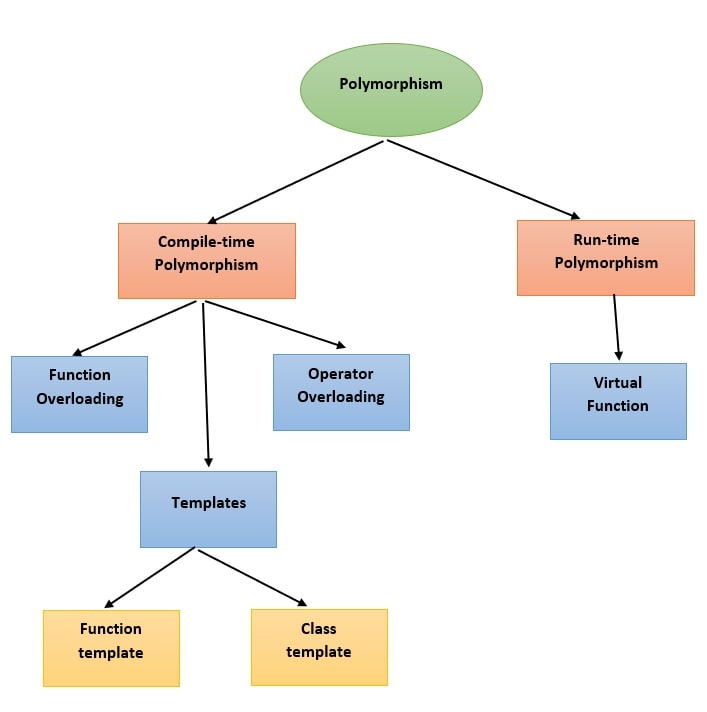
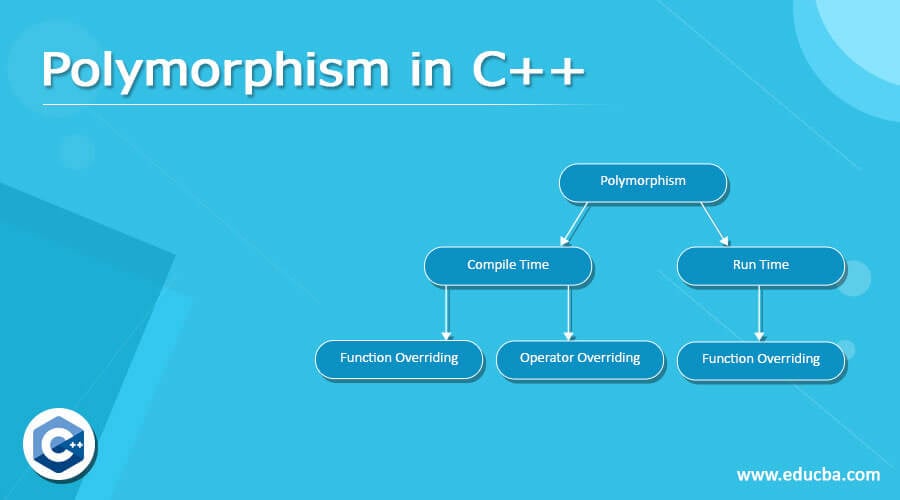
C++ supports several ways to achieve polymorphism, each with its own strengths and use cases. The two primary categories are compile-time polymorphism and run-time polymorphism.
Compile-Time Polymorphism (Static Polymorphism)
Compile-time polymorphism, also known as static polymorphism, is resolved during the compilation phase of the program. The compiler knows exactly which function to call at compile time.
Function Overloading
Function overloading allows you to define multiple functions with the same name within the same scope, but with different parameter lists (different number of parameters, different types of parameters, or both). The compiler determines which function to call based on the arguments provided during the function call.
Example:
#include <iostream>

void print(int i) {
    std::cout << "Printing integer: " << i << std::endl;
}

void print(double d) {
    std::cout << "Printing double: " << d << std::endl;
}

void print(const char* s) {
    std::cout << "Printing string: " << s << std::endl;
}

int main() {
    print(10);      // Calls print(int)
    print(3.14);    // Calls print(double)
    print("Hello"); // Calls print(const char*)
    return 0;
}
In this example, the print function is overloaded to handle integers, doubles, and strings. The compiler selects the appropriate print function based on the data type of the argument passed.
Operator Overloading
Operator overloading allows you to redefine the behavior of built-in operators (like +, -, *, /, <<, >>, etc.) for user-defined types (classes). This enables you to use operators in a natural and intuitive way with your objects, enhancing code readability.
Example:
#include <iostream>

class Vector {
public:
    int x, y;

    Vector(int x_val = 0, int y_val = 0) : x(x_val), y(y_val) {}

    // Overloading the '+' operator for vector addition
    Vector operator+(const Vector& other) const {
        return Vector(x + other.x, y + other.y);
    }
};

int main() {
    Vector v1(1, 2);
    Vector v2(3, 4);

    Vector v3 = v1 + v2; // Uses the overloaded '+' operator

    std::cout << "Vector v3: (" << v3.x << ", " << v3.y << ")" << std::endl; // Output: (4, 6)
    return 0;
}
Here, the + operator is overloaded for the Vector class, allowing us to add two Vector objects as if they were simple numerical types.
Run-Time Polymorphism (Dynamic Polymorphism)
Run-time polymorphism, also known as dynamic polymorphism or late binding, is resolved during the execution of the program. This is achieved through virtual functions and pointers/references to base classes. It’s the type of polymorphism most commonly associated with the term “polymorphism” in OOP.
Virtual Functions and Inheritance
Virtual functions are member functions declared within a base class using the virtual keyword. When a derived class overrides a virtual function, it provides its own specific implementation. The magic of run-time polymorphism happens when you have a pointer or reference to a base class that actually points to an object of a derived class. When you call a virtual function through this base class pointer/reference, the version of the function that gets executed is determined by the actual type of the object at run-time, not the type of the pointer/reference.
Key Components for Run-time Polymorphism:
- Base Class: Must have at least one virtual function.
- Derived Classes: Must override the virtual function(s) from the base class.
- Base Class Pointer/Reference: Used to point to or refer to objects of derived classes.
Example:
#include <iostream>
#include <vector>

// Base class
class Shape {
public:
    // Virtual function
    virtual void draw() const {
        std::cout << "Drawing a generic shape." << std::endl;
    }
    virtual ~Shape() {} // Virtual destructor is important!
};

// Derived class 1
class Circle : public Shape {
public:
    void draw() const override { // 'override' is good practice
        std::cout << "Drawing a circle." << std::endl;
    }
};

// Derived class 2
class Square : public Shape {
public:
    void draw() const override {
        std::cout << "Drawing a square." << std::endl;
    }
};

int main() {
    // Using base class pointers to point to derived class objects
    Shape* shape1 = new Circle();
    Shape* shape2 = new Square();
    Shape* shape3 = new Shape(); // An instance of the base class

    shape1->draw(); // Calls Circle's draw()
    shape2->draw(); // Calls Square's draw()
    shape3->draw(); // Calls Shape's draw()

    // Using a collection of base class pointers
    std::vector<Shape*> shapes;
    shapes.push_back(new Circle());
    shapes.push_back(new Square());
    shapes.push_back(new Circle());

    std::cout << "nDrawing shapes from a collection:n";
    for (const auto& shape : shapes) {
        shape->draw(); // Polymorphic call!
    }

    // Clean up memory
    delete shape1;
    delete shape2;
    delete shape3;
    for (const auto& shape : shapes) {
        delete shape;
    }

    return 0;
}
In this illustration:
Shapeis the base class with avirtualdraw()function.CircleandSquareare derived classes thatoverridethedraw()function.- We create
Shapepointers (shape1,shape2,shape3) and assign themCircle,Square, andShapeobjects respectively. - When
shape1->draw()is called, even thoughshape1is aShape*, the actual object it points to is aCircle, soCircle::draw()is executed. Similarly forshape2. - The
std::vector<Shape*>demonstrates how you can manage a collection of diverse objects through a common base class interface, making your code highly adaptable.
The Importance of the Virtual Destructor:
Notice the virtual ~Shape() {} in the base class. This is crucial. When you delete a derived class object through a base class pointer, if the base class destructor is not virtual, only the base class destructor will be called, leading to resource leaks and undefined behavior. A virtual destructor ensures that the correct destructors (derived class then base class) are called in the proper order.
Abstract Classes and Pure Virtual Functions
An abstract class is a class that cannot be instantiated on its own. It’s designed to be a base class for other classes. Abstract classes are typically used to define a common interface that all derived classes must adhere to. This is achieved through pure virtual functions.
A pure virtual function is a virtual function that is declared in a base class but has no implementation in the base class. It’s declared by appending = 0 to its declaration.
Example:
#include <iostream>

// Abstract class
class Animal {
public:
    virtual void speak() const = 0; // Pure virtual function
    virtual ~Animal() {}
};

class Dog : public Animal {
public:
    void speak() const override {
        std::cout << "Woof!" << std::endl;
    }
};

class Cat : public Animal {
public:
    void speak() const override {
        std::cout << "Meow!" << std::endl;
    }
};

int main() {
    // Animal a; // Error: cannot instantiate abstract class 'Animal'

    Animal* myDog = new Dog();
    Animal* myCat = new Cat();

    myDog->speak(); // Calls Dog::speak()
    myCat->speak(); // Calls Cat::speak()

    delete myDog;
    delete myCat;

    return 0;
}
In this example:
Animalis an abstract class because it contains a pure virtual functionspeak().- You cannot create an
Animalobject directly. - Any class derived from
Animalmust provide an implementation forspeak()to be instantiable.DogandCatdo this. - This pattern enforces a contract: any
Animalobject, regardless of its specific type, will have aspeak()method.
Polymorphism in Practice: Beyond Code
The principles of polymorphism extend far beyond the syntax of C++. They represent a powerful design philosophy that influences how we approach building complex systems, from intricate software applications to strategic brand management.
Tech Applications: Building Adaptable Software
In the tech industry, polymorphism is the backbone of many sophisticated software designs:
- GUI Frameworks: Frameworks like Qt or MFC use polymorphism extensively. A
Buttonwidget, aTextBoxwidget, and aWindowwidget might all inherit from a commonWidgetbase class. They can all be added to a generalContainerobject, and when arender()method is called on the container, each widget’s specificrender()implementation (e.g., drawing a button border, drawing text, drawing a window frame) is invoked polymorphically. - Game Development: In games, a
GameObjectbase class can have virtual methods likeupdate()orrender(). Different types of game objects (enemies, player characters, items) inherit fromGameObjectand provide their unique implementations. A game engine can then iterate through a list ofGameObjectpointers and callupdate()on each, seamlessly managing the behavior of diverse entities. - Database Systems: When interacting with different types of databases (SQL, NoSQL), a common
DatabaseConnectorinterface can be defined with virtual methods forconnect(),query(), anddisconnect(). Concrete classes likeMySQLConnectorandMongoDBConnectorwould implement these methods, allowing the application to switch database backends without major code refactoring. - AI and Machine Learning Tools: In AI toolkits, you might have a base class
Modelwith a virtualpredict()method. Different machine learning models (e.g.,NeuralNetwork,DecisionTree,SVM) would inherit fromModeland implement their specific prediction logic. This allows for easily swapping out or adding new model types to an existing system.
Brand Strategy: Unified yet Diverse Messaging
While not a direct code application, the concept of polymorphism resonates strongly in brand strategy. A strong brand needs to maintain a consistent core identity (the base class) while adapting its message and presentation across different platforms and target audiences (the derived classes).
- Brand Identity: The core values, mission, and visual elements of a brand are its fundamental characteristics.
- Marketing Campaigns: A campaign for social media will have a different tone and format than a campaign for a formal print advertisement. However, both should align with the overarching brand identity.
- Product Lines: Different product lines under a single brand umbrella might have distinct features and target demographics, but they should all feel like they belong to the same overarching brand family.
The ability to project a consistent brand essence while adapting to diverse contexts is, in a conceptual sense, a form of brand polymorphism.
Money and Finance: Flexible Financial Tools
In personal and business finance, the ability of a concept to take on different forms or be applied in various ways is a form of polymorphism.
- Investment Strategies: A core principle of investing (e.g., long-term growth) can be applied through various instruments like stocks, bonds, or real estate. The underlying goal remains, but the specific “form” of investment varies.
- Budgeting Tools: A budgeting app might allow users to categorize expenses in numerous ways. The core function is tracking spending, but the “form” of categorization can be highly personalized.
- Business Models: A company might offer its services through different revenue models – subscription, pay-per-use, freemium. The core service is consistent, but the “form” of monetization differs.
Conclusion
Polymorphism in C++ is a powerful and fundamental concept that empowers developers to write more flexible, reusable, and maintainable code. By understanding and effectively utilizing compile-time and run-time polymorphism, you can build more robust and adaptable software solutions. Whether you’re designing intricate applications, managing complex data structures, or simply aiming for cleaner, more efficient code, embracing polymorphism is a crucial step towards mastering C++ and building the next generation of innovative technology. It’s a testament to how a well-designed programming paradigm can mirror and enable sophisticated, multi-faceted approaches in various domains, from the digital realm to strategic brand building and sound financial planning.
aViewFromTheCave is a participant in the Amazon Services LLC Associates Program, an affiliate advertising program designed to provide a means for sites to earn advertising fees by advertising and linking to Amazon.com. Amazon, the Amazon logo, AmazonSupply, and the AmazonSupply logo are trademarks of Amazon.com, Inc. or its affiliates. As an Amazon Associate we earn affiliate commissions from qualifying purchases.