
In the dynamic world of business, efficiency, quality, and cost control are not just buzzwords; they are fundamental pillars of sustained profitability and competitive advantage. One profound concept that underpins these pillars, often overlooked in its direct financial impact, is Poka-Yoke. Originating from the Toyota Production System, Poka-Yoke, roughly translating to “mistake-proofing” or “inadvertent error prevention,” is more than just an operational methodology; it is a powerful financial tool designed to eliminate costly errors before they occur, thereby safeguarding revenue, reducing expenses, and enhancing overall business value. From a business finance perspective, Poka-Yoke is an investment in prevention that yields significant returns through improved quality, reduced waste, and elevated customer satisfaction.

Understanding Poka-Yoke: The Essence of Error Prevention
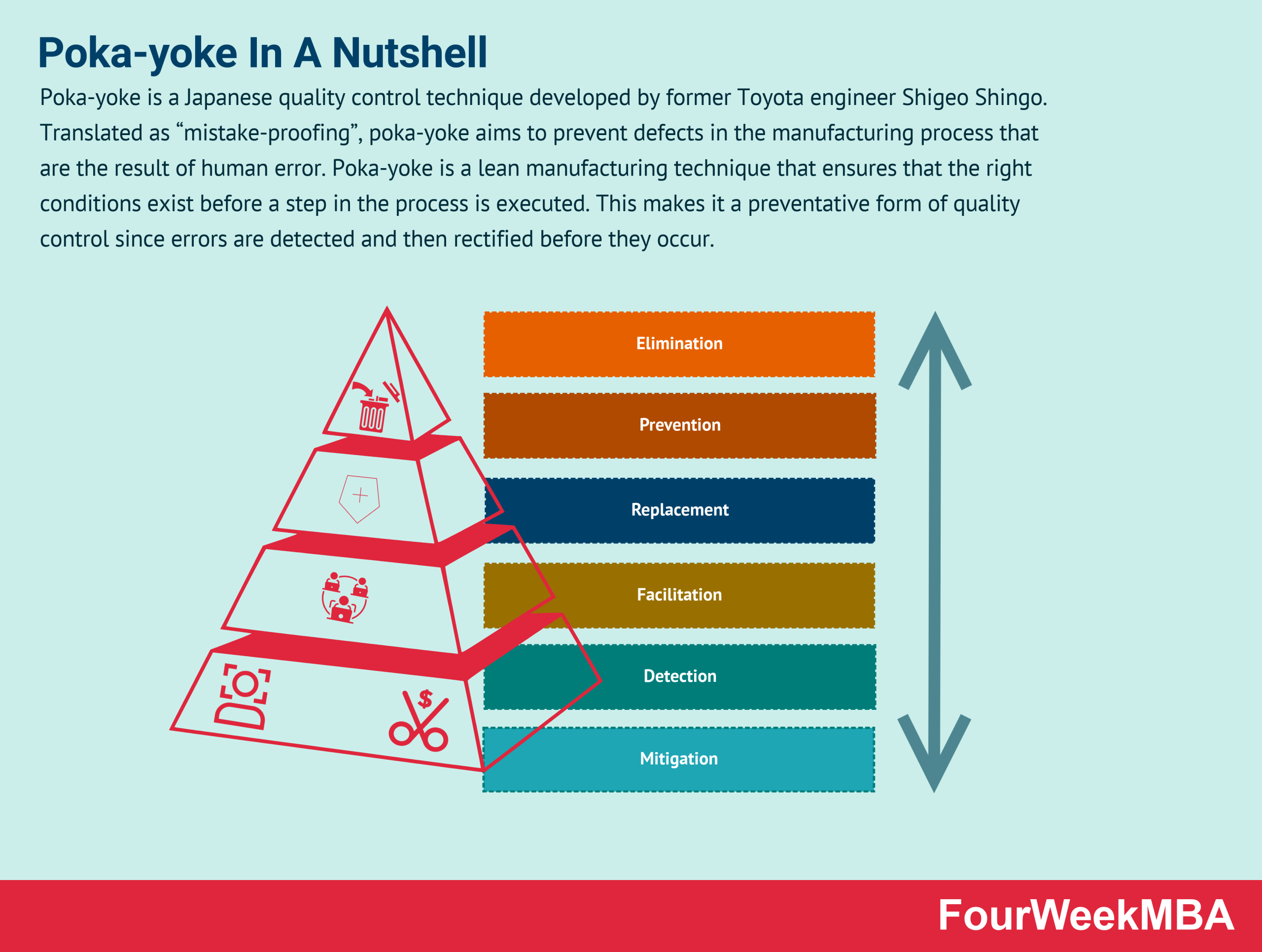
At its core, Poka-Yoke is about designing processes and products in such a way that errors are either impossible to make or immediately obvious. It shifts the focus from detecting errors after they happen to preventing them from occurring in the first place. This proactive stance is crucial for businesses aiming to optimize their financial health by minimizing the costly ramifications of mistakes.
Origins and Core Principles
The term Poka-Yoke was coined by Shigeo Shingo, an industrial engineer at Toyota, in the 1960s. Shingo’s work emphasized the need to move beyond simply identifying defects to designing systems that inherently prevent them. The central philosophy is that human beings are fallible, and rather than blaming individuals for errors, the system itself should be designed to absorb or prevent such mistakes. This principle resonates strongly with financial management, where systemic controls are often preferred over individual vigilance to prevent fraud, miscalculations, or inefficient resource allocation.
The core principles of Poka-Yoke include:
-
Zero Defects: The ultimate goal is to achieve a state where errors cannot occur.
-
Instant Feedback: If an error does occur, the system should immediately detect and signal it.
-
Simplicity: Poka-Yoke devices and methods should be simple, inexpensive, and easy to implement.
-
Universal Application: Applicable not just in manufacturing, but across all business functions, including finance, administration, and services.
Types of Poka-Yoke Devices: Control and Warning
Poka-Yoke mechanisms generally fall into two categories, each with distinct implications for financial control:
-
Control Poka-Yoke: These devices actively prevent an error from occurring by halting the process or making the incorrect action impossible. For instance, a jig that only allows a part to be inserted in the correct orientation, or a software prompt that prevents a user from proceeding without entering required data. From a financial viewpoint, control Poka-Yoke acts as a hard stop against financially damaging mistakes, such as incorrect data entry that could lead to billing errors, production of faulty goods, or non-compliance penalties. This immediate prevention saves costs associated with rework, customer complaints, and potential legal issues.
-
Warning Poka-Yoke: These devices alert the user when an error has occurred or is about to occur, allowing for immediate corrective action. Examples include alarm sounds, flashing lights, or error messages. While not preventing the error outright, warning Poka-Yoke minimizes the damage by ensuring prompt detection. In financial operations, this could be a system alert flagging an unusually large transaction for review before processing, or a warning for duplicate invoice entries. By catching errors early, businesses can avoid compounding financial losses, maintain accurate records, and ensure timely rectification, all of which contribute to better financial health.
The Financial Imperative of Poka-Yoke: Beyond Quality Control
While Poka-Yoke is often discussed in the context of manufacturing quality, its most profound impact is on a company’s financial bottom line. Errors, regardless of their origin, invariably translate into costs – direct or indirect. By systematically eliminating error points, Poka-Yoke directly contributes to cost reduction, revenue protection, and enhanced profitability.
Direct Cost Savings: Reducing Rework, Scrap, and Warranty Claims
The most immediate financial benefit of Poka-Yoke comes from the elimination of waste. Every error in a process typically leads to:
-
Rework: The cost of additional labor, materials, and time to correct a defective product or service. This is pure unproductive expenditure.
-
Scrap: Material that is so defective it cannot be reworked and must be discarded, representing a complete loss of investment in raw materials and processing.
-
Warranty Claims and Returns: Products that reach customers with defects often result in costly warranty claims, product recalls, return shipping, replacement costs, and repair expenses.
Poka-Yoke directly attacks these cost centers by preventing the creation of defects. Imagine a manufacturing line where a Poka-Yoke device ensures that every component is installed correctly, eliminating a common defect that previously led to 10% rework. The savings in labor, materials, and reduced warranty claims directly boost the profit margin for each unit produced. Similarly, in an office environment, a Poka-Yoke system that prevents incorrect data entry into a financial system can save hours of reconciliation effort and prevent costly billing errors.
Indirect Financial Benefits: Customer Loyalty and Market Reputation
Beyond direct cost reduction, Poka-Yoke offers significant indirect financial advantages through its impact on customer satisfaction and brand reputation.
-
Increased Customer Loyalty: Customers value reliability and quality. Products or services consistently delivered without defects foster trust and loyalty. Loyal customers are more likely to make repeat purchases, recommend the business to others, and are less sensitive to price fluctuations. This stable customer base provides predictable revenue streams, which is a key indicator of financial health.
-
Enhanced Market Reputation: A reputation for high quality and minimal errors positions a company as a reliable and trustworthy entity in the market. This can attract new customers, open doors to premium pricing strategies, and even improve investor confidence. Conversely, a history of product defects or service failures can severely damage a brand, leading to loss of market share and a decline in revenue, both of which have adverse financial consequences.
Impact on Operational Efficiency and Throughput
By preventing errors, Poka-Yoke streamlines operations. When processes run smoothly without interruptions for error correction or quality checks, overall efficiency increases.
-
Reduced Cycle Times: Fewer errors mean less time spent on inspections, rework, and problem-solving, leading to faster completion of tasks and shorter production cycles.
-
Increased Throughput: With fewer bottlenecks caused by defects, production capacity can be maximized, allowing businesses to produce more with the same resources, directly impacting revenue potential.
-
Optimized Resource Utilization: Resources (labor, machinery, materials) are used effectively for value-adding activities instead of being tied up in rectifying mistakes. This optimization of resource allocation directly translates to better financial performance, as capital and operational expenditures yield higher returns.
Implementing Poka-Yoke for Financial Gain: Strategies and Examples
Implementing Poka-Yoke isn’t just about technical gadgets; it’s a strategic approach to process design with clear financial objectives. It requires a systematic effort to identify error points and devise simple, effective prevention mechanisms.
Identifying Error Points: The Root Cause Analysis
The first step in implementing Poka-Yoke is to identify where errors are most likely to occur and what their financial impact is. This involves:
-
Process Mapping: Visualizing the entire workflow to pinpoint critical steps where mistakes can happen.
-
Defect Data Analysis: Reviewing historical data on errors, defects, customer complaints, and financial losses associated with them. This helps prioritize which error points to address first based on their financial severity.
-
Root Cause Analysis (e.g., 5 Whys): Digging deeper to understand why errors occur, rather than just what they are. This helps design Poka-Yoke solutions that address the fundamental cause. For instance, if invoice errors are frequent, is it due to manual entry, lack of validation, or unclear instructions? Each root cause points to a different Poka-Yoke solution.
Designing Poka-Yoke Solutions: Simple Yet Effective
The beauty of Poka-Yoke lies in its simplicity and cost-effectiveness. Solutions don’t have to be high-tech; they just need to be foolproof.
-
Physical Constraints: Designing jigs, templates, or connectors that only allow assembly in the correct way.
-
Sequencing Controls: Using checklists, automation, or interlocks to ensure steps are performed in the correct order.
-
Sensory Aids: Color-coding, labels, or visual indicators to make correct choices obvious and incorrect ones glaring.
-
Counting and Timing Mechanisms: Ensuring the correct number of items are present or that operations are performed for the right duration.
For example, in financial operations, a Poka-Yoke could be a mandatory field in an expense reporting system that prevents submission without a receipt attached, reducing compliance errors and audit risks. Or, a spreadsheet template that automatically calculates sums and flags discrepancies, preventing calculation errors.
Integrating Poka-Yoke into Lean Operations
Poka-Yoke is a cornerstone of Lean principles, which are fundamentally about eliminating waste (Muda) to improve profitability. When integrated into a broader Lean framework, its financial benefits are amplified. By preventing errors, Poka-Yoke reduces all forms of waste: overproduction (due to defective parts), waiting, transport, over-processing, inventory (of defective goods), motion, and defects themselves. This holistic approach ensures that resources are always deployed for value-adding activities, leading to maximum financial efficiency.
Measuring the ROI of Poka-Yoke: From Waste to Wealth
For any business investment, particularly in operational improvements, quantifying the Return on Investment (ROI) is crucial. Poka-Yoke, despite its often intangible quality benefits, offers clear pathways to demonstrate financial returns.
Quantifying Reduced Waste and Increased Productivity
Tracking the financial impact of Poka-Yoke involves monitoring key performance indicators (KPIs) before and after implementation:
-
Defect Rate: A direct measure of reduction in errors, e.g., parts per million (PPM) defects, or error incidents per period.
-
Rework Costs: The savings in labor and material associated with correcting errors.
-
Scrap Costs: The financial value of materials no longer discarded due to defects.
-
Warranty Costs: The reduction in expenses related to product repairs, replacements, and customer service for defective items.
-
Cycle Time: Improvements in process speed, indicating increased efficiency and capacity.
-
Labor Efficiency: Productive hours versus hours spent on error correction.
By assigning monetary values to these metrics, a clear picture of direct financial savings emerges, justifying the investment in Poka-Yoke design and implementation.
Evaluating Customer Satisfaction and Brand Value (from a Financial Standpoint)
While customer satisfaction is qualitative, its financial impact can be observed through:
-
Customer Retention Rates: Higher retention means sustained revenue streams and lower customer acquisition costs.
-
Net Promoter Score (NPS): Improved NPS can correlate with increased referrals and organic growth.
-
Sales Revenue Growth: Poka-Yoke contributes to consistent quality, which can lead to higher sales volumes or the ability to command premium pricing.
-
Reduced Marketing Spend on Reputation Repair: Avoiding quality issues means less need for costly marketing campaigns to rebuild trust.
These indicators, when tracked over time, can demonstrate the financial value generated by Poka-Yoke through strengthening the brand and securing market position.
Long-Term Financial Sustainability
Ultimately, Poka-Yoke contributes to long-term financial sustainability by embedding quality and efficiency into the organizational DNA. It reduces financial risks associated with product failures, operational disruptions, and reputational damage. A company that systematically eliminates errors is inherently more resilient, adaptable, and profitable, ensuring its financial viability far into the future.
Poka-Yoke in the Modern Business Landscape: Digital Tools and Financial Foresight
The principles of Poka-Yoke are more relevant than ever in today’s complex, digitized business environment. Its application extends far beyond the factory floor, becoming a critical component of robust financial management and digital process optimization.
Poka-Yoke in Service Industries and Office Environments
In service sectors and administrative functions, Poka-Yoke can prevent costly errors in data entry, invoice processing, contract management, and customer service.
-
Financial Data Entry: Automated validation rules in accounting software that prevent users from entering alphanumeric characters into numerical fields, or flagging unbalanced entries.
-
Loan Application Processing: Digital forms with conditional logic that ensure all necessary fields are completed before submission, preventing delays and compliance issues.
-
Procurement: Systems that automatically cross-reference purchase orders with budget allocations and supplier agreements, preventing unauthorized spending or overspending.
These applications directly impact the accuracy of financial statements, reduce audit risks, and ensure efficient cash flow management.
Leveraging Technology for Automated Error Proofing (Financial Implications)
Modern technology significantly enhances the power of Poka-Yoke, particularly in financial contexts.
-
AI and Machine Learning: Algorithms can identify unusual patterns in financial transactions, acting as advanced warning Poka-Yoke systems to detect potential fraud or erroneous payments.
-
Robotic Process Automation (RPA): Bots can automate repetitive, rule-based tasks in finance (e.g., invoice processing, reconciliation), eliminating human error entirely and ensuring consistent, accurate execution. This translates directly to reduced labor costs and improved data integrity.
-
Blockchain Technology: In supply chain finance or secure transaction processing, blockchain can act as a Poka-Yoke by creating an immutable ledger, preventing alterations or fraudulent entries after a transaction is recorded.
These technological integrations not only prevent errors but also reduce the operational costs associated with manual checks and reconciliations, freeing up financial personnel for more strategic, value-adding activities.

Fostering a Culture of Financial Responsibility through Poka-Yoke
Implementing Poka-Yoke is not a one-time project; it’s an ongoing commitment that fosters a culture of continuous improvement and financial responsibility. When employees are empowered with systems that prevent errors, they become more confident, productive, and focused on delivering value. This proactive mindset, centered on preventing financial leakage and optimizing resource utilization, permeates the entire organization, leading to sustained financial health and competitive excellence. By embedding Poka-Yoke principles into every process, businesses don’t just fix problems; they build a financially resilient and highly profitable operational model.
aViewFromTheCave is a participant in the Amazon Services LLC Associates Program, an affiliate advertising program designed to provide a means for sites to earn advertising fees by advertising and linking to Amazon.com. Amazon, the Amazon logo, AmazonSupply, and the AmazonSupply logo are trademarks of Amazon.com, Inc. or its affiliates. As an Amazon Associate we earn affiliate commissions from qualifying purchases.