
In the landscape of big data and enterprise software, few names evoke as much intrigue and complexity as Palantir Technologies. Often shrouded in the mystique of high-stakes government intelligence and secretive corporate turnarounds, Palantir is frequently misunderstood as a mere data collection agency or a consulting firm. In reality, Palantir is a software powerhouse that builds foundational platforms for integrating, managing, and securing data. It does not sell data; it sells the “operating system” that allows organizations—from global banks to special operations commands—to make sense of the data they already possess.
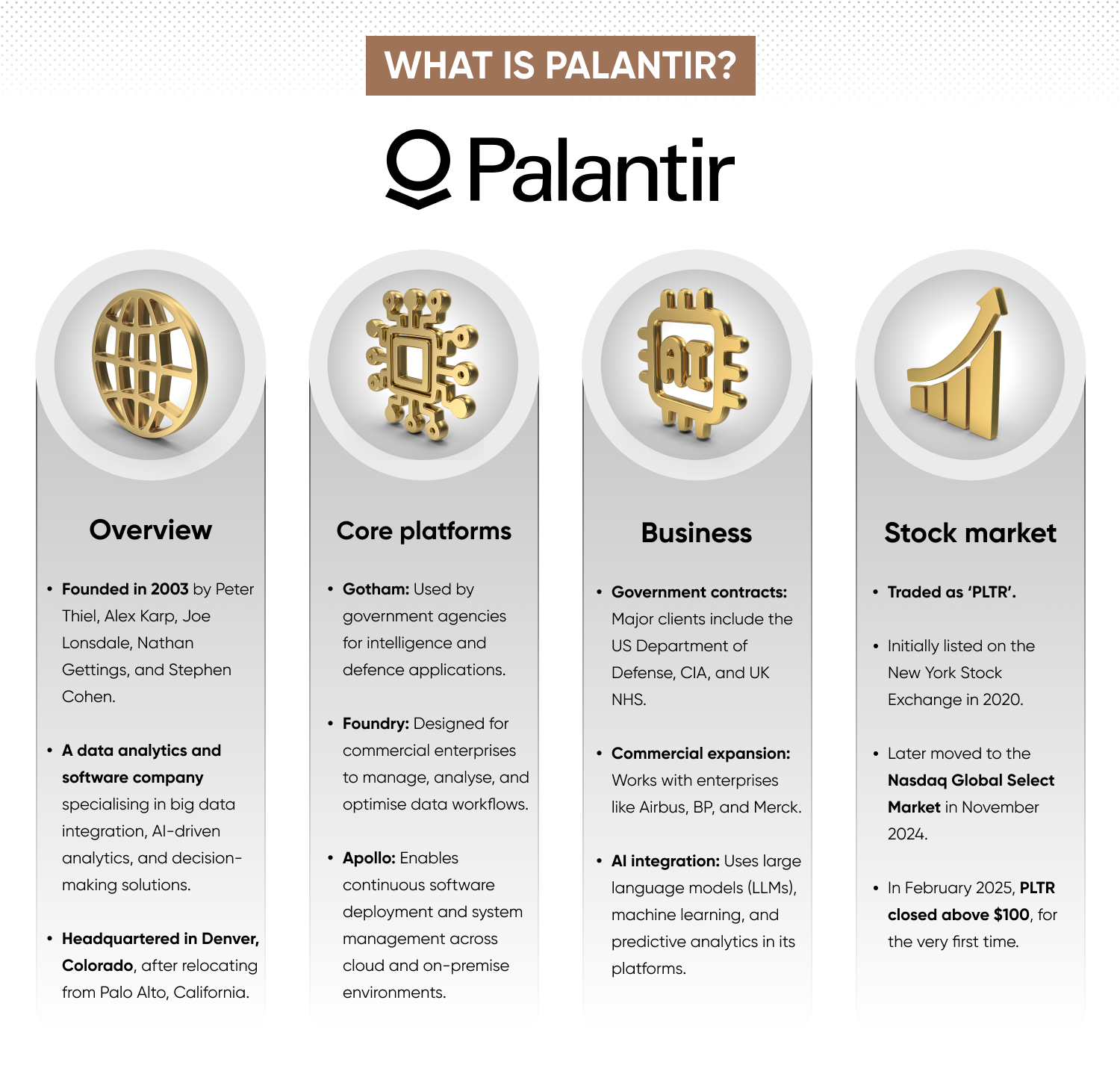
Founded in 2003 by a group including Peter Thiel and Alex Karp, Palantir emerged from the realization that the analytical challenges faced by the intelligence community in the wake of 9/11 were fundamentally similar to the challenges faced by modern corporations. Both needed a way to find a “needle in a haystack” within massive, disparate datasets. Today, the company’s suite of tools—Gotham, Foundry, Apollo, and the newly released Artificial Intelligence Platform (AIP)—represents the cutting edge of how software can transform institutional decision-making.
The Core Ecosystem: Gotham, Foundry, and Apollo
To understand Palantir, one must look at its primary platforms. While they share a common philosophy of human-machine symbiosis, they are designed for distinct operational environments.
Palantir Gotham: The Intelligence Layer
Gotham was Palantir’s first flagship product, designed primarily for the defense and intelligence sectors. It functions by pulling massive amounts of unstructured data—think logs, spreadsheets, signals intelligence, and even hand-written reports—and mapping them into a unified graphical interface.
In Gotham, “objects” are the center of the universe. An object could be a person, a vehicle, or a specific bank transaction. By linking these objects through a “spiderweb” of relationships, analysts can identify patterns that would be invisible in a standard database. It is the tool that helped investigators track down financial fraudsters and assisted military personnel in identifying improvised explosive devices (IEDs) in combat zones.
Palantir Foundry: The Corporate Digital Twin
If Gotham is for finding the enemy, Foundry is for running the business. Foundry was developed to solve the “data silo” problem that plagues large enterprises. In a typical Fortune 500 company, the sales data lives in one system, supply chain data in another, and human resources data in a third. These systems rarely talk to each other.
Foundry acts as a connective tissue. It creates a “digital twin” of the entire organization. By integrating data from every corner of a company, it allows executives to run simulations. For instance, an airline using Foundry can see how a weather delay in London will ripple through their flight schedules, crew assignments, and fuel costs globally, allowing them to make adjustments in real-time.
Palantir Apollo: Continuous Delivery and Sovereignty
The third pillar, Apollo, is the autonomous software deployment engine. Large organizations often operate in “disconnected” environments—submarines, remote oil rigs, or secure government facilities. Apollo ensures that Gotham and Foundry can run anywhere, from the public cloud to a private server in a basement, and stay updated without manual intervention. It manages the complexity of microservices, ensuring that the software remains resilient and secure regardless of the hardware it sits on.
The Ontology: The Secret Sauce of Palantir’s Data Logic
The true differentiator of Palantir’s technology is not just its ability to process data, but its “Ontology.” In most technical environments, data is stored in rows and columns that only data scientists can understand. To a CEO or a field medic, a SQL query is meaningless.
Transforming Rows into Reality
Palantir’s Ontology layer sits between the raw data and the end-user. It translates technical data into real-world concepts. Instead of looking at “TableAColumn4,” a user sees “Aircraft Engine.” Instead of “TransactionID_99,” they see “Suspect Payment.”

By mapping the entire business or mission into an Ontology, Palantir allows non-technical users to interact with data using the language of their specific industry. This democratization of data is what allows a floor manager in a factory to use the same platform as the Chief Technology Officer to optimize production lines.
The Feedback Loop
The Ontology is not a one-way street. When a user makes a decision within a Palantir platform—such as rerouting a shipment or flagging a security risk—that decision is captured as data and fed back into the system. This creates a “read-write” environment where the software actually learns from the institutional knowledge of the humans using it. This feedback loop is essential for building a truly intelligent enterprise that evolves alongside its environment.
AIP: Bridging Generative AI and Enterprise Reality
With the explosion of Large Language Models (LLMs) and Generative AI, Palantir introduced the Artificial Intelligence Platform (AIP). While many companies are struggling to figure out how to use AI without compromising security or hallucinating incorrect data, Palantir has integrated LLMs directly into its existing Ontology.
AI with Guardrails
The biggest hurdle for AI in the enterprise is trust. A bank cannot afford to have an AI “guess” a customer’s credit score, and a military commander cannot rely on a probabilistic model that lacks a clear audit trail. AIP solves this by anchoring the LLM to the organization’s private data through the Ontology.
When a user asks AIP a question, the AI doesn’t just scan the open internet. It queries the secure, structured data within the company’s Foundry or Gotham environment. This ensures that the AI’s outputs are grounded in reality and, more importantly, are fully auditable.
Automating the Workflow
AIP allows users to build “Agents” that can automate complex workflows. For example, in a supply chain crisis, a user could ask AIP to “find all alternative suppliers for this specific chip and draft an email to the procurement team.” The AI identifies the options, checks the budget constraints, and prepares the communication—all within the secure confines of the platform. This moves AI from a “chatbot” curiosity to a core tactical advantage.
Security, Ethics, and the Future of Sovereign Data
One cannot discuss Palantir without addressing the critical issues of digital security and privacy. Because Palantir works with the world’s most sensitive data, its architecture is “secure by design.”
Granular Access Control
Unlike many data platforms that offer “all-or-nothing” access, Palantir utilizes highly granular tagging. An analyst might have permission to see a person’s phone number but not their social security number, even if both pieces of data exist in the same record. Every single click, view, and modification is tracked in an immutable log, making it nearly impossible for data to be misused without a clear digital paper trail.
The Concept of Data Sovereignty
In an era of increasing geopolitical tension, Palantir has positioned itself as a champion of “data sovereignty.” This is the idea that nations and institutions must have total control over their own data and the software that processes it. By refusing to work with adversaries of the West and focusing on “allied” technology, Palantir has become a critical component of the technological defense infrastructure for the U.S. and its partners.

Conclusion: The Shift from Analysis to Action
The evolution of Palantir reflects a broader shift in the technology industry. We are moving away from the era of “Big Data,” where the goal was simply to collect as much information as possible, and into the era of “Big Action,” where the goal is to use that information to drive real-world outcomes.
Palantir is not a tool for looking at graphs; it is a tool for making decisions. Whether it is helping a hospital manage bed capacity during a pandemic, assisting an automaker in predicting part shortages months in advance, or enabling a military unit to navigate a complex tactical environment, Palantir’s software provides the digital scaffolding for the 21st century. As AI continues to integrate into every facet of our lives, the importance of platforms that can provide structure, security, and human-centric logic to that AI will only grow. Palantir stands at the center of this transition, defining what it means to be a truly data-driven organization in an increasingly volatile world.
aViewFromTheCave is a participant in the Amazon Services LLC Associates Program, an affiliate advertising program designed to provide a means for sites to earn advertising fees by advertising and linking to Amazon.com. Amazon, the Amazon logo, AmazonSupply, and the AmazonSupply logo are trademarks of Amazon.com, Inc. or its affiliates. As an Amazon Associate we earn affiliate commissions from qualifying purchases.