
Planned obsolescence, a term often whispered with a mix of frustration and resignation, refers to the deliberate design of products to have an artificially limited lifespan. In an age dominated by rapid technological advancement and insatiable consumer demand, this practice has become particularly pervasive and pronounced within the tech sector. It’s the reason why your smartphone feels sluggish after a couple of years, why your printer mysteriously stops working just outside its warranty, or why the latest software update renders your perfectly functional old laptop frustratingly slow. Understanding planned obsolescence isn’t just about identifying a controversial business strategy; it’s about dissecting the very fabric of how technology is designed, marketed, consumed, and ultimately discarded, shaping both our digital lives and the environmental landscape.

The Core Concept: Designing for an End-of-Life
At its heart, planned obsolescence is a strategic approach by manufacturers to ensure that consumers will repeatedly purchase new versions of their products. This isn’t accidental; it’s a calculated decision embedded in product development from conception to market release, with profound implications for technology users and the broader digital ecosystem.
Defining Planned Obsolescence in a Tech Context
In the realm of technology, planned obsolescence manifests as the deliberate engineering of devices, software, or components with a predetermined expiry date, or with features that quickly become outdated or incompatible. Unlike natural wear and tear, this process is accelerated by design choices. These choices might involve using non-durable materials, creating components that are difficult or impossible to repair, discontinuing software support for older models, or even subtle marketing tactics that make current products seem antiquated long before they cease to function. The goal is clear: to shorten the replacement cycle and drive continuous sales in a highly competitive market.
Historical Roots and Modern Manifestations
While the term “planned obsolescence” gained prominence in the mid-20th century with consumer goods like light bulbs (famously the Phoebus cartel) and nylon stockings, its application in the modern technology sector has reached unprecedented levels of sophistication and impact. Early examples focused on physical durability. Today, in an increasingly digital world, obsolescence can be engineered not just into hardware but deeply into software and ecosystem dependencies. The constant churn of new smartphone models, the swift deprecation of older operating systems, and the relentless pressure to upgrade to the “latest and greatest” are all hallmarks of this strategy at play in contemporary tech. What began as a way to stimulate economic growth in post-industrial societies has evolved into a complex interplay of hardware limitations, software restrictions, and marketing-driven perception shifts.
The Driving Forces: Innovation, Competition, and Consumerism
Several powerful forces perpetuate planned obsolescence in tech. Firstly, the relentless pace of technological innovation creates a fertile ground for it. New chips, faster networks, and advanced software features mean that last year’s cutting-edge device can genuinely feel less capable today. However, this natural progression is often amplified by deliberate design choices. Secondly, intense competition among tech giants means that companies are constantly vying for market share. Encouraging frequent upgrades can secure recurring revenue streams and maintain a competitive edge. Lastly, a pervasive culture of consumerism, fueled by aggressive marketing and social media, constantly cultivates a desire for novelty. The “fear of missing out” (FOMO) on new features, improved performance, or simply a refreshed aesthetic often pushes consumers to replace perfectly functional devices, even when the upgrades are incremental. These forces combine to create an environment where planned obsolescence is not just tolerated but, in many ways, expected.
The Mechanics of Obsolescence in Technology
Planned obsolescence in technology is a multi-faceted phenomenon, implemented through various design and business strategies that make products less desirable, functional, or repairable over time. These mechanisms can be broadly categorized into several distinct approaches.
Functional Obsolescence: When Performance Degrades
One of the most common forms of planned obsolescence in tech is functional obsolescence, where the performance of a device degrades to a point where it becomes frustrating or impractical to use. This can happen in several ways:
-
Slower Processors with New Software: Manufacturers often release software updates that, while optimized for newer hardware, can significantly slow down older models. This isn’t always malicious; new software demands more processing power and memory. However, the lack of backward compatibility or options to retain older, more efficient software often leaves users with a choice between security vulnerabilities (by not updating) or a sluggish device (by updating). Iconic examples include older iPhones purportedly slowing down after iOS updates.
-
Battery Degradation: Batteries, particularly in portable devices, have a finite number of charge cycles. While natural degradation occurs, non-replaceable batteries or those with purposefully limited lifespans force consumers to replace the entire device when the battery’s performance becomes unacceptable. Even when replaceable, proprietary designs or high replacement costs can deter users.
-
Component Lifespans: Some components might be designed with a specific operational limit, such as print heads in printers or certain internal storage drives, making repair costly or simply uneconomical compared to purchasing a new device.
Systemic Obsolescence: Incompatibility and Ecosystem Lock-in
Systemic obsolescence occurs when a product becomes incompatible with newer technologies, standards, or within a proprietary ecosystem, effectively isolating it.
-
Proprietary Connectors and Chargers: The constant shift in charging ports (e.g., Apple’s Lightning vs. USB-C) or unique data connectors forces users to buy new accessories or renders older ones useless, creating a dependency on the brand’s ecosystem.
-
Software Update Incompatibility: Beyond performance degradation, older devices might simply lose support for essential software updates, security patches, or even popular applications, rendering them vulnerable or functionally obsolete for modern tasks.
-
Lack of Driver Support: For peripherals like scanners or printers, manufacturers might cease to provide updated drivers for new operating systems, making a perfectly functional piece of hardware unusable with a new computer.
Perceived Obsolescence: The Allure of the New
Perceived obsolescence is less about a product’s actual functionality and more about its psychological impact. It’s the deliberate cultivation of a desire for new products, making current ones seem outdated through marketing and design.
-
Aesthetic Changes: Minor cosmetic updates or new color options are often marketed as significant upgrades, making last year’s model feel less desirable, even if its internal components are largely the same.
-
“New Features” that Aren’t Critical: Companies often highlight incremental features – a slightly better camera, a marginally faster processor – as revolutionary, subtly implying that older models are now inferior, even when their core functionality remains robust. This strategy taps into consumer aspirations for status and the “best” available technology.
Repairability Obstacles: Making Fixes Impractical or Impossible
A critical mechanism of planned obsolescence is the deliberate design of products that are difficult, expensive, or impossible to repair, pushing consumers towards replacement.
-
Glued Components and Proprietary Fasteners: Many tech gadgets are now sealed with strong adhesives or use unique screws, requiring specialized tools and skills to open, discouraging DIY repairs and increasing professional repair costs.
-
Parts Unavailability or High Cost: Manufacturers may restrict the availability of spare parts to independent repair shops or price them so high that repair becomes financially unviable compared to buying a new device.
-
“Pairing” Components: Some companies digitally “pair” internal components (like screens or batteries) to the device’s logic board. Replacing these parts with un-paired, even genuine, replacements can trigger error messages or limit functionality, effectively forcing repairs through authorized channels or replacement.
The Impact on the Technology Ecosystem
The widespread adoption of planned obsolescence in the tech sector has far-reaching consequences that extend beyond individual consumer frustration, affecting the environment, the economy, and consumer trust.

Environmental Costs: E-Waste and Resource Depletion
Perhaps the most alarming consequence of planned obsolescence is its devastating environmental impact. The accelerated replacement cycle leads to an astronomical increase in electronic waste (e-waste). Smartphones, laptops, tablets, and other gadgets contain hazardous materials like lead, mercury, cadmium, and brominated flame retardants, which can leach into soil and water if not properly disposed of. Furthermore, the manufacturing of these devices consumes vast amounts of finite natural resources, including rare earth elements, precious metals, and vast quantities of water and energy. The continuous demand for new products fueled by obsolescence puts immense pressure on global supply chains, contributing to deforestation, habitat destruction, and carbon emissions. Addressing planned obsolescence is crucial for mitigating this escalating environmental crisis.
Economic Implications: Consumer Burden and Corporate Profits
From an economic standpoint, planned obsolescence creates a paradox. For consumers, it represents a significant financial burden. The constant need to replace devices translates into recurring expenses that can strain personal finances, especially for essential items like smartphones or computers. This disproportionately affects lower-income households, widening the digital divide. For corporations, however, it’s a highly profitable strategy. Guaranteed replacement cycles ensure a steady stream of revenue, encourage growth, and provide a predictable market. It allows companies to amortize R&D costs over shorter product lifecycles and maintain a competitive edge by continually introducing “new” products. This creates an economic model where corporate profit often takes precedence over product longevity and consumer value.
The Erosion of Trust and Brand Loyalty
While planned obsolescence can boost short-term sales, it risks eroding long-term consumer trust and brand loyalty. When consumers perceive that a product has been deliberately designed to fail or become outdated prematurely, they may develop a cynical view of the brand. This can lead to resentment, negative word-of-mouth, and ultimately, a shift towards competitors perceived as more ethical or offering more durable products. In an increasingly transparent world, where information spreads rapidly, brands face a delicate balance between driving sales and maintaining a reputation for quality and reliability. The growing “Right to Repair” movement, for instance, is a direct manifestation of consumer frustration with opaque repair policies and purposefully fragile designs.
Stifling Innovation vs. Driving Progress
There’s a nuanced debate about whether planned obsolescence stifles genuine innovation or drives progress. Proponents argue that the constant demand for new products encourages R&D, leading to genuinely better technologies. Without the pressure to upgrade, innovation might slow down. Critics contend that it often incentivizes superficial changes (e.g., minor aesthetic tweaks) over fundamental, robust advancements. It can prioritize proprietary ecosystems and non-repairable designs over universally compatible, durable, or modular solutions. True innovation should ideally focus on creating more efficient, sustainable, and long-lasting products, rather than simply accelerating the consumption cycle. Planned obsolescence, at its worst, can divert resources from truly transformative research into merely perpetuating the replacement treadmill.
Counteracting Obsolescence: Towards a Sustainable Tech Future
The tide is slowly turning against the ubiquity of planned obsolescence. Growing consumer awareness, environmental concerns, and advocacy groups are driving a movement towards more sustainable and repairable technology.
The Right to Repair Movement
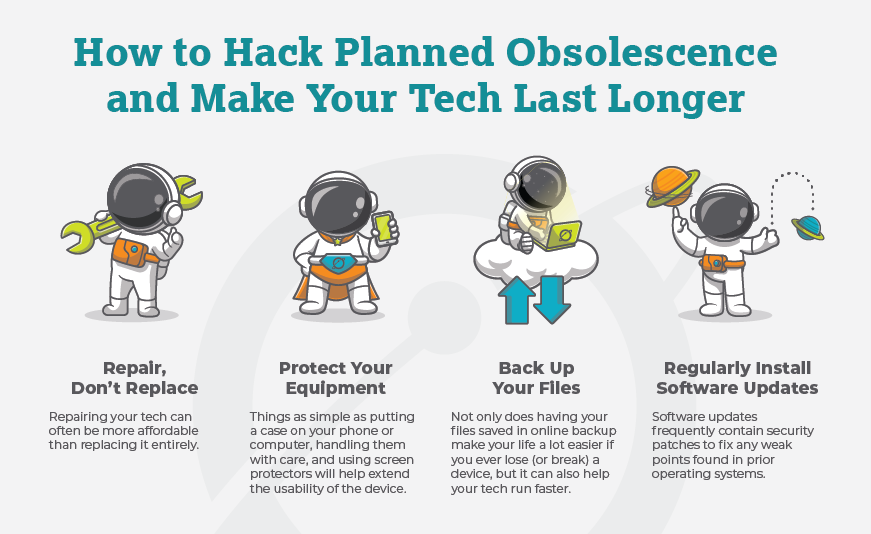
The “Right to Repair” movement is a global campaign advocating for legislation that would require manufacturers to make spare parts, tools, and repair manuals available to consumers and independent repair shops. This aims to empower users to fix their own devices or choose independent repair services, thereby extending product lifespans and reducing e-waste. Several jurisdictions, including parts of the EU and some U.S. states, have already begun enacting such laws, challenging decades of proprietary control by manufacturers. This movement is a direct pushback against the repairability obstacles inherent in planned obsolescence strategies.
Modular Design and Upgradability
An alternative to disposable tech is modular design, where components can be easily replaced or upgraded. Companies like Framework Laptops have pioneered this approach, offering laptops where users can swap out processors, memory, storage, and even ports with ease. This model not only extends the life of a device but also reduces waste and empowers consumers with genuine choice and control over their technology. While not yet mainstream, the concept of upgradable and repairable electronics is gaining traction as a viable and desirable alternative.
Open Source and Long-Term Software Support
Software plays a crucial role in planned obsolescence. Open-source operating systems and applications often offer longer-term support and community-driven solutions for older hardware, bypassing manufacturers’ arbitrary end-of-life declarations. Furthermore, demanding manufacturers commit to extended software and security update support for a longer period (e.g., 5-7 years for smartphones) can significantly increase the functional lifespan of devices, decoupling hardware longevity from software availability.
Consumer Awareness and Ethical Purchasing
Ultimately, consumer demand holds immense power. By becoming more aware of planned obsolescence and its implications, consumers can make more ethical purchasing decisions. This includes researching a product’s repairability score (e.g., from iFixit), considering refurbished devices, supporting companies known for their durability and repair policies, and demanding longer warranties and software support. A shift in consumer priorities from “the latest” to “the most sustainable and durable” can send a powerful message to manufacturers.
The Future of Tech and Obsolescence: A Shifting Paradigm?
The dialogue around planned obsolescence is evolving, hinting at a potential paradigm shift in the technology industry. This shift is being driven by a combination of regulatory pressure, innovative business models, and changing consumer expectations.
Policy and Regulation: Global Efforts for Longevity
Governments and supranational bodies are increasingly recognizing the detrimental effects of planned obsolescence. The European Union has been at the forefront, introducing eco-design regulations for various products, including requirements for easier repair, availability of spare parts, and longer-lasting batteries. Similar legislative efforts are gaining momentum in North America and other regions. These policies aim to standardize repairability, extend warranty periods, and mandate transparency from manufacturers regarding product lifespans and update policies. Such regulatory frameworks are essential to level the playing field, ensuring that sustainable practices become a competitive advantage rather than a niche offering.
The Circular Economy in Tech
The concept of a “circular economy” stands in stark contrast to the linear “take-make-dispose” model perpetuated by planned obsolescence. In a circular tech economy, products are designed for durability, reusability, repairability, and recyclability. Materials are kept in use for as long as possible, minimizing waste and resource extraction. This involves a fundamental rethinking of product design, manufacturing processes, and business models. Instead of selling a single, disposable product, companies might offer “product-as-a-service” models, encouraging them to design for longevity and easy maintenance, as they retain ownership and responsibility for the product’s entire lifecycle. While challenging to implement on a large scale, pioneers are demonstrating that a truly circular tech industry is achievable.
Consumer Demand for Durable and Ethical Products
Perhaps the most significant long-term driver of change will be sustained consumer demand. As younger generations become more environmentally conscious and financially astute, the appeal of disposable electronics wanes. There’s a growing market for products that are built to last, easy to repair, and supported by ethical manufacturing practices. Social media and independent review sites amplify these voices, holding companies accountable. This growing preference for longevity, sustainability, and transparency could compel more tech companies to integrate these values into their core strategies, moving away from planned obsolescence towards models that prioritize enduring value and environmental stewardship. The future of tech could well be one where products are celebrated not for their rapid replacement cycles, but for their ability to serve users reliably for years to come.
aViewFromTheCave is a participant in the Amazon Services LLC Associates Program, an affiliate advertising program designed to provide a means for sites to earn advertising fees by advertising and linking to Amazon.com. Amazon, the Amazon logo, AmazonSupply, and the AmazonSupply logo are trademarks of Amazon.com, Inc. or its affiliates. As an Amazon Associate we earn affiliate commissions from qualifying purchases.