
In the intricate world of finance, numbers tell a story. But raw figures alone often lack the context needed for meaningful interpretation. This is where percentages step in, transforming absolute values into relative proportions that illuminate trends, compare performance, and quantify impact across every facet of our financial lives. From evaluating a sales discount to analyzing investment returns, understanding “what is percent of” isn’t merely an arithmetic skill; it’s a critical lens through which we interpret and make informed decisions about our money.
This article delves into the foundational concept of percentages, specifically focusing on its profound implications within the realm of finance. We’ll explore why this seemingly simple calculation is indispensable for personal budgeting, investment analysis, business strategy, and even navigating everyday transactions. By mastering the core mechanics and appreciating the broad applications of percentages, individuals and businesses alike can cultivate a more sophisticated and empowered financial perspective.

The Foundational Role of Percentages in Finance
At its core, a percentage is a way of expressing a number as a fraction of 100. The phrase “percent” itself derives from the Latin per centum, meaning “by the hundred.” This common denominator of 100 makes percentages incredibly versatile and easy to compare, providing a universal language for financial evaluation.
Defining “Percent Of”: More Than Just a Number
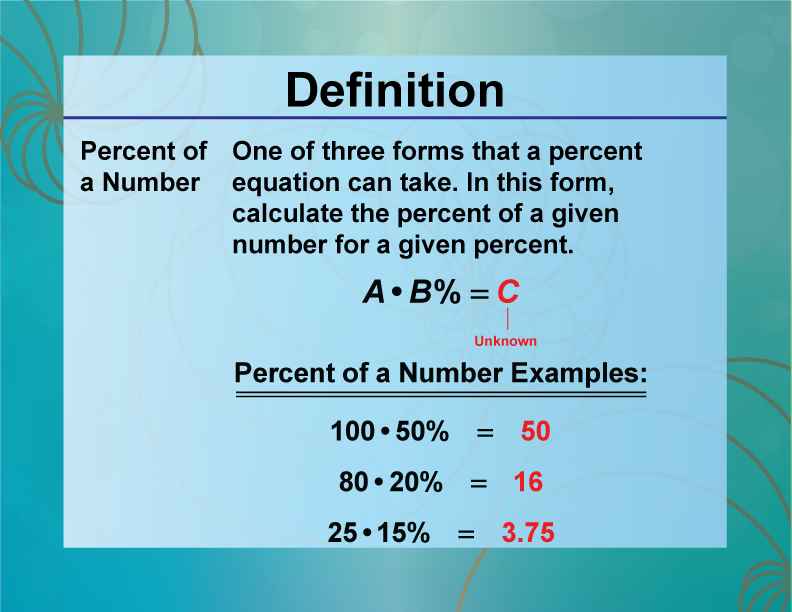
When we ask “what is percent of,” we are essentially asking to find a part of a whole, expressed proportionally. For instance, if you want to know “what is 20 percent of $500,” you’re looking for a specific segment of that $500, specifically 20 hundredths of it. This isn’t just about obtaining a single numerical answer; it’s about understanding the relative magnitude. It tells you that $100 is 20% of $500, which might represent a discount, a portion of income, or an allocation of funds.
This concept extends beyond simple parts of a whole to encompass relationships between different numbers. We might ask, “$100 is what percent of $500?” This shifts the focus from finding a part to identifying the proportion that one number represents in relation to another. Both aspects—finding a percentage of a number and finding what percentage one number is of another—are fundamental to financial literacy.
Why Proportions Matter in Money Management
Raw figures can be misleading without context. An increase of $1,000 might seem substantial, but its significance depends entirely on the base amount. If your income increased by $1,000 from $10,000, that’s a significant 10% raise. If it increased by $1,000 from $100,000, it’s a modest 1% raise. Percentages provide this crucial context, allowing for:
- Standardization: They normalize figures, making it possible to compare financial performance across different scales. A 5% profit margin is comparable for a small business and a large corporation, whereas a $10,000 profit for the former is vastly different from a $10,000 profit for the latter.
- Contextual Understanding: Percentages help us grasp the true impact of financial events. A 0.5% interest rate hike on a mortgage has a different dollar impact than a 0.5% hike on a small personal loan.
- Goal Setting and Tracking: Financial goals, from savings rates to investment returns, are often set and tracked as percentages, enabling consistent progress monitoring irrespective of the absolute amounts involved.
Mastering Core Percentage Calculations for Financial Empowerment
The ability to confidently perform percentage calculations is a cornerstone of financial acumen. While calculators are readily available, understanding the underlying mechanics empowers you to interpret results critically and apply them intelligently.
Calculating a Percentage of a Whole (e.g., discounts, taxes)
This is perhaps the most common application of “what is percent of.” You’re given a total amount and a percentage, and you need to find the specific value that percentage represents.
Formula: Part = (Percentage / 100) * Whole or Part = Percentage (as decimal) * Whole
- Example (Discount): A shirt costs $60, and there’s a 25% discount.
- Discount amount = (25 / 100) * $60 = 0.25 * $60 = $15.
- Final price = $60 – $15 = $45.
- Example (Tax): Your taxable income is $50,000, and the tax rate is 15%.
- Tax owed = (15 / 100) * $50,000 = 0.15 * $50,000 = $7,500.
Determining What Percentage One Number is of Another (e.g., profit margins, asset allocation)
Here, you have two numbers – a part and a whole – and you want to express the part as a percentage of the whole. This is vital for evaluating efficiency, allocation, or performance.
Formula: Percentage = (Part / Whole) * 100
- Example (Profit Margin): A business has revenue of $100,000 and a net profit of $15,000.
- Profit Margin = ($15,000 / $100,000) * 100 = 0.15 * 100 = 15%.
- Example (Asset Allocation): You have $20,000 in stocks and a total investment portfolio of $50,000.
- Percentage in stocks = ($20,000 / $50,000) * 100 = 0.40 * 100 = 40%.
Understanding Percentage Change (e.g., investment growth, inflation)
Percentage change quantifies the relative increase or decrease of a value over time or between two different points. It’s essential for tracking growth, inflation, investment performance, and budget variances.
Formula: Percentage Change = ((New Value - Old Value) / Old Value) * 100
- Example (Investment Growth): An investment grew from $1,000 to $1,200.
- Percentage Change = (($1,200 – $1,000) / $1,000) * 100 = ($200 / $1,000) * 100 = 0.20 * 100 = 20% increase.
- Example (Inflation): The price of an item rose from $50 to $52.
- Percentage Change = (($52 – $50) / $50) * 100 = ($2 / $50) * 100 = 0.04 * 100 = 4% increase.

Practical Applications: Percentages Across Key Financial Domains
The theoretical understanding of “what is percent of” truly comes alive through its diverse applications in real-world financial scenarios.
Personal Finance: Budgeting, Savings, and Debt
Percentages are the bedrock of effective personal financial management.
- Budgeting: The 50/30/20 rule (50% for needs, 30% for wants, 20% for savings/debt repayment) is a popular percentage-based budgeting framework. You use percentages to allocate your income, ensuring that you’re not overspending in certain categories.
- Savings: Setting a goal to save “X percent” of each paycheck is a common strategy. You calculate what 10% or 15% of your income is and commit to transferring that amount to savings.
- Debt: Understanding interest rates (the percentage charged on borrowed money) is crucial. A 19.99% APR on a credit card versus a 4.5% APR on a mortgage highlights the vastly different costs of borrowing, calculated as a percentage of the principal.
Investing: Returns, Risk, and Portfolio Diversification
For investors, percentages are the primary language for assessing performance and managing risk.
- Returns: Investment returns are almost always quoted as percentages (e.g., “The S&P 500 returned 10% last year”). This allows investors to compare the performance of different assets or fund managers, regardless of the initial investment amount.
- Risk: Volatility is often expressed as a percentage, indicating how much an investment’s value fluctuates.
- Portfolio Diversification: Asset allocation, the division of investments among different asset classes (stocks, bonds, real estate), is managed using percentages (e.g., 60% stocks, 30% bonds, 10% cash). This strategy is vital for managing risk and optimizing returns.
Business Finance: Profitability, Pricing, and Growth Analysis
Businesses rely heavily on percentages for operational efficiency, strategic planning, and performance evaluation.
- Profitability: Key metrics like Gross Profit Margin, Operating Profit Margin, and Net Profit Margin are all percentages, revealing how much profit a company makes relative to its revenue.
- Pricing: Discounts, markups, and sales commissions are all percentage-based calculations that directly impact a company’s revenue and profitability. Understanding “what is percent of” is fundamental to setting competitive prices and offering attractive promotions.
- Growth Analysis: Companies track year-over-year revenue growth, customer acquisition rates, and market share as percentages, providing clear indicators of expansion or contraction.
Common Pitfalls and Advanced Considerations
While percentages simplify comparisons, it’s important to be aware of potential misinterpretations and more nuanced applications.
The Illusion of Small Percentages: Cumulative Impact
A seemingly small percentage can have a massive cumulative effect over time.
- Compounding Interest: A 7% annual return on an investment might not look like much year-to-year, but over decades, its compounding effect can lead to exponential wealth growth. Conversely, a 1% annual fee on a mutual fund might seem negligible, but it can erode a substantial portion of your returns over 20-30 years.
- Inflation: A seemingly low 2% annual inflation rate means that the purchasing power of your money decreases by 2% each year, silently eating away at your savings if they aren’t earning at least that much.
Understanding these cumulative impacts requires thinking beyond just the single percentage figure and considering the time horizon and base amount.
Beyond Simple Percentages: Basis Points and Annualized Rates
In professional finance, you’ll encounter variations that build upon basic percentage concepts.
- Basis Points (BPS): Often used for very small percentage changes, especially in bond yields and interest rates. One basis point equals 0.01% or 1/100th of a percentage point. So, a change from 3.00% to 3.25% is a 25 basis point increase. This provides greater precision for minute but significant shifts.
- Annualized Rates: When returns or costs are quoted for periods less than a year, they are often annualized to allow for consistent comparison. For example, a 0.5% monthly return might be annualized to roughly 6% (0.5% * 12 months) to represent the potential yearly return.
Leveraging Percentage Knowledge for Informed Financial Decisions
The journey from asking “what is percent of” to confidently applying percentage concepts in diverse financial scenarios is a journey towards greater financial control and insight.
Developing a Percentage-Driven Mindset
Cultivating a mindset that naturally thinks in percentages rather than just absolute numbers is a powerful tool. When you see a price increase, ask “what percent increase is that?” When evaluating a new investment, consider the percentage return relative to its risk. This habit transforms passive observation into active financial analysis. It allows for critical assessment of claims, comparison of offers, and proactive planning for the future.
Tools and Resources for Confident Calculations
While mental math is useful, leveraging technology is practical. Financial calculators, spreadsheet software (like Excel or Google Sheets), and dedicated online tools can quickly perform complex percentage calculations. However, the true value of these tools comes from your understanding of what you are calculating and why it matters—an understanding rooted in the fundamental concept of “what is percent of.”
In conclusion, “what is percent of” is far more than a basic math problem; it’s the gateway to financial literacy. By mastering this concept and its myriad applications across personal and business finance, investing, and economic analysis, you empower yourself to make smarter decisions, interpret financial data with confidence, and ultimately, build a more secure and prosperous financial future.
aViewFromTheCave is a participant in the Amazon Services LLC Associates Program, an affiliate advertising program designed to provide a means for sites to earn advertising fees by advertising and linking to Amazon.com. Amazon, the Amazon logo, AmazonSupply, and the AmazonSupply logo are trademarks of Amazon.com, Inc. or its affiliates. As an Amazon Associate we earn affiliate commissions from qualifying purchases.