
In the intricate world of finance, where numbers tell stories of growth, decline, and opportunity, understanding how to accurately measure change is paramount. Whether you’re tracking your investments, analyzing business performance, or simply budgeting for household expenses, the ability to quantify growth is a fundamental skill. Among the most potent tools in this analytical arsenal is the percent increase formula. Far more than a simple mathematical equation, it serves as a critical lens through which individuals and organizations can gauge progress, assess returns, and make informed decisions that shape their financial futures. This article delves into the percent increase formula, exploring its mechanics, diverse applications across personal and business finance, and the nuances essential for its correct interpretation.
Understanding the Fundamentals of Growth Measurement
Before dissecting the formula itself, it’s crucial to grasp the foundational concepts that underscore its importance. At its heart, the percent increase formula is designed to express the relative change between two values over time, providing a standardized way to compare growth across different scales and contexts.
The Core Concept: Quantifying Change
Every financial journey involves change. Your salary might increase, an investment might appreciate, or the cost of living could rise. While knowing the absolute difference between an old and a new value is useful, it often lacks the context needed for meaningful analysis. For instance, a $100 increase might seem substantial for a $500 initial investment (a 20% gain), but insignificant for a $10,000 portfolio (a mere 1% gain). This is where relative change, expressed as a percentage, becomes indispensable. It normalizes the comparison, allowing us to understand the proportion of change relative to the starting point, making it an intuitive metric for assessing performance and impact.
Distinguishing Absolute vs. Relative Change
To fully appreciate the power of percent increase, it’s helpful to differentiate between absolute and relative change.
-
Absolute Change is the straightforward numerical difference between the new value and the original value.
-
Formula: Absolute Change = New Value – Original Value
-
Example: If your stock went from $50 to $60, the absolute change is $10.
-
-
Relative Change (or percentage change) expresses this absolute change as a proportion of the original value, then multiplies by 100 to convert it into a percentage. This provides context and comparability.
- Example: The $10 increase on a $50 stock is a 20% relative increase, a far more insightful metric when comparing it to other investments.
While absolute change tells you how much something changed, relative change (percent increase) tells you how significant that change was in proportion to its starting point. This distinction is vital for accurate financial analysis and decision-making, as a large absolute change might be a small percentage if the original value was enormous, and vice versa.
Deconstructing the Percent Increase Formula
Now that we understand the ‘why,’ let’s delve into the ‘how.’ The percent increase formula is elegantly simple, yet profoundly powerful in its application.
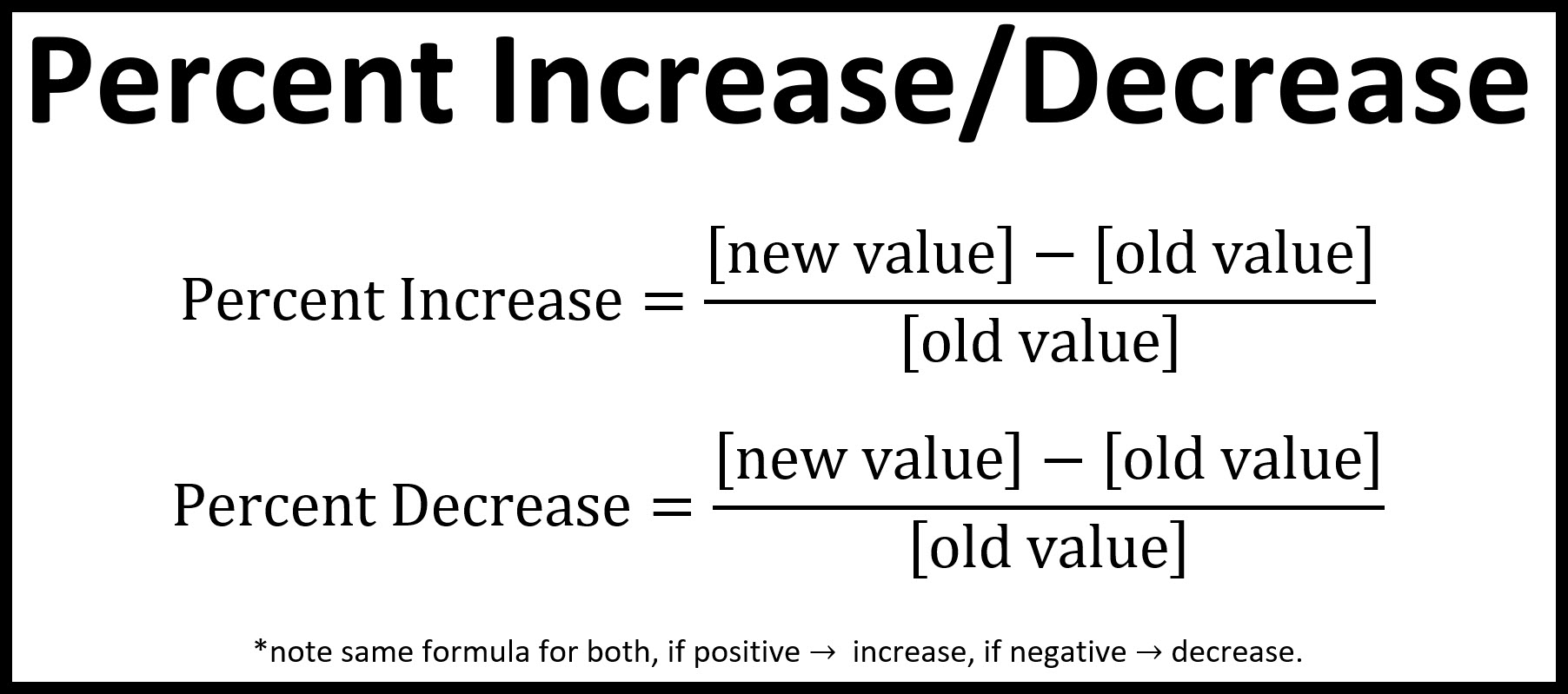
Step-by-Step Breakdown: (New Value – Original Value) / Original Value * 100
The formula for percent increase is:
$$ text{Percent Increase} = frac{text{New Value} – text{Original Value}}{text{Original Value}} times 100 $$
Let’s break down each component:
-
Subtract the Original Value from the New Value:
(New Value - Original Value)- This first step calculates the absolute increase, telling you the raw numerical difference between where you ended up and where you started.
-
Divide the Result by the Original Value:
/ Original Value- This is the crucial step that normalizes the increase. By dividing the absolute increase by the starting value, you determine the increase as a proportion or fraction of the original.
-
Multiply by 100:
* 100- This final step converts the decimal or fractional proportion into a percentage, making it easy to understand and compare.
Practical Example: A Simple Investment Scenario
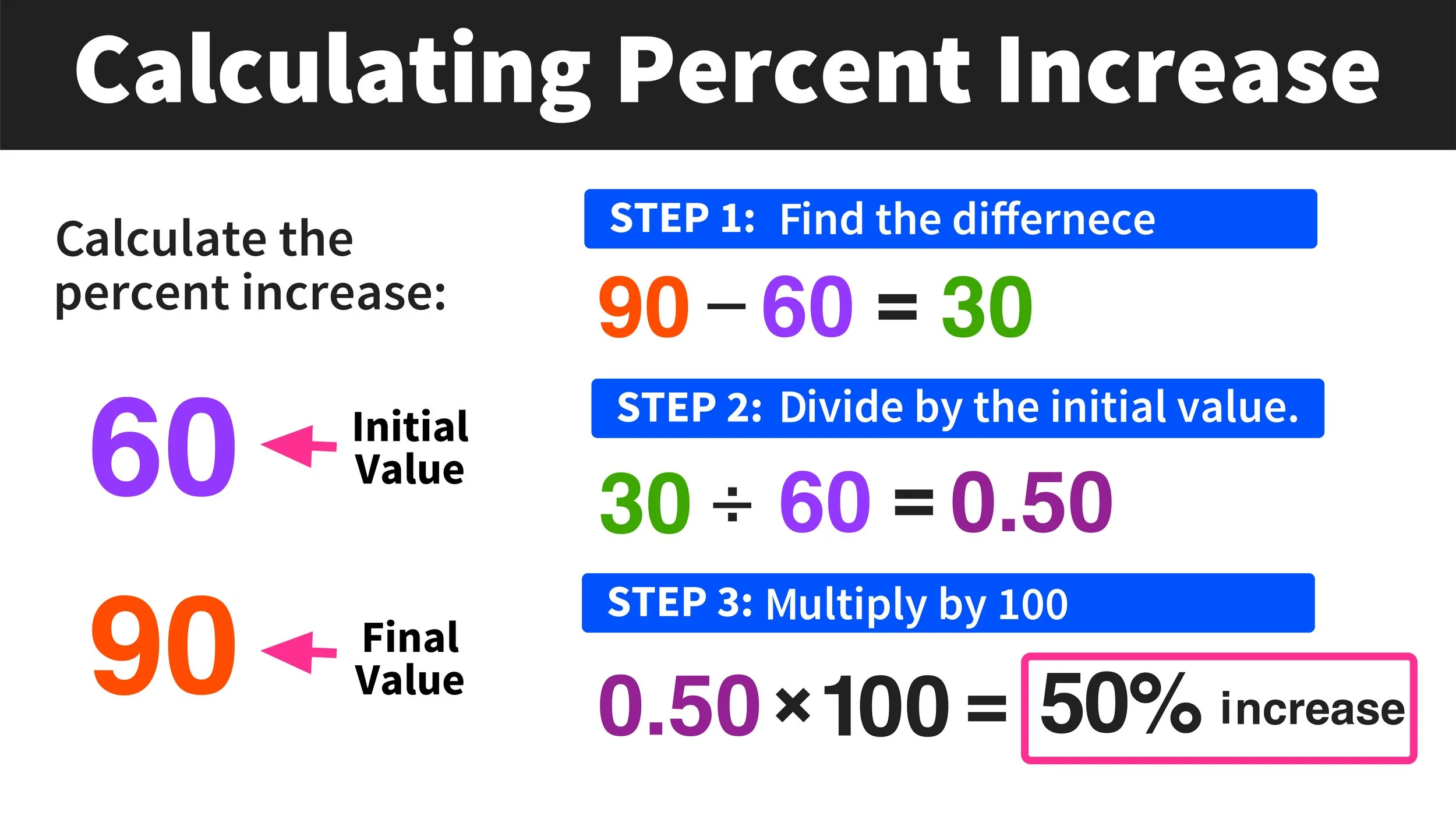
Imagine you invested $1,000 in a particular stock at the beginning of the year. By year-end, its value has risen to $1,250. What is the percent increase in your investment?
-
Original Value: $1,000
-
New Value: $1,250
Let’s apply the formula:
-
Absolute Increase: $1,250 – $1,000 = $250
-
Proportional Increase: $250 / $1,000 = 0.25
-
Percent Increase: 0.25 * 100 = 25%
Your investment saw a 25% increase. This single number succinctly communicates the growth of your capital, allowing you to easily compare this performance to other investment opportunities or market benchmarks.
The Importance of the Original Value (Base)
The ‘Original Value’ (also known as the ‘base value’) is arguably the most critical component of the formula. It serves as the reference point against which all change is measured. Selecting the correct original value is paramount; an error here will lead to a completely misleading percentage. For instance, if you’re measuring the growth of an investment over a year, the original value should be the investment’s value at the beginning of that year. If you’re tracking quarterly growth, the original value would be the value at the start of that specific quarter. The integrity of your percent increase calculation hinges entirely on identifying and using the correct starting point.
Real-World Applications in Personal Finance and Investing
The percent increase formula is not just an academic exercise; it’s a practical tool that empowers individuals to make smarter financial choices across numerous aspects of their personal monetary lives.
Tracking Investment Performance
For investors, the percent increase formula is the bedrock of performance measurement.
-
Stock Appreciation: When you hear that a stock “gained 15%,” you’re hearing a percent increase. Investors use this to compare the returns of different stocks, mutual funds, or ETFs over specific periods, helping them evaluate fund managers and adjust portfolio allocations.
-
Real Estate Appreciation: The growth in property value is often discussed in percentage terms. A house bought for $300,000 and now appraised at $360,000 has seen a 20% increase in value, a critical figure for homeowners’ equity calculations or potential sales.
-
Portfolio Growth: Consistently calculating the percent increase in your overall investment portfolio helps you monitor your progress towards financial goals, such as retirement or a down payment on a house.
Analyzing Salary and Income Growth
Your personal income is a vital financial metric, and percent increases play a direct role in understanding its trajectory.
-
Salary Raises: A “5% raise” sounds much clearer and more impactful than “$2,500 raise,” especially when comparing across different salary levels. Understanding your percent increase allows you to assess if your income is keeping pace with inflation or market standards.
-
Gig Economy Earnings: Freelancers or those with side hustles can track the percent increase in their monthly or annual earnings to identify growth trends in their entrepreneurial ventures.
-
Negotiations: Armed with data on your previous year’s income and projected value, you can articulate your desired salary increase in percentage terms, a standard practice in professional negotiations.
Understanding Inflation’s Impact
Inflation, the silent erosion of purchasing power, is almost always expressed as a percent increase.
-
Cost of Living: When the Consumer Price Index (CPI) shows a 3% increase, it means the average cost of goods and services has risen by 3%. Understanding this helps individuals assess if their income growth is truly increasing their purchasing power or just keeping pace with rising costs.
-
Retirement Planning: Factoring in future inflation via percent increase projections is crucial for ensuring that retirement savings will be adequate decades down the line.
Budgeting and Expense Management
The formula helps identify areas where spending is creeping up.
-
Rising Costs: If your grocery bill jumped from $500 to $550 in a month, that’s a 10% increase. Identifying these percentage increases helps pinpoint categories where costs are escalating and where adjustments might be needed in your budget.
-
Subscription Services: Track the percentage increase in annual fees for services to ensure you’re getting value for money.
Leveraging Percent Increase in Business Finance
For businesses, the percent increase formula is an indispensable tool for strategic planning, operational analysis, and evaluating overall health and performance. It translates raw numbers into actionable insights, guiding decisions from product development to market expansion.
Measuring Revenue and Profit Growth
These are perhaps the most vital metrics for any commercial enterprise, almost universally reported as percentage changes.
-
Revenue Growth: A company’s revenue increasing from $1 million to $1.2 million signifies a 20% growth. This percentage provides a clear indicator of market traction and sales team effectiveness.
-
Profit Margin Improvement: If net profit grows from $100,000 to $130,000, that’s a 30% increase, signaling better cost management or stronger pricing power. Investors and stakeholders rely heavily on these percentage increases to assess a company’s financial strength and future prospects.
Assessing Sales Performance
Sales departments live and breathe percent increases to gauge success.
-
Sales Quota Attainment: Teams measure their month-over-month or year-over-year sales volume increases.
-
Marketing Campaign Effectiveness: The increase in leads, conversions, or website traffic following a campaign is best evaluated using percent increase, directly linking investment in marketing to measurable outcomes.
-
Market Share Growth: An increase in a company’s share of the total market, often presented as a percentage, indicates successful competitive strategies.
Projecting Future Growth and Setting Targets
Forecasting and goal-setting rely heavily on historical percent increases.
-
Financial Forecasting: Businesses use past growth percentages to project future revenue, expenses, and profits, forming the basis of budgets and strategic plans.
-
Strategic Planning: Setting targets like “achieve 15% revenue growth next year” provides clear, measurable objectives for the entire organization.
-
Investor Relations: When pitching to investors, demonstrating a consistent percent increase in key metrics is crucial for attracting capital and building confidence.
Evaluating Cost Management Strategies
Just as important as revenue growth is managing costs effectively.
-
Supplier Price Changes: An increase in raw material costs, expressed as a percentage, helps procurement teams renegotiate or seek alternative suppliers.
-
Operational Efficiency: Reducing energy consumption or waste, when quantified as a percent decrease (the inverse of percent increase), highlights successful efficiency initiatives.
-
Budget Adherence: Monitoring the percent increase in departmental spending against allocated budgets ensures financial discipline.
Common Pitfalls and Nuances to Consider
While the percent increase formula is robust, its misuse or misinterpretation can lead to flawed conclusions. Awareness of these common pitfalls is essential for accurate analysis.
The “Zero” Original Value Problem
A fundamental mathematical rule states you cannot divide by zero. If your original value is zero, the percent increase formula becomes undefined. In practical terms, if you had zero customers and now have five, you cannot calculate a percent increase. Instead, you’ve experienced infinite growth. In such cases, it’s better to state the absolute increase (e.g., “we gained 5 customers”) rather than attempting a percentage.
Misinterpreting Small Base Numbers
A common trap is to be swayed by a large percent increase that originates from a very small original value. For example, if a startup grows its user base from 10 to 100 in a month, that’s a phenomenal 900% increase. While impressive, this needs to be viewed in context. A 900% increase on 10 users is still only 90 new users, which might be less significant than a 5% increase on a base of 1 million users (50,000 new users). Always consider the absolute numbers alongside the percentages, especially when the base is small.
The Difference Between Percent Increase and Percentage Point Increase
These terms are often confused but carry distinct meanings.
-
Percent Increase: Refers to the proportional growth of a value. (e.g., “The unemployment rate increased by 10% from 5% to 5.5%.”)
-
Percentage Point Increase: Refers to the absolute difference between two percentages. (e.g., “The unemployment rate increased by 0.5 percentage points from 5% to 5.5%.”)
Confusing these can have significant implications. An investment going from a 5% return to a 10% return is a 100% percent increase in return, but only a 5 percentage point increase. Understanding this distinction is crucial, particularly in financial reporting and policy discussions.
Annualized vs. Cumulative Growth
When discussing growth over time, it’s important to differentiate between annualized and cumulative percentages.
-
Cumulative Growth: Represents the total percent increase over an entire period (e.g., “The investment grew by 30% over three years”).
-
Annualized Growth (CAGR – Compound Annual Growth Rate): Spreads that cumulative growth evenly across each year, providing a consistent yearly rate (e.g., “The investment had an average annualized growth rate of 9.14% over three years to reach 30% cumulative growth”).
For long-term financial planning and investment comparisons, annualized growth rates often provide a more comparable and insightful metric, as they normalize for different time horizons.
The percent increase formula is an indispensable tool in the lexicon of finance, offering clarity and context to the often-complex narrative of numerical change. From empowering individuals to track their personal financial progress and make informed investment decisions, to providing businesses with crucial insights for strategic planning and performance evaluation, its utility is pervasive. By understanding its mechanics, recognizing its diverse applications, and remaining vigilant against common misinterpretations, anyone can harness the power of this simple yet profound formula to navigate the financial landscape with greater confidence and precision.
aViewFromTheCave is a participant in the Amazon Services LLC Associates Program, an affiliate advertising program designed to provide a means for sites to earn advertising fees by advertising and linking to Amazon.com. Amazon, the Amazon logo, AmazonSupply, and the AmazonSupply logo are trademarks of Amazon.com, Inc. or its affiliates. As an Amazon Associate we earn affiliate commissions from qualifying purchases.