
In the dynamic landscape of academic and scholarly communication, the efficient dissemination of research is paramount. For decades, traditional publishing models presented numerous barriers, from high subscription costs to opaque review processes, often limiting global access to critical knowledge. Enter Open Journal Systems (OJS), a robust, open-source software application designed to democratize and streamline the process of journal publishing. Developed and maintained by the Public Knowledge Project (PKP), OJS has emerged as a cornerstone of the open access movement, empowering institutions, societies, and individual scholars to publish scholarly content with unprecedented ease and reach.
At its core, OJS is more than just a content management system; it’s a comprehensive web-based platform that manages every stage of the journal publishing workflow. From author submission and peer review to editorial processing, copyediting, layout, and ultimately, publication and archiving, OJS provides a unified, integrated solution. This technological innovation has significantly reduced the operational overhead associated with running a scholarly journal, making high-quality, peer-reviewed research accessible to a wider audience, free of charge, in line with the principles of open access.
Understanding Open Journal Systems (OJS)
To fully grasp the significance of OJS, it’s essential to understand its foundational principles and the problem it was designed to solve. In an era where information travels at light speed, academic publishing often felt stuck in the slow lane, burdened by legacy systems and commercial interests that sometimes prioritized profit over broad dissemination.
The Genesis and Purpose of OJS
The Public Knowledge Project (PKP) initiated OJS in 2001 with a clear mission: to improve the scholarly and public quality of research. PKP, a non-profit initiative based out of Simon Fraser University Library and Stanford University, recognized the need for an open-source alternative to proprietary publishing systems. Their goal was to develop software that would not only facilitate the publication of scholarly journals but also champion the principles of open access, making research freely available online without subscription fees or paywalls. OJS was conceived as a tool to help journals manage and publish their content effectively, ensuring that academic outputs could reach a global readership unhindered by economic barriers. It sought to provide the technical infrastructure necessary for academic communities worldwide to establish and maintain their own peer-reviewed journals, thereby fostering greater control over their intellectual output.
Key Principles of Open Access Publishing
OJS is inextricably linked to the open access (OA) movement. OA publishing advocates for the free, immediate, online availability of research articles, coupled with the rights to use these articles fully in the digital environment. This stands in stark contrast to the traditional subscription-based model, where access is often restricted to individuals or institutions paying a fee. OJS embodies the ‘Gold Open Access’ route, providing the platform for journals to publish all their articles as open access from the moment of publication. By doing so, it promotes:
- Wider Dissemination: Research can reach anyone with an internet connection, regardless of their institutional affiliation or economic status.
- Increased Visibility and Impact: Studies show that open access articles tend to be cited more frequently, as they are more discoverable and accessible.
- Enhanced Collaboration: Greater access facilitates interdisciplinary and international collaboration, as researchers can more easily build upon each other’s work.
- Public Benefit: Publicly funded research, when made openly available, offers a greater return on investment for taxpayers and contributes to societal progress.
OJS provides the technical framework to uphold these principles, offering features that align with the rigorous standards of scholarly communication while embracing the openness that defines the movement.
Core Features and Functionalities of OJS
The power of OJS lies in its comprehensive suite of features, meticulously designed to support every aspect of the journal publishing lifecycle. It acts as a digital nerve center, orchestrating the complex interactions between authors, editors, reviewers, and readers.
Manuscript Submission and Tracking
The journey of an article in OJS begins with author submission. The platform provides a user-friendly interface for authors to submit their manuscripts, along with metadata, supplementary files, and declarations. Once submitted, OJS assigns a unique identifier and initiates a tracking process. Authors can monitor the status of their submission at every stage, from editorial assignment to peer review and final decision, ensuring transparency and reducing the need for constant communication with the editorial office. This streamlined submission portal is crucial for attracting high-quality research and providing a positive experience for contributors.
Peer Review Management
Central to academic rigor is the peer review process. OJS offers sophisticated tools to manage this critical stage, supporting various review models (e.g., single-blind, double-blind). Editors can invite reviewers, assign submissions, and track reviewer responses and deadlines. The system facilitates secure communication between editors and reviewers, allowing for the confidential exchange of feedback and recommendations. Reviewers are guided through a structured evaluation process, often using customizable forms, to ensure consistent and thorough assessment of manuscripts. This robust management system helps maintain the integrity and quality of published research.
Editorial Workflow and Decision Making
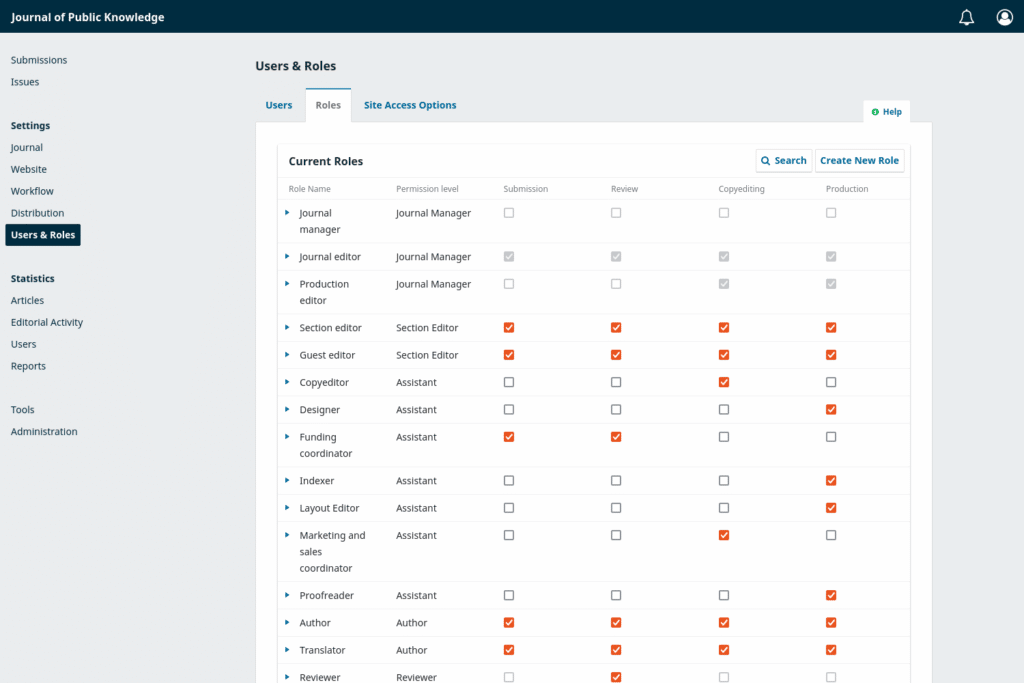
Beyond peer review, OJS provides a detailed workflow for editorial decision-making. Editors can accept, revise, or reject submissions based on reviewer feedback. For accepted articles, the system moves seamlessly into copyediting, layout, and proofreading stages. OJS allows for the assignment of specific roles (e.g., section editor, copyeditor, layout editor, proofreader) with distinct permissions, ensuring that each task is handled by the appropriate personnel. This segmented workflow enhances efficiency and accountability throughout the publication process. The platform also maintains a complete audit trail of all editorial actions, offering transparency and accountability.
Content Hosting and Dissemination
Once an article is finalized, OJS serves as the hosting platform for the published content. It supports various file formats (e.g., PDF, XML, HTML) and allows for the creation of issues and volumes, mimicking the structure of traditional journals. The platform is designed for optimal discoverability, generating rich metadata that adheres to international standards (e.g., Dublin Core, CrossRef DOI). This metadata is crucial for indexing services, ensuring that published articles are easily found in academic databases and search engines. Furthermore, OJS supports various feeds (e.g., RSS, Atom) to disseminate new content alerts to subscribers and interested readers, maximizing reach and impact.
User Management and Roles
OJS is built around a comprehensive user management system that defines specific roles and permissions within the journal’s ecosystem. Key roles include:
- Site Administrator: Manages the entire OJS instance, including server settings, global themes, and journal creation.
- Journal Manager: Oversees a specific journal, configures its settings, manages users, and handles publishing logistics.
- Editor: Manages the editorial process, assigns submissions, makes decisions, and oversees review and production.
- Section Editor: Handles specific sections of the journal, similar to an editor but with a narrower scope.
- Author: Submits manuscripts, tracks their progress, and responds to editorial requests.
- Reviewer: Evaluates submitted manuscripts and provides feedback.
- Copyeditor, Layout Editor, Proofreader: Handle the production aspects of accepted manuscripts.
- Reader: Accesses and reads published content.
This granular control over user roles ensures a secure and organized workflow, with each participant having access only to the functionalities relevant to their tasks.
Technological Underpinnings and Architecture
The strength and adaptability of OJS stem from its robust technological foundation, built upon open-source principles and designed for scalability and interoperability. Understanding these underpinnings reveals why OJS is a preferred choice for thousands of journals globally.
Open Source Philosophy and Community
OJS is a prime example of successful open-source software. Developed under the GNU General Public License, its source code is freely available, allowing anyone to download, use, modify, and distribute it. This open-source philosophy fosters a vibrant global community of developers, users, and academics who contribute to its continuous improvement. Bugs are identified and fixed collaboratively, new features are proposed and implemented, and documentation is enriched by collective effort. This community-driven development model ensures that OJS remains current, secure, and responsive to the evolving needs of scholarly publishing without being tied to a single commercial entity. It also promotes transparency and trust, as the underlying code is subject to public scrutiny.
System Requirements and Deployment
OJS is typically deployed on a web server running a LAMP (Linux, Apache, MySQL/PostgreSQL, PHP) stack or a WAMP (Windows, Apache/IIS, MySQL, PHP) stack. These are widely available and relatively inexpensive environments, making OJS accessible even to institutions with limited IT budgets. The software is written primarily in PHP, a popular scripting language for web development, ensuring broad compatibility and ease of customization for those with web development expertise.
Deployment involves installing the OJS package on a server, configuring the database, and setting up file permissions. While the initial setup requires some technical knowledge, various hosting providers specialize in OJS, offering managed services that simplify deployment and maintenance for journals.
Extensibility and Integrations (APIs, Plugins)
One of OJS’s most powerful technical attributes is its extensibility. The platform is built with a modular architecture that allows for significant customization and integration with other systems.
- Plugins: OJS supports a rich ecosystem of plugins that extend its functionality without modifying the core code. These can range from authentication plugins (e.g., LDAP, Shibboleth) to statistics and metrics plugins (e.g., COUNTER, Altmetrics), export plugins (e.g., for CrossRef, PubMed), and theme plugins for visual customization. This plugin architecture allows journals to tailor OJS to their specific needs and integrate with external services seamlessly.
- APIs (Application Programming Interfaces): OJS provides APIs that allow other software applications to interact with its data and functionalities. This enables seamless data exchange with institutional repositories, indexing services, and other scholarly platforms, further enhancing the discoverability and interoperability of published content. For example, the OAI-PMH (Open Archives Initiative Protocol for Metadata Harvesting) interface allows for automatic harvesting of journal metadata by federated search engines and archives.
Security and Data Management Considerations
As a platform handling sensitive data (manuscripts, peer reviews, personal information), OJS places a strong emphasis on security and data management. It incorporates features such as user authentication, role-based access control, and encrypted communications. Regular updates released by PKP address security vulnerabilities and introduce enhancements. For data management, OJS stores content and metadata in a robust relational database (MySQL or PostgreSQL), ensuring data integrity and facilitating backups. Journals are responsible for their server security and backup policies, but OJS provides the necessary framework to implement best practices. Compliance with data protection regulations (e.g., GDPR) is also a key consideration, and OJS provides tools to manage user consent and data privacy.
Benefits of Adopting OJS for Academic Publishing
The adoption of OJS by thousands of journals worldwide is a testament to its profound benefits for the academic publishing ecosystem. It represents a paradigm shift from proprietary, closed systems to an open, collaborative, and efficient model.
Democratizing Knowledge and Global Reach
The primary benefit of OJS is its role in democratizing knowledge. By enabling open access publishing, OJS breaks down financial barriers that have historically limited access to scholarly research. This means researchers in developing nations, independent scholars, and the general public can access cutting-edge research without prohibitive subscription fees. This global reach ensures that research findings can have a broader impact, fostering innovation and informed decision-making across all sectors of society. OJS empowers any institution or group, regardless of its size or financial resources, to launch and manage a professional-grade scholarly journal, thereby leveling the playing field in academic publishing.
Enhancing Efficiency and Workflow Streamlining
OJS significantly streamlines the entire journal publishing workflow, from submission to publication. The automated features for manuscript tracking, peer review management, and editorial decision-making drastically reduce the administrative burden on editors and journal staff. This efficiency translates into faster publication times, a critical factor for authors who want their research to be disseminated promptly. The structured workflow minimizes errors, ensures adherence to best practices, and provides a clear overview of all ongoing processes, allowing editors to focus more on content quality rather than logistical challenges.
Cost-Effectiveness and Sustainability
For many institutions and scholarly societies, the cost of commercial publishing platforms can be prohibitive. OJS, being open-source, offers a highly cost-effective alternative. While there might be costs associated with hosting, technical support, or customization, these are typically far less than the licensing fees for proprietary software. This affordability makes it sustainable for small to medium-sized journals and institutions with limited budgets. By reducing financial barriers, OJS promotes a more diverse and equitable publishing landscape, allowing more voices and perspectives to contribute to the global scholarly conversation.
Fostering Transparency and Quality Control
OJS is designed to support transparent publishing practices. The clear tracking of submissions, reviewer comments, and editorial decisions provides an auditable trail, enhancing accountability throughout the process. The robust peer review management system helps maintain the high standards of scholarly quality. Furthermore, the platform’s ability to integrate with plagiarism detection tools and adherence to metadata standards further reinforces its commitment to integrity and quality control. By providing a structured and transparent environment, OJS helps build trust in the published research.
Challenges and Future Directions of OJS
While OJS has been transformative, like any sophisticated software system, it faces ongoing challenges and is continuously evolving to meet the demands of a rapidly changing digital environment.
Navigating the Digital Landscape
The digital publishing landscape is constantly in flux, with new technologies, standards, and expectations emerging regularly. OJS must continually adapt to these changes, from supporting new content formats (e.g., rich media, interactive data visualizations) to integrating with emerging research infrastructure (e.g., persistent identifiers beyond DOIs, ORCID for author identification). Staying current with web standards, accessibility requirements (WCAG), and evolving SEO best practices is crucial for ensuring OJS journals remain discoverable and user-friendly. The distributed nature of its development, while a strength, also requires strong coordination to ensure timely updates and forward compatibility.
User Experience and Accessibility Enhancements
While OJS offers powerful functionality, its user interface, particularly for less technically savvy users, has historically been a point of feedback. PKP is actively working on enhancing the user experience (UX) and overall accessibility of OJS, making it more intuitive and easier to navigate for authors, reviewers, and editors alike. This includes efforts to modernize the interface, improve mobile responsiveness, and ensure compliance with accessibility standards to cater to users with disabilities. A more refined UX will reduce the learning curve and foster greater adoption and satisfaction among its diverse user base.
Sustaining Development and Community Engagement
The long-term sustainability of any open-source project hinges on continued development and a thriving community. For OJS, this means ensuring stable funding for the core PKP team, attracting new developers, and fostering active engagement among its global user base. Encouraging community contributions, providing comprehensive documentation, and offering effective support channels are vital for its continued growth and relevance. As scholarly publishing continues to evolve, the collective intelligence and collaborative spirit of the OJS community will be essential in shaping its future direction and ensuring it remains a leading platform for open access scholarly communication.
In conclusion, Open Journal Systems is a powerful, flexible, and essential technological solution for modern academic publishing. By providing a comprehensive, open-source platform, OJS has not only streamlined the publication workflow but has also been instrumental in advancing the principles of open access, democratizing knowledge, and making scholarly research more accessible and impactful globally. Its continuous development, driven by a dedicated community, ensures its relevance and vital role in the future of scholarly communication.
aViewFromTheCave is a participant in the Amazon Services LLC Associates Program, an affiliate advertising program designed to provide a means for sites to earn advertising fees by advertising and linking to Amazon.com. Amazon, the Amazon logo, AmazonSupply, and the AmazonSupply logo are trademarks of Amazon.com, Inc. or its affiliates. As an Amazon Associate we earn affiliate commissions from qualifying purchases.