
In the vast lexicon of video technology, NTSC stands as a monumental, though now largely historical, pillar. An acronym for the National Television System Committee, NTSC defined the analog television broadcast standard predominantly used in North America, Japan, and several other regions for over half a century. Understanding NTSC is crucial for comprehending the evolution of television, video recording, and the technical challenges that shaped our modern digital media landscape. From its inception in the mid-20th century to its eventual phased retirement in favor of digital standards, NTSC was more than just a specification; it was the backbone of home entertainment and broadcast communication for generations.
The Genesis of a Standard: A Historical Perspective
The development of NTSC was a story of innovation driven by necessity, particularly the burgeoning public demand for television and the complex engineering task of integrating color into an existing black-and-white infrastructure.
The Need for Color Television
Following World War II, television rapidly transitioned from a niche curiosity to a household staple in developed nations. Early television systems, like those initially standardized in the U.S., were exclusively black and white. However, the allure of color broadcasting was undeniable. The challenge wasn’t merely inventing color technology; it was doing so in a way that wouldn’t render the millions of existing black-and-white television sets obsolete. Any new color standard had to be “backward-compatible,” meaning black-and-white sets could still receive and display the color broadcast in monochrome. This requirement profoundly influenced the technical specifications of what would become the NTSC color standard.
Birth of the Standard
The National Television System Committee was formed in the United States to address these complex technical and economic considerations. After various proposals and extensive testing, the FCC (Federal Communications Commission) adopted the NTSC’s first standard for monochrome television in 1941. This initial standard set the framework for broadcast parameters like scan lines and frame rates. However, the true legacy of NTSC emerged in 1953 when the committee proposed and the FCC approved the second, crucial standard for color television. This 1953 NTSC standard was a triumph of engineering compromise, allowing color information to be encoded within the existing black-and-white signal without significantly degrading it, thereby ensuring backward compatibility. The first commercial NTSC color broadcast aired in 1954, marking a pivotal moment in media history.
Technical Specifications: Diving into NTSC’s Core
The NTSC standard is defined by a precise set of technical parameters that govern how video signals are generated, transmitted, and displayed. These specifications dictated everything from picture resolution to color accuracy.
Frame Rate and Interlacing
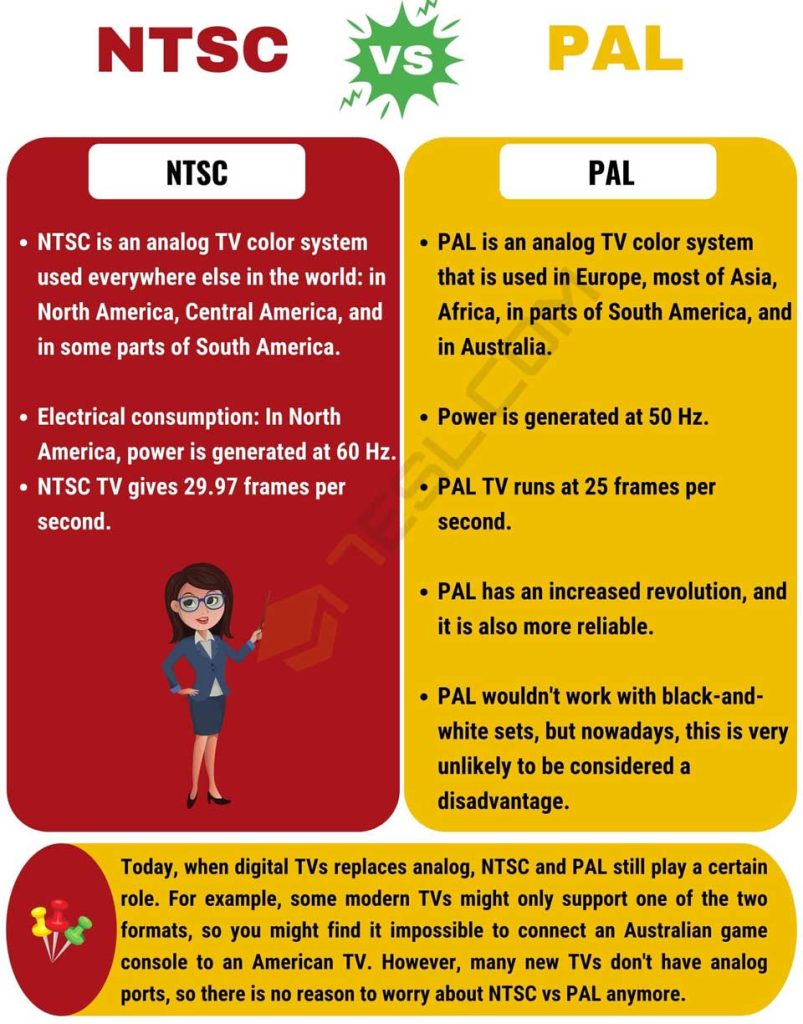
One of the most defining characteristics of NTSC is its frame rate. The standard specifies a refresh rate of approximately 29.97 frames per second (fps). While often rounded to 30 fps, the precise 29.97 Hz figure was a clever technical adjustment. When color was introduced, the color subcarrier frequency (explained below) interfered with the audio carrier, causing a high-pitched whine. To avoid this, the frame rate was slightly lowered from the original 30 Hz to 29.97 Hz, and the line frequency was similarly adjusted, minimizing the audible interference.
NTSC also employs an interlaced scanning method. Instead of drawing all lines of a frame sequentially (progressive scan), interlacing draws alternate lines in two passes, called fields. An NTSC signal consists of 525 total scan lines per frame. Of these, typically 480 lines are visible (often referred to as 480i, where ‘i’ denotes interlaced), with the remaining lines used for vertical blanking interval (VBI) data like closed captions or teletext. Each frame is composed of two fields, each containing 262.5 lines, drawn 60 times per second (specifically 59.94 fields per second). This interlacing technique helped reduce flicker on older CRT displays while conserving bandwidth, although it could introduce motion artifacts on fast-moving objects.
Color Encoding: The YIQ Model
The genius of NTSC’s color implementation lay in its YIQ color model. This model separates the video signal into three components:
- Y (Luminance): This component carries the brightness information, essentially the black-and-white image. This was critical for backward compatibility, as monochrome sets only processed the Y component.
- I (In-phase) and Q (Quadrature): These are the chrominance components, carrying the color information. They modulate a color subcarrier frequency, which for NTSC is precisely 3.579545 MHz. The color information is encoded by varying the phase and amplitude of this subcarrier.
By separating brightness from color, NTSC allowed black-and-white televisions to simply ignore the color subcarrier and display the luminance signal as usual. Color televisions, on the other hand, would decode both the luminance and chrominance signals to reconstruct the full-color image. This system, while ingenious, was also the source of some of NTSC’s notorious shortcomings.
Aspect Ratio
The native aspect ratio for NTSC television was 4:3, which translates to a rectangular screen that is four units wide for every three units high. This square-ish format was standard for television sets for decades. As widescreen content (like cinematic films, typically 16:9) became more prevalent, it had to be adapted for NTSC broadcasts. This was often achieved through “letterboxing” (adding black bars to the top and bottom of the screen) or “pan and scan” (cropping the sides of the widescreen image to fit the 4:3 frame).
NTSC in Practice: Strengths, Limitations, and Regional Adoption
While NTSC represented a significant technological leap, its analog nature and specific design choices led to both advantages and disadvantages in practical use.
Geographic Reach
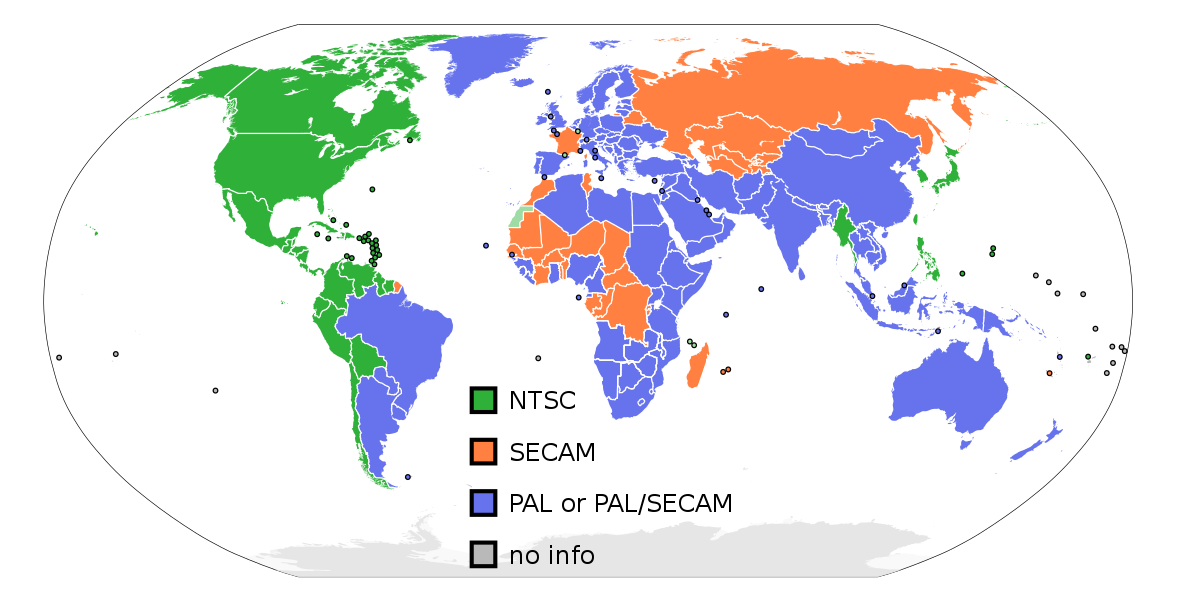
NTSC primarily became the dominant standard in North America, including the United States, Canada, and Mexico. It was also adopted in Japan, South Korea, Taiwan, and parts of South America (e.g., Colombia, Ecuador). However, much of Europe, Africa, Asia, and Australia adopted the PAL (Phase Alternating Line) standard, while France and some Eastern European countries developed the SECAM (Sequential Couleur à Mémoire) standard. These regional differences highlighted varying engineering philosophies and led to compatibility issues when media created in one NTSC region was played in a PAL or SECAM region without proper conversion.
NTSC’s Strengths
Despite its eventual replacement, NTSC offered several key advantages in its heyday:
- Pioneering Color Television: NTSC was the first widely adopted standard for color television, setting the pace for broadcast innovation worldwide.
- Backward Compatibility: Its ability to deliver color broadcasts that could still be viewed on black-and-white sets was an extraordinary achievement, ensuring a smooth transition for consumers and broadcasters.
- Higher Frame Rate: Compared to PAL’s 25 fps, NTSC’s 29.97 fps (effectively 60 fields per second) provided smoother motion, particularly noticeable in live sports broadcasts or fast-action sequences, reducing perceived flicker on older CRT displays.
Notorious Limitations: “Never The Same Color”
NTSC earned a playful, yet telling, nickname: “Never The Same Color.” This moniker alluded to its most significant weakness: susceptibility to color inaccuracies and phase shifts. Because NTSC encoded color information via phase modulation of the subcarrier, any minor distortion or interference in the signal path could cause the colors to shift. This meant that the color hue could vary from broadcast to broadcast, or even within the same broadcast as the signal strength fluctuated. This was particularly problematic for consumer VCRs and often led to a need for manual “tint” adjustments on television sets.
Other notable limitations included:
- Dot Crawl: A visual artifact where a pattern of moving dots appears along sharp color transitions, caused by the imperfect separation of luminance and chrominance signals.
- Color Bleed: Where colors would “spill” into adjacent areas, especially noticeable with highly saturated hues.
- Lower Resolution (Compared to Digital): While 480i was standard for analog, it pales in comparison to the crispness of modern digital high-definition formats.
These limitations, primarily rooted in its analog nature and the specific design choices made for backward compatibility, often made NTSC appear less stable in color reproduction compared to PAL, which employed a phase-alternating line technique to largely cancel out phase errors.
The Legacy and Evolution: NTSC in a Digital World
While NTSC broadcasts have largely ceased, its influence continues to ripple through various aspects of modern technology and media.
The Transition to Digital Television (DTV)
The analog limitations of NTSC eventually paved the way for the digital television revolution. In the late 1990s and early 2000s, countries that had used NTSC began transitioning to digital broadcast standards. In the United States, this meant the adoption of the ATSC (Advanced Television Systems Committee) standard, which delivers vastly superior picture and sound quality, multiple programming streams (multicasting), and interactive services. The “digital switchover” in the US, completed in 2009, marked the official sunset of full-power analog NTSC television broadcasts, with similar transitions occurring in Canada, Japan, and other regions.
NTSC’s Enduring Presence
Despite the cessation of analog broadcasts, NTSC’s legacy persists:
- Legacy Equipment: Millions of NTSC-compatible devices still exist, including older VCRs, DVD players, game consoles (like the original PlayStation, Nintendo 64, etc.), and security camera systems. Understanding NTSC is essential for anyone dealing with these retro technologies or digitizing old media.
- Resolution Descriptor: The “480i” or “NTSC resolution” is still commonly used to describe standard-definition video, even in digital contexts (e.g., NTSC DVD resolution is typically 720×480 pixels).
- Archiving and Restoration: Much of the world’s audiovisual heritage from the latter half of the 20th century was recorded and broadcast in NTSC. Video archivists and restorers constantly work with NTSC footage, requiring a deep understanding of its characteristics and potential artifacts.

Modern Context and Comparison
NTSC’s specifications, particularly its line count and frame rate, influenced the development of subsequent digital standards. For instance, the 480 active lines of NTSC are a direct precursor to resolutions like 480p in progressive scan digital video. The transition from interlaced to progressive scan is one of the most significant shifts from the NTSC era to modern digital displays, offering vastly improved clarity for motion.
In a world dominated by 4K streaming, OLED displays, and AI-powered upscaling, the analog artifacts of NTSC might seem like a distant memory. However, NTSC represents a critical chapter in technological history, a testament to ingenious engineering solutions to complex problems, and a fundamental building block that shaped how we consume and create video content even today. Understanding NTSC is not just about historical trivia; it’s about appreciating the journey of video technology and the foundational principles that continue to inform its ongoing evolution.
aViewFromTheCave is a participant in the Amazon Services LLC Associates Program, an affiliate advertising program designed to provide a means for sites to earn advertising fees by advertising and linking to Amazon.com. Amazon, the Amazon logo, AmazonSupply, and the AmazonSupply logo are trademarks of Amazon.com, Inc. or its affiliates. As an Amazon Associate we earn affiliate commissions from qualifying purchases.