
In today’s data-driven world, the ability to effectively manage, analyze, and leverage information is paramount. Whether you’re a burgeoning startup optimizing its customer relationship management (CRM) system, a seasoned marketer crafting personalized campaigns, or an individual investor seeking to understand market trends, the quality of your data directly impacts the effectiveness of your strategies. One fundamental process that underpins robust data management, particularly in the realms of technology and business finance, is data normalization. But what exactly is data normalization, and why should it be a cornerstone of your data strategy?
At its core, data normalization is the process of organizing data to reduce redundancy and improve data integrity. Think of it as tidying up your digital filing cabinet. Instead of having multiple copies of the same information scattered across different files, or having the same pieces of information repeated within a single file, normalization aims to consolidate and structure this data in a logical and efficient way. This is typically achieved by breaking down larger tables into smaller, more manageable tables and establishing relationships between them.
The primary goal of normalization is to eliminate undesirable characteristics of data, such as insertion anomalies (inability to add new data without introducing redundancy), deletion anomalies (loss of unintended data when deleting records), and update anomalies (inconsistency when updating duplicated data). By addressing these issues, normalization ensures that your data is more accurate, consistent, and easier to work with, ultimately leading to better decision-making and more efficient operations across various domains.
The Pillars of Data Normalization: Understanding the Relational Model
To truly grasp data normalization, it’s crucial to understand the foundational concepts of the relational database model. Most modern data management systems, especially those used in technology and finance, are built upon this model. The relational model, conceived by E.F. Codd, represents data in tables (also known as relations) consisting of rows (tuples) and columns (attributes). The power of this model lies in its ability to define relationships between these tables, allowing for complex queries and data retrieval without compromising integrity.
From Chaotic Data to Structured Systems: The Need for Normalization
Imagine a small business owner who initially manages all their customer information in a single spreadsheet. This spreadsheet might contain customer names, addresses, purchase history, and even details about the products they bought. While this might work initially, as the business grows, this single spreadsheet will quickly become unwieldy and prone to errors.
Consider the following scenario: a customer makes multiple purchases. In a non-normalized spreadsheet, the customer’s name, address, and contact information would be repeated for every single purchase. If the customer moves, updating their address would require finding and changing it in every single row associated with their purchases. This is a classic example of an update anomaly. If one of these rows is accidentally deleted, you might lose valuable customer information. This is a deletion anomaly. Furthermore, if you want to add a new customer who hasn’t made any purchases yet, you might have to leave the purchase history columns blank, which can be awkward and potentially lead to data inconsistencies – an insertion anomaly.
This is where data normalization steps in. It provides a systematic approach to break down this monolithic spreadsheet into multiple, smaller tables, each focusing on a specific entity. For instance, you could have a “Customers” table, a “Products” table, and an “Orders” table. The “Orders” table would then link customers to the products they purchased, rather than duplicating all the customer and product details within the order itself. This structuring significantly reduces redundancy and enhances data integrity.
The Family of Normal Forms: A Hierarchy of Data Organization
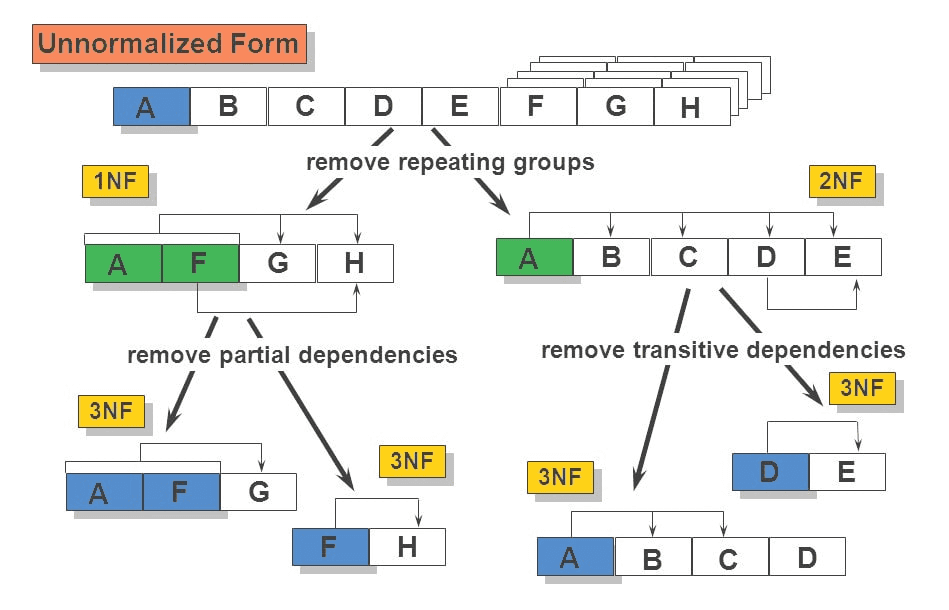
Data normalization is not a one-size-fits-all solution; it’s a hierarchical process defined by a series of “normal forms.” Each normal form builds upon the previous one, imposing stricter rules to eliminate more anomalies and improve data organization. The most commonly encountered normal forms are the first three: First Normal Form (1NF), Second Normal Form (2NF), and Third Normal Form (3NF).
First Normal Form (1NF): Eliminating Repeating Groups
The foundational step in normalization is achieving First Normal Form. A table is in 1NF if:
- Each column contains atomic values: This means that each cell in the table should hold a single, indivisible piece of data. For example, a “Phone Numbers” column should not contain multiple phone numbers separated by commas; instead, you might have a separate row for each phone number.
- There are no repeating groups of columns: This refers to situations where you have multiple columns that represent the same type of data for a single record. For example, having columns like “Product1Name,” “Product2Name,” “Product3Name” within an order table would violate 1NF. Instead, these should be moved to a separate “OrderItems” table.
- Each row is unique: This is typically achieved by having a primary key, which is a column (or set of columns) that uniquely identifies each row in the table.
Achieving 1NF is the initial step in tidying up your data, ensuring that each piece of information is distinct and addressable.
Second Normal Form (2NF): Tackling Partial Dependencies
Once a table is in 1NF, the next step is to ensure it’s in Second Normal Form. A table is in 2NF if:
- It is in 1NF.
- All non-key attributes are fully functionally dependent on the primary key. This means that every column that is not part of the primary key must depend on the entire primary key, not just a part of it. This rule primarily applies to tables with composite primary keys (primary keys made up of multiple columns).
Consider an example where you have a table for “OrderItems” with a composite primary key of (OrderID, ProductID). If you have a “ProductName” column in this table, it’s only dependent on ProductID, not the entire (OrderID, ProductID) key. If you were to look up a product, its name would be the same regardless of the order it’s in. To achieve 2NF, you would separate “ProductName” into a “Products” table and link it to the “OrderItems” table using ProductID.
Third Normal Form (3NF): Eliminating Transitive Dependencies
The final common normal form is Third Normal Form. A table is in 3NF if:
- It is in 2NF.
- There are no transitive dependencies. A transitive dependency exists when a non-key attribute depends on another non-key attribute, which in turn depends on the primary key.
Let’s revisit our customer example. Imagine a “Customers” table with columns like CustomerID (primary key), CustomerName, City, and State. If City and State are both determined by the customer’s address, and the address is part of the customer’s overall information, this might lead to transitive dependencies if you were to add a Region column. If Region is determined by State, and State is determined by the customer, then Region is transitively dependent on CustomerID. To achieve 3NF, you would create a separate “Locations” table with City, State, and Region information, and then link your “Customers” table to this “Locations” table.
The Impact of Normalization: Across Tech, Brand, and Money
The principles of data normalization are not confined to the technical intricacies of database design; their impact reverberates across the core pillars of your website’s focus: Tech, Brand, and Money.
Leveraging Normalized Data in Technology and Software Development
For technology companies and software developers, data normalization is not just a best practice; it’s a fundamental requirement for building scalable, robust, and efficient applications.
- Improved Database Performance: Normalized databases require less storage space and allow for faster data retrieval through optimized queries. When data isn’t duplicated, the database engine doesn’t have to sift through as many records to find what it needs.
- Enhanced Data Integrity and Accuracy: By reducing redundancy, normalization minimizes the chances of inconsistencies and errors. This is critical for applications dealing with financial transactions, user authentication, or any system where data accuracy is paramount.
- Simplified Development and Maintenance: When data is well-organized, it’s easier for developers to understand, modify, and extend the database schema. This reduces development time and the likelihood of introducing bugs.
- Foundation for Advanced Analytics and AI: For AI tools and machine learning algorithms to function effectively, they require clean, structured data. Normalization provides this structured foundation, enabling more accurate predictions, better pattern recognition, and more insightful analysis. Think of training a recommendation engine – it needs to accurately understand user preferences and product attributes, which is facilitated by a normalized dataset.
Building Strong Brands on a Foundation of Reliable Data
The impact of data normalization extends to the strategic and reputational aspects of branding.
- Consistent Customer Experience: For businesses focused on personal branding or corporate identity, understanding customer behavior is key. Normalized data ensures that customer information is consistent across all touchpoints. This allows for personalized marketing campaigns, tailored customer service, and a unified brand experience, preventing instances where a customer might receive conflicting information from different departments.
- Effective Marketing and Reputation Management: Marketing campaigns often rely on segmenting audiences and delivering targeted messages. Normalized customer data, including purchase history, demographics, and preferences, allows for precise audience segmentation, leading to higher campaign ROI. Furthermore, accurate and consistent data is crucial for managing online reputation, ensuring that customer feedback and interactions are correctly attributed and addressed. Case studies, a common element in brand strategy, also benefit from well-structured data to showcase impact and success.
- Informed Design and Product Development: Whether it’s designing a new app interface or developing a new product line, understanding user needs and market trends is vital. Normalized data provides a reliable source of information for making these critical decisions, ensuring that branding efforts are aligned with actual customer behavior and market demands.
Optimizing Financial Strategies with Normalized Data
For individuals and businesses alike, effective financial management hinges on accurate and accessible data. Data normalization plays a significant role in this domain.
- Accurate Financial Reporting and Analysis: Whether it’s personal finance tracking, investment portfolio management, or business finance accounting, accurate data is non-negotiable. Normalization ensures that financial data, such as transactions, account balances, and investment details, is free from inconsistencies, enabling reliable financial reporting and insightful analysis.
- Improved Business Finance Operations: For businesses, normalized data streamlines processes like invoicing, payroll, and inventory management. This reduces errors, improves efficiency, and provides a clearer picture of the company’s financial health, crucial for making sound investment decisions and managing business finances effectively.
- Empowering Online Income and Side Hustles: Individuals pursuing online income or side hustles often manage multiple revenue streams and expenses. Normalized data allows them to track their earnings and expenditures accurately, identify profitable ventures, and make informed decisions about reinvesting or scaling their efforts. Financial tools that rely on accurate data input benefit directly from this process.
- Informed Investment Decisions: Investors use data to analyze market trends, company performance, and economic indicators. Normalized datasets, whether for stock prices, economic indicators, or company financial statements, provide a cleaner and more reliable basis for making investment decisions, minimizing the risk of acting on flawed information.
Conclusion: Embracing Normalization for Data Excellence
In conclusion, data normalization is a fundamental process that transforms raw, potentially chaotic data into a structured, reliable, and efficient asset. By understanding and implementing the principles of normal forms, individuals and organizations can significantly improve data integrity, reduce redundancy, and unlock the full potential of their information. Whether you’re developing cutting-edge technology, building a powerful brand, or navigating the complexities of personal and business finance, a commitment to data normalization is a critical step towards achieving accuracy, efficiency, and ultimately, success. It’s the silent architect behind many of the seamless digital experiences and informed decisions we rely on every day.
aViewFromTheCave is a participant in the Amazon Services LLC Associates Program, an affiliate advertising program designed to provide a means for sites to earn advertising fees by advertising and linking to Amazon.com. Amazon, the Amazon logo, AmazonSupply, and the AmazonSupply logo are trademarks of Amazon.com, Inc. or its affiliates. As an Amazon Associate we earn affiliate commissions from qualifying purchases.