
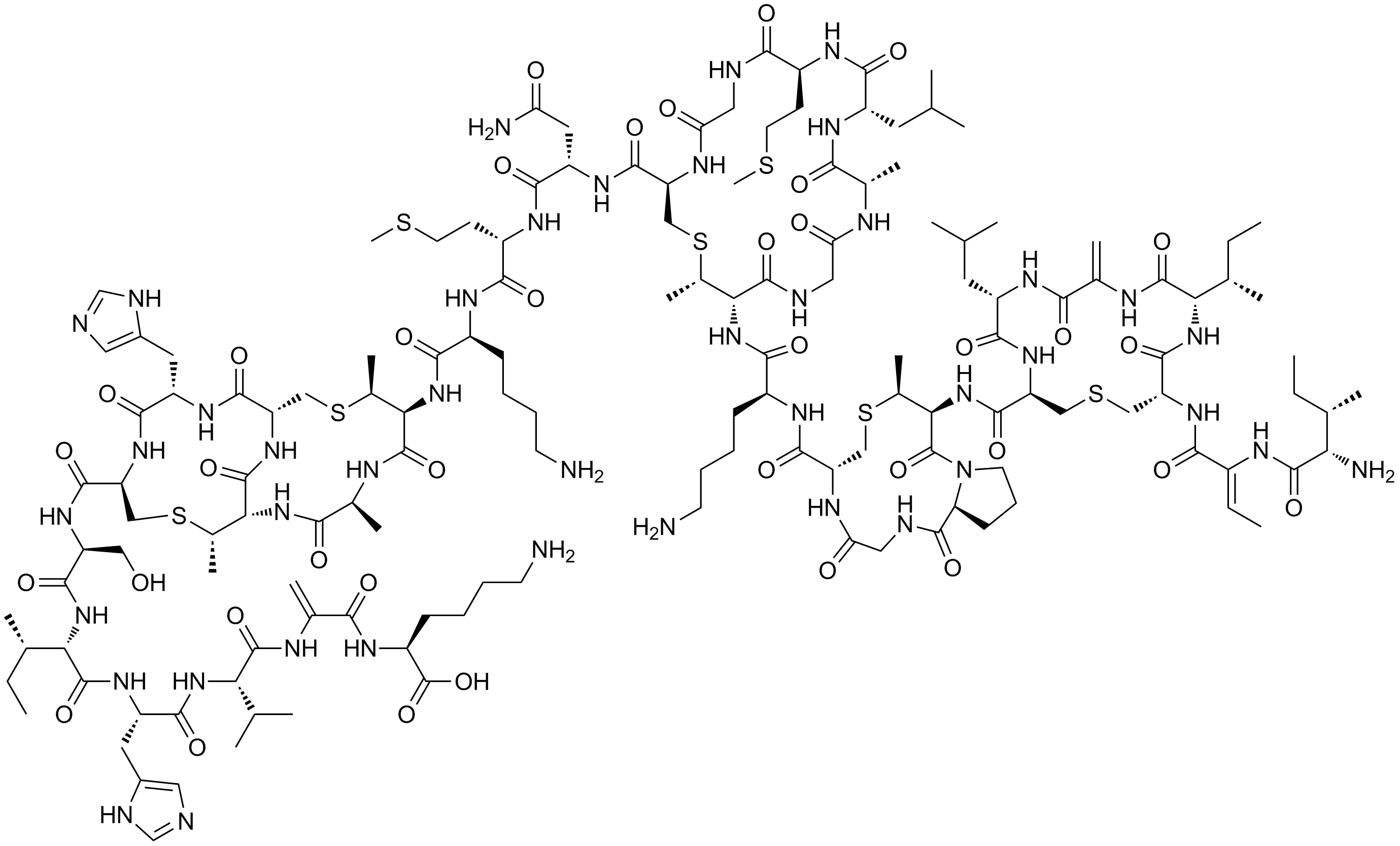
Nisin stands as a remarkable innovation at the intersection of microbiology and food technology, representing a significant stride in natural food preservation. Far from being a synthetic additive, nisin is a naturally occurring antimicrobial peptide produced by the bacterium Lactococcus lactis, a microorganism commonly found in dairy products. Its discovery and subsequent application have revolutionized strategies for extending the shelf life of various food items while addressing the growing consumer demand for “clean label” ingredients and reduced reliance on artificial preservatives. Understanding nisin involves delving into its biotechnological origins, sophisticated mechanism of action, and its pivotal role in the future of food safety and sustainability.
Nisin: A Biotechnological Marvel in Food Preservation
The emergence of nisin as a leading bio-preservative is a testament to advancements in biotechnology and food science. Its classification as a bacteriocin, a type of protein with antimicrobial properties, positions it as a sophisticated biological tool in the arsenal against food spoilage. The very nature of nisin, being a product of microbial fermentation, aligns perfectly with modern technological trends favoring natural and sustainable solutions.
Unveiling Nisin’s Microbial Origins
Nisin’s journey from a bacterial metabolite to a globally recognized food additive highlights the power of applied microbiology. Lactococcus lactis, the producer organism, is a non-pathogenic, Gram-positive bacterium extensively used in the dairy industry for cheese and yogurt production. This intrinsic link to common food fermentation processes underscores nisin’s natural provenance. The strain L. lactis produces nisin as a defense mechanism, a biochemical tool to inhibit the growth of competing bacteria in its environment. Scientists, recognizing this natural antimicrobial capacity, harnessed the bacterium’s genetic machinery to produce nisin on an industrial scale. This biotechnological exploitation of a natural process is a prime example of how scientific understanding of microbial ecosystems can be leveraged for practical, large-scale applications in the food sector. The controlled fermentation process, akin to a sophisticated biomanufacturing operation, ensures consistent quality and purity, transforming a microbial byproduct into a powerful preservative technology.
The Sophisticated Mechanism of Action
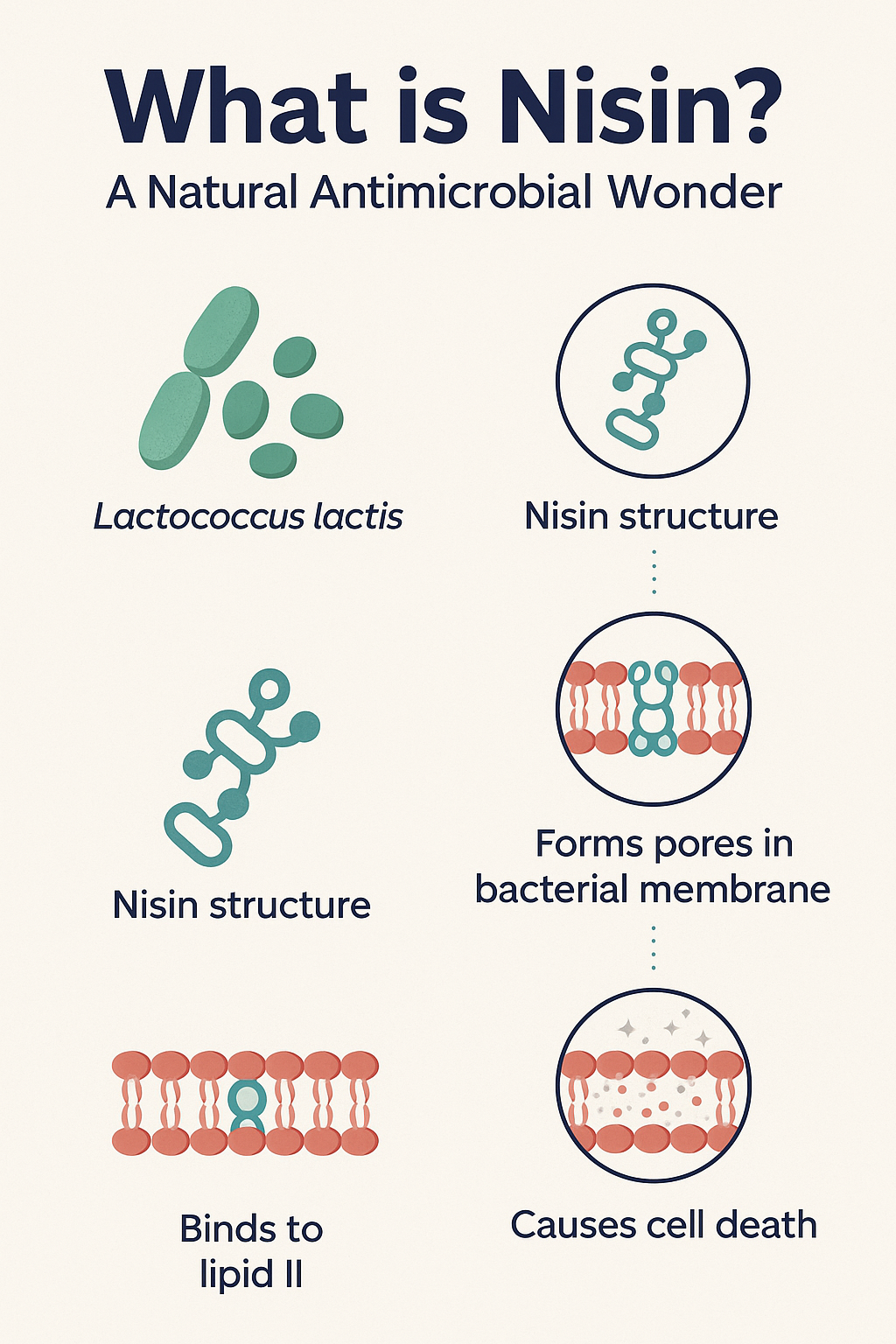
At a molecular level, nisin operates with remarkable precision, demonstrating a highly evolved antimicrobial technology. Its primary mode of action targets the cell membranes of Gram-positive bacteria, including notorious foodborne pathogens like Listeria monocytogenes, Staphylococcus aureus, and Clostridium botulinum. Nisin achieves this by binding to lipid II, a crucial precursor molecule involved in bacterial cell wall synthesis. This binding action effectively sequesters lipid II, preventing the bacteria from constructing new cell walls, a vital process for their survival and reproduction. Furthermore, the nisin-lipid II complex undergoes a conformational change, leading to the formation of stable pores in the bacterial cell membrane. These pores disrupt the cell’s integrity, causing the leakage of essential intracellular components such as ATP, ions, and metabolites. This dual assault – inhibiting cell wall synthesis and causing membrane permeabilization – renders the target bacteria unable to maintain homeostasis, leading to their rapid death. This multi-target mechanism makes nisin highly effective even at low concentrations, a hallmark of efficient biotechnological design, and reduces the likelihood of resistance development compared to single-target antimicrobial agents.
Nisin’s Technological Edge Over Traditional Preservatives
Nisin’s unique properties provide distinct advantages over conventional food preservation methods, marking it as a superior technological solution in many contexts. Its natural origin, potent efficacy, and specific targeting make it an invaluable tool for modern food manufacturers striving for both safety and market appeal.
Enhancing Food Safety and Shelf Life
The ability of nisin to specifically target a broad spectrum of Gram-positive spoilage and pathogenic bacteria, even those resistant to heat, offers a significant technological leap in food safety. Traditional thermal processing, while effective, can sometimes compromise the sensory quality and nutritional value of food products. By incorporating nisin, food manufacturers can often employ milder heat treatments, known as minimal processing technologies, which preserve flavor, texture, and nutrient content more effectively. This synergistic effect – nisin inhibiting microbial growth while milder heat treatments handle other aspects – results in products with extended shelf life without sacrificing quality. For example, in dairy products, canned foods, and processed meats, nisin can prevent the growth of spore-forming bacteria that might survive pasteurization or sterilization, thereby ensuring product stability and reducing the risk of foodborne illness. This integrated approach to preservation leverages biochemical technology to optimize both safety and product attributes.
Addressing the “Clean Label” Trend with Biotech
In today’s consumer landscape, there is an increasing demand for “clean label” products, characterized by fewer, recognizable ingredients and a perception of naturalness. Nisin, as a natural antimicrobial peptide derived from a benign bacterium, fits seamlessly into this trend. Unlike synthetic chemical preservatives that often carry negative connotations, nisin provides a technologically advanced yet naturally sourced alternative. Its inclusion allows manufacturers to remove or reduce artificial preservatives, enhancing the marketability and consumer acceptance of their products. This shift aligns with a broader technological trend towards biomimicry and sustainable chemistry in the food industry, where solutions are sought from biological systems rather than purely synthetic pathways. For brands, featuring nisin can be a powerful marketing tool, signaling a commitment to natural ingredients and innovative food technology without compromising on food safety or shelf stability.
Production and Application: A Glimpse into Food Tech Operations
The journey of nisin from a microbial byproduct to a staple in food preservation systems involves sophisticated biotechnological production methods and precise application protocols, embodying advanced food processing technology.
Fermentation as a Core Production Technology
Industrial production of nisin relies heavily on controlled fermentation technology. Specialized strains of Lactococcus lactis are cultivated in large bioreactors under carefully optimized conditions. This involves providing the bacteria with a nutrient-rich medium containing carbohydrates, proteins, and minerals, along with strict control over pH, temperature, and aeration. The fermentation process is a delicate balance of biological engineering and process control, designed to maximize nisin yield and purity. Following fermentation, the nisin-containing broth undergoes a series of purification steps, which can include centrifugation, filtration, ultrafiltration, and spray drying. These downstream processing technologies are critical for concentrating the nisin and removing impurities, resulting in a highly active and stable powder that meets stringent food-grade standards. The efficiency and scalability of this bioproduction process are key technological achievements that have made nisin a cost-effective and widely available food preservative.
Integration into Modern Food Processing
Nisin’s application in food manufacturing is a testament to its versatility and compatibility with existing food processing technologies. It is typically added directly to food products during various stages of production, depending on the food matrix and desired preservative effect. In dairy products like cheese and yogurt, nisin can be incorporated into the milk before fermentation or directly into the final product. For canned goods, nisin might be added to the brine or sauce before heat treatment. In processed meats, it can be included in marinades, brines, or directly mixed into the meat batter. The precise dosage and method of incorporation are critical and often require specific technical expertise to ensure optimal efficacy and uniform distribution. This integration requires a thorough understanding of food chemistry and engineering to ensure nisin’s stability and activity within complex food systems, highlighting its role as an adaptable technological component in diverse food production lines.
The Future of Bio-Preservation: Nisin’s Role in Emerging Food Technologies
Nisin’s success story is just one chapter in the unfolding narrative of bio-preservation. Its continued evolution and the exploration of new applications underscore its importance in the future landscape of food technology, driving innovation towards safer, more sustainable food systems.
Expanding Applications and Research Frontiers
Research into nisin continues to push the boundaries of food preservation technology. Scientists are exploring its potential in novel food matrices, such as plant-based alternatives, and investigating synergistic effects with other natural antimicrobials or mild processing techniques. For example, combining nisin with high-pressure processing (HPP) or pulsed electric fields (PEF) could lead to even greater microbial inactivation and extended shelf life with minimal impact on product quality. Furthermore, genetic engineering techniques are being employed to develop nisin variants with enhanced activity against a broader spectrum of pathogens or improved stability under various environmental conditions. There is also interest in nisin’s applications beyond food, including its potential in veterinary medicine and clinical settings due to its broad-spectrum antimicrobial properties, indicating a far-reaching impact of this biotechnological agent. These research efforts exemplify the dynamic nature of food tech innovation, constantly seeking to optimize and diversify existing solutions.

Sustainability and Innovation in Food Tech
Nisin embodies several core principles of sustainable food technology. Its natural origin reduces reliance on synthetic chemicals, contributing to a more environmentally friendly food chain. By extending shelf life and preventing spoilage, nisin directly combats food waste, a major global challenge. This reduction in waste not only has environmental benefits but also significant economic implications, minimizing losses across the supply chain. As the food industry grapples with the pressures of feeding a growing global population while minimizing its ecological footprint, innovations like nisin provide crucial tools. It represents a shift towards smart, bio-based solutions that leverage nature’s own mechanisms for human benefit. The continued development and adoption of nisin, alongside other advanced bio-preservatives, are pivotal to building resilient, efficient, and sustainable food systems for the future, firmly placing it at the forefront of food technology trends.
aViewFromTheCave is a participant in the Amazon Services LLC Associates Program, an affiliate advertising program designed to provide a means for sites to earn advertising fees by advertising and linking to Amazon.com. Amazon, the Amazon logo, AmazonSupply, and the AmazonSupply logo are trademarks of Amazon.com, Inc. or its affiliates. As an Amazon Associate we earn affiliate commissions from qualifying purchases.