
The ocean, a vast and powerful force, is in constant motion. Among its most predictable and awe-inspiring phenomena are the tides – the regular rise and fall of sea levels. While many of us are familiar with the general concept of tides, the nuances of their behavior, particularly the distinct variations between neap and spring tides, are often less understood. These differences are not random occurrences but are the direct result of intricate gravitational interactions between celestial bodies. This article will delve into the science behind neap and spring tides, exploring the gravitational forces at play and how they influence our planet’s oceans.
The Gravitational Dance: The Moon’s Dominant Influence
At the heart of tidal forces lies gravity. While the Earth itself exerts a gravitational pull, it’s the Moon’s influence that is primarily responsible for the most significant tidal bulges. Imagine the Earth and Moon as two magnets, each pulling on the other. The Moon’s gravitational force is strongest on the side of the Earth facing it, pulling the water towards it. This creates a bulge of water on that side.
However, the story doesn’t end there. On the opposite side of the Earth, farthest from the Moon, another bulge of water forms. This is due to inertia. As the Moon pulls the Earth itself towards it, the water on the far side, experiencing a weaker gravitational pull, is “left behind” to a degree, effectively creating another bulge. So, for every full Earth, there are two bulges of water – one facing the Moon and one on the opposite side.
As the Earth rotates on its axis, different parts of the planet pass through these bulges. When a particular location on Earth moves into one of these bulges, we experience high tide. As it moves out of the bulge, we experience low tide. Since there are two bulges, most coastal locations experience two high tides and two low tides approximately every 24 hours and 50 minutes. The extra 50 minutes is because the Moon is also orbiting the Earth, so the Earth has to rotate a little further each day to “catch up” to the Moon.
The Sun’s Supporting Role: A Secondary Tidal Force
While the Moon is the primary driver of tides, the Sun also plays a significant role. The Sun, being much more massive than the Moon, exerts a considerable gravitational force on Earth. However, due to its vast distance from Earth, its tidal influence is about half as strong as the Moon’s.
The Sun’s gravitational pull also creates tidal bulges, similar to the Moon. These bulges occur on the side of the Earth facing the Sun and on the opposite side. The key to understanding neap and spring tides lies in the alignment of the Sun, Earth, and Moon.
Spring Tides: When Gravitational Forces Align
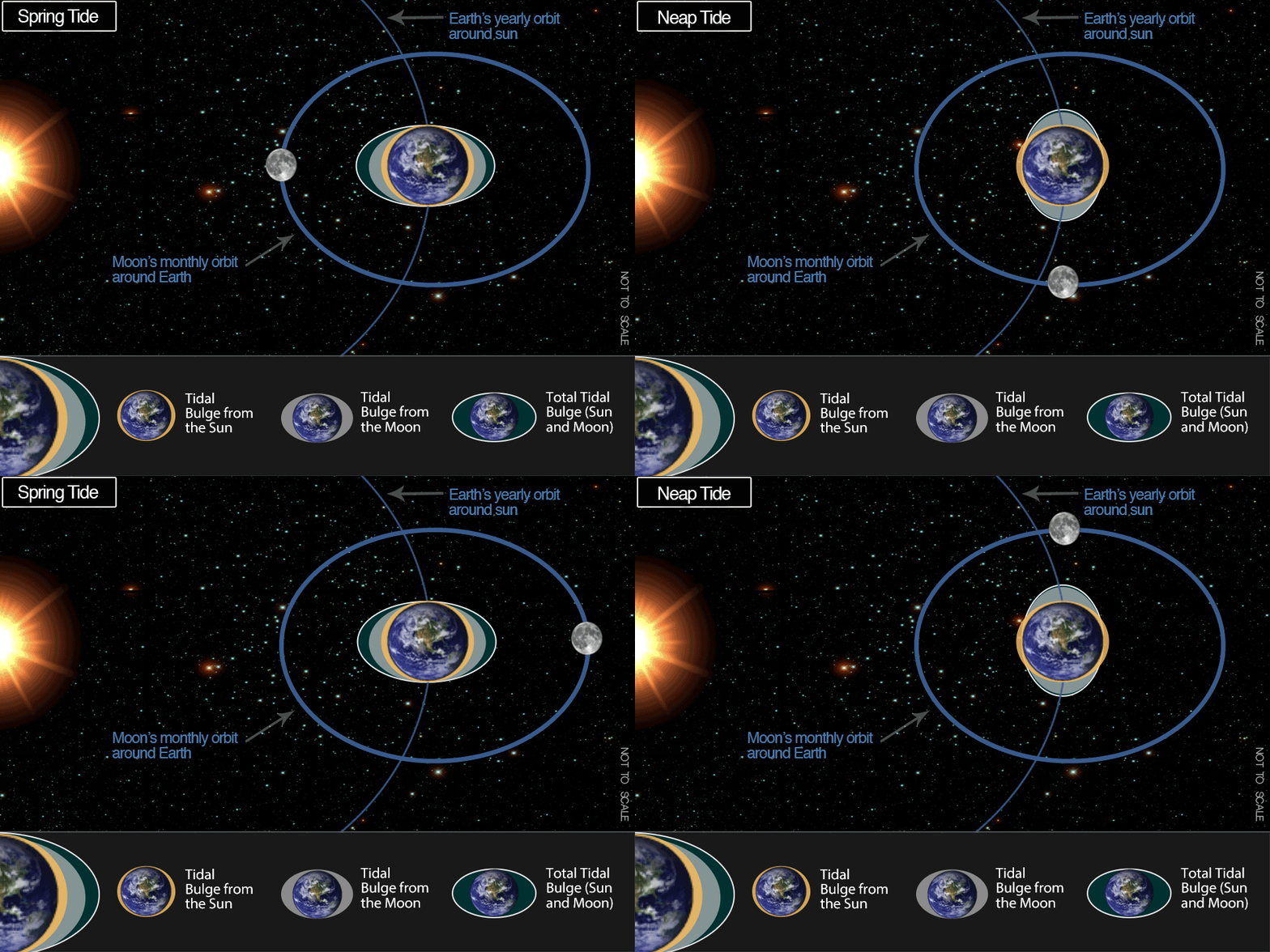
The term “spring tide” has nothing to do with the season. Instead, it refers to the “springing up” or the exceptionally high and low tides that occur when the gravitational forces of the Sun and Moon are aligned. This alignment happens twice each lunar month, during the new moon and the full moon.
New Moon Alignment
During a new moon, the Moon is positioned between the Earth and the Sun. In this configuration, the gravitational pulls of both the Sun and the Moon are acting in roughly the same direction – towards the Moon on the near side and away from the Moon on the far side. The combined gravitational forces of the Sun and Moon essentially “add up,” creating larger tidal bulges. This results in exceptionally high high tides and exceptionally low low tides.
Full Moon Alignment
During a full moon, the Earth is positioned between the Sun and the Moon. Even though the Earth is in between, the gravitational forces of the Sun and Moon are still aligned in a way that amplifies their tidal effects. The Moon’s gravitational pull is still creating its bulges, and the Sun’s gravitational pull is also acting along the same line, reinforcing the tidal forces. Again, this leads to the extreme tidal ranges characteristic of spring tides.
The amplitude of spring tides can be significantly higher than average, meaning the difference between high and low tide is more pronounced. This can have noticeable effects on coastal areas, leading to greater inundation during high tide and more exposed shorelines during low tide.
Neap Tides: When Gravitational Forces Oppose
In contrast to spring tides, neap tides occur when the gravitational forces of the Sun and Moon are acting at approximately right angles to each other relative to the Earth. This happens during the first quarter and third quarter phases of the moon.
First and Third Quarter Moon Alignment
During the first and third quarter moons, the Moon is positioned at a 90-degree angle to the line connecting the Earth and the Sun. Imagine the Sun’s gravitational pull creating its tidal bulges, and the Moon’s gravitational pull creating its own set of bulges. Because these forces are acting perpendicular to each other, they partially cancel each other out.
The bulge created by the Moon is offset by the bulge created by the Sun, and vice versa. This results in smaller tidal bulges and, consequently, a reduced difference between high and low tide. Therefore, neap tides are characterized by less extreme tidal ranges – the high tides are not as high, and the low tides are not as low, compared to spring tides.

Neap tides represent the “slack water” period in terms of tidal range. The gravitational forces are in opposition, leading to a more moderate tidal cycle. While less dramatic than spring tides, neap tides are still a crucial part of the Earth’s tidal rhythm.
Factors Influencing Tidal Range Beyond the Sun and Moon
While the Sun and Moon’s gravitational interplay is the primary driver of spring and neap tides, several other factors can influence the actual tidal range experienced at a specific location:
1. Coastal Geography and Topography
The shape of the coastline, bays, gulfs, and inlets can significantly amplify or dampen tidal ranges. Narrow inlets, for instance, can funnel tidal waters, leading to higher high tides and more pronounced tidal currents. Conversely, wide-open coastlines might experience less dramatic tidal fluctuations. The depth of the water also plays a role; shallower areas can experience more significant tidal effects.
2. Ocean Basins and Their Shapes
The size and shape of ocean basins can also influence tidal patterns. Larger, more enclosed basins may have different tidal characteristics compared to open oceans. The movement of tidal waves within these basins can create complex patterns and variations.
3. Atmospheric Pressure and Winds
While their influence is generally less significant than celestial bodies, atmospheric pressure and prevailing winds can also have a temporary impact on sea levels. High-pressure systems can depress sea levels, while low-pressure systems can cause them to rise. Strong winds can also push water towards or away from the coast, creating what is known as a storm surge, which can temporarily augment or diminish the tidal effect.
4. Underwater Topography
Seamounts, underwater ridges, and other bathymetric features can refract and reflect tidal waves, altering their behavior and the resulting tidal range. These features can create localized variations in tidal patterns that differ from the broader regional trends.
The Significance of Understanding Tides
Understanding the mechanics of neap and spring tides is not just an academic exercise; it has practical implications across various fields.
For Coastal Communities and Industries
For communities living in coastal areas, understanding tidal patterns is essential for a multitude of reasons. Maritime activities, such as shipping, fishing, and recreational boating, rely heavily on accurate tidal predictions. Ports and harbors need to manage their operations around high and low tide cycles. Coastal engineering projects, like the construction of seawalls or tidal energy systems, require a deep understanding of tidal forces.
For Marine Life and Ecosystems
Tidal cycles are fundamental to the health and functioning of many marine ecosystems. Intertidal zones, the areas exposed during low tide and submerged during high tide, are unique environments that support a diverse range of life. The rhythmic inundation and exposure are crucial for feeding, reproduction, and survival for many species, including shellfish, crustaceans, and various forms of algae. Changes in tidal patterns, even subtle ones, can have significant impacts on these delicate ecosystems.
For Renewable Energy Development
The predictable nature of tides makes them an attractive source of renewable energy. Tidal power generation harnesses the kinetic energy of moving tidal waters. Understanding the strength and timing of spring and neap tides is crucial for optimizing the design and operation of tidal turbines and barrages, ensuring maximum energy capture. The enhanced energy potential during spring tides is particularly valuable for power generation.

Conclusion
Neap and spring tides are a beautiful and powerful testament to the intricate gravitational dance between the Earth, Moon, and Sun. While the Moon is the primary architect of our tides, the Sun’s gravitational influence plays a crucial supporting role, leading to the amplified ranges of spring tides when their forces align and the moderated ranges of neap tides when they act at right angles. Beyond these celestial forces, local geography and atmospheric conditions add further layers of complexity to the tidal experience. By understanding these fundamental principles, we gain a deeper appreciation for the dynamic rhythm of our oceans and their profound impact on life on Earth.
aViewFromTheCave is a participant in the Amazon Services LLC Associates Program, an affiliate advertising program designed to provide a means for sites to earn advertising fees by advertising and linking to Amazon.com. Amazon, the Amazon logo, AmazonSupply, and the AmazonSupply logo are trademarks of Amazon.com, Inc. or its affiliates. As an Amazon Associate we earn affiliate commissions from qualifying purchases.