
The landscape of professional video production has undergone a seismic shift over the last decade. Historically, the industry relied on dedicated hardware and expensive, rigid cabling systems like SDI (Serial Digital Interface) and HDMI to transport high-quality video signals. However, as information technology (IT) and broadcast media began to converge, the need for a more flexible, scalable, and cost-effective solution became apparent. This shift gave birth to NDI—Network Device Interface.
Developed by NewTek (now a part of the Vizrt Group), NDI is a high-performance software-driven protocol that allows video, audio, and metadata signals to be transmitted over standard Ethernet networks in real-time. By leveraging existing local area network (LAN) infrastructure, NDI has effectively replaced the need for point-to-point cable runs, enabling a new era of “Video over IP” that is accessible to everyone from global broadcasters to independent content creators.

The Shift from SDI to IP
To understand NDI, one must first understand the limitations it was designed to solve. In a traditional SDI environment, every camera, switcher, and monitor requires a dedicated physical cable. If you have ten cameras, you need ten long runs of coaxial cable back to a central hub. This architecture is not only expensive but also physically demanding and difficult to scale. If you want to move a camera to a different room, you have to run a new cable.
NDI flips this paradigm by treating video as data. Once a video source—be it a camera, a laptop screen, or a media player—is connected to the network, it becomes an “IP source.” Any other device on that same network can “see” and use that source. This eliminates the “one-to-one” physical connection and replaces it with a “many-to-many” logical connection. In an NDI-enabled facility, any room with an Ethernet jack becomes a potential studio.
How NDI Works: The Software-Driven Approach
The brilliance of NDI lies in its software-centric design. Unlike other IP standards that require specialized, high-cost network switches and complex timing protocols (like SMPTE ST 2110), NDI is designed to run on standard 1 Gigabit Ethernet (GbE) networks. It uses sophisticated compression algorithms to maintain visually lossless image quality while keeping latency low enough for live production.
When an NDI device is plugged into a network, it uses an auto-discovery mechanism. This means that an NDI-compatible switcher, such as OBS Studio or vMix, will automatically populate a list of all available NDI sources on the network. There is no need to manually enter IP addresses or configure complex routing tables. This “plug-and-play” nature is what has made NDI the gold standard for modern tech-focused production environments.
Technical Varieties: NDI High Bandwidth vs. NDI|HX
As the protocol evolved, the tech community realized that a single version of NDI couldn’t solve every problem. Different network environments have different bandwidth constraints. This led to the creation of two primary branches: NDI High Bandwidth and NDI|HX.
NDI High Bandwidth (Full NDI)
NDI High Bandwidth, often referred to as “Full NDI,” is the original iteration of the protocol. It is designed for maximum quality and the lowest possible latency. It uses an I-frame-only compression codec (meaning every frame is a complete image), which requires significant bandwidth. A single 1080p60 stream can take up about 125–150 Mbps, while a 4K60 stream can exceed 250 Mbps.
Full NDI is the preferred choice for high-end studio environments where the network infrastructure can support multi-gigabit speeds. Because the latency is virtually non-existent (often less than a single frame), it is ideal for live sports, broadcast news, and any scenario where real-time interaction is critical.
NDI|HX (High Efficiency)
Recognizing that many users operate on congested networks or even over Wi-Fi, NewTek introduced NDI|HX. The “HX” stands for High Efficiency. This version uses Long-GOP H.264 or H.265 (HEVC) compression to drastically reduce the bandwidth footprint. An NDI|HX 1080p60 stream typically uses between 8 and 20 Mbps—a fraction of what Full NDI requires.
While NDI|HX introduces a slight increase in latency compared to Full NDI, it is still significantly faster than traditional streaming protocols like RTMP. This efficiency makes it perfect for PTZ (Pan-Tilt-Zoom) cameras, mobile apps, and remote production where bandwidth is a premium. The latest iteration, NDI|HX3, further bridges the gap, offering near-Full NDI quality at much lower bitrates.
NDI 5 and the Power of Remote Connection
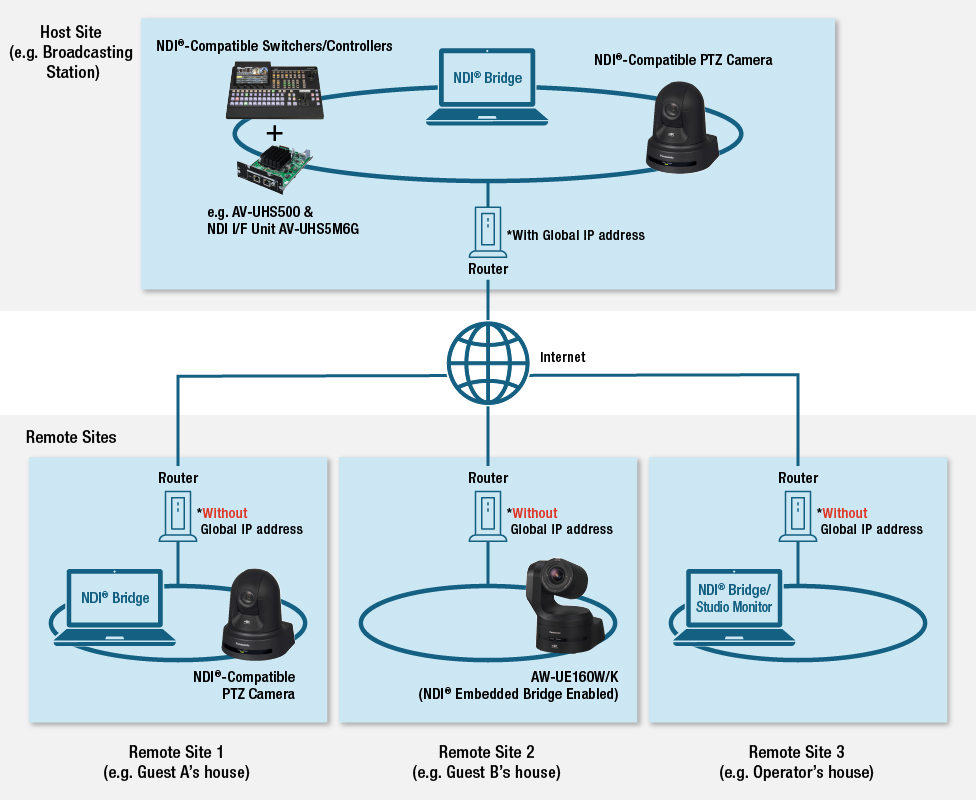
The release of NDI 5 marked a turning point in the technology’s history. Before NDI 5, the protocol was largely confined to the local network. NDI 5 introduced “NDI Bridge” and “NDI Remote,” features that allow NDI signals to travel across the public internet.
NDI Bridge allows users to securely connect entire NDI networks across different cities or even continents. A producer in New York can pull a camera feed from a studio in London as if it were a local source. NDI Remote allows anyone with a smartphone and a web link to contribute a high-quality video feed directly into a professional production. This has fundamentally changed how remote interviews and global events are produced, making high-end production tools accessible via simple URLs.
The Benefits of NDI in Modern Tech Ecosystems
NDI isn’t just a video cable replacement; it’s a workflow enhancer. Its integration into the broader tech ecosystem provides several distinct advantages for developers, IT managers, and creative professionals.

Cost-Efficiency and Infrastructure
One of the most significant barriers to professional video production is the cost of infrastructure. Standard SDI cables, distribution amplifiers, and matrix routers are expensive. NDI allows organizations to use their existing IT infrastructure. A company that has already wired its office with Cat6 Ethernet can instantly use that network for internal communications, live-streamed town halls, and digital signage without laying a single new cable. Furthermore, NDI is bi-directional; a single cable can carry video, audio, tally lights, PTZ camera control, and even power (via PoE—Power over Ethernet).
Flexibility and Scalability
In a traditional setup, adding a camera often means buying a new capture card for your computer. With NDI, your only limit is the bandwidth of your network. If you have a 10GbE backbone, you can theoretically run dozens of high-definition streams simultaneously. This scalability allows productions to grow organically. You can start with a single NDI-enabled camera and eventually scale to a massive multi-cam setup simply by adding devices to the network.
Interoperability Across Software and Hardware
NDI has achieved a level of industry-wide adoption that few other protocols can claim. It is supported by a massive array of software and hardware. Professional production software like vMix, OBS, Wirecast, and TriCaster all have native NDI support. Adobe Creative Cloud users can use NDI to output their Premiere Pro or After Effects timeline to a monitor on the network in real-time. Even communication tools like Microsoft Teams and Zoom have integrated NDI, allowing users to pull high-quality isolated feeds of participants for use in professional broadcasts.
Implementing NDI: Tools, Hardware, and Software
Transitioning to an NDI-based workflow requires an understanding of the hardware and software tools available in the tech market today.
Encoders and Decoders
If you have existing HDMI or SDI cameras, you don’t need to replace them to use NDI. Encoders (often called NDI converters) are small hardware devices that take a physical video signal and convert it into an NDI stream on the network. Companies like BirdDog and Magewell specialize in these devices. Conversely, decoders take an NDI signal from the network and convert it back to HDMI or SDI for display on a television or traditional monitor.
PTZ Cameras and Mobile Integration
The most popular hardware category for NDI is undoubtedly PTZ cameras. Manufacturers like Panasonic, Sony, and Lumens produce cameras with NDI built-in. These cameras are controlled entirely over the network, allowing a single operator to manage multiple angles from a remote location using a joystick or software interface.
For those looking for a lower entry point, mobile apps like the NDI HX Camera app can turn an iPhone or Android device into a high-quality wireless NDI source. This is a game-changer for “run-and-gun” journalism or adding unique angles to a live stream without the bulk of a full camera rig.
Software Compatibility and Utilities
Beyond the big-name switchers, there are numerous free utilities provided by the NDI team that enhance the tech stack. “NDI Screen Capture” allows a computer to send its desktop as a high-quality video source, perfect for gaming streams or software tutorials. “NDI Webcam” allows any NDI source to be recognized as a standard USB webcam, significantly improving the video quality of standard video calls on platforms like Skype or Google Meet.
The Future of NDI: AI, Cloud, and Beyond
As we look toward the future, NDI is positioned at the intersection of several emerging technology trends, most notably Artificial Intelligence and Cloud computing.
AI-Driven Production Workflows
The metadata capabilities of NDI are a goldmine for AI integration. Because NDI carries data alongside video, AI algorithms can “read” the stream to perform real-time tasks. We are already seeing NDI-integrated AI tools that can automatically track a speaker in a room, perform real-time background removal (chroma keying) without a green screen, and generate live closed captions by analyzing the audio metadata. As AI continues to evolve, the software-defined nature of NDI will allow these tools to be integrated directly into the video pipeline with minimal friction.
NDI in the Cloud
The industry is moving toward “Cloud Production,” where the video switcher and all processing happen on virtual machines in data centers like AWS or Azure. NDI 5’s ability to traverse the WAN (Wide Area Network) makes it the perfect transport protocol for this. Producers can send local camera feeds to the cloud, mix the show in a virtual environment, and then distribute the final product to social media or broadcast outlets without ever needing a physical control room.
In conclusion, NDI video is more than just a protocol; it is the fundamental architecture of modern visual communication. By democratizing high-quality video transport and leveraging the power of ubiquitous network infrastructure, NDI has dismantled the barriers to entry for professional production. Whether it is through the ultra-low latency of Full NDI or the global reach of NDI Bridge, this technology continues to define how we create, share, and consume video in a digitally connected world. For tech professionals and creators alike, mastering NDI is no longer an option—it is a necessity for staying relevant in the future of media.
aViewFromTheCave is a participant in the Amazon Services LLC Associates Program, an affiliate advertising program designed to provide a means for sites to earn advertising fees by advertising and linking to Amazon.com. Amazon, the Amazon logo, AmazonSupply, and the AmazonSupply logo are trademarks of Amazon.com, Inc. or its affiliates. As an Amazon Associate we earn affiliate commissions from qualifying purchases.