
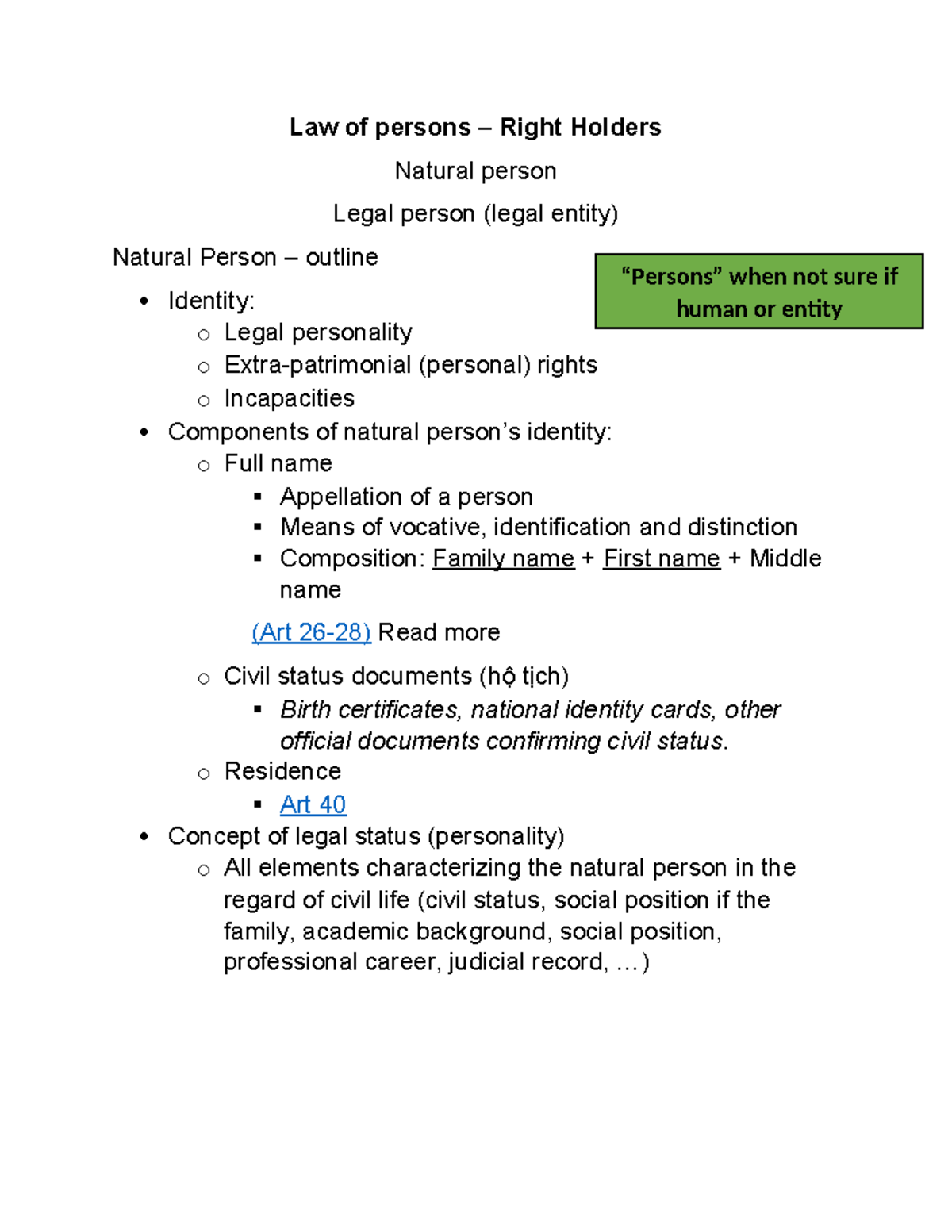
In the complex landscape of global finance, law, and business, the term “natural person” serves as the foundational unit of all transactions. While the terminology may sound like legal jargon, it carries profound implications for how individuals earn money, pay taxes, protect their assets, and engage with the banking system. At its simplest level, a natural person is a human being—a living, breathing individual with a legal identity. However, in the world of personal finance and business strategy, being a natural person is distinct from being a “legal person” or a “juridical entity,” such as a corporation or a limited liability company (LLC).

Understanding this distinction is not merely an academic exercise; it is the cornerstone of effective financial planning. Whether you are a freelancer launching a side hustle, an investor building a portfolio, or a high-net-worth individual concerned with estate planning, your status as a natural person determines your level of personal liability, your tax obligations, and your access to credit.
Defining the Natural Person in the Global Financial System
In a financial context, the definition of a natural person is rooted in the capacity to hold rights and subject oneself to obligations. Unlike a corporation, which is a creation of law, a natural person is recognized by the legal system from birth until death. This recognition allows individuals to enter into contracts, open bank accounts, and own property in their own name.
The Legal Human vs. the Corporate Entity
The financial world operates on a binary distinction between natural persons and legal persons. A legal person is an entity—like a corporation, a non-profit, or a trust—that is treated by the law as having its own identity separate from the people who own or manage it. While a legal person can sue, be sued, and pay taxes, it lacks the biological and inherent rights of a natural person.
For the individual entrepreneur or investor, the primary question is often when to act as a natural person and when to create a legal person. Operating as a natural person is the default state for most people. When you work a standard job, your paycheck is issued to you as a natural person. When you spend money using a personal credit card, you are doing so as a natural person. The simplicity of this state is its main advantage, but it comes with significant financial risks.
Rights, Responsibilities, and Financial Agency
As a natural person, you possess “financial agency.” This means you are the ultimate decision-maker regarding your assets. You have the right to claim ownership of tangible goods (like a home or a car) and intangible assets (like stocks or intellectual property). However, this agency is inseparable from your personal identity. In the eyes of the bank and the tax authorities, there is no wall between your “business” activities and your “personal” life if you are acting solely as a natural person. This lack of separation is the defining characteristic of the natural person’s role in the economy.
Financial Implications of Operating as a Natural Person
The way a natural person interacts with money is fundamentally different from how a business entity does. These differences manifest most clearly in three areas: taxation, liability, and credit.
Tax Obligations and Pass-Through Income
For most individuals, the relationship with the tax man is direct. As a natural person, you are taxed on your worldwide income. In many jurisdictions, this is handled through a progressive tax system where your personal income tax rate increases as your earnings grow.
For those engaged in side hustles or freelance work without a formal business structure (like an LLC or a corporation), the IRS and other global tax authorities view you as a “Sole Proprietor.” In this scenario, your business income is synonymous with your personal income. This is known as “pass-through” taxation. While this simplifies your tax filings—as you don’t need to file a separate corporate tax return—it also means you are personally responsible for self-employment taxes, which cover Social Security and Medicare contributions. As a natural person, you cannot easily defer income or utilize the lower corporate tax rates that many entities enjoy.
The Burden of Unlimited Liability
Perhaps the most critical financial risk for a natural person is “unlimited liability.” When you conduct business or hold assets as an individual, your personal wealth is entirely exposed to your professional or legal risks. If you are a natural person operating a small business and you are sued, or if you default on a business loan, your personal bank accounts, your home, and even your future earnings can be seized to satisfy the debt.
This is the primary reason why financial advisors often recommend moving beyond “natural person” status for any activity involving significant risk. A natural person lacks the “corporate shield” that protects personal assets from business failures. In the world of money, the natural person is the ultimate guarantor of their own obligations.
Personal Credit and the Individual Identity
In the modern economy, a natural person’s financial life is often defined by their credit score. This score is a numerical representation of the natural person’s reliability as a borrower. Unlike business credit, which is tied to an Employer Identification Number (EIN), personal credit is tied to your Social Security Number (SSN) or equivalent national ID.
Because a natural person has a limited lifespan and a finite earning capacity, lenders view personal credit through a different lens than business credit. Your personal credit history follows you everywhere, influencing your ability to secure a mortgage, an auto loan, or even a cell phone contract. Maintaining the “financial health” of your identity as a natural person is a lifelong endeavor that dictates your purchasing power.
Moving Beyond the Individual: From Natural Person to Legal Entity
As wealth grows and business activities become more complex, the limitations of acting strictly as a natural person become apparent. This leads many to the process of “incorporation” or entity formation.
Creating the Shield: The Corporate Veil
When a natural person creates an LLC or a corporation, they are essentially birthing a new “legal person.” This entity acts as a buffer. In the world of business finance, this is known as the “corporate veil.” If the entity incurs debt, the natural person (the owner) is generally not held personally liable for it. This separation is vital for building a sustainable side hustle or a scalable business without risking one’s personal financial survival.
Access to Business Credit and Institutional Capital
There is a limit to how much capital a natural person can borrow based on their personal income. Banks and investors are often more willing to lend to a legal entity that has its own cash flow and assets. By separating yourself from your business, you can build “business credit.” This allows you to leverage debt to grow your wealth without it appearing on your personal credit report or impacting your personal debt-to-income ratio, which is crucial for personal financial milestones like buying a family home.
Strategic Separation for Asset Protection
Sophisticated wealth management often involves a natural person owning nothing but controlling everything. This is achieved through trusts and holding companies. By transferring ownership of assets (like real estate or stock portfolios) from yourself as a natural person to a legal entity, you protect those assets from personal lawsuits or bankruptcy. This strategic separation ensures that your family’s wealth is not tied to the volatility of your professional career.
The Natural Person in Investing and Wealth Management
Investing is one of the few areas where the natural person has distinct advantages, particularly in terms of tax-advantaged accounts and ease of access.
Individual Brokerage Accounts vs. Entity Investing
Most retail investors operate as natural persons. This allows them to use accounts like the 401(k), IRA, or ISA (in the UK), which are specifically designed for individuals. These accounts offer tax-deferred or tax-free growth that is generally unavailable to corporations. Furthermore, the “natural person” status simplifies the Know Your Customer (KYC) process at major brokerages, making it easy to start investing with small amounts of money.
However, as an individual’s net worth increases, they may find that “natural person” investing has its limits. High-level private equity, hedge funds, and certain real estate syndications may require individuals to be “Accredited Investors.” While this is still a status held by a natural person, it is defined by the person’s financial sophistication and net worth, marking a transition point between a general consumer and a professional financial actor.
KYC (Know Your Customer) and Digital Verification
In the digital age, being a natural person involves constant verification. Anti-Money Laundering (AML) laws require financial institutions to verify the identity of the “Ultimate Beneficial Owner” (UBO) of any account. Even if a corporation opens a bank account, the bank must eventually “look through” the entity to find the natural person who ultimately controls the money. In the realm of digital finance and fintech, your identity as a natural person is your most valuable asset, verified through biometrics, government IDs, and digital footprints.
Future-Proofing the Financial Identity of the Natural Person
As we move toward an increasingly digital and automated economy, the concept of the natural person is evolving.
Estate Planning and the Transfer of Individual Wealth
The primary “weakness” of a natural person in the financial system is mortality. Unlike a corporation, which can exist indefinitely, a natural person’s financial life ends. Estate planning is the process of managing how a natural person’s wealth is transitioned to other natural persons or entities after death. Without a proper strategy, a significant portion of a natural person’s life work can be lost to probate costs and inheritance taxes. Using tools like “Living Trusts” allows a natural person to maintain control during their lifetime while ensuring a seamless transfer of wealth that bypasses the limitations of individual personhood.

The Impact of Digital Personhood on Personal Finance
With the rise of Artificial Intelligence and decentralized finance (DeFi), the definition of a “person” in financial transactions is being challenged. We are seeing the emergence of “autonomous agents” that can execute trades and manage wallets. However, for the foreseeable future, the “natural person” remains the only entity capable of being held legally and morally accountable for financial decisions. As a result, protecting your digital identity and your status as a natural person is the ultimate form of digital security.
In conclusion, while the world of money is filled with complex entities and abstract structures, it all returns to the natural person. Your status as a human being gives you the right to participate in the economy, but it also places the ultimate responsibility for your financial health on your shoulders. By understanding the limits and the power of being a natural person, you can better navigate the journey from earning a simple paycheck to building a protected and lasting financial legacy.
aViewFromTheCave is a participant in the Amazon Services LLC Associates Program, an affiliate advertising program designed to provide a means for sites to earn advertising fees by advertising and linking to Amazon.com. Amazon, the Amazon logo, AmazonSupply, and the AmazonSupply logo are trademarks of Amazon.com, Inc. or its affiliates. As an Amazon Associate we earn affiliate commissions from qualifying purchases.