
In the vast and often complex world of financial markets, certain indicators stand out as critical barometers of economic health and specific industry performance. Among these, the Nasdaq 100 index holds a particularly prominent position, especially for investors keen on growth-oriented sectors. Often synonymous with technological innovation and disruptive companies, the Nasdaq 100 is far more than just a list of big tech firms; it represents a dynamic slice of the global economy, showcasing the leading non-financial companies listed on the Nasdaq Stock Market. Understanding “what is Nasdaq 100” is fundamental for anyone looking to navigate modern investment strategies, offering insights into market trends, potential growth areas, and the risks inherent in a concentrated portfolio of leading innovators.

This index serves as a benchmark for many investors, reflecting the collective performance of 100 of the largest and most actively traded non-financial companies on the Nasdaq exchange. Its unique composition, heavy weighting towards technology and other growth sectors, and its role as an investable index make it an indispensable tool for financial analysis and portfolio construction. For those in personal finance, investing, or business finance, grasping the nuances of the Nasdaq 100 is key to informed decision-making.
The Core Mechanics of the Nasdaq 100
To truly appreciate the Nasdaq 100, it’s essential to delve into its fundamental structure and how it operates. Unlike broader market indices that aim for a wide representation of the entire economy, the Nasdaq 100 has a very specific mandate and methodology that shapes its character and performance.
Composition and Eligibility Criteria
The Nasdaq 100 is meticulously constructed to capture the essence of leading innovation and growth. Its most defining characteristic is its exclusion of financial companies. While Nasdaq is home to many banks and investment firms, the Nasdaq 100 deliberately focuses on industries outside of finance, such as technology, retail, healthcare, industrials, and biotechnology. This critical distinction ensures that the index provides a pure play on the non-financial growth sectors.
The “100” in its name signifies the selection of the 100 largest non-financial companies, based on market capitalization, that are listed on the Nasdaq Stock Market. Eligibility criteria are stringent: a company must have been listed on Nasdaq for at least three months, have average daily trading volume of at least 200,000 shares, and not be in bankruptcy. Furthermore, companies must meet specific corporate governance standards. The index is market-capitalization weighted, meaning companies with larger market values exert a greater influence on the index’s movement. This weighting scheme naturally gives more prominence to the largest, most successful companies within its specified sectors. The composition is reviewed and rebalanced quarterly and annually, ensuring that it remains relevant and reflective of the current market leaders. This rebalancing process involves adding or removing companies based on their market capitalization and other criteria, maintaining the index’s integrity as a representation of top-tier growth stocks.
How it Differs from Other Major Indices
Understanding the Nasdaq 100 is often best achieved by comparing it to other well-known market indices, each designed with a different purpose and methodology. This comparison highlights its unique value proposition for investors.
-
Compared to the S&P 500: The S&P 500 is often considered the broadest benchmark for the U.S. stock market, representing 500 large-cap U.S. companies across all major sectors, including financials. Its selection process is committee-driven, aiming for sector balance and economic representation. The Nasdaq 100, in contrast, is less diversified by sector due to its non-financial focus and its inherent concentration in technology. While there’s significant overlap in constituent companies (many Nasdaq 100 companies are also in the S&P 500), their weighting and overall sector exposure differ considerably. The S&P 500 offers broader market exposure, while the Nasdaq 100 offers a more concentrated bet on growth and innovation.
-
Compared to the Dow Jones Industrial Average (DJIA): The DJIA is arguably the oldest and most widely cited U.S. market index, comprising 30 significant American companies. However, it is a price-weighted index, meaning companies with higher share prices have a greater impact, regardless of their market capitalization. This methodology is considered less representative by modern financial standards compared to market-cap weighting. The DJIA is also far less diversified in terms of company count and often reflects more traditional industrial giants, though it has evolved. The Nasdaq 100, with its 100 companies and market-cap weighting, provides a more dynamic and sector-specific view than the DJIA.
The primary distinction of the Nasdaq 100 lies in its concentrated exposure to innovative growth companies, particularly in the technology sector, and its exclusion of financial services firms. This makes it a distinct and powerful tool for investors seeking targeted exposure to this segment of the market.
Why the Nasdaq 100 Matters to Investors
For individuals and institutions engaged in personal finance and investing, the Nasdaq 100 is more than just a statistical measure; it’s a vital tool that offers unique insights and investment avenues. Its relevance stems from its capacity to act as a bellwether for innovation and a gateway to some of the world’s most dynamic companies.
A Barometer for Growth and Innovation
The Nasdaq 100 has earned its reputation as a leading indicator for growth and innovation due to its specific composition. It captures companies at the forefront of technological advancement, scientific discovery, and evolving consumer trends. Think of the giants that have redefined industries, from e-commerce to cloud computing, artificial intelligence to biotechnology – many of these are prominent components of the Nasdaq 100.
Consequently, the index’s performance often reflects investor sentiment towards these high-growth sectors. When these industries are thriving, propelled by new products, services, or market expansions, the Nasdaq 100 tends to outperform broader indices. Conversely, during periods of economic uncertainty or shifts in market preference away from growth stocks, the index can experience higher volatility. For investors, monitoring the Nasdaq 100 offers a real-time pulse on the health and direction of the innovative segments of the economy, providing valuable context for investment decisions in related industries or individual stocks. It’s a quick reference point for understanding where capital is flowing in the pursuit of future growth.
Investment Opportunities and Products
The significance of the Nasdaq 100 is amplified by the numerous investment products specifically designed to track its performance, making it highly accessible to a wide range of investors. These products allow individuals to gain diversified exposure to the index’s constituent companies without having to buy each stock individually.
The most popular way to invest in the Nasdaq 100 is through Exchange Traded Funds (ETFs). The Invesco QQQ Trust (QQQ) is by far the most well-known ETF that tracks the Nasdaq 100. Investing in QQQ means an investor owns a piece of a fund that holds all the stocks in the Nasdaq 100 in roughly the same proportions as the index itself. This provides instant diversification across 100 leading companies.
Beyond ETFs, investors can also gain exposure through:
- Mutual Funds: While less common than ETFs specifically tracking the Nasdaq 100, some mutual funds may have a mandate to invest in Nasdaq-listed growth companies, or a segment of their portfolio might align closely with the index’s composition.
- Futures and Options: For more sophisticated investors and traders, futures contracts and options on the Nasdaq 100 (or on the QQQ ETF) offer leveraged ways to speculate on or hedge against the index’s movements. These are advanced financial tools requiring a deep understanding of derivatives.
- Individual Stock Picking: While less efficient for tracking the index, investors can, of course, choose to invest directly in individual companies that are part of the Nasdaq 100 if they have a strong conviction about specific businesses within the index.
These diversified products underscore the Nasdaq 100’s role as a cornerstone of many modern investment portfolios, offering a convenient and cost-effective way to participate in the growth of leading non-financial enterprises.
Understanding Performance and Volatility
The Nasdaq 100’s distinct characteristics, particularly its concentration in growth sectors, translate into a unique performance profile and a different risk-reward dynamic compared to broader market indices. Investors must understand these aspects to integrate the index effectively into their financial planning.
Historical Performance and Growth Potential
Historically, the Nasdaq 100 has demonstrated impressive growth, particularly over the last few decades, largely driven by the monumental rise of technology companies. Periods of rapid innovation, such as the dot-com boom of the late 1990s and the subsequent era of cloud computing, e-commerce, and social media in the 2010s and early 2020s, have seen the index deliver substantial returns, often outpacing the S&P 500 and the Dow Jones Industrial Average. This strong performance potential is a major draw for growth-oriented investors.
The index’s growth trajectory is intrinsically linked to the ability of its constituent companies to continuously innovate, capture market share, and expand globally. As these companies reinvest profits into research and development, acquire competitors, and penetrate new markets, their market capitalizations tend to increase, driving the index higher. For long-term investors, the Nasdaq 100 represents an opportunity to participate in the wealth creation generated by some of the most successful and transformative businesses of our time.
Risks and Considerations for Investors
While the allure of high growth is significant, the Nasdaq 100 is not without its risks, which informed investors must carefully consider.
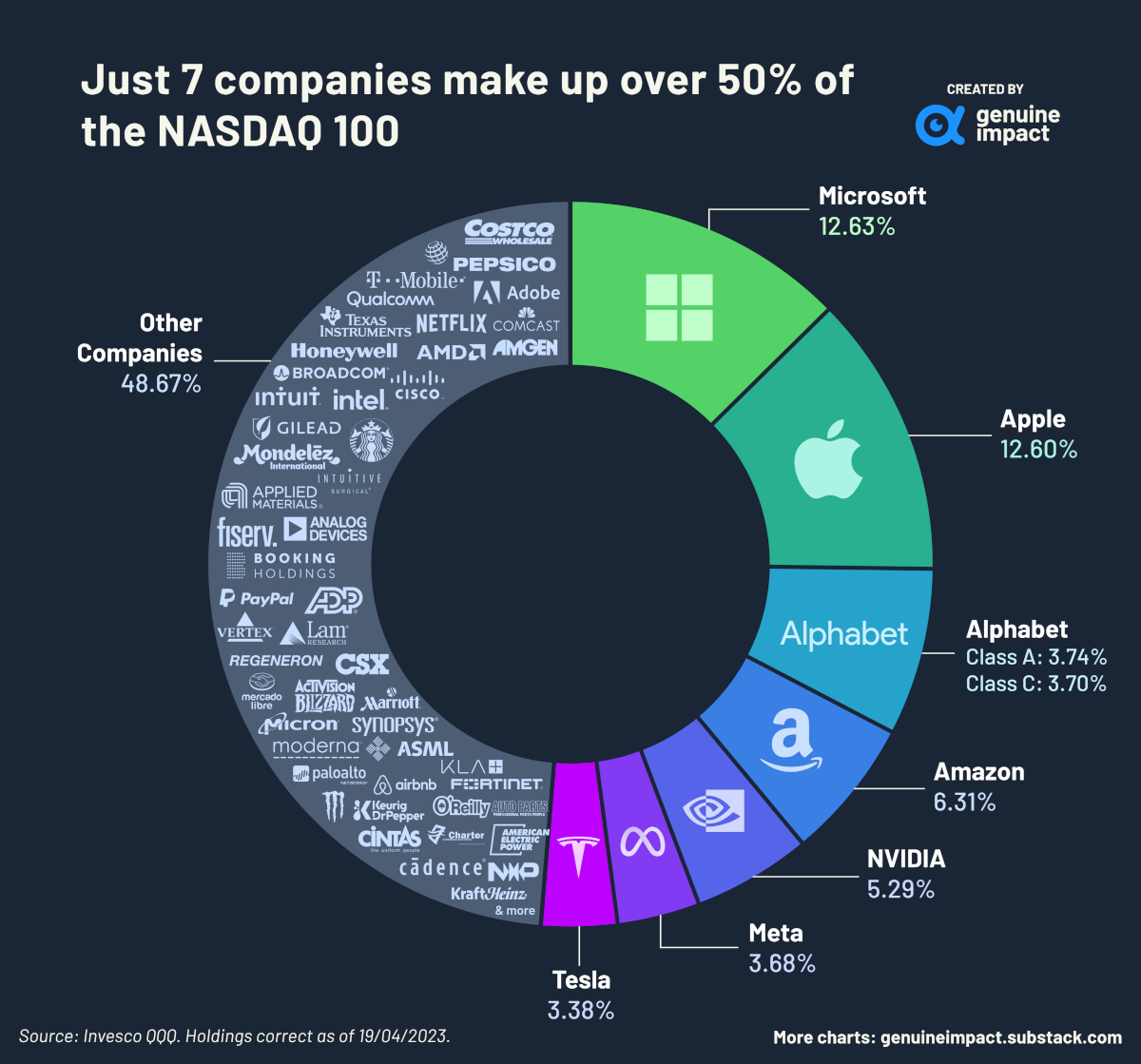
- Concentration Risk: The most significant risk stems from its inherent concentration. With only 100 companies, heavily weighted towards a few dominant players (e.g., Apple, Microsoft, Amazon, Google, Nvidia), the index’s performance can be disproportionately influenced by the fortunes of these select few. If one or more of these mega-cap companies face headwinds, it can have a noticeable impact on the entire index.
- Sector-Specific Risk: Despite its diversification across non-financial sectors, the Nasdaq 100 remains heavily tilted towards technology and related growth industries. This means it can be more vulnerable to sector-specific downturns, regulatory changes impacting tech, or shifts in investor sentiment away from growth stocks towards value stocks. Economic conditions that particularly affect growth companies, such as rising interest rates (which can diminish the present value of future earnings), can also cause the index to underperform.
- Higher Volatility: Due to its growth orientation and concentration, the Nasdaq 100 typically exhibits higher volatility compared to broader indices like the S&P 500. While this can lead to larger gains during bull markets, it also means potentially steeper drawdowns during market corrections or bear markets. Investors must have a higher tolerance for risk and a longer time horizon to ride out these fluctuations.
Understanding these risks is crucial for any investor considering adding the Nasdaq 100 to their portfolio. It’s a powerful engine for growth, but one that requires a clear-eyed assessment of its specific vulnerabilities.
Integrating the Nasdaq 100 into Your Investment Strategy
For investors committed to building a robust and resilient financial future, the Nasdaq 100 can be a valuable component. However, its integration requires thoughtful consideration of individual financial goals, risk tolerance, and the broader portfolio context.
For Long-Term Growth Investors
The Nasdaq 100 is particularly well-suited for long-term growth investors who are comfortable with higher risk and seeking exposure to innovative, market-leading companies. These investors typically have a time horizon of 10 years or more, allowing them to weather market downturns and benefit from the compounding growth of its constituent companies.
A common strategy is to invest in a Nasdaq 100-tracking ETF (like QQQ) through dollar-cost averaging. This involves investing a fixed amount of money at regular intervals, regardless of the index’s current price. This strategy helps mitigate the risk of buying at a market peak and allows investors to accumulate more shares when prices are lower, thereby lowering their average cost over time. For investors aiming to capture the essence of modern innovation and the potential for significant capital appreciation, the Nasdaq 100 offers a focused and powerful vehicle.
Considerations for Portfolio Diversification
While the Nasdaq 100 provides diversification across 100 companies, it does not offer complete portfolio diversification due to its sector concentration and exclusion of financials. Therefore, it should generally be viewed as one component within a broader, well-diversified portfolio, rather than a standalone investment.
To achieve true diversification, investors should consider pairing Nasdaq 100 exposure with:
- Broader Market Indices: Investments in S&P 500 funds or total U.S. stock market funds can provide exposure to a wider array of sectors, including financials, and potentially lower overall portfolio volatility.
- International Stocks: Diversifying geographically through international or emerging market funds can reduce country-specific risk and capture growth opportunities outside the U.S.
- Fixed Income: Bonds and other fixed-income securities can provide stability and income, acting as a ballast against stock market volatility.
- Alternative Investments: Depending on risk tolerance and financial sophistication, real estate, commodities, or other alternative assets can further enhance diversification.
The goal is to balance the growth potential of the Nasdaq 100 with the stability and breadth offered by other asset classes, creating a portfolio that aligns with an individual’s specific financial objectives and risk capacity.
Staying Informed
The dynamic nature of the companies within the Nasdaq 100 necessitates continuous learning and vigilance for investors. The technology and growth sectors are constantly evolving, with new innovations, competitive pressures, and regulatory landscapes emerging regularly.
Investors should make it a practice to:
- Monitor Economic Indicators: Keep an eye on macroeconomic factors, such as interest rate decisions by central banks, inflation data, and GDP growth, as these can significantly impact growth stocks.
- Understand Sector Trends: Stay abreast of developments in key sectors represented in the index, such as artificial intelligence, biotechnology, e-commerce, and cloud computing.
- Review Constituent Companies: While not necessary to analyze all 100 companies, having a general awareness of the performance and strategic direction of the largest components of the index can provide valuable insights.
- Read Reputable Financial News: Regularly consume content from credible financial news sources to stay updated on market sentiment and expert analyses.
An informed investor is a more confident and successful investor. For those leveraging the Nasdaq 100, staying attuned to the forces shaping the future of innovation is paramount.
In conclusion, the Nasdaq 100 is a powerful and popular stock market index that offers investors a concentrated stake in 100 of the largest and most innovative non-financial companies listed on the Nasdaq exchange. Its historical performance, driven by the relentless march of technological progress, makes it an attractive option for growth-oriented investors. However, its sector concentration and higher volatility demand a clear understanding of its risks and a thoughtful approach to portfolio integration. By understanding “what is Nasdaq 100,” its mechanics, and its role within a diversified financial strategy, investors can effectively harness its potential to achieve their long-term financial goals in the ever-evolving investment landscape.
aViewFromTheCave is a participant in the Amazon Services LLC Associates Program, an affiliate advertising program designed to provide a means for sites to earn advertising fees by advertising and linking to Amazon.com. Amazon, the Amazon logo, AmazonSupply, and the AmazonSupply logo are trademarks of Amazon.com, Inc. or its affiliates. As an Amazon Associate we earn affiliate commissions from qualifying purchases.