
Understanding your annual income is the cornerstone of sound financial management. While the question “What is my annual income?” might seem straightforward, the answer is often multi-layered. For some, it is the figure written in an employment contract; for others, it is a complex tapestry of hourly wages, freelance dividends, investment returns, and seasonal bonuses. Knowing this number with precision is not just about satisfying curiosity—it is a functional necessity for tax filing, loan applications, budgeting, and long-term wealth building.
In this guide, we will deconstruct the components of annual income, provide step-by-step calculation methods for various employment types, and explore why this metric is the most critical variable in your personal finance journey.
Defining Annual Income: More Than Just a Number
To accurately answer “What is my annual income?”, one must first distinguish between different financial definitions. Depending on who is asking—whether it is the IRS, a mortgage lender, or a landlord—the definition of “income” can shift significantly.
Gross Annual Income vs. Net Annual Income
The most fundamental distinction in personal finance is the difference between gross and net income.
Gross Annual Income is the total amount of money you earn in a calendar year before any deductions are taken out. This includes your base salary, bonuses, tips, and any secondary income streams. When a bank asks for your income on a credit card application, they are almost always looking for your gross income.
Net Annual Income, often referred to as “take-home pay,” is the amount remaining after taxes (Federal, State, and local), Social Security contributions, Medicare (FICA), and employer-sponsored deductions (such as health insurance premiums or 401(k) contributions) have been subtracted. While gross income determines your tax bracket, net income determines your lifestyle and monthly budget.
Total Compensation vs. Base Salary
Many professionals make the mistake of equating their base salary with their annual income. However, in modern corporate environments, Total Compensation is a broader and more accurate reflection of your financial standing. Total compensation includes your base pay plus the value of employer-paid benefits, such as health insurance subsidies, life insurance, retirement matching, and stock options (RSUs). Understanding the gap between your salary and your total compensation is vital when negotiating raises or considering a new job offer.
How to Calculate Your Annual Income Across Different Pay Structures
Not everyone receives a predictable monthly paycheck. The method you use to calculate your annual income depends heavily on how you are compensated.
Calculating Income for Hourly Workers
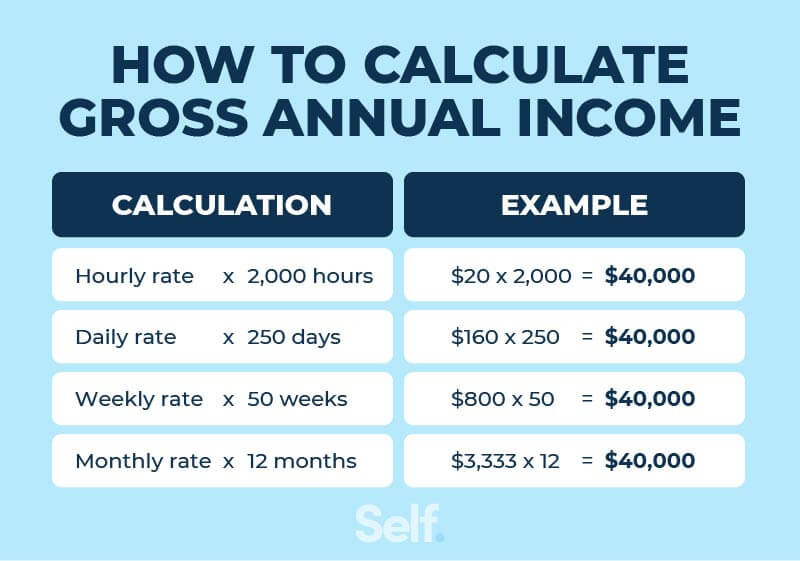
For hourly employees, the calculation requires an understanding of your average weekly hours. If you work a standard 40-hour week for the entire year, the math is simple:
- The 2,080 Rule: There are typically 2,080 work hours in a year (40 hours x 52 weeks). Multiply your hourly rate by 2,080 to find your gross annual income. For example, $25 per hour equals a gross annual income of $52,000.
However, if your hours fluctuate, you should look at your year-to-date (YTD) earnings on your most recent pay stub. Divide that amount by the number of months passed and multiply by 12 to get an estimated annual projection.
Estimating Earnings for Freelancers and Gig Workers
In the “gig economy,” annual income is rarely static. Freelancers must look at their Gross Receipts—the total amount invoiced and collected. To arrive at a “Personal Income” figure, freelancers must subtract business expenses (software, equipment, office space) from their gross receipts.
For those with irregular income, it is best to use a three-year average if possible. If you are in your first year of self-employment, look at your average monthly revenue over the last six months and project it forward, while setting aside a “buffer” for slow months.
Factoring in Bonuses, Commissions, and Overtime
Variable pay can significantly inflate your annual income. When calculating your total for the year, you should categorize these as “Variable Income.”
- Commissions: Often common in sales roles, these should be calculated based on historical performance.
- Overtime: If you consistently work 5 to 10 hours of overtime per week, this “time-and-a-half” pay must be added to your base 2,080-hour calculation.
- Bonuses: Annual or quarterly bonuses are often taxed at a higher supplemental rate, so while they increase your gross annual income, their impact on your net take-home pay might be less than expected.

The Strategic Importance of Knowing Your Exact Annual Income
Why does the exact figure matter? Beyond simply knowing how much you have to spend, your annual income is the primary data point for several major life milestones.
Tax Planning and Federal Obligations
Your gross annual income determines your federal income tax bracket. In a progressive tax system, earning even a few dollars over a certain threshold can push a portion of your income into a higher tax percentage. By knowing your projected annual income mid-year, you can make strategic moves—such as increasing 401(k) contributions or donating to charity—to lower your Adjusted Gross Income (AGI) and potentially drop into a lower tax bracket.
Debt Management and Loan Eligibility
When applying for a mortgage or an auto loan, lenders use the Debt-to-Income (DTI) Ratio. This is calculated by dividing your monthly debt payments by your gross monthly income (your annual income divided by 12). If your DTI is too high (usually above 43%), you may be denied a loan regardless of your credit score. Knowing your annual income allows you to calculate your DTI in advance and decide if you need to pay down debt before applying for a major loan.
Retirement Contributions and Long-Term Wealth Building
Financial advisors often recommend saving 15% to 20% of your annual income for retirement. If you do not have a firm grasp on your total annual earnings—including side hustles and dividends—you may be undersaving. Furthermore, certain retirement accounts, like the Roth IRA, have income eligibility limits. If your annual income exceeds a certain threshold, you are legally barred from contributing directly to these accounts, making it essential to monitor your earnings throughout the year.
Managing Variable Income and Side Hustles
In the modern financial landscape, it is increasingly common for individuals to have multiple streams of income. This “portfolio” approach to earning makes calculating annual income more complex but also provides more financial security.
Tracking Secondary Revenue Streams
Secondary income can include rental property income, dividends from stocks, interest from high-yield savings accounts, or a weekend side hustle. To get a true picture of your annual income, you must aggregate these sources.
- Passive Income: Often overlooked, the interest and dividends you earn are technically part of your annual income and are taxable.
- Capital Gains: If you sell an asset (like stock or real estate) for a profit, that gain is added to your income for that specific year.
Accounting for Business Expenses and Deductions
If your annual income includes money from a side business, you must distinguish between “Revenue” and “Income.” If your side hustle brought in $20,000, but you spent $5,000 on materials and marketing, your annual income from that source is $15,000. Failing to account for these expenses can lead to an overestimation of your spending power and an unpleasant surprise during tax season.
Tools and Strategies for Financial Growth
Once you have identified your annual income, the next step is to move from calculation to optimization.
Leveraging Financial Software and Spreadsheets
Manual calculation is prone to error. Professional-grade budgeting tools and even simple spreadsheets can help you track every dollar. By categorizing your income sources—Fixed (Salary), Variable (Bonuses), and Passive (Investments)—you can visualize which areas of your financial life are growing and which are stagnating. Modern apps can link directly to your bank accounts to provide a real-time update of your year-to-date earnings.
Setting Financial Milestones Based on Income Brackets
Understanding your annual income allows you to set “Income Milestones.” For instance, once you cross the $100,000 threshold, your strategy might shift from “debt reduction” to “aggressive investing.”
Knowing your annual income also empowers you during salary negotiations. By understanding the market rate for your role and comparing it to your current total compensation, you can present a data-driven case for a raise. Remember, your annual income is not just a reflection of your past year’s work; it is the engine that drives your future financial independence.
In conclusion, “What is my annual income?” is a question that requires a comprehensive look at your gross earnings, net take-home pay, and all supplemental streams. By masterfully tracking these figures, you position yourself to make smarter tax decisions, secure better loan terms, and ultimately accelerate your journey toward wealth.
aViewFromTheCave is a participant in the Amazon Services LLC Associates Program, an affiliate advertising program designed to provide a means for sites to earn advertising fees by advertising and linking to Amazon.com. Amazon, the Amazon logo, AmazonSupply, and the AmazonSupply logo are trademarks of Amazon.com, Inc. or its affiliates. As an Amazon Associate we earn affiliate commissions from qualifying purchases.