
In the world of business finance and operational management, the difference between a thriving enterprise and a struggling one often boils down to a single concept: efficiency. While many entrepreneurs and financial managers focus exclusively on increasing top-line revenue, the most sophisticated players understand that sustainable wealth is built by optimizing the bottom line. This is where the Japanese concept of “Muda” becomes an essential tool for any financial strategist.
Muda, a key pillar of the Toyota Production System and Lean methodology, translates literally to “wastefulness” or “uselessness.” However, in a financial context, Muda represents any activity, process, or expenditure that consumes resources—be it capital, time, or labor—without adding value to the end product or the customer. By identifying and systematically eliminating Muda, businesses can unlock hidden capital, improve cash flow, and significantly enhance their return on investment (ROI).
The Concept of Muda in the Financial Landscape
To understand Muda from a financial perspective, one must first redefine what “value” means. In business finance, value is determined by the customer’s willingness to pay for a specific attribute of a product or service. Anything else is an overhead cost that eats into the profit margin.
Defining Value vs. Waste
Every dollar spent within a company falls into one of two categories: Value-Added (VA) or Non-Value-Added (NVA). Value-added activities are those that physically or functionally change the product or service in a way that the customer appreciates. Non-value-added activities—Muda—are the “hidden taxes” a business pays to itself due to inefficient systems. For an investor or business owner, identifying Muda is equivalent to finding “free” money that has been trapped in the gears of the organization.
The Origins: Lean Thinking and the Bottom Line
While Muda originated on the factory floors of post-WWII Japan, its application in modern finance is profound. The philosophy suggests that instead of simply raising prices to increase margins (which can alienate customers), a business should look inward. If you can produce the same result with 20% less waste, you have effectively increased your profit without needing to sell a single additional unit. This “lean” approach to capital management is what separates high-performance firms from their bloated competitors.
The Eight Wastes of Muda and Their Financial Impact
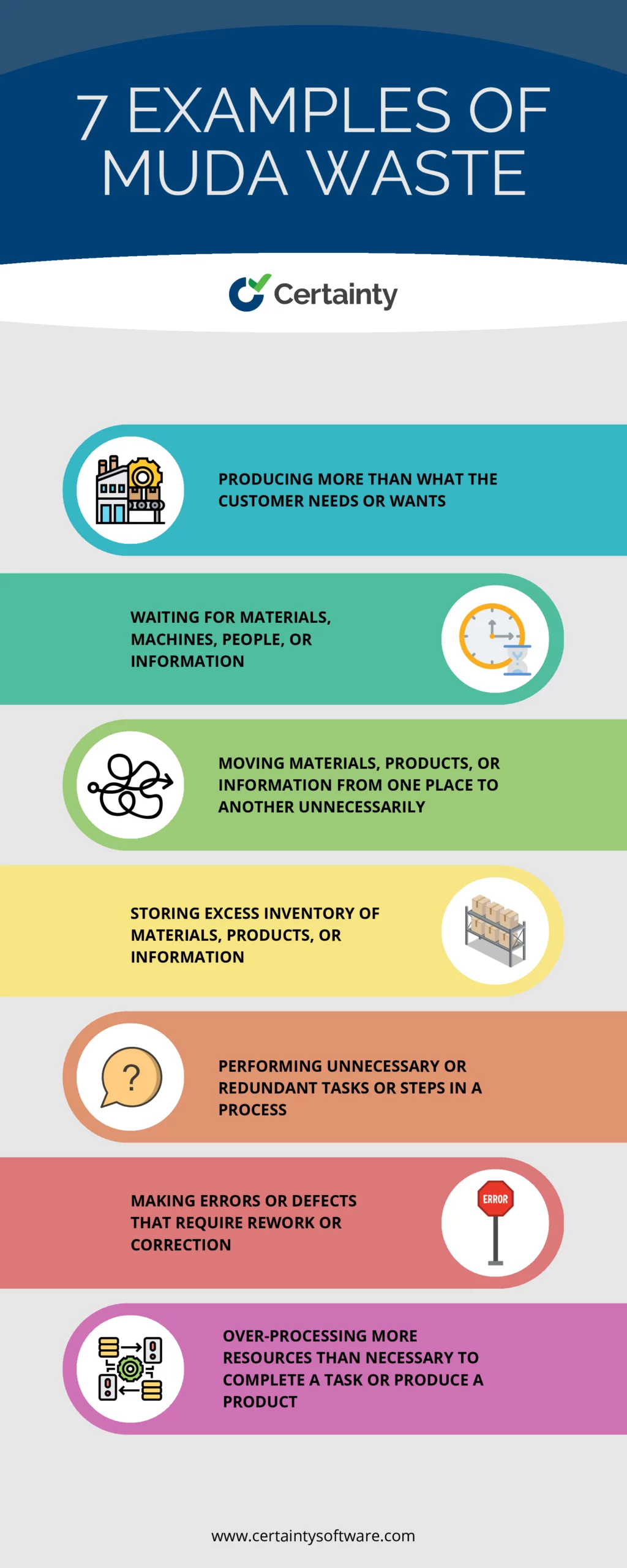
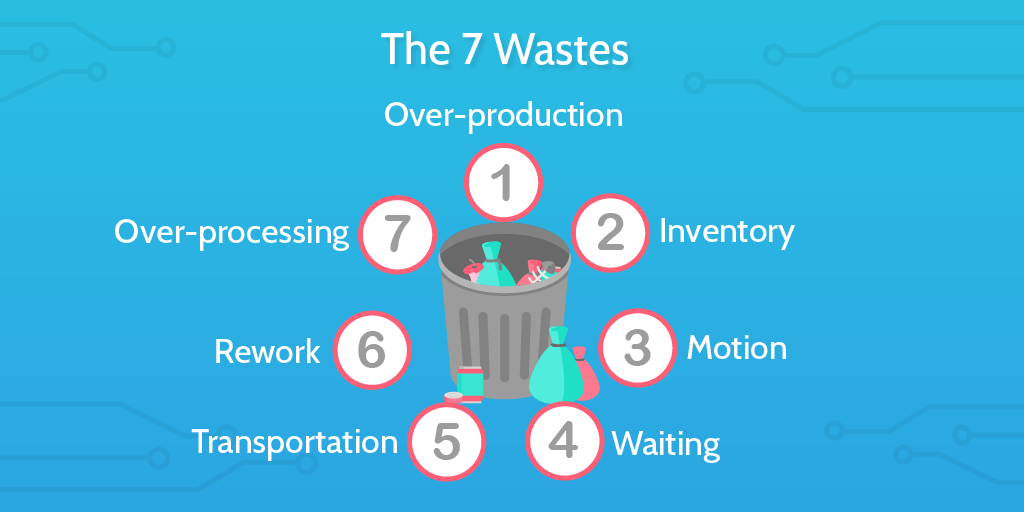
Taiichi Ohno, the father of the Toyota Production System, originally identified seven types of Muda, with an eighth added later by management experts. Each of these wastes has a direct, quantifiable impact on a company’s financial health.
Transportation and Inventory: The Cost of Stagnant Capital
Transportation waste involves the unnecessary movement of materials or information. From a financial standpoint, every time a product is moved, there is a cost in labor, fuel, and potential damage, with zero increase in market value.
Inventory waste is even more dangerous for business finance. Excess inventory represents “dead capital”—money that is tied up in raw materials or finished goods sitting in a warehouse. This capital is not earning interest, it isn’t being used for R&D, and it incurs carrying costs (rent, insurance, security). For a business looking to maintain high liquidity, minimizing inventory Muda is a primary objective.
Motion and Waiting: Paying for Idle Time
Motion refers to the unnecessary movement of people, such as a worker walking across a large office to use a printer or a convoluted digital workflow that requires too many clicks. While seemingly minor, the cumulative cost of wasted motion over a fiscal year can amount to thousands of unproductive labor hours.
Waiting is perhaps the most obvious form of financial Muda. Whether it is a machine waiting for a repair, a project waiting for an executive’s signature, or capital waiting in a low-yield account, “waiting” is the enemy of cash flow velocity. In finance, time is literally money; the longer the cycle time of a process, the lower the internal rate of return (IRR).
Overproduction and Over-processing: The Margin Killers
Overproduction is often cited as the worst form of Muda because it triggers the other seven wastes. Making more than the market demands leads to excess inventory, which leads to transportation costs, which leads to waiting. Financially, overproduction creates a false sense of asset growth on the balance sheet while simultaneously draining cash reserves.
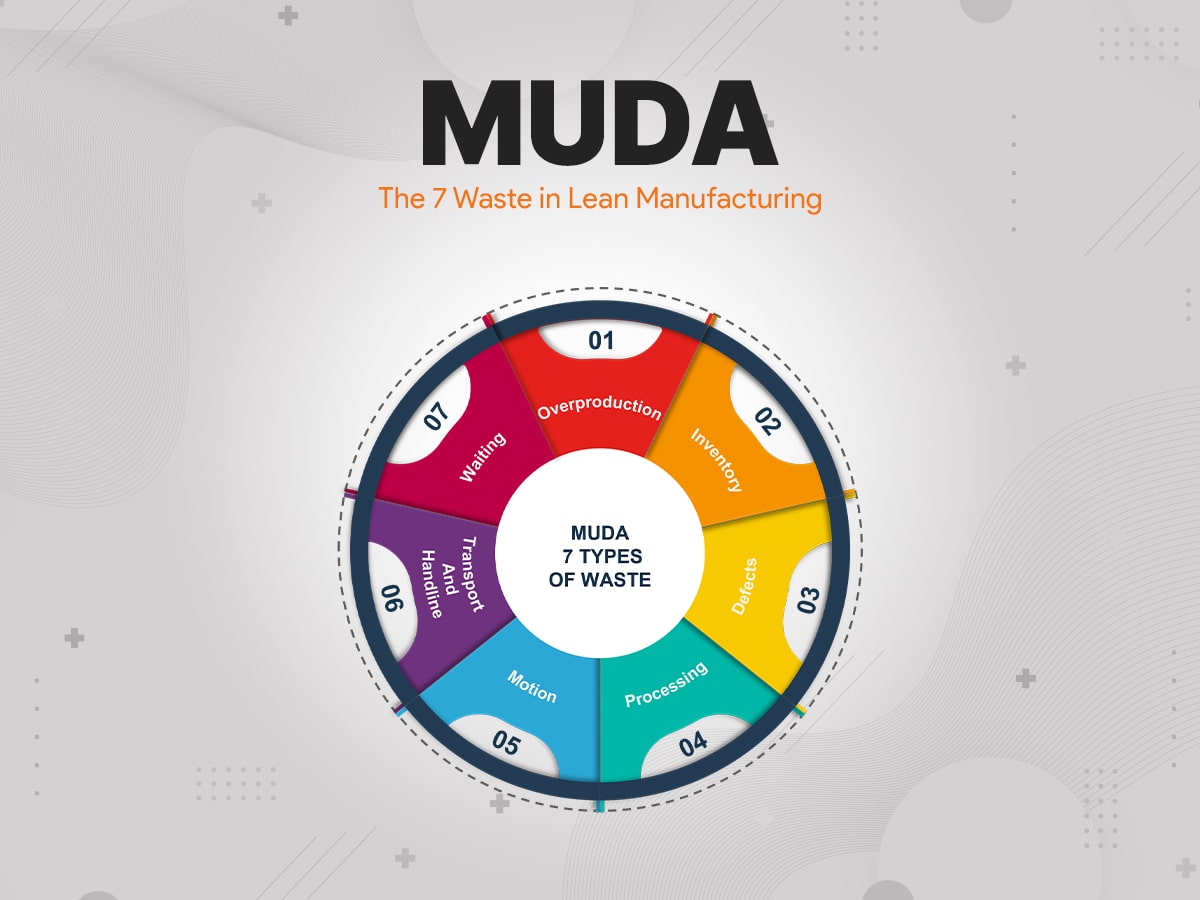
Over-processing occurs when a company puts more work into a product than the customer requires—such as using high-precision components for a low-cost toy. In a “Money” context, this is a failure of cost-benefit analysis. Spending $10 in labor to add a feature that the customer only values at $2 is a $8 loss per unit.
Defects and Unused Talent: The Hidden Drain on Revenue
Defects are the most visible financial drain. A defective product requires rework, scrap, and additional customer service support, all of which are pure losses. Furthermore, defects damage brand equity, leading to higher customer acquisition costs (CAC) in the future.
The eighth waste, Unused Talent, is the failure to leverage the skills and insights of the workforce. When employees are merely “cogs in a machine” and their ideas for efficiency are ignored, the business loses out on intellectual capital. From a strategic investment perspective, failing to optimize human capital is a missed opportunity for exponential growth.
Quantifying Muda: Financial Tools for Waste Detection
Identifying waste is one thing; quantifying it for a financial report is another. To turn the concept of Muda into an actionable financial strategy, leaders must use specific analytical tools.
Value Stream Mapping for Financial Audits
Value Stream Mapping (VSM) is a visual tool used to chart the path of a product or service from inception to the customer. In a financial audit, VSM allows managers to see exactly where “value” is added and where “cost” is added. By timing each step and attaching a dollar value to the labor and resources consumed, a company can calculate its Process Cycle Efficiency. If the total time taken to deliver a service is 40 hours, but only 2 hours involve actual value-added work, the business has a massive Muda problem that is inflating its operating expenses.
Activity-Based Costing (ABC)
Traditional accounting often lumps overhead into broad categories, making it hard to see where waste lives. Activity-Based Costing (ABC) assigns costs to specific activities rather than departments. This granular view allows financial officers to see if a specific product line is actually profitable or if it is being propped up by more efficient sectors of the business. ABC is the financial microscope used to find Muda in complex organizational structures.
Strategies to Eliminate Muda and Scale Your Income
Once Muda is identified and quantified, the focus shifts to elimination. In the niche of business finance, this involves two primary strategies: JIT and Kaizen.
Implementing Just-In-Time (JIT) Financing
Just-In-Time is a strategy where materials are received and products are produced only as they are needed. Applied to finance, JIT means optimizing cash flow so that capital is deployed exactly when it is required. This minimizes the “inventory” of cash sitting in non-productive accounts. By utilizing credit lines effectively and timing accounts payable and receivable, a business can operate with less “buffer” capital, allowing that excess money to be invested in high-growth opportunities or market instruments.
Kaizen: Continuous Improvement for Compound Growth
Kaizen is the philosophy of continuous, incremental improvement. In a personal finance or business context, Kaizen is the equivalent of compound interest. By making small, 1% improvements in efficiency every week—reducing a recurring software subscription, renegotiating a vendor contract, or automating a manual data-entry task—the cumulative effect on the annual budget is transformative. Eliminating Muda is not a one-time event; it is a permanent financial discipline.
The Long-Term ROI of a Muda-Free Business Model
Understanding “What is Muda” is more than just an academic exercise in management theory; it is a fundamental shift in how one views capital. In an era of rising interest rates and volatile markets, the ability to generate higher margins through efficiency rather than just sales volume is a massive competitive advantage.
A business that masters the elimination of Muda enjoys several financial benefits:
- Increased Liquidity: Less money is tied up in waste, meaning more cash is available for acquisitions, dividends, or emergency reserves.
- Lower Break-Even Point: By reducing operating expenses, the business can remain profitable even during market downturns.
- Higher Valuation: Investors and venture capitalists look favorably on lean operations because they represent lower risk and higher scalability.
In conclusion, Muda is the silent thief of profitability. Whether you are managing a multinational corporation, a small business, or your own personal portfolio, the pursuit of a “Muda-free” environment is the fastest path to financial freedom. By treating every instance of waste as a direct loss of income, you can transform your financial trajectory and build a more resilient, profitable future.
aViewFromTheCave is a participant in the Amazon Services LLC Associates Program, an affiliate advertising program designed to provide a means for sites to earn advertising fees by advertising and linking to Amazon.com. Amazon, the Amazon logo, AmazonSupply, and the AmazonSupply logo are trademarks of Amazon.com, Inc. or its affiliates. As an Amazon Associate we earn affiliate commissions from qualifying purchases.