
The world of optics and spectroscopy is built upon the fundamental principle of interacting with light. While we often perceive light as a unified entity, it’s in fact composed of a spectrum of different wavelengths, each carrying unique information. Understanding and manipulating this spectral composition is crucial for a vast array of scientific and technological applications, from medical diagnostics to materials science and astronomical observation. At the heart of this spectral manipulation lies a vital optical instrument: the monochromator.
A monochromator, at its core, is a device designed to isolate and select a narrow band of wavelengths from a broader spectrum of light. Think of it as a highly sophisticated color filter, but instead of simply blocking unwanted colors, it precisely extracts a specific “shade” of light for further analysis or application. This ability to control and direct specific wavelengths makes monochromators indispensable tools in fields where the precise measurement of light-matter interactions is paramount.
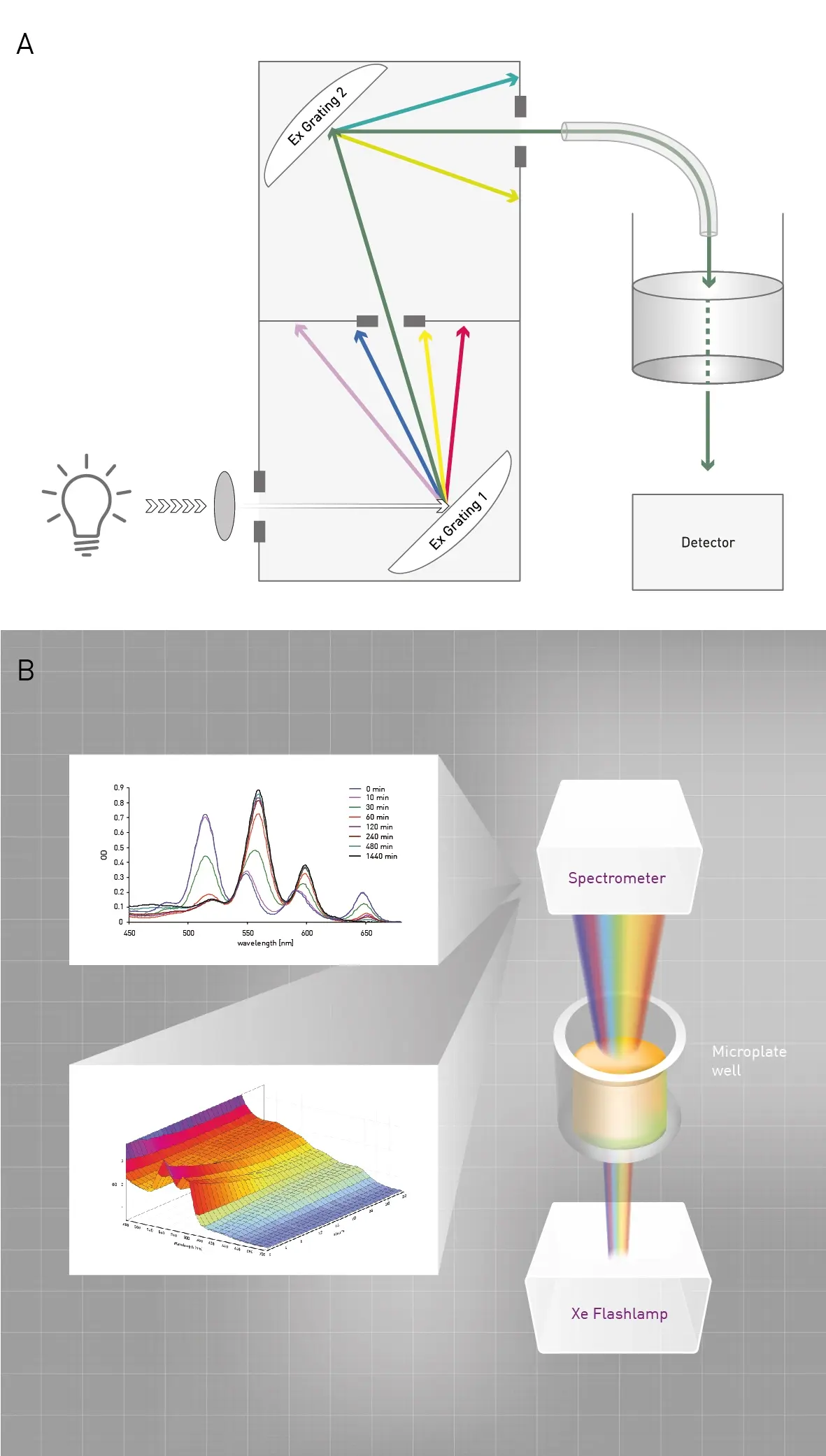
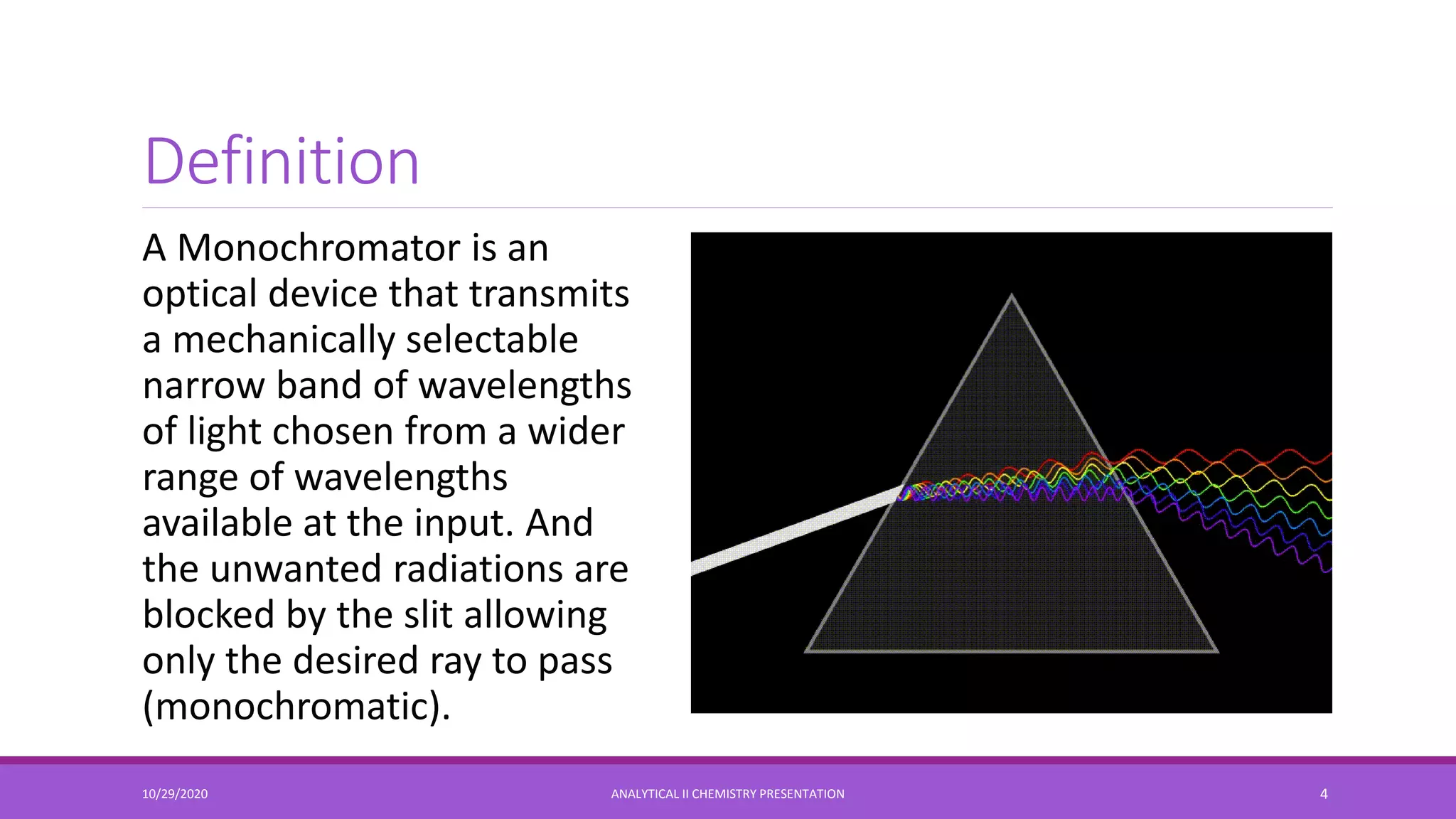
The operation of a monochromator hinges on the physical principle of dispersion, the phenomenon where the angle of refraction (or diffraction) of light depends on its wavelength. By employing dispersive elements, monochromators can spatially separate the different wavelengths present in an incoming light source, allowing for the selection of a single, desired wavelength. This fundamental capability underpins their widespread use in scientific instrumentation and advanced technologies.
The Fundamental Principles of Monochromator Operation
The ability of a monochromator to isolate specific wavelengths is not magic; it’s rooted in well-understood principles of physics, primarily dispersion. Understanding these principles is key to appreciating how monochromators function and why they are so effective in their role.
Dispersion: The Cornerstone of Wavelength Separation
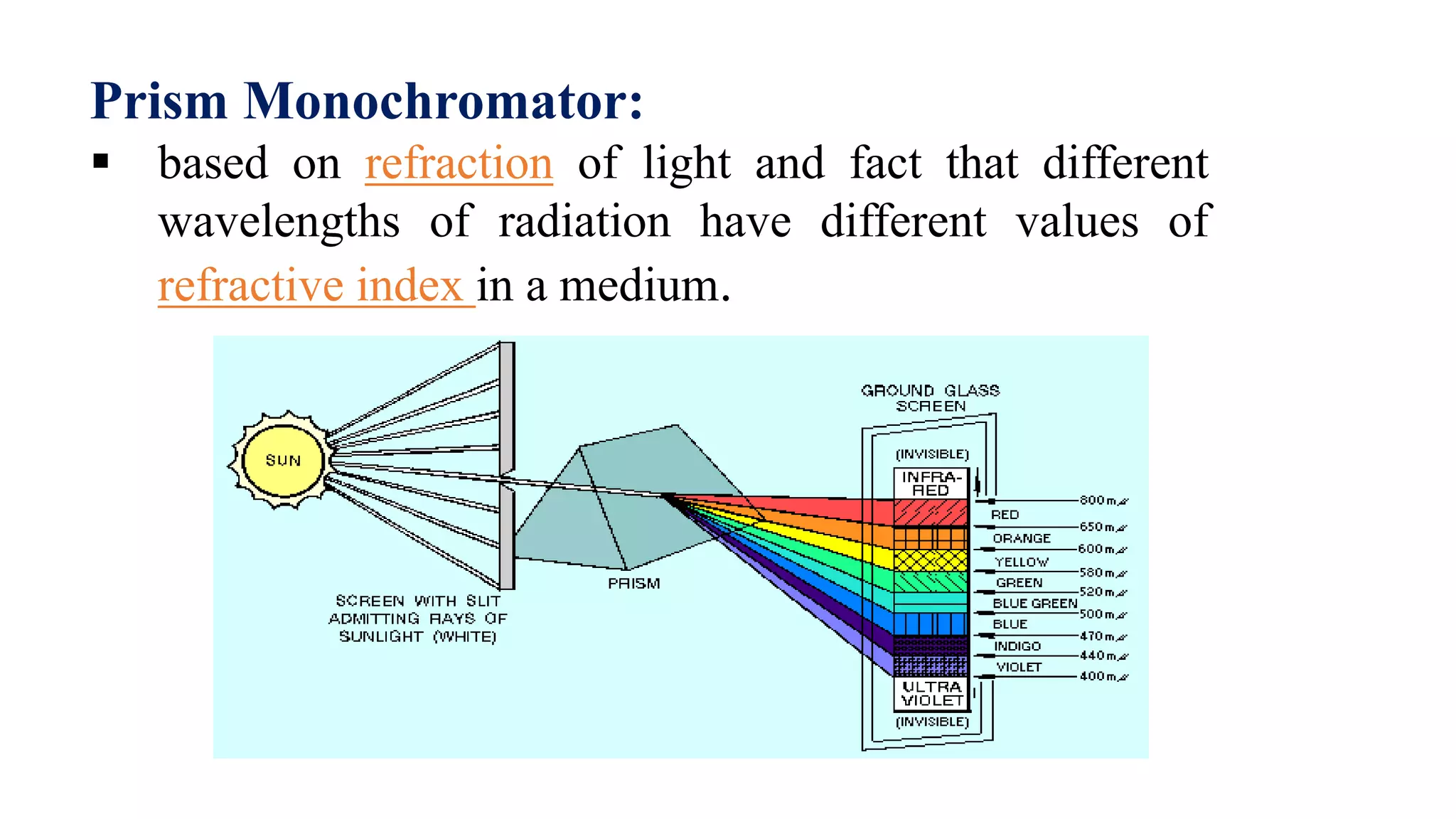
Dispersion is the phenomenon where the refractive index of a material varies with the wavelength of light. This means that different colors (wavelengths) of light will bend at slightly different angles when passing through a transparent medium. This effect is most commonly observed when white light passes through a prism, breaking into its constituent rainbow of colors.
Refractive Dispersion (Prisms)
One of the earliest and most intuitive methods of achieving dispersion is through the use of a prism. When light enters a prism, it refracts. Due to refractive dispersion, shorter wavelengths (like blue and violet) are bent more than longer wavelengths (like red). This angular separation of wavelengths is the basis for how a prism-based monochromator works. By rotating the prism, different wavelengths can be directed towards an exit slit, effectively selecting a specific spectral band. While prisms are effective, their dispersion is not always uniform across the spectrum, and they can absorb certain wavelengths, limiting their applicability in some scenarios.
Diffractive Dispersion (Diffraction Gratings)
A more versatile and widely used method for dispersion in modern monochromators is the diffraction grating. A diffraction grating is a surface with a large number of finely spaced parallel grooves or lines. When light strikes a diffraction grating, it is diffracted. According to the principles of diffraction, different wavelengths of light will be diffracted at different angles. This angular separation is often more pronounced and linear across a broader spectral range compared to prisms.
The angle of diffraction ($theta$) for a grating is given by the grating equation:
$d sin(theta) = m lambda$
where:
- $d$ is the spacing between the grooves on the grating.
- $theta$ is the diffraction angle.
- $m$ is an integer representing the order of diffraction (m=1 for the first order, m=2 for the second order, etc.).
- $lambda$ is the wavelength of light.
This equation clearly shows that for a given grating and order, the diffraction angle is directly proportional to the wavelength. By precisely controlling the angle of the grating or the direction of the incident light, a specific wavelength can be directed towards an exit slit. This makes diffraction gratings the preferred dispersive element in most sophisticated monochromators.
Slits: The Precision Apertures for Wavelength Selection
Once the light has been dispersed, separating it into its constituent wavelengths, it’s crucial to isolate a specific, narrow band. This is where slits come into play. Monochromators typically feature an entrance slit and an exit slit.
The Entrance Slit
The entrance slit defines the spatial extent of the light source entering the monochromator. It acts as the initial aperture, ensuring that only light within a certain area impinges upon the dispersive element. The width of the entrance slit directly influences the spectral purity and the amount of light that can enter the monochromator. A narrower slit leads to higher spectral purity (a narrower band of wavelengths passing through) but also reduces the overall light throughput.
The Exit Slit
The exit slit is positioned after the dispersive element and is aligned to receive light at a specific angle. As the dispersive element separates the wavelengths, only the light corresponding to the desired wavelength will strike the exit slit and proceed to the detector or application. The width of the exit slit, similar to the entrance slit, determines the bandwidth of the isolated light. A narrower exit slit yields a more monochromatic output but again at the cost of light intensity. The combination of entrance and exit slit widths is often referred to as the spectral resolution of the monochromator, defining its ability to distinguish between closely spaced wavelengths.
Types of Monochromators and Their Architectures
The fundamental principles of dispersion and slit selection are implemented in various architectural designs, each offering specific advantages for different applications. These designs primarily differ in how they arrange the dispersive element and the slits to optimize performance.
Czerny-Turner Configuration
The Czerny-Turner configuration is one of the most common and widely used designs for monochromators, especially in spectroscopy. It employs a concave diffraction grating and two mirrors to direct light.
Optical Path and Components
In a Czerny-Turner monochromator, light enters through an entrance slit. It is then collimated by a spherical mirror, meaning it is converted into a parallel beam. This parallel beam strikes a diffraction grating, which disperses the light. The dispersed light is then focused by another spherical mirror onto an exit slit. The angle of the grating is typically rotated to select different wavelengths.
Advantages and Disadvantages
Advantages:
- Compactness: The Czerny-Turner design is relatively compact, making it suitable for integration into smaller instruments.
- Good Aberration Correction: Using spherical mirrors can lead to good focusing properties and manageable optical aberrations, especially when the slits are placed symmetrically around the optical axis.
- Flexibility: The design allows for easy adjustment of the grating angle for wavelength scanning.
Disadvantages:
- Field Curvature: Spherical mirrors can introduce field curvature, meaning the focal plane is not perfectly flat, which can affect performance if the slits are extended.
- Astigmatism: Astigmatism can also be an issue, causing different wavelengths to focus at different points in the plane perpendicular to the dispersive plane.
Ebert-Fastie Configuration
The Ebert-Fastie configuration is another well-established design that shares some similarities with the Czerny-Turner but uses a single concave mirror.
Optical Path and Components
In this design, light enters through an entrance slit and is immediately directed onto a concave diffraction grating, which also acts as the focusing element. The grating disperses the light, and the diffracted light is focused back onto an exit slit. The entrance and exit slits are typically placed side-by-side.
Advantages and Disadvantages
Advantages:
- Simplicity: The use of a single optical element for both dispersion and focusing simplifies the optical path and can lead to a more robust design.
- Reduced Aberrations: In some implementations, the Ebert-Fastie design can achieve better aberration correction than a Czerny-Turner, particularly regarding astigmatism.
Disadvantages:
- Higher Cost: Concave gratings are more complex and expensive to manufacture than separate mirrors and gratings.
- Limited Spectral Range: The spectral range covered by a single concave grating might be more limited compared to designs using separate optics.
Other Configurations (e.g., Littrow)
While Czerny-Turner and Ebert-Fastie are prevalent, other configurations exist for specific needs. The Littrow configuration, for instance, uses a grating that is also the focusing element. Light is incident on the grating at an angle, and the diffracted light is reflected back along the same path to be focused onto an exit slit. This design is very compact and can offer excellent performance but is often limited to a narrower spectral range and requires precise alignment.
Applications of Monochromators in Technology
The ability of monochromators to precisely control and select specific wavelengths of light makes them indispensable components in a vast array of technological applications across numerous scientific and industrial sectors. Their role is often to illuminate a sample with a specific wavelength of light for analysis or to provide a precisely tuned light source for a particular process.
Spectroscopy and Spectrophotometry
One of the most prominent applications of monochromators is in spectroscopy. Spectroscopy is the study of the interaction between matter and electromagnetic radiation. Spectrophotometry, a sub-discipline of spectroscopy, specifically measures the intensity of light as a function of wavelength.
UV-Vis Spectroscopy
In Ultraviolet-Visible (UV-Vis) spectroscopy, monochromators are used to scan through a range of UV and visible wavelengths. A sample is illuminated with this scanned light, and the amount of light absorbed or transmitted at each wavelength is measured by a detector. This absorption or transmission spectrum provides crucial information about the chemical composition and concentration of the sample. Industries ranging from pharmaceuticals and environmental monitoring to food quality control heavily rely on UV-Vis spectrophotometers equipped with monochromators.
Fluorescence Spectroscopy
Fluorescence spectroscopy utilizes monochromators to excite a sample with a specific excitation wavelength and then to measure the emitted fluorescence at different emission wavelengths. This technique is invaluable for identifying and quantifying fluorescent compounds in biological samples, materials, and chemical analyses.
Infrared (IR) Spectroscopy
While often employing different dispersive elements, IR spectroscopy also relies on the principle of wavelength selection. Fourier Transform Infrared (FTIR) spectroscopy, a highly advanced technique, uses interferometry to obtain spectral information, but traditional IR monochromators also exist and are used in specific applications where scanning through discrete IR wavelengths is necessary for analyzing molecular vibrations and identifying chemical bonds.
Laser Technology and Wavelength Tuning
While lasers inherently produce highly monochromatic light, some applications require the ability to tune the laser’s output wavelength over a range. Monochromators, or tunable filters based on similar principles, can be integrated into laser systems to achieve this wavelength tunability. This is particularly important in:
Tunable Lasers
Tunable lasers find applications in areas like remote sensing, optical communications, and advanced scientific research where the precise wavelength of light is critical for interacting with specific materials or achieving resonance. A monochromator can act as an external cavity element, forcing the laser to oscillate at a specific wavelength selected by the monochromator’s optics.
Optical Instrumentation and Measurement
Beyond spectroscopy, monochromators are integral to various optical instruments that require precise wavelength control.
Optical Coherence Tomography (OCT)
In medical imaging, particularly in ophthalmology and cardiology, Optical Coherence Tomography (OCT) uses low-coherence interferometry to obtain cross-sectional images of biological tissues. While some OCT systems use broadband light sources and interferometry, others employ swept-source OCT (SS-OCT) where a laser’s wavelength is rapidly swept. The scanning mechanism in SS-OCT often relies on tunable filters or external cavities that incorporate monochromator principles to achieve the precise wavelength sweeping required for high-resolution imaging.
Color Measurement and Calibration
Accurate color measurement is crucial in industries like printing, textiles, and display manufacturing. Monochromators can be used in colorimeters and spectrophotometers designed for color calibration and analysis, ensuring that colors are consistently reproduced and measured across different devices and batches. By isolating specific wavelengths, these instruments can precisely characterize the spectral reflectance or transmittance of a colored object, thereby defining its color digitally.
Materials Science and Quality Control
In materials science, understanding how materials interact with specific wavelengths of light is essential for characterizing their properties, detecting defects, and ensuring quality.
Photoluminescence and Electroluminescence Studies
Monochromators are used to analyze the light emitted by materials when they are excited by various means (photons, electrons, or electrical current). This photoluminescence (PL) or electroluminescence (EL) spectroscopy helps researchers understand band gaps, doping levels, and defect states in semiconductors and other advanced materials. For example, in the development of LEDs and solar cells, monochromators are used to characterize the emission and absorption spectra of novel materials.
Non-Destructive Testing
In certain non-destructive testing applications, specific wavelengths of light might be used to reveal subsurface features or defects in materials that are not visible under broadband illumination. A monochromator can provide the precisely tuned light source needed for such specialized inspection techniques.
In summary, the monochromator is far more than a simple optical component; it’s a fundamental enabler of precise light manipulation. Its ability to isolate and control specific wavelengths of light underpins a vast spectrum of technological advancements, making it an indispensable tool in scientific discovery, industrial innovation, and everyday technologies that rely on the accurate measurement and application of light.
aViewFromTheCave is a participant in the Amazon Services LLC Associates Program, an affiliate advertising program designed to provide a means for sites to earn advertising fees by advertising and linking to Amazon.com. Amazon, the Amazon logo, AmazonSupply, and the AmazonSupply logo are trademarks of Amazon.com, Inc. or its affiliates. As an Amazon Associate we earn affiliate commissions from qualifying purchases.