
In the complex landscape of employer-sponsored retirement savings, money purchase plans represent a distinct and historically significant vehicle for employees to build wealth for their post-career years. Often overshadowed by the more ubiquitous 401(k) and profit-sharing plans, the money purchase plan (MPP) offers a unique blend of predictability for employees and specific obligations for employers. Understanding its structure, benefits, and comparative position within the defined contribution universe is crucial for both businesses designing retirement benefits and individuals planning their financial future.
Understanding Defined Contribution Plans
At its core, a money purchase plan is a type of defined contribution retirement plan. This classification is fundamental to grasping its nature, as it sets it apart from its “defined benefit” counterparts, such as traditional pensions. In a defined contribution plan, the focus is on the contributions made to an individual’s account, not on a promised payout amount at retirement.
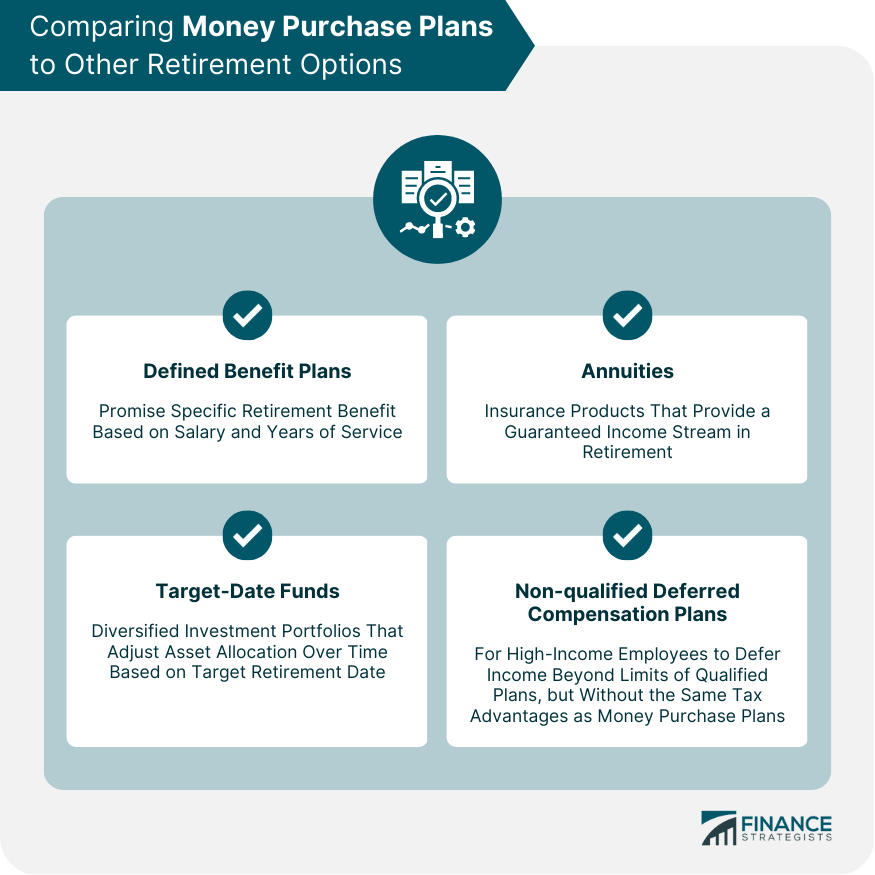
Distinguishing from Defined Benefit Plans
The primary distinction lies in who bears the investment risk and what is guaranteed. In a defined benefit plan, the employer promises a specific monthly benefit at retirement, often calculated based on factors like salary and years of service. The employer assumes the investment risk and is responsible for ensuring sufficient funds are available to pay out these benefits, regardless of market performance.
Conversely, a defined contribution plan, like a money purchase plan, specifies the amount of money contributed to each employee’s account. The eventual retirement benefit depends entirely on the total contributions made, plus the investment gains (or losses) generated over time. The employee typically bears the investment risk and makes choices regarding how their account balance is invested, within the options provided by the plan. This fundamental difference shifts the responsibility and risk profile significantly from the employer to the employee regarding the ultimate retirement payout.
The Landscape of Retirement Savings
Money purchase plans fit into a broader ecosystem of retirement savings options, each designed to meet different employer needs and employee expectations. While 401(k)s allow for both employer and employee contributions, and profit-sharing plans offer flexible employer contributions tied to company performance, money purchase plans mandate a fixed employer contribution, making them a hybrid in terms of predictability and flexibility. This mandatory contribution is a defining characteristic that provides a certain level of security and consistent growth for participating employees.
The Mechanics of a Money Purchase Plan
A money purchase plan operates under specific rules and regulations established by the Internal Revenue Service (IRS) and the Employee Retirement Income Security Act (ERISA). These regulations govern contributions, investments, vesting, and distributions, ensuring the plan’s integrity and protecting participants’ interests.
Employer Contribution Structure
The most defining feature of a money purchase plan is its mandatory employer contribution. Unlike profit-sharing plans where contributions can vary or even be skipped based on company profitability, an MPP requires the employer to contribute a fixed percentage of each eligible employee’s compensation every year. This percentage is predetermined and stated in the plan document. For instance, a plan might dictate that the employer contributes 5% of each employee’s annual salary to their retirement account. This commitment makes money purchase plans a predictable expense for employers but also a stable source of retirement savings for employees. Failure to make the mandatory contribution can result in penalties for the employer.
Employee Vesting Schedules
Vesting refers to the point at which an employee gains non-forfeitable ownership of the employer’s contributions to their retirement account. In a money purchase plan, employer contributions are typically subject to a vesting schedule. Common vesting schedules include:
- Cliff Vesting: The employee becomes 100% vested after a certain number of years of service (e.g., three years). If they leave before this period, they forfeit all employer contributions.
- Graded Vesting: The employee becomes partially vested over several years, with the percentage increasing annually until they reach 100% (e.g., 20% after two years, 40% after three, up to 100% after six years).
Employee contributions, if allowed, are always 100% vested immediately. The vesting schedule encourages employee retention while ensuring that the employer’s contributions are directed toward long-term employees.
Investment Options and Participant Control
Similar to 401(k)s, money purchase plans typically offer participants a range of investment options, such as mutual funds, target-date funds, and stable value funds. Employees usually have the discretion to direct how their account balance is invested among these choices. This level of control allows employees to tailor their investment strategy to their risk tolerance and financial goals, thereby impacting the growth potential of their retirement savings. However, the employer (or plan administrator) has a fiduciary duty to ensure the investment options offered are prudent and diversified.
Contribution Limits and IRS Regulations
Money purchase plans are subject to annual contribution limits set by the IRS, which are aggregated with other defined contribution plans an employer might sponsor. The total amount contributed to an employee’s account in a given year (including employer contributions, and any voluntary employee contributions if the plan allows) cannot exceed the lesser of a specific dollar amount (which is adjusted for inflation annually) or 100% of the employee’s compensation. These limits are designed to prevent excessive tax-deferred savings by high-income earners and ensure the plan remains a broad-based benefit.
Advantages and Disadvantages for Employers
For businesses considering or currently offering a money purchase plan, understanding its unique pros and cons is essential for strategic financial planning and employee benefits management.
Predictable Costs and Administrative Simplicity
One significant advantage for employers is the predictability of costs. Since the contribution rate is fixed, businesses can more accurately budget for their annual retirement plan expenses. This contrasts with profit-sharing plans, where contributions can fluctuate, or defined benefit plans, which can have volatile funding requirements based on actuarial assumptions and market performance. Administratively, money purchase plans are generally simpler than defined benefit plans, as they do not require complex actuarial calculations to determine funding levels.
Tax Benefits and Employee Retention
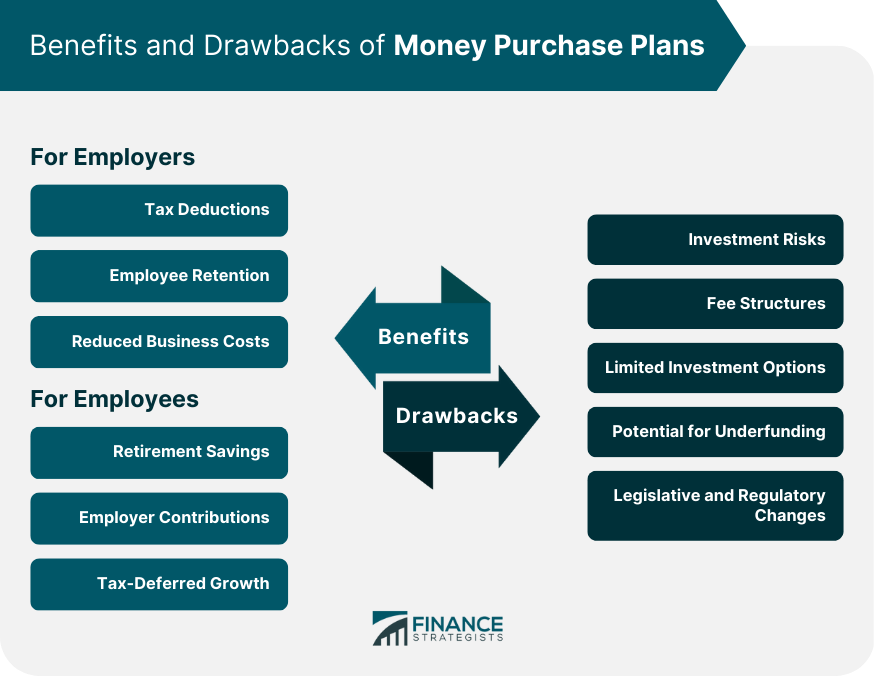
Employer contributions to a money purchase plan are tax-deductible for the business, reducing its taxable income. This provides a clear financial incentive for offering the plan. Furthermore, a robust retirement plan like an MPP, with its guaranteed employer contributions, can be a powerful tool for attracting and retaining talent. Employees value predictable and consistent contributions to their retirement savings, enhancing their sense of financial security and loyalty to the employer. The vesting schedules also act as an incentive for employees to remain with the company.
Fiduciary Responsibilities and Compliance Burden
Employers sponsoring a money purchase plan assume significant fiduciary responsibilities under ERISA. This includes prudently selecting and monitoring investment options, ensuring the plan operates solely in the best interests of participants, and adhering to strict reporting and disclosure requirements. Non-compliance can lead to substantial penalties and legal liabilities. While simpler than defined benefit plans, MPPs still require ongoing administration, record-keeping, and compliance with annual testing to ensure non-discrimination.
Flexibility Constraints Compared to Other Plans
A notable disadvantage is the lack of flexibility in employer contributions. Unlike profit-sharing plans, which allow employers to skip or reduce contributions during lean years, a money purchase plan mandates the fixed contribution regardless of the company’s financial performance. This can be a burden during economic downturns or periods of low profitability. Amending the plan to change the contribution rate or terminating the plan is possible but involves a formal process and can have tax implications.
Benefits and Considerations for Employees
For employees, a money purchase plan offers a clear pathway to retirement savings, but it also comes with its own set of responsibilities and considerations.
Guaranteed Contributions and Steady Growth Potential
The primary benefit for employees is the guaranteed employer contribution. This ensures that a portion of their compensation is consistently set aside for retirement, year after year, fostering steady growth in their retirement account balance. This predictability can be particularly appealing compared to profit-sharing plans, where employer contributions might be sporadic or absent in certain years. Over decades, these consistent contributions, combined with compound interest, can accumulate into a substantial nest egg.
Ownership and Portability of Funds
Once vested, employees have full ownership of the employer contributions. If an employee leaves the company, they can typically roll over their vested balance into an Individual Retirement Account (IRA) or their new employer’s retirement plan, provided the new plan accepts rollovers. This portability ensures that their accumulated savings are not tied to a single employer, offering flexibility in career changes without sacrificing retirement progress.
Investment Risk and Performance
While contributions are guaranteed, the investment returns are not. Employees bear the investment risk, meaning the value of their account can fluctuate with market performance. Poor investment choices or a market downturn can negatively impact their retirement savings. Therefore, it is crucial for employees to actively engage with their investment options, understand their risk tolerance, and make informed decisions, or seek professional financial advice.
Withdrawal Rules and Taxation
Withdrawals from a money purchase plan are typically only permitted upon reaching retirement age, separation from service, disability, or death. Early withdrawals (before age 59½) are generally subject to ordinary income tax and a 10% early withdrawal penalty, with some exceptions. Upon retirement, distributions are taxed as ordinary income. Understanding these rules is critical for tax planning and ensuring funds are available when truly needed in retirement.
Comparing Money Purchase Plans with Other Retirement Vehicles
To fully appreciate the role and advantages of a money purchase plan, it’s helpful to see how it stacks up against other popular retirement savings options.
401(k) vs. Money Purchase Plan
The 401(k) is arguably the most common employer-sponsored defined contribution plan. The key differences lie in contribution flexibility and employee involvement:
- Employee Contributions: 401(k)s heavily rely on elective deferrals from employees (pre-tax or Roth). Money purchase plans may or may not allow employee contributions, but their defining feature is the employer’s mandatory contribution.
- Employer Contributions: 401(k) employer contributions are typically discretionary (e.g., matching contributions or discretionary profit-sharing). In an MPP, employer contributions are mandatory and fixed.
- Contribution Limits: While both are subject to overall IRS limits, the structure of who contributes what differs significantly. 401(k)s often have higher limits for employee elective deferrals than what might be contributed solely by an employer in an MPP.
Profit-Sharing Plans vs. Money Purchase Plan
Profit-sharing plans also allow employer contributions to employee retirement accounts but offer greater flexibility than MPPs:
- Contribution Discretion: In a profit-sharing plan, the employer can decide each year whether to contribute and how much, often tied to company profits. In contrast, an MPP demands a fixed contribution annually, regardless of profits.
- Contribution Formula: Profit-sharing contributions can be allocated using various formulas (e.g., pro-rata, age-weighted, new comparability), offering flexibility in how funds are distributed among employees. MPP contributions are typically a uniform percentage of compensation.
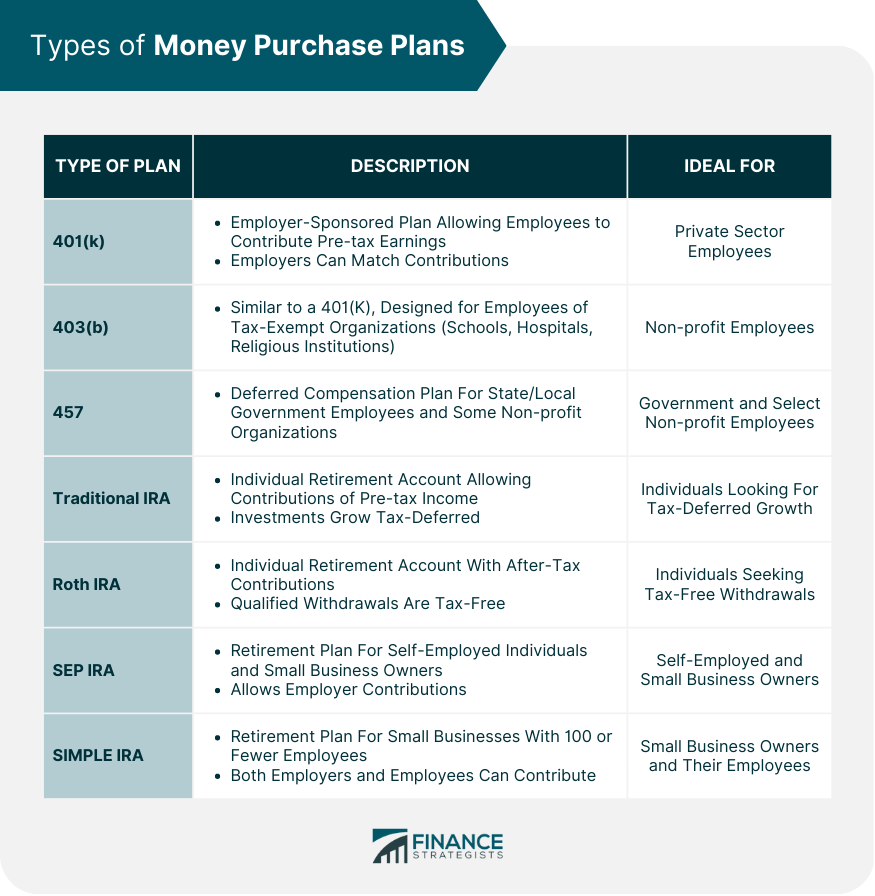
SEP IRAs and SIMPLE IRAs
For smaller businesses, SEP IRAs and SIMPLE IRAs are simpler, less administratively burdensome retirement options:
- SEP IRA: Funded solely by employer contributions, which are discretionary and can vary year to year (up to 25% of compensation, with a dollar limit). Much simpler to administer than an MPP, but offers less control over individual employee accounts and no employee elective deferrals.
- SIMPLE IRA: Available to businesses with 100 or fewer employees. Requires mandatory employer contributions (either a 2% non-elective contribution or a 3% matching contribution). Allows for employee elective deferrals. Simpler than a 401(k) or MPP but has lower contribution limits.
When a Money Purchase Plan is the Right Fit
A money purchase plan can be an excellent choice for businesses that value predictable, consistent contributions to their employees’ retirement. It suits employers who want to make a clear, committed statement about their investment in their workforce’s long-term financial security and can comfortably budget for a fixed annual expense. For employees, it offers the reassurance of steady employer contributions, providing a solid foundation for their retirement savings efforts. While less flexible for employers than some alternatives, its structured nature can be a significant advantage in ensuring consistent retirement wealth accumulation.
aViewFromTheCave is a participant in the Amazon Services LLC Associates Program, an affiliate advertising program designed to provide a means for sites to earn advertising fees by advertising and linking to Amazon.com. Amazon, the Amazon logo, AmazonSupply, and the AmazonSupply logo are trademarks of Amazon.com, Inc. or its affiliates. As an Amazon Associate we earn affiliate commissions from qualifying purchases.