
In the landscape of modern business and finance, few entities carry as much weight or influence as the Multinational Enterprise (MNE). As our world becomes increasingly interconnected through trade, technology, and capital flows, the MNE has emerged as the primary engine of global economic activity. For investors, entrepreneurs, and financial professionals, understanding the mechanics of an MNE is not just a matter of corporate theory—it is essential for navigating the complexities of international markets, tax strategies, and portfolio diversification.
Defining the Multinational Enterprise (MNE)
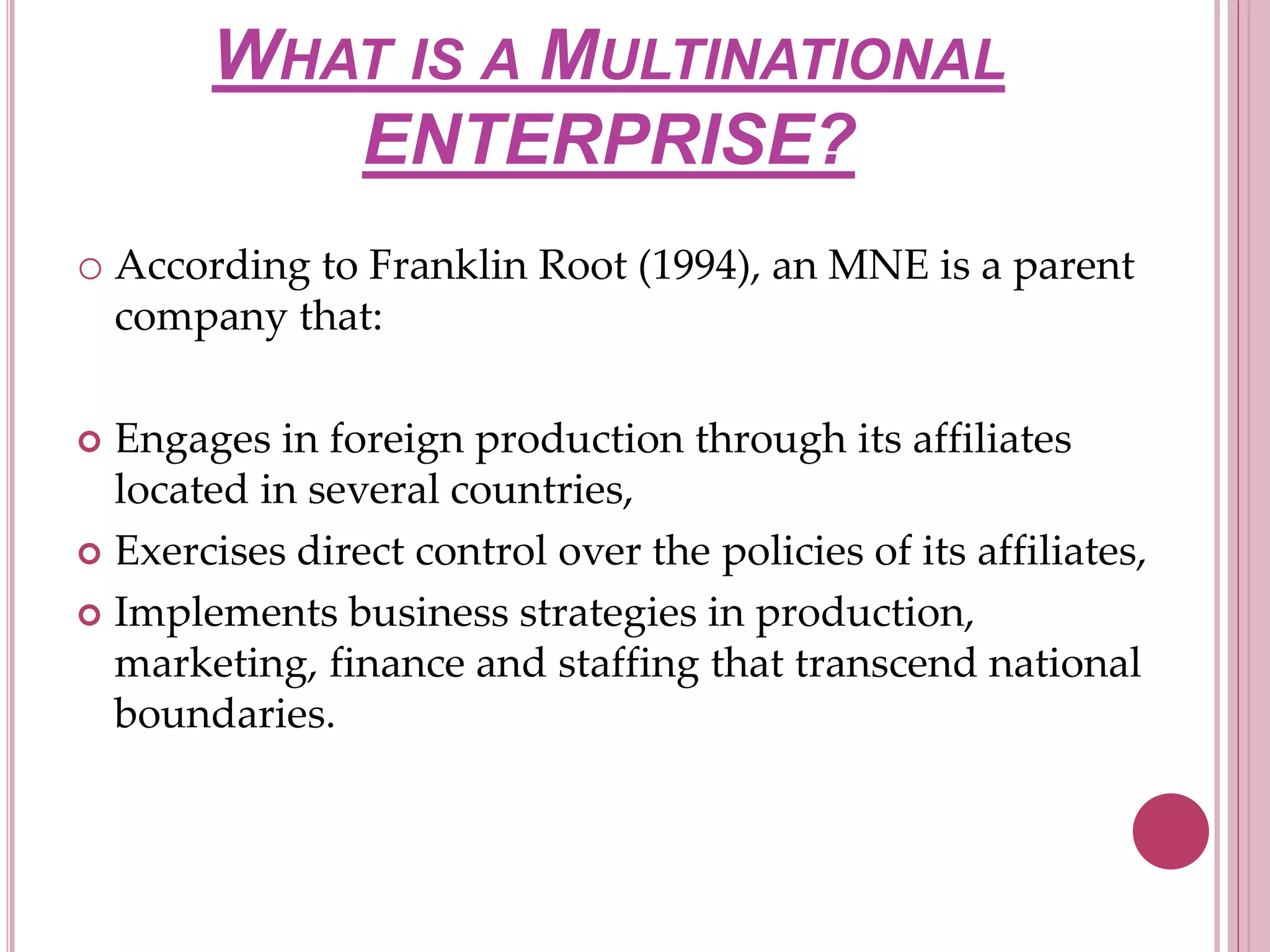
At its most fundamental level, a Multinational Enterprise is a corporate organization that owns or controls the production of goods or services in at least one country other than its home country. Unlike a standard domestic business that may simply export products abroad, an MNE maintains a physical presence and operational footprint in multiple jurisdictions. This cross-border integration allows them to tap into local markets, leverage regional resources, and optimize their financial structures on a global scale.

Core Characteristics of MNEs
An MNE is defined by more than just its size; it is defined by its strategic reach. These entities typically possess a centralized management system that coordinates activities across various geographic regions. Key characteristics include high levels of Foreign Direct Investment (FDI), a diverse workforce spanning multiple nationalities, and a sophisticated supply chain that ignores traditional borders. Financially, an MNE is characterized by its ability to move capital, intellectual property, and human resources across borders to maximize efficiency and shareholder value.
MNE vs. MNC: Is There a Difference?
In financial literature, the terms Multinational Enterprise (MNE) and Multinational Corporation (MNC) are often used interchangeably, but there is a subtle distinction. While an MNC typically refers to a large incorporated company, “Enterprise” is a broader term that can include partnerships, joint ventures, or state-owned entities that operate internationally. In the modern financial context, “MNE” is often preferred because it encompasses the diverse range of legal structures that global businesses now utilize to operate in foreign markets.
The Financial Strategy Behind Global Expansion
The transition from a domestic firm to an MNE is rarely accidental; it is a calculated financial move designed to achieve “economies of scale” and “economies of scope.” By expanding internationally, a company can spread its fixed costs over a larger number of units sold, reducing the per-unit cost and increasing profit margins.
Capital Allocation and Foreign Direct Investment (FDI)
The lifeblood of an MNE is Foreign Direct Investment. When a company decides to build a factory in Vietnam, open a research center in Germany, or acquire a competitor in Brazil, it is engaging in FDI. From a finance perspective, this is a complex capital budgeting decision. The MNE must weigh the projected Return on Investment (ROI) against the risks of operating in a foreign environment. This involves analyzing the cost of capital in different markets and determining whether to fund expansion through local debt, parent company equity, or reinvested foreign earnings.
Diversifying Revenue Streams Across Borders
One of the most significant financial advantages of being an MNE is risk diversification. A domestic company is at the mercy of its local economy; if the national GDP stalls, the company suffers. An MNE, however, can offset a recession in the United Kingdom with high growth in India or Brazil. This geographic diversification smooths out earnings volatility, making the MNE more attractive to institutional investors and providing a more stable credit profile for lenders.
Navigating the Financial Challenges of International Operations
While the rewards of global operations are vast, the financial complexities are equally daunting. Managing a business across multiple legal and economic systems requires a level of financial sophistication that domestic firms simply do not need.
Managing Currency Fluctuations and Forex Risk
For an MNE, exchange rate volatility is a constant threat to the bottom line. When a U.S.-based MNE earns revenue in Euros but reports its financial results in Dollars, a strengthening Dollar can “erase” profits during currency translation. To combat this, MNE finance departments utilize complex “hedging” strategies. This involves using financial derivatives such as forward contracts, options, and swaps to lock in exchange rates and protect the company’s cash flow from unpredictable market swings.
Transfer Pricing and Global Tax Optimization
Perhaps the most scrutinized aspect of MNE finance is transfer pricing. This refers to the prices charged between different branches or subsidiaries of the same MNE for goods, services, or intellectual property. By strategically setting these prices, an MNE can shift profits from high-tax jurisdictions to low-tax ones. While this is a legal method of tax optimization, it is subject to intense regulation by authorities like the OECD and the IRS. Effective tax management is a cornerstone of MNE profitability, ensuring that the global effective tax rate remains competitive while maintaining compliance with international law.
Investing in MNEs: Opportunities and Risks for Shareholders
For the individual investor, MNEs often represent the “blue chips” of a portfolio. Companies like Apple, Toyota, and Nestlé offer a unique blend of stability and growth potential that is difficult to find in purely domestic stocks.
Why MNEs Often Anchor Growth Portfolios
Investors are drawn to MNEs because of their “moats”—competitive advantages that are hard for rivals to breach. These moats often include global brand recognition, massive R&D budgets, and unparalleled supply chain efficiency. From a dividend perspective, MNEs are frequently “Dividend Aristocrats,” having the diverse cash flows necessary to maintain and grow payouts even during regional economic downturns. For an investor looking for exposure to emerging markets without the volatility of local stocks, buying shares in a Western MNE with high sales in those regions is a classic “prudent” strategy.
Political Risk and Regulatory Hurdles
Investing in MNEs is not without risk. Political instability is a major factor; an MNE’s assets in a foreign country can be seized through nationalization, or its operations can be crippled by sudden changes in trade tariffs or sanctions. Furthermore, MNEs face “repatriation risk”—the danger that a foreign government might restrict the company’s ability to move its profits back to the home country. Investors must monitor geopolitical tensions as closely as they monitor balance sheets when dealing with multinational entities.
The Future of MNEs in the Digital and Sustainable Era
The traditional image of an MNE—a massive conglomerate with smoking chimneys and heavy machinery—is rapidly evolving. The digital age and the rise of Environmental, Social, and Governance (ESG) standards are reshaping what it means to be a global enterprise.
The Rise of “Born Global” Digital Firms
We are seeing a new breed of MNE: the “Born Global” firm. Unlike traditional companies that spend decades dominating their home market before moving abroad, digital MNEs (like SaaS providers or mobile app developers) operate internationally from day one. Their “assets” are not factories but code and data stored in the cloud. Financially, these firms have much lower capital expenditures (CapEx) than traditional MNEs, allowing them to scale at a speed that was previously impossible. This shift is forcing a rewrite of international tax laws and investment valuation models.

ESG Compliance as a Financial Metric
Today, an MNE’s value is increasingly tied to its ESG performance. Large institutional investors and sovereign wealth funds are divesting from companies that fail to meet sustainability benchmarks. For an MNE, this means managing a global carbon footprint and ensuring ethical labor practices across a sprawling network of international suppliers. What was once seen as a public relations exercise is now a core financial necessity; poor ESG ratings can lead to a higher cost of capital and a lower stock valuation.
In conclusion, the Multinational Enterprise is the quintessential institution of the modern financial era. By bridging markets, optimizing capital, and navigating the nuances of global trade, MNEs drive the world economy forward. For the savvy investor or business leader, mastering the “what” and “how” of MNEs is the key to unlocking the opportunities of a globalized world. Whether through the lens of tax efficiency, currency management, or strategic expansion, the MNE remains the most powerful vehicle for wealth creation on the planet.
aViewFromTheCave is a participant in the Amazon Services LLC Associates Program, an affiliate advertising program designed to provide a means for sites to earn advertising fees by advertising and linking to Amazon.com. Amazon, the Amazon logo, AmazonSupply, and the AmazonSupply logo are trademarks of Amazon.com, Inc. or its affiliates. As an Amazon Associate we earn affiliate commissions from qualifying purchases.