
Maximum Power Point Tracking (MPPT) is a sophisticated electronic technique employed to maximize the power output from variable power sources, most notably solar photovoltaic (PV) panels. In essence, an MPPT system is designed to constantly find and operate a solar panel at its most efficient point, ensuring that the maximum possible power is extracted from the panel under varying environmental conditions. This technology has become indispensable in the realm of renewable energy, significantly enhancing the efficiency and economic viability of solar power systems, from residential rooftops to utility-scale solar farms and off-grid applications. Without MPPT, a substantial portion of a solar panel’s potential energy could be left unharvested, directly impacting system performance and return on investment.
The Fundamental Challenge of Solar Power Optimization
The inherent variability of solar energy sources presents a significant challenge to consistent power generation. Unlike conventional power plants that operate at predictable outputs, solar panels are subject to dynamic environmental factors that constantly alter their electrical characteristics.
The IV Curve and Power-Voltage Relationship
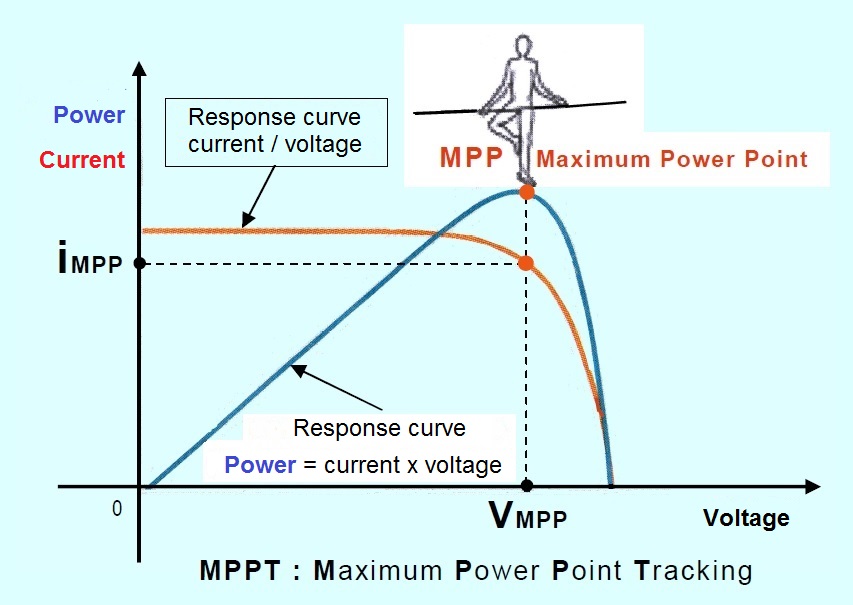
Every solar panel possesses a unique current-voltage (I-V) characteristic curve, which graphically represents the relationship between the current it produces and the voltage across its terminals. More critically, the power output of a solar panel (P = V * I) is not constant across its operating range. For any given set of environmental conditions (irradiance and temperature), there exists a single, specific operating point on the I-V curve where the product of voltage and current yields the absolute maximum power output. This point is known as the Maximum Power Point (MPP).
If a solar panel is connected directly to a load, its operating point will be dictated by the load’s impedance. Without an MPPT controller, it is highly improbable that the load’s impedance will perfectly match the solar panel’s internal impedance at its MPP. Consequently, the panel will operate at a sub-optimal voltage and current, resulting in a significantly lower power output than its maximum potential.
Factors Affecting Power Output
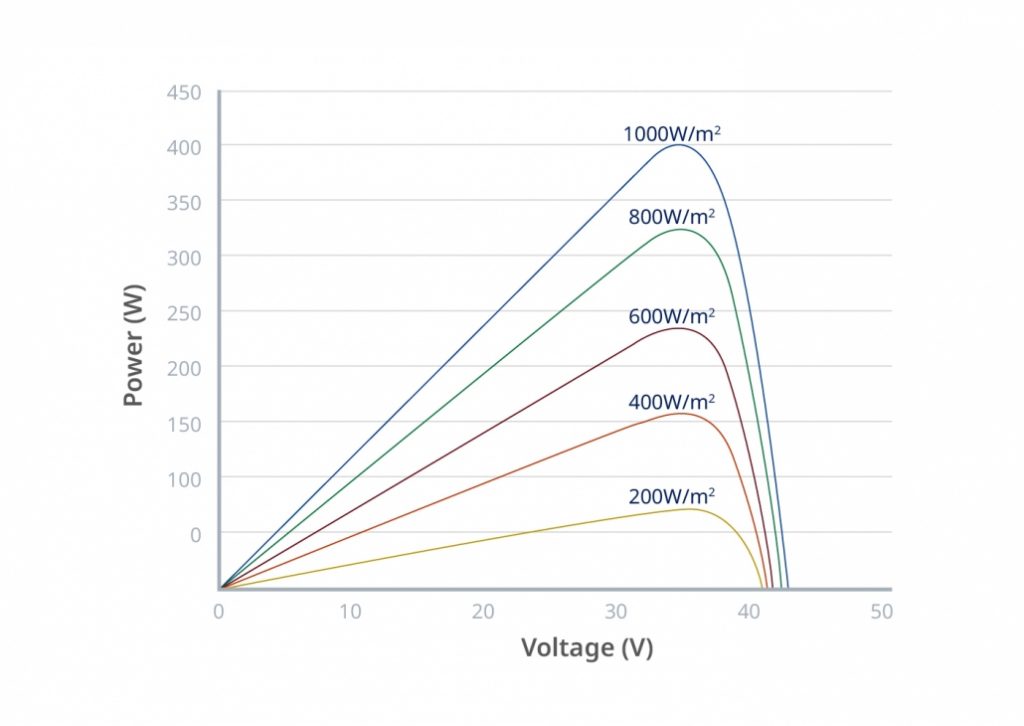
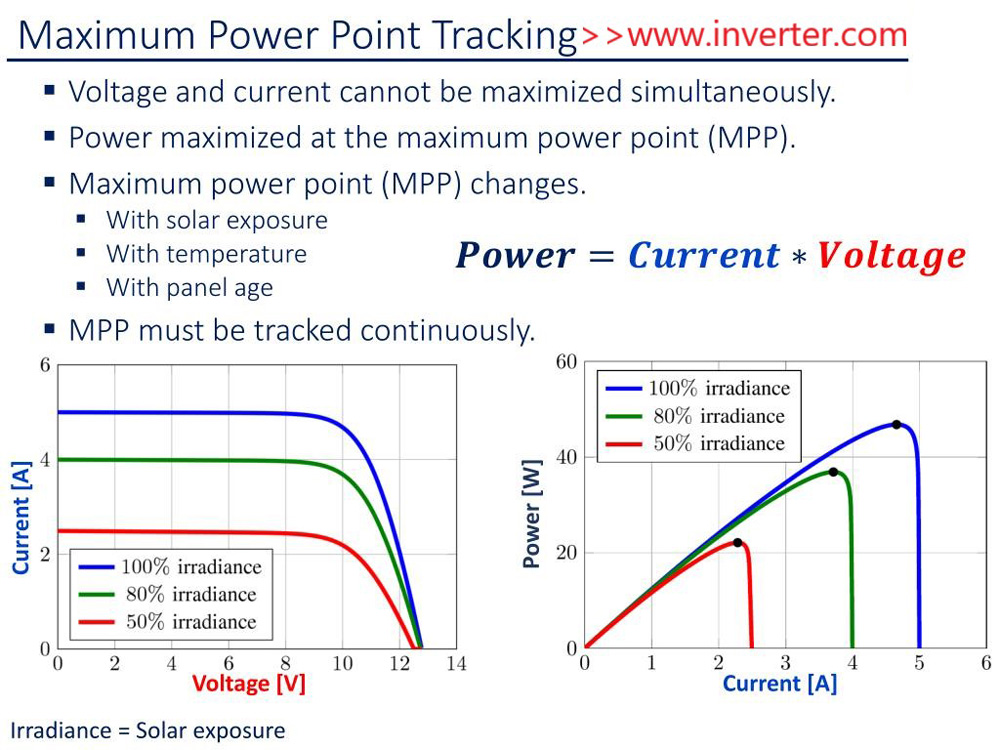
The location of the MPP on the I-V curve is not static; it dynamically shifts based on environmental conditions.
- Solar Irradiance (Sunlight Intensity): As the intensity of sunlight striking the panel changes (e.g., from clear sky to partial cloud cover, or during different times of day), the short-circuit current (Isc) of the panel changes almost proportionally. While the open-circuit voltage (Voc) changes only slightly, the entire I-V curve, and therefore the MPP, shifts. Higher irradiance generally leads to higher current and higher maximum power.
- Temperature: Temperature has an inverse relationship with a solar panel’s performance. As the panel’s temperature increases, its open-circuit voltage (Voc) decreases significantly, while the short-circuit current (Isc) increases only slightly. This leads to a substantial reduction in the overall power output and a downward shift of the MPP. A panel operating at 25°C will produce more power than the same panel operating at 45°C, even under identical irradiance.
These constant fluctuations mean that a fixed operating point for a solar panel would inevitably lead to considerable energy losses. An MPPT system is precisely engineered to overcome this variability by continuously tracking the shifting MPP.
How Maximum Power Point Tracking Works
The core functionality of MPPT lies in its ability to dynamically adjust the electrical load presented to the solar panel, forcing it to operate at its maximum power point, regardless of environmental changes or the state of the battery bank it is charging.
The Role of the MPPT Controller
At the heart of an MPPT system is an intelligent DC-to-DC converter. Unlike simple charge controllers that might only regulate voltage, an MPPT controller actively transforms the higher voltage, lower current output from the solar panel into the optimal voltage and current required by the battery or load. This transformation typically occurs via buck (step-down), boost (step-up), or buck-boost converter topologies, depending on the relative voltages of the solar array and the battery bank.
The controller’s primary task is to measure the current and voltage from the solar panel, calculate the instantaneous power, and then adjust its own internal impedance to draw the maximum possible power. It effectively acts as an impedance matching device between the solar panel and the load.
Core Algorithms and Techniques
Various algorithms are employed within MPPT controllers to efficiently track the MPP. The choice of algorithm impacts tracking speed, accuracy, and complexity.
-
Perturb and Observe (P&O): This is one of the simplest and most widely implemented algorithms. The P&O method works by periodically “perturbing” (slightly increasing or decreasing) the operating voltage of the solar panel and then “observing” the resulting change in power output.
- If a perturbation in voltage leads to an increase in power, the algorithm continues to perturb in the same direction.
- If power decreases, it reverses the direction of the perturbation.
The process is continuous, causing the operating point to oscillate around the true MPP. While easy to implement, P&O can sometimes struggle in rapidly changing conditions (e.g., fast-moving clouds) and may oscillate unnecessarily around the MPP, leading to minor power losses.
-
Incremental Conductance (IncCond): This algorithm offers improved performance over P&O. It utilizes the principle that the slope of the power-voltage (P-V) curve is zero at the MPP (dP/dV = 0). The IncCond algorithm continuously calculates the incremental conductance (dI/dV) and compares it to the instantaneous conductance (I/V) of the PV array.
- If dI/dV = -I/V, the operating point is at the MPP.
- If dI/dV > -I/V, the operating point is to the left of the MPP, and the voltage needs to be increased.
- If dI/dV < -I/V, the operating point is to the right of the MPP, and the voltage needs to be decreased.
IncCond generally provides faster tracking and reduces oscillations around the MPP, making it more robust, especially under dynamic weather conditions. However, it requires more complex calculations and sensing.
- Other Advanced Algorithms: More sophisticated algorithms leverage techniques like fuzzy logic, artificial neural networks (ANNs), and fractional open-circuit voltage or short-circuit current methods. These are often used in scenarios with complex shading patterns (where multiple local maxima can exist on the P-V curve) or for extremely rapid tracking needs. These methods typically require more computational power and sensor inputs.
System Components
An MPPT controller comprises several key components working in concert:
- Power Stage: The DC-DC converter (e.g., buck, boost) that performs the voltage and current transformation using switching components like MOSFETs.
- Control Unit: A microcontroller or digital signal processor (DSP) that executes the MPPT algorithm.
- Sensors: Voltage and current sensors to monitor the PV array’s output and the battery’s state.
- Driver Circuits: To switch the MOSFETs efficiently.
- Communication Interface: (Optional) For monitoring and remote control.
Why MPPT is Crucial for Renewable Energy Systems
The integration of MPPT technology has profoundly impacted the efficiency, reliability, and economic viability of solar power installations. Its benefits extend across various scales and applications.
Maximizing Energy Harvest
The most significant advantage of MPPT is its ability to extract the maximum possible power from solar panels. Depending on factors such as panel technology, temperature variations, and the specific MPPT algorithm used, these controllers can increase energy yield by an impressive 10% to 30% compared to traditional PWM (Pulse Width Modulation) charge controllers. In cooler climates or during periods of partial shading, the gains can be even more substantial. This direct increase in energy harvest translates into more electricity generated over the lifetime of the system, providing a faster return on investment and greater energy independence. For off-grid systems, it means more consistent power availability and reduced reliance on auxiliary power sources.
Enhancing System Efficiency and Reliability
MPPT controllers optimize the power flow not just from the panels, but also into the battery bank. By converting the solar panel’s output to the ideal charging voltage and current for the batteries, they ensure efficient and healthy battery charging cycles. This not only prolongs battery lifespan but also reduces wasted energy due to improper charging. Moreover, by ensuring optimal operating conditions, MPPT reduces electrical stress on the solar panels themselves, potentially contributing to their longevity and reliability. For grid-tied inverters, MPPT allows them to feed maximum power into the grid, optimizing revenue generation.
Adaptability to Environmental Changes
The dynamic nature of solar resources requires a system that can adapt. MPPT excels in this aspect, continuously adjusting the operating point to maintain maximum power output through fluctuating irradiance, temperature shifts, and even partial shading scenarios. This constant adaptation means that the system is always performing at its peak potential, regardless of whether it’s a bright, cold winter morning or a hot, hazy summer afternoon. This resilience makes solar power systems more dependable and predictable, even in regions with highly variable weather patterns.
Applications Beyond Solar PV
While most commonly associated with solar PV systems, the underlying principle of maximizing power extraction from a variable source has broader technological applications.
Wind Turbines
Similar to solar panels, small to medium-scale wind turbines produce power that varies significantly with wind speed. MPPT techniques are employed in wind energy conversion systems to optimize the generator’s output. By adjusting the load presented to the turbine’s generator, MPPT algorithms can ensure that the turbine operates at its most efficient aerodynamic point for any given wind speed, maximizing the mechanical power captured and converted into electricity. This often involves controlling the rotational speed of the turbine to match the optimal tip-speed ratio.
Thermoelectric Generators and Fuel Cells
Thermoelectric generators (TEGs) convert heat energy directly into electrical energy, and their output characteristics are highly dependent on temperature differentials. Fuel cells, which convert chemical energy into electricity, also exhibit non-linear output characteristics influenced by fuel flow and load. In both cases, applying MPPT principles allows for the extraction of maximum power, improving the overall efficiency of these alternative energy conversion devices. This is particularly relevant in niche applications where maximizing every joule of energy is critical.
Future Trends in MPPT Technology
The field of MPPT continues to evolve. Future trends include:
- Integration with Smart Grids: MPPT controllers are becoming more intelligent, communicating with grid systems to optimize power dispatch and participate in demand-response programs.
- AI-Driven Prediction and Optimization: Advanced algorithms using artificial intelligence and machine learning can predict shading patterns or weather changes to proactively adjust tracking, further minimizing power losses.
- Hybrid MPPT Systems: Combining different energy sources (e.g., solar and wind) into a single system, requiring complex MPPT strategies to balance and optimize power from multiple inputs.
- Module-Level Power Electronics (MLPE): Micro-inverters and power optimizers, which perform MPPT at the individual solar panel level, are gaining traction. This approach mitigates the impact of partial shading on an entire string of panels, leading to higher overall system efficiency and more granular control.
In conclusion, Maximum Power Point Tracking is a cornerstone technology in modern renewable energy systems, enabling solar panels and other variable sources to perform at their highest potential. Its continued development promises even greater efficiency, reliability, and integration into the energy infrastructure of the future.
aViewFromTheCave is a participant in the Amazon Services LLC Associates Program, an affiliate advertising program designed to provide a means for sites to earn advertising fees by advertising and linking to Amazon.com. Amazon, the Amazon logo, AmazonSupply, and the AmazonSupply logo are trademarks of Amazon.com, Inc. or its affiliates. As an Amazon Associate we earn affiliate commissions from qualifying purchases.