
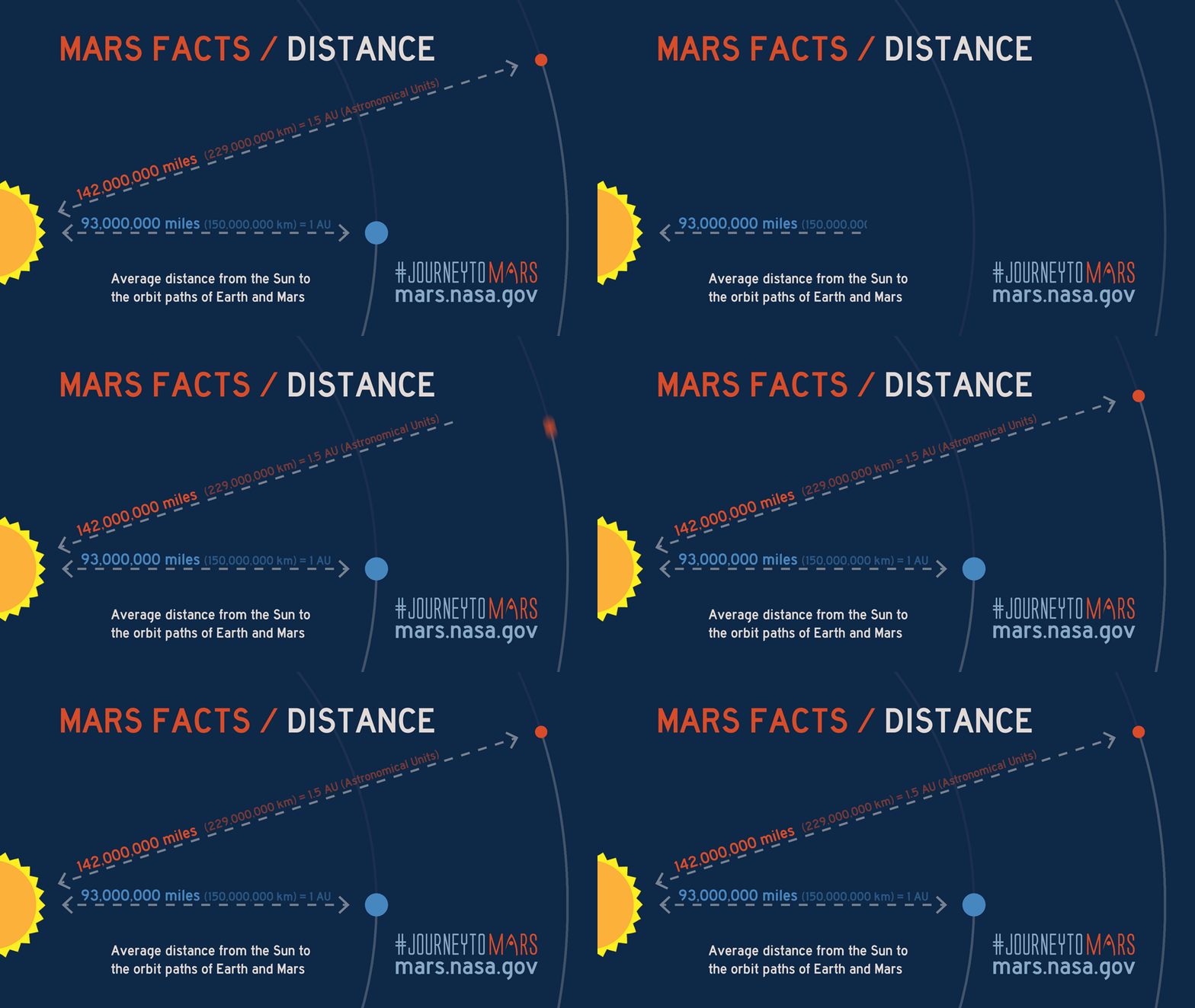
The question of Mars’ distance from the Sun, while seemingly a simple astronomical query, unlocks a profound narrative of technological innovation, computational prowess, and human ingenuity. It is not merely a static figure but a dynamic range, as Mars, like all planets, traces an elliptical path around our star. On average, Mars orbits approximately 228 million kilometers (142 million miles) from the Sun. However, this distance fluctuates significantly, ranging from a perihelion (closest point) of about 206.7 million kilometers (128.4 million miles) to an aphelion (farthest point) of roughly 249.2 million kilometers (154.8 million miles). Pinpointing and predicting these precise distances has been a cornerstone of space exploration, driven by an ever-evolving suite of advanced technologies.
The Technological Pursuit of Martian Orbits
Our understanding of celestial mechanics, and specifically Mars’ orbital parameters, has been a testament to continuous technological advancement. Early astronomers, relying on naked-eye observations and rudimentary instruments, painstakingly charted planetary movements, laying the groundwork for Kepler’s laws and Newton’s law of universal gravitation. These foundational scientific principles, however, required increasingly sophisticated tools to refine and apply to real-world observations.
Modern astronomy leverages an intricate network of observational technologies. Optical telescopes, from ground-based giants with adaptive optics to space-based observatories like the Hubble Space Telescope, provide high-resolution imaging and spectroscopic data, allowing scientists to track Mars’ position relative to background stars with incredible accuracy. Radio telescopes, part of global arrays such as the Very Large Array or the Atacama Large Millimeter/submillimeter Array (ALMA), contribute by detecting faint radio emissions and precisely measuring angular positions. Beyond mere observation, these instruments are intertwined with sophisticated data acquisition systems, digital signal processing, and high-speed data transfer networks, converting raw light and radio waves into structured datasets ready for analysis. The ability to precisely measure angular displacements and velocities over time is paramount, feeding into the complex algorithms that model Mars’ elliptical journey.
Software and Computational Astronomy: Pinpointing Planetary Paths
The sheer volume of observational data, coupled with the inherent complexities of gravitational dynamics involving multiple celestial bodies, necessitates powerful software and computational models. Early celestial mechanics relied on laborious manual calculations, but the advent of digital computing transformed the field.
Today, sophisticated N-body simulation software is the backbone of orbital mechanics. These programs simulate the gravitational interactions between Mars, the Sun, Earth, Jupiter, and other significant solar system bodies, predicting future positions with astonishing precision. They factor in subtle perturbations from planetary alignments, solar wind pressure, and even the relativistic effects predicted by Einstein’s theory of general relativity. Algorithms designed for numerical integration solve complex differential equations that govern orbital motion, iteratively calculating positions and velocities over vast timescales.
Furthermore, advanced data processing and visualization tools are indispensable. They transform raw telescope data, sometimes gigabytes per observation session, into meaningful orbital parameters. Software platforms allow astronomers and mission planners to visualize Mars’ trajectory in 3D, identify optimal launch windows for interplanetary missions, and simulate various mission scenarios. These tools don’t just answer “what is Mars’ distance from the Sun?” but predict “what will be Mars’ distance from the Sun on a specific date, from Earth’s perspective?” – a critical question for successful space travel. Predictive analytics in this domain involves not just deterministic models but also probabilistic methods to account for measurement uncertainties, ensuring robust mission planning.
AI and Machine Learning in Orbital Mechanics
The frontier of computational astronomy is increasingly shaped by artificial intelligence (AI) and machine learning (ML). These technologies are augmenting traditional numerical methods, offering new ways to enhance accuracy and efficiency.
AI algorithms can be trained on vast datasets of historical orbital observations and simulation results to identify subtle patterns and relationships that might be missed by human analysis or conventional models. This enables AI to refine orbital parameters, improve the accuracy of long-term predictions, and even detect minor deviations that could indicate unknown forces or measurement errors. For instance, ML models can optimize trajectory corrections for deep space probes, allowing them to autonomously adjust their paths in real-time based on onboard sensor data and predictive models of gravitational influences, thus conserving fuel and maximizing mission longevity.
Machine learning also plays a crucial role in anomaly detection within orbital data. By establishing baselines of expected behavior, AI systems can flag unexpected positional shifts or velocity changes, potentially indicating instrumentation errors, solar flares affecting spacecraft, or even the subtle effects of unmodeled celestial bodies. As space exploration becomes more complex, AI-driven automation and insight generation will be indispensable for managing missions that span millions of kilometers.
Gadgets of Exploration: Probes and Their Role in Distance Verification
While ground-based telescopes provide initial data, it is the “gadgets” of space exploration – the interplanetary probes and orbiters – that provide the ultimate verification and refinement of our understanding of Mars’ distance from the Sun.
The Deep Space Network (DSN), operated by NASA, is a prime example of a critical technological gadget. Comprising massive radio antennas strategically located around the globe, the DSN communicates with spacecraft throughout the solar system. By precisely measuring the round-trip time of radio signals (which travel at the speed of light) between Earth and a Mars-bound probe, scientists can calculate the exact distance between the two planets at any given moment. Furthermore, Doppler shift measurements of these radio signals provide extremely accurate data on the relative velocity of the spacecraft, which in turn helps to refine orbital models.
Mars orbiters and landers carry an array of sophisticated instruments. Laser altimeters map the Martian surface, providing highly accurate topographical data that can be correlated with orbital models. Radio science experiments use precise radio signals from orbiters to probe the Martian atmosphere and gravitational field, providing data that indirectly helps to confirm the probe’s position relative to Mars and, by extension, its orbital position around the Sun. These on-board instruments don’t just study Mars; they are critical data points for ground-truthing and improving the fidelity of our solar system models.
The propulsion technology that powers these probes, from traditional chemical rockets to advanced ion propulsion systems, also relies heavily on accurate distance calculations. Efficient trajectories are meticulously planned years in advance, taking into account planetary alignments and gravitational assists, all predicated on a precise understanding of Mars’ dynamic distance from the Sun.
Digital Security and the Integrity of Astronomical Data
In an era of increasing cyber threats, the integrity of astronomical data, especially that which governs interplanetary missions, is paramount. Knowing Mars’ distance from the Sun requires accurate and trustworthy data, and this necessitates robust digital security measures.
Protecting data streams from deep space missions is a critical concern. Encrypting telemetry data, command sequences, and scientific observations ensures that sensitive orbital parameters and mission-critical instructions cannot be intercepted or tampered with. Authentication protocols verify the source and legitimacy of all communications, preventing unauthorized entities from injecting false data or issuing erroneous commands that could jeopardize a mission or corrupt our understanding of celestial mechanics.
Cybersecurity for ground control systems and supercomputing facilities that run orbital simulations is equally vital. The financial, scientific, and geopolitical implications of a compromised mission or manipulated astronomical data are immense. Ensuring the integrity of software that calculates trajectories, manages power systems, and processes observational data is a continuous effort, involving regular audits, intrusion detection systems, and strict access controls. Without secure data, the scientific consensus on fundamental facts like planetary distances could be undermined, impacting future research, mission planning, and even our collective understanding of the cosmos.
Future Tech and Interplanetary Travel
The quest for ever-greater precision in understanding Mars’ distance from the Sun continues to drive future technological advancements. Next-generation observational tools, such as advanced adaptive optics on ground-based telescopes and new space telescopes designed for high-precision astrometry, promise even more accurate measurements. The development of quantum computing, with its potential to simulate complex N-body gravitational systems with unprecedented speed and accuracy, could revolutionize our ability to predict planetary positions and optimize interplanetary trajectories.
These technological pursuits are not academic exercises; they are the bedrock upon which future interplanetary travel will be built. As humanity eyes crewed missions to Mars, the precise knowledge of its dynamic distance from the Sun, underpinned by cutting-edge technology in observation, computation, AI, and digital security, will be the ultimate enabler of safe, efficient, and successful journeys across the vast expanse of space.
aViewFromTheCave is a participant in the Amazon Services LLC Associates Program, an affiliate advertising program designed to provide a means for sites to earn advertising fees by advertising and linking to Amazon.com. Amazon, the Amazon logo, AmazonSupply, and the AmazonSupply logo are trademarks of Amazon.com, Inc. or its affiliates. As an Amazon Associate we earn affiliate commissions from qualifying purchases.