
For the uninitiated, the term “links” is frequently misused in the golfing world. It has become a catch-all descriptor for any course located near the ocean, or perhaps one that features tall fescue grass and pot bunkers. However, in the world of golf architecture and professional sports strategy, a true links course is a specific geographical and botanical phenomenon. Understanding the distinction is essential for any player, spectator, or analyst who wants to appreciate the nuances of the game as it was originally intended.
The Geomorphology of a Links Course
The term “links” is derived from the Old English word hlinc, meaning rising ground or ridge. Historically, it refers to the strip of land—often barren and sandy—that connects the fertile agricultural land of a coastal village to the sandy beaches of the sea. This transitional zone, carved by wind and tide, represents the primordial foundation upon which the game of golf was built.

The Sandy Substrate
The defining characteristic of a true links course is its sandy soil composition. Because these lands are essentially dunes reclaimed from the sea, they possess a unique drainage profile. Rainwater does not pool on the surface; instead, it filters rapidly through the sand. This natural drainage is why links courses remain playable even in the most torrential weather, a stark contrast to the clay-heavy “parkland” courses found inland. This substrate dictates the entire experience of the game, forcing the ball to bounce and roll rather than landing with the “stop-and-drop” precision seen on manicured, irrigated inland greens.
The Absence of Trees
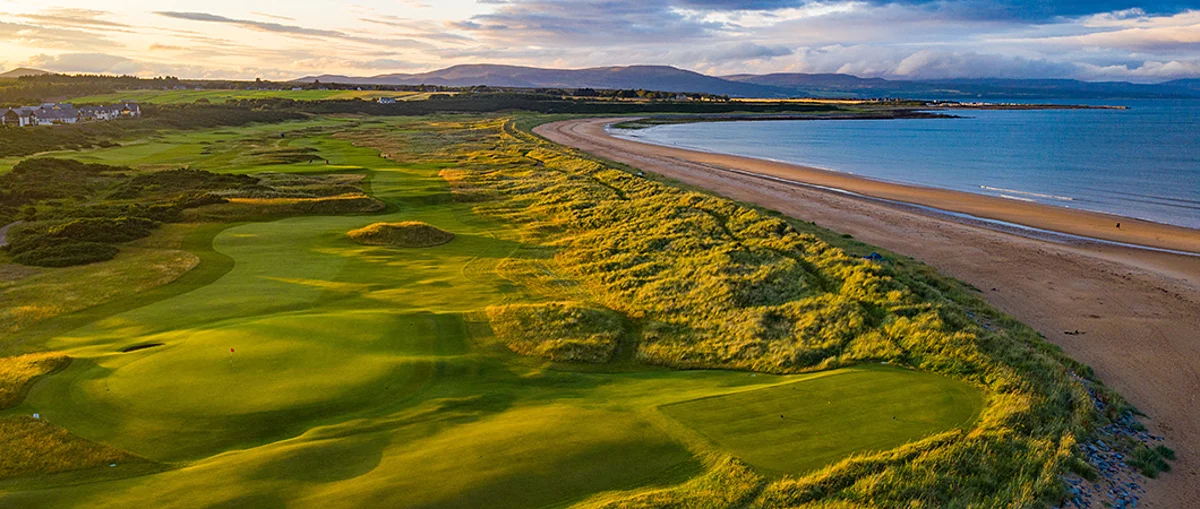
You will rarely find trees on a traditional links course. This is not due to a stylistic choice by the architect, but rather a biological reality. The salt spray blowing off the ocean, combined with the extreme winds and the nutrient-poor, sandy soil, makes it nearly impossible for forest ecosystems to establish themselves. This lack of vertical obstructions is what makes a links course so exposed. When the wind picks up, there is nowhere to hide, and the golfer must account for every gust in their trajectory.
The Architectural Philosophy of Nature
While modern golf design often focuses on landscaping, earth-moving, and irrigation, links design is an act of discovery. Legendary architects like Old Tom Morris and Alister MacKenzie did not “build” these courses so much as they uncovered the holes that the dunes had already hidden.
The Ground Game
On a modern parkland course, the aerial game is paramount; the objective is to launch the ball high, carry it over hazards, and stop it near the flag. On a links course, the aerial game is a trap. Because the turf is firm and the wind is unpredictable, playing high shots often leads to disaster. A true links golfer masters the “ground game”—the art of bumping and running the ball along the turf, using the natural contours of the fairways to guide the ball toward the hole. Understanding the bounce of the land is the highest form of skill on a links layout.
Natural Hazards
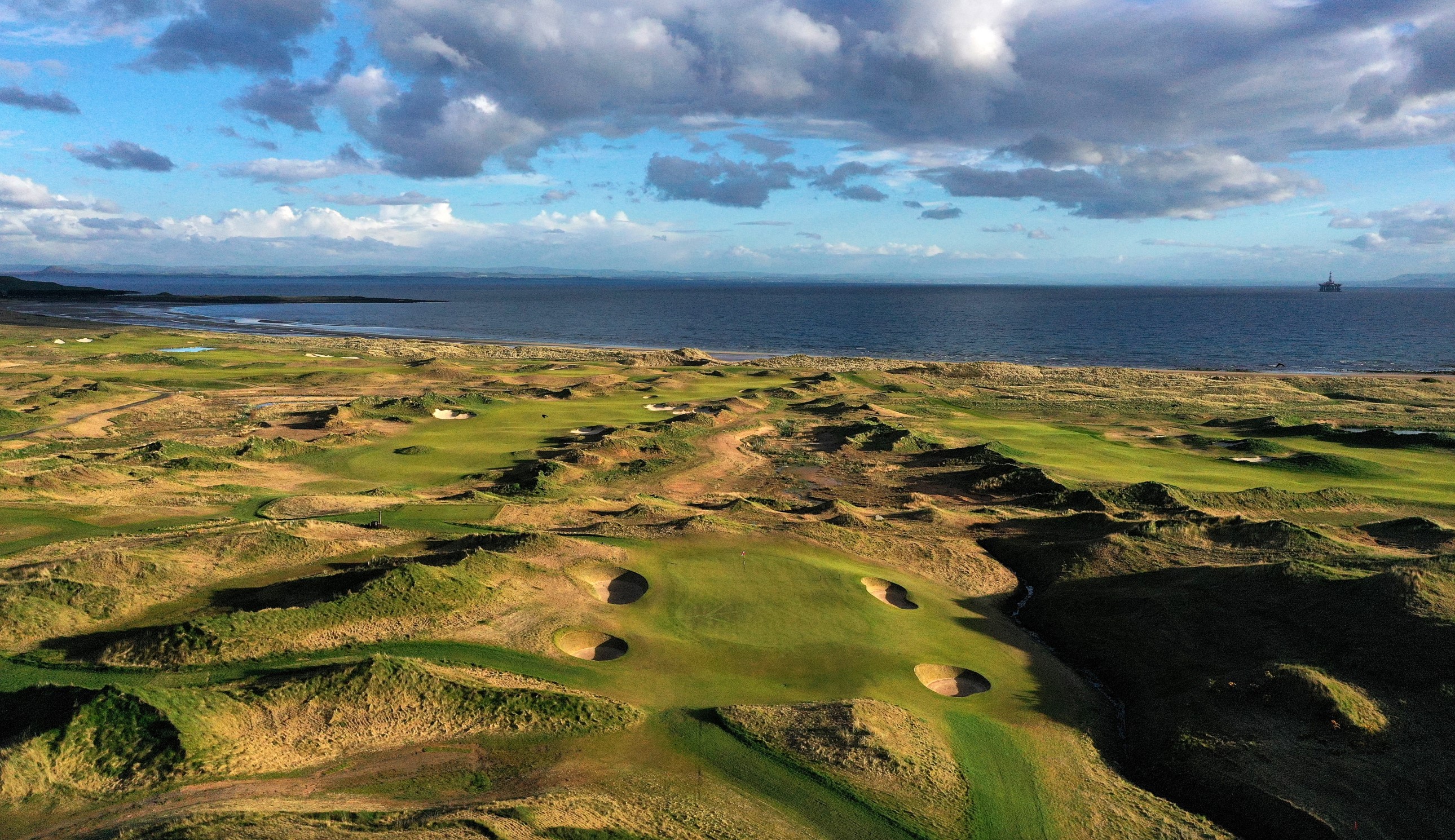
Inland courses often rely on man-made bunkers, manicured water features, and symmetrical landscaping. Links courses use the landscape itself as a hazard. The bunkers on a links course are typically deep, vertical-walled “pot” bunkers, designed to penalize the errant shot severely. Because the sand is firm and the wind is constant, these bunkers are not just obstacles—they are tactical zones that force players to take significant risks or prioritize safer, circuitous routes to the green.
Managing the Links Environment
Playing a links course requires a shift in both strategy and temperament. It is a psychological test as much as a physical one. The conditions change not just day-to-day, but hour-to-hour. A player who masters the links is one who learns to respect the randomness of the bounces and the overwhelming presence of the elements.
The Importance of Low Ball Flight
A primary technique on a links course is the “knockdown” or “punch” shot. By moving the ball back in the stance and restricting the follow-through, players can keep their shots low, penetrating the wind and minimizing the effect of gusts. This is a skill rarely required on the lush, soft courses of the American PGA Tour, but it is the prerequisite for success at events like The Open Championship.
Reading the Firmness
The greens on a links course are rarely “soft.” They are often firm and undulating, meaning that a ball landing on the putting surface will behave like a bowling ball on a hardwood floor if the angle of descent is too steep. Strategic play involves aiming for the “shoulders” or the “aprons” of the greens, using the slope of the land to feed the ball toward the hole. It is a game of geometry, requiring the player to see the course as a three-dimensional puzzle rather than a series of targets.
The Cultural Legacy of the Links
The culture of links golf is deeply intertwined with the history of the sport itself. These courses are almost always public or semi-private, deeply integrated into the fabric of the towns they inhabit. Unlike the exclusive, gated country clubs of the United States, links courses are often public land where golf is simply the activity that happens to take place there.
Minimalism and Sustainability
In an era where golf is often criticized for its environmental impact—due to the massive water consumption and chemical usage required to keep inland greens bright green—links golf stands as a model for sustainability. Because links grasses are fescue-based and adapted to the coastal environment, they require very little water and thrive on natural conditions. The aesthetic of a links course is “brown is beautiful.” When the grass turns golden in the heat of summer, it is not a sign of neglect, but a sign of a healthy, natural ecosystem.
The Human Element
Finally, the links course serves as a great equalizer. Because the terrain is so unpredictable and the weather so fickle, the gap between a scratch golfer and an average player often narrows. A bad bounce on a links course is an inevitable part of the game, and the golfer who complains about luck is the one who will struggle the most. Links golf teaches humility. It demands that players accept the imperfections of the earth, the ferocity of the wind, and the inevitable reality that in this game, nature is the ultimate arbiter of success.
By understanding that a links course is a specific, sandy, wind-swept, tree-less, naturally drained landscape, one gains a deeper appreciation for why this format remains the gold standard for pure golf. It is not merely a place to play; it is a direct line to the history of the sport, a challenge to one’s tactical ingenuity, and a reminder that the best golf architecture is often found exactly where it was left by the sea.
aViewFromTheCave is a participant in the Amazon Services LLC Associates Program, an affiliate advertising program designed to provide a means for sites to earn advertising fees by advertising and linking to Amazon.com. Amazon, the Amazon logo, AmazonSupply, and the AmazonSupply logo are trademarks of Amazon.com, Inc. or its affiliates. As an Amazon Associate we earn affiliate commissions from qualifying purchases.