
In the ever-expanding landscape of data science and machine learning, dealing with complex datasets rich in features is a common yet challenging task. As businesses and researchers harness more data than ever before, the need for robust, efficient, and interpretable models becomes paramount. This is where regularization techniques like Lasso regression step in, offering a powerful solution to some of the most persistent problems in predictive modeling.
The Challenge of Complex Datasets
Modern datasets are often characterized by a high number of features or variables, sometimes far exceeding the number of observations. This “high dimensionality” introduces several significant problems for traditional statistical models, particularly Ordinary Least Squares (OLS) regression. Firstly, a multitude of features can lead to multicollinearity, where independent variables are highly correlated with each other, making it difficult to ascertain the individual impact of each feature. Secondly, and perhaps more critically, an abundance of features increases the risk of overfitting. Overfitting occurs when a model learns the training data too well, capturing noise and specific patterns that do not generalize to new, unseen data. The result is a model that performs excellently on historical data but fails miserably in real-world predictions. To build reliable and practical predictive systems, especially within AI and software development, effective strategies for feature selection and complexity management are essential.

Demystifying Lasso Regression
Lasso, an acronym for “Least Absolute Shrinkage and Selection Operator,” is a revolutionary regularization technique designed to enhance the accuracy and interpretability of regression models by performing both variable selection and regularization. It addresses the challenges of high-dimensional data by introducing a penalty term to the standard OLS objective function. Unlike traditional methods that only minimize the sum of squared errors, Lasso adds a constraint that shrinks regression coefficients, effectively reducing their magnitude and even forcing some to exactly zero.
The L1 Penalty: Driving Coefficients to Zero
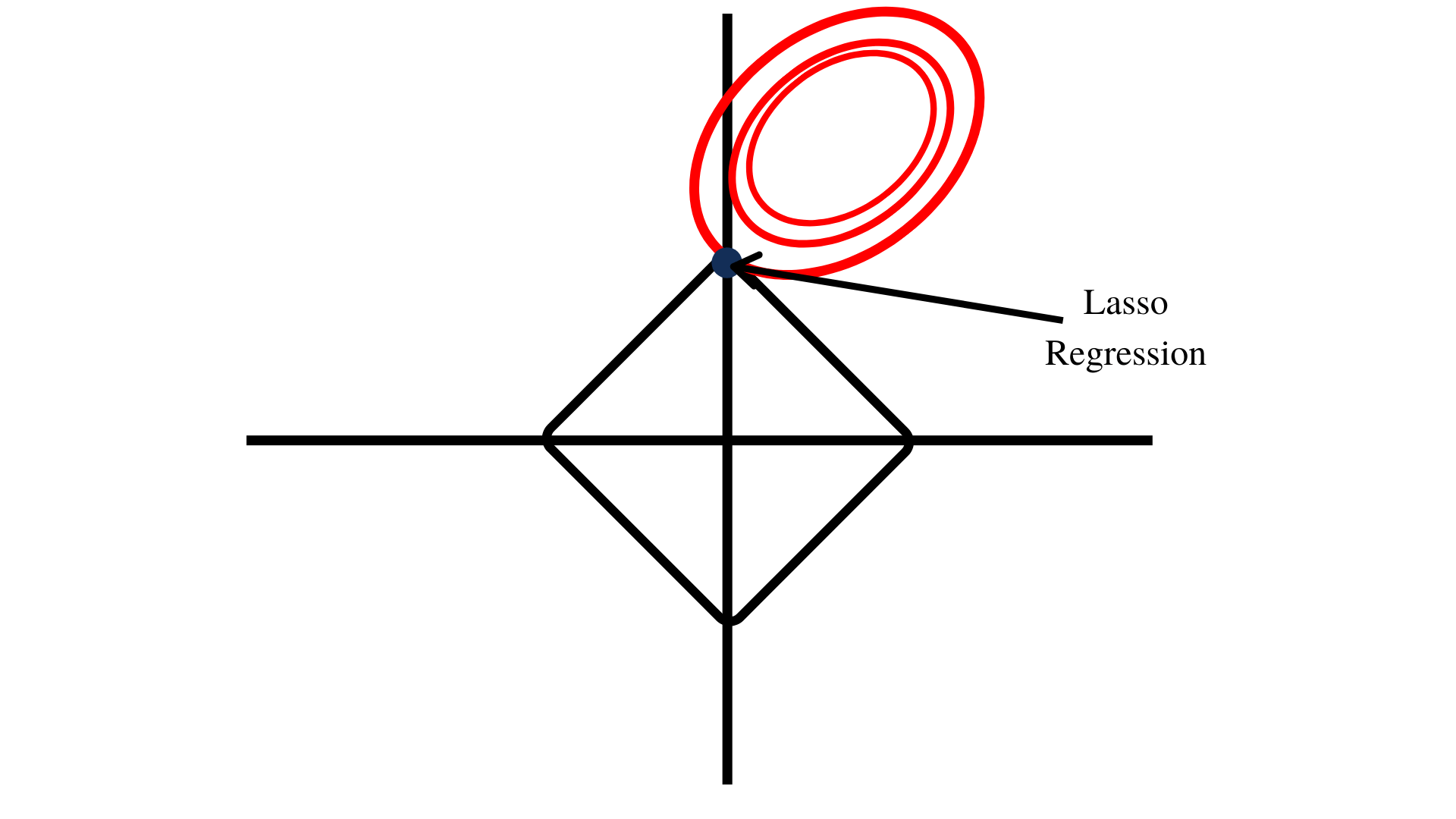
The core mechanism behind Lasso’s power lies in its use of the L1 penalty, also known as the Manhattan distance or taxicab norm. Mathematically, the Lasso objective function minimizes the sum of squared residuals plus a penalty proportional to the sum of the absolute values of the regression coefficients. This L1 norm penalty ($lambda sum | beta_j |$) is critical because of its unique property: it tends to force the coefficients of less important features to exactly zero. When a coefficient becomes zero, it means that the corresponding feature has been entirely excluded from the model. This automatic feature selection is Lasso’s defining characteristic and a significant advantage over other regularization methods like Ridge regression, which only shrinks coefficients towards zero without eliminating them completely. By simplifying the model and focusing on the most relevant features, Lasso reduces complexity and enhances the model’s interpretability.
The Tuning Parameter: Balancing Bias and Variance
A crucial component of Lasso regression is the tuning parameter, often denoted by $lambda$ (lambda) or $alpha$ (alpha). This parameter controls the strength of the L1 penalty applied to the coefficients.
- When $lambda$ is set to zero, the L1 penalty term vanishes, and Lasso regression essentially reverts to standard OLS regression. In this scenario, there is no coefficient shrinkage or feature selection.
- As $lambda$ increases, the penalty for large coefficients becomes stronger. This forces more coefficients to shrink towards zero, and eventually, many are driven to exactly zero. A higher $lambda$ leads to a simpler model with fewer features, increasing bias but potentially reducing variance and thus improving generalization to new data.
The optimal value for $lambda$ is typically determined through techniques like cross-validation. This involves splitting the dataset into multiple subsets, training the model on some subsets, and evaluating its performance on the others, allowing for an unbiased selection of the $lambda$ that yields the best predictive accuracy on unseen data. The careful selection of $lambda$ is key to striking the right balance between model complexity and predictive power, ensuring the model is neither overfit nor underfit.
Core Benefits for Modern Technology
Lasso regression offers a suite of compelling benefits that make it an invaluable tool across various technological domains, from AI development to data analytics platforms. Its ability to simplify models while maintaining or even improving predictive performance is particularly attractive in a world drowning in data.
Automatic Feature Selection
One of Lasso’s most celebrated advantages is its inherent capability for automatic feature selection. In datasets with hundreds or thousands of potential predictors, manually identifying the most relevant features is a daunting, often subjective, and computationally intensive task. Lasso elegantly automates this process by driving the coefficients of irrelevant or redundant features to zero. This results in a “sparse” model, meaning a model with fewer active predictors. For technology applications, this translates into several practical benefits:
- Reduced Model Complexity: Simpler models are easier to understand, maintain, and deploy.
- Improved Computational Efficiency: Models with fewer features train faster and make predictions more quickly, which is critical for real-time applications and large-scale deployments.
- Targeted Data Collection: Understanding which features are most important can guide future data collection efforts, leading to more efficient resource allocation.
Robust Overfitting Prevention
Overfitting is a pervasive threat in machine learning, particularly when models are trained on limited data or datasets with many features relative to observations. Lasso directly addresses this by introducing the L1 penalty, which constrains the model’s complexity. By shrinking coefficients and setting many to zero, Lasso prevents the model from learning the noise in the training data. This regularization leads to models that generalize much better to new, unseen data, making predictions more reliable and robust. For AI systems, where trust and accuracy are paramount, a model’s ability to avoid overfitting is non-negotiable. This translates to more stable and dependable AI products, from recommendation engines to diagnostic tools.
Enhanced Model Interpretability
Beyond just predicting accurately, understanding why a model makes certain predictions is increasingly important, especially in critical applications like healthcare, finance, or autonomous systems. Lasso significantly enhances model interpretability by producing sparse models. When only a subset of features has non-zero coefficients, it becomes much clearer which variables are driving the model’s decisions. This transparency is invaluable for:
- Debugging and Validation: Easier to pinpoint potential issues or biases in the model.
- Domain Insight: Provides actionable insights into the underlying processes or relationships within the data, aiding human experts in decision-making.
- Regulatory Compliance: Fulfills requirements for explainable AI (XAI) in regulated industries.
For example, in a predictive maintenance system, Lasso can highlight which sensor readings are the strongest indicators of equipment failure, allowing engineers to focus on those specific components.
Practical Deployment and Use Cases
Integrating Lasso regression into modern technological workflows is straightforward, thanks to its widespread availability in popular programming libraries and its conceptual simplicity. Its effectiveness makes it a go-to technique for data scientists and machine learning engineers across various industries.
Data Preprocessing and Model Training
Before applying Lasso, a crucial preprocessing step involves standardizing or normalizing the features. Since the L1 penalty adds the absolute value of coefficients to the cost function, features with larger scales would inherently have a greater impact on the penalty than features with smaller scales, even if their actual importance is similar. Standardization ensures that all features contribute equally to the penalty term, preventing features with larger numerical ranges from disproportionately influencing the shrinkage process.
Training a Lasso model typically involves selecting the optimal $lambda$ through cross-validation. Libraries such as scikit-learn in Python, glmnet in R, and similar packages in MATLAB or Julia provide highly optimized implementations that allow for efficient fitting of Lasso models across a range of $lambda$ values. These tools often include built-in cross-validation utilities to streamline the parameter tuning process, making Lasso accessible even for users with limited theoretical expertise.
Real-World Applications Across Tech
Lasso’s versatility makes it applicable to a wide array of technological challenges:
- Predictive Analytics: In business intelligence, Lasso can predict sales trends, customer churn, or stock prices by identifying the most influential economic indicators, marketing efforts, or customer demographics.
- Bioinformatics and Genomics: For analyzing high-dimensional gene expression data, Lasso is instrumental in selecting a small subset of genes that are most relevant for predicting disease outcomes, drug response, or patient classification, aiding in precision medicine.
- Natural Language Processing (NLP): When dealing with text data, features often represent word frequencies or N-grams. Lasso can select the most discriminative words or phrases for tasks like sentiment analysis, spam detection, or document classification, reducing the dimensionality of the text feature space.
- Image and Signal Processing: Lasso can be used for tasks such as image denoising or compression by identifying the most important coefficients in sparse representations of signals.
- Cybersecurity: In anomaly detection, Lasso can help identify which network traffic features are most indicative of malicious activity, thereby building more efficient and accurate intrusion detection systems.
- IoT and Sensor Data: Analyzing streams of sensor data from IoT devices, Lasso helps pinpoint critical sensor readings that predict system failures or abnormal conditions, crucial for preventative maintenance and operational efficiency.

Lasso in the Broader Machine Learning Ecosystem
Lasso regression is not an isolated technique but an integral part of the broader machine learning toolkit. It serves as a fundamental building block in many advanced algorithms and methodologies. For instance, it underpins the development of techniques like Elastic Net regularization, which combines Lasso’s L1 penalty with Ridge regression’s L2 penalty. Elastic Net is particularly useful when faced with groups of highly correlated features, as it can select entire groups of correlated features together, whereas Lasso might arbitrarily pick only one from the group.
Furthermore, Lasso’s principles are extended to other models beyond linear regression, such as logistic Lasso for classification tasks or generalized linear models. Its efficacy in feature selection and regularization has also made it a key component in automated machine learning (AutoML) platforms, where it can be used to intelligently reduce the feature space before applying more complex models, thereby improving overall model performance and training times. Its impact on the development of robust, scalable, and interpretable AI and machine learning solutions continues to grow, solidifying its place as a cornerstone in modern data-driven technology.
aViewFromTheCave is a participant in the Amazon Services LLC Associates Program, an affiliate advertising program designed to provide a means for sites to earn advertising fees by advertising and linking to Amazon.com. Amazon, the Amazon logo, AmazonSupply, and the AmazonSupply logo are trademarks of Amazon.com, Inc. or its affiliates. As an Amazon Associate we earn affiliate commissions from qualifying purchases.