
Understanding the currency of a nation is the first step toward mastering its financial landscape, whether you are a global investor, a business traveler, or a personal finance enthusiast. South Korea, one of the world’s most vibrant economies, operates on a unique monetary system that reflects its rapid transition from an agrarian society to a global technological powerhouse.
The official currency of South Korea is the South Korean Won. In international financial markets, it is denoted by the ISO code KRW and represented by the symbol ₩. While the name “Won” is simple, the financial infrastructure, history, and modern management of this currency are multifaceted. This guide explores everything from the denominations and historical evolution of the Won to its current standing in the global economy and its future in a digital-first world.
Understanding the South Korean Won (KRW): Symbols, Denominations, and Value
To engage with the South Korean economy, one must first understand the mechanics of its physical and digital money. The Won is the sole legal tender in the Republic of Korea, managed and issued by the Bank of Korea (BOK), the nation’s central bank based in Seoul.
The Basics: Won, Jeon, and the Symbol ₩
The term “Won” is a cognate of the Chinese Yuan and the Japanese Yen, all of which historically derived from the same Chinese character meaning “round shape” or “round coin.” While the Won is the primary unit, there is a theoretical subunit called the Jeon, which represents 1/100th of a Won. However, in modern daily transactions, the Jeon is no longer used for physical currency due to the Won’s valuation; it exists only in foreign exchange calculations and accounting contexts.
The symbol for the Won, ₩, consists of a capital “W” with two horizontal strikes. When looking at exchange rates, you will see it paired against the US Dollar (USD/KRW) or the Euro (EUR/KRW). Because the Won’s value per unit is lower than that of the Dollar, exchange rates often appear in the thousands (e.g., 1,300 KRW to 1 USD).
Current Denominations in Circulation
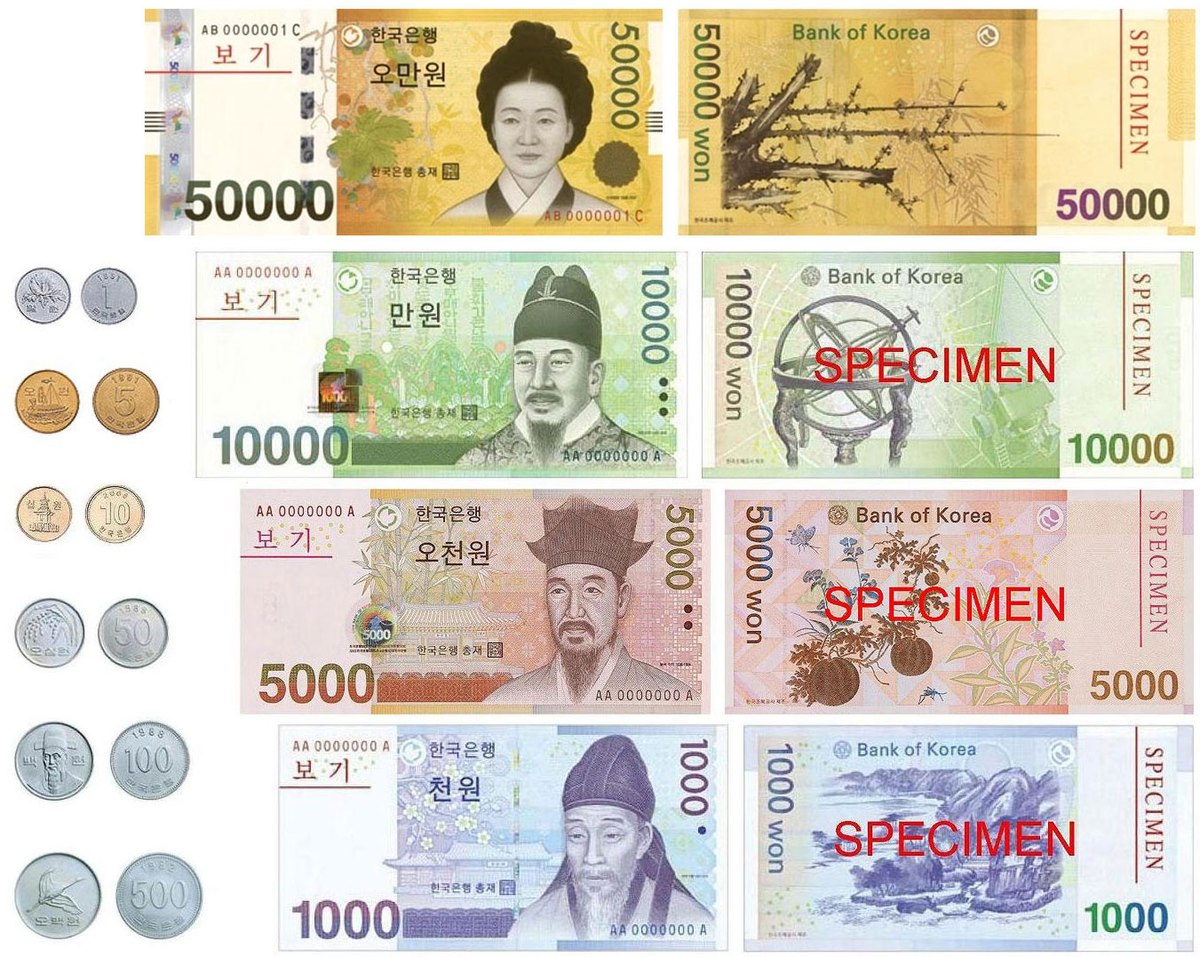
South Korean currency is available in both banknotes and coins, designed with high-security features and honoring significant historical figures and cultural landmarks.
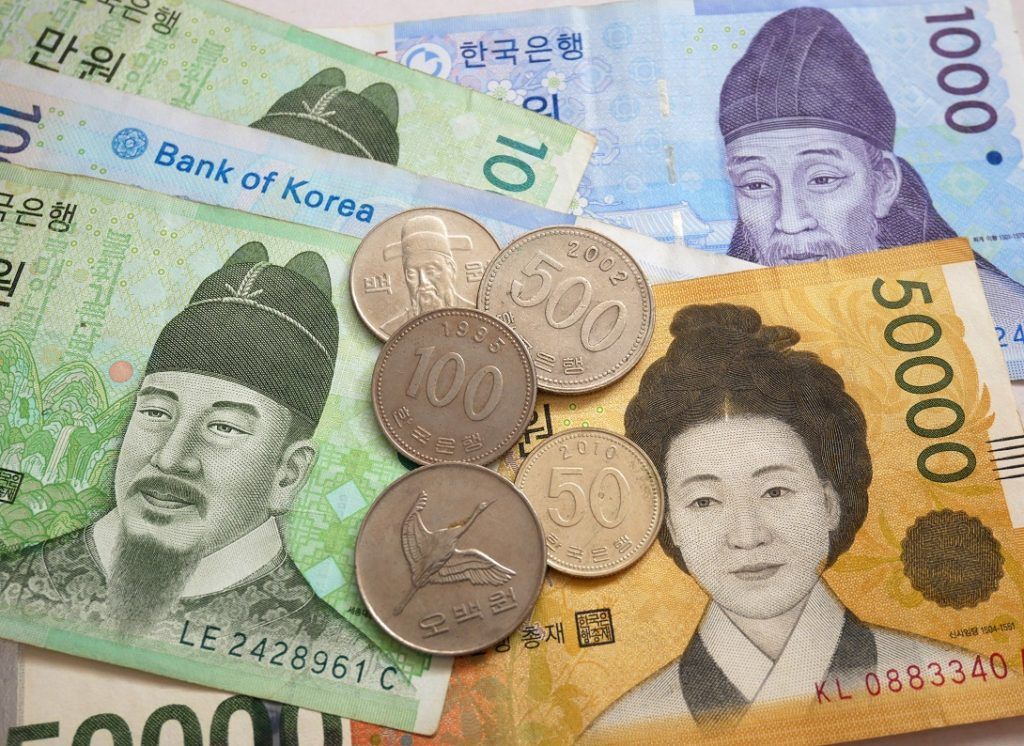
- Banknotes: The most common notes are the 1,000, 5,000, 10,000, and 50,000 Won. The 50,000 Won note, introduced in 2009, is the highest denomination and features Shin Saimdang, a prominent female artist and calligrapher from the Joseon Dynasty.
- Coins: Coins are issued in denominations of 1, 5, 10, 50, 100, and 500 Won. In practice, the 1 and 5 Won coins are extremely rare in circulation, as most prices are rounded to the nearest 10 Won. The 100 and 500 Won coins remain the workhorses of small-scale cash transactions.
The Exchange Rate Mechanism and Global Standing
The KRW is a “fully floating” currency, meaning its value is determined by the open market through supply and demand. As the currency of the world’s 10th to 12th largest economy (depending on the year), the Won is a significant player in Asian markets. Its value is often seen as a barometer for global tech demand, as South Korea is a leading exporter of semiconductors, automobiles, and electronics.
A Financial History: The Evolution of Money in Korea
The story of the Won is a reflection of the “Miracle on the Han River”—the rapid economic growth South Korea experienced following the Korean War. The currency has undergone several iterations to reach its current state of stability.
From Ancient Bartering to the Introduction of the First Won
Before the modern Won, Korea used various forms of currency, including grain, cloth, and eventually copper coins known as Sangpyeong Tongbo during the Joseon Dynasty. The first “Won” was introduced in 1902, replacing the Yang. However, following the Japanese occupation in 1910, the currency was replaced by the Korean Yen, which was pegged to the Japanese Yen.
Post-War Economic Shifts and the Second Won
After World War II and the subsequent division of the peninsula, the South Korean Won was reintroduced in 1945. This era was marked by extreme volatility. The Korean War (1950–1953) led to massive inflation, forcing the government to replace the Won with a new currency called the Hwan in 1953 at a rate of 100 to 1.
The “Second Won” (the current version) was established in June 1962. The Hwan was replaced by the Won at a rate of 10 to 1. At that time, the currency was pegged to the US Dollar to maintain stability during the country’s early industrialization phase.
The Path to Modern Stability: Inflation and Currency Reform
Throughout the 1980s and 1990s, South Korea transitioned toward a more liberalized financial system. The most significant turning point occurred during the 1997 Asian Financial Crisis. As part of an IMF agreement, South Korea allowed the Won to float freely against international currencies. While this led to a sharp initial devaluation, it ultimately allowed the South Korean economy to become more resilient and market-oriented. Today, the Won is considered a stable and reliable currency within the global financial system.
Navigating the Korean Financial Landscape for Travelers and Investors
Whether you are managing personal finance during a trip or looking at the KRW as an investment asset, understanding the practical application of the currency is essential.
Managing Personal Finance While Visiting South Korea
For those traveling to or living in South Korea, managing money is remarkably efficient. While cash is still used for traditional markets or small street food stalls, South Korea is one of the most credit-card-friendly countries in the world.
- Currency Exchange: It is generally recommended to exchange a small amount of cash at the airport and then use local ATMs (marked “Global ATM”) for better rates.
- Taxes and Tipping: In South Korea, the Value Added Tax (VAT) is usually included in the price of goods. Tipping is not a standard practice and can sometimes be misunderstood; the price you see is the price you pay.
Digital Payments vs. Cash: The Shift Toward a Cashless Society
South Korea is rapidly becoming a cashless society. Financial tools like KakaoPay, Naver Pay, and Samsung Pay are integrated into almost every facet of life. Furthermore, the “T-Money” card—originally a transportation card—has evolved into a versatile financial tool that can be used at convenience stores, cafes, and vending machines.
From a personal finance perspective, the transparency of digital transactions in Korea makes it easy to track spending via mobile apps. For expats and locals alike, the banking apps provided by institutions like KB Kookmin, Shinhan, or the digital-only KakaoBank offer world-class user interfaces and financial management features.
Investing in the KRW: Risks and Opportunities
For currency traders and investors, the South Korean Won offers a unique profile. It is often categorized as a “high-beta” currency among emerging markets, meaning it can be sensitive to shifts in global risk appetite.
- Export Correlation: Because South Korea’s economy is export-led, the Won often strengthens when global trade is booming.
- Geopolitical Factors: Movements in the Won can also be influenced by geopolitical tensions on the Korean Peninsula.
- Interest Rates: The Bank of Korea’s interest rate decisions are closely watched by investors looking for yield, particularly in comparison to the US Federal Reserve’s movements.
The Future of the Won: Digital Currencies and Economic Outlook
As we move further into the decade, the South Korean Won is poised for a digital transformation that could redefine how money is used in East Asia.
The Bank of Korea’s Exploration of CBDCs
The Bank of Korea has been at the forefront of researching Central Bank Digital Currencies (CBDCs). Unlike decentralized cryptocurrencies like Bitcoin, a digital Won would be a regulated, digital version of the fiat currency. The BOK has already conducted multiple phases of testing for a digital Won, focusing on its use in retail payments and cross-border transfers.
The implementation of a CBDC could lower transaction costs, increase financial inclusion, and provide the government with better tools to combat financial fraud. For the average consumer, it would mean a seamless transition between physical and programmable money.
The Won’s Role in the “Miracle on the Han River” Legacy
The future of the Won is inextricably linked to South Korea’s ability to innovate. As the nation invests heavily in AI, green energy, and biotechnology, the Won must maintain its purchasing power to support these capital-intensive industries. While the country faces demographic challenges such as an aging population, its robust foreign exchange reserves (among the highest in the world) provide a significant cushion against financial shocks.

Summary of Financial Strategy
For those interacting with the South Korean Won, the strategy should be one of digital integration. Utilizing local fintech apps for daily management, keeping an eye on the BOK’s interest rate trends for investment, and understanding the historical resilience of the KRW provides a clear advantage. The South Korean Won is more than just “Korean currency”; it is the financial lifeblood of one of the world’s most innovative and disciplined economies.
By understanding what the Korean currency is called and how it functions, you gain more than just a fact—you gain a window into the financial soul of South Korea. Whether you are holding a 50,000 Won note or tapping a digital wallet in a Seoul subway, you are participating in a sophisticated monetary legacy that continues to evolve.
aViewFromTheCave is a participant in the Amazon Services LLC Associates Program, an affiliate advertising program designed to provide a means for sites to earn advertising fees by advertising and linking to Amazon.com. Amazon, the Amazon logo, AmazonSupply, and the AmazonSupply logo are trademarks of Amazon.com, Inc. or its affiliates. As an Amazon Associate we earn affiliate commissions from qualifying purchases.