
In the rapidly evolving landscape of data technology, the ability to transform raw information into actionable insights is no longer a luxury—it is a fundamental requirement for survival. As organizations grapple with the “Big Data” era, the demand for accessible yet powerful analytical tools has surged. Enter KNIME, the Konstanz Information Miner.
KNIME is a sophisticated, open-source platform designed for data analytics, reporting, and integration. It serves as a bridge between complex data science and intuitive user experience, allowing both seasoned data scientists and business analysts to build data pipelines without writing a single line of code. By utilizing a graphical user interface (GUI) based on a “visual programming” paradigm, KNIME has established itself as a cornerstone in the modern tech stack for organizations seeking to democratize data science.

Understanding the Core Architecture of KNIME
At its heart, KNIME is built on the principle of modularity. Unlike traditional programming environments where logic is hidden behind blocks of text, KNIME represents data processes as visual workflows. This transparency not only aids in development but also enhances collaboration across technical and non-technical teams.
The Visual Workflow Paradigm
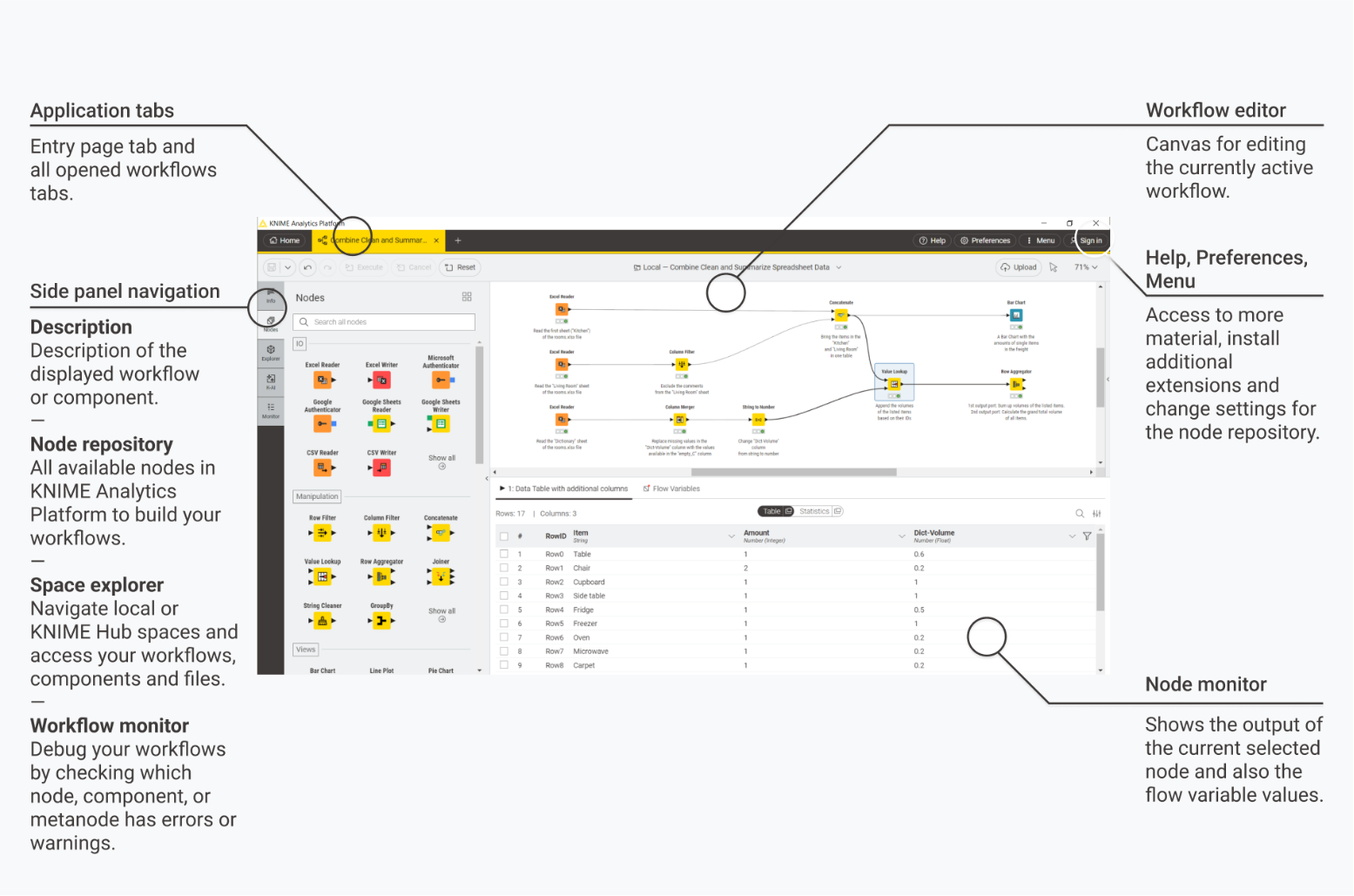
The defining characteristic of KNIME is its use of a visual “workflow” or “pipeline.” In this environment, users drag and drop functional blocks—known as nodes—onto a canvas and connect them to define the flow of data. Each node performs a specific task, such as reading a file, filtering rows, or training a machine learning model. This approach allows users to see the entire data journey from ingestion to visualization, making debugging and optimization significantly more intuitive than in script-based environments like Python or R.
Nodes and Connectors: The Building Blocks
Every action in KNIME is encapsulated within a “Node.” Nodes are categorized by their function: IO (Input/Output), Data Manipulation, Mining (Machine Learning), and Analytics. Each node has input and output ports; a data table flows out of one node and into the next.
- The Traffic Light System: KNIME uses a simple yet effective status indicator for each node. A red light means the node is not configured; yellow means it is ready to be executed; and green means it has successfully processed the data. This immediate visual feedback is a hallmark of the platform’s user-friendly design.
Open-Source vs. Commercial Offerings
KNIME maintains a unique position in the tech market by offering its core “KNIME Analytics Platform” as free and open-source software. This includes the full range of data processing and machine learning capabilities. However, for enterprise-level needs, the company offers the KNIME Business Hub. This commercial extension focuses on collaboration, automation, and deployment, allowing teams to share workflows, manage versions, and deploy data apps or REST APIs within a secure corporate environment.
Key Features and Capabilities for Modern Data Science
While the visual interface is the “hook,” the true power of KNIME lies in its immense versatility. It is frequently described as a “Swiss Army Knife” for data, capable of handling everything from simple spreadsheet automation to complex deep learning projects.
Data Integration and ETL (Extract, Transform, Load)
One of the most common hurdles in data science is “data munging”—the process of cleaning and preparing data. KNIME excels in this area. It provides hundreds of nodes for data transformation, including joining tables, pivoting data, handling missing values, and normalization. Furthermore, KNIME can connect to a staggering array of data sources, including traditional SQL databases (PostgreSQL, Oracle, MySQL), cloud storage (AWS S3, Azure Blob, Google Drive), and even specialized APIs or NoSQL databases like MongoDB.
Machine Learning and Predictive Analytics
KNIME is not just a data cleaning tool; it is a powerhouse for predictive modeling. It integrates seamlessly with popular machine learning libraries, including Weka, H2O, and Keras. Users can build sophisticated models—such as Random Forests, Support Vector Machines (SVM), and Neural Networks—using dedicated nodes. The platform also supports the entire model lifecycle, including feature selection, cross-validation, and hyperparameter optimization, all within the visual interface.
Seamless Integration with Python, R, and SQL
A common misconception is that visual tools limit the power of advanced users. KNIME disrupts this notion by offering “Scripting Nodes.” If a specific function is not available as a standard node, users can embed Python, R, or SQL scripts directly into the workflow. This allows developers to leverage the vast libraries of the Python ecosystem (like Pandas, Scikit-learn, or PyTorch) while still benefiting from KNIME’s visual orchestration and data management capabilities.
Bridging the Gap: KNIME in the Era of AI and Generative Models

As Artificial Intelligence (AI) moves from the fringes to the center of software development, KNIME has adapted by integrating advanced AI and Large Language Model (LLM) capabilities into its ecosystem. This evolution ensures that the platform remains relevant in a tech landscape dominated by Generative AI.
AI Extensions and Prompt Engineering
KNIME recently introduced specialized AI extensions that allow users to interact with models from OpenAI (GPT-4), Anthropic, and open-source models hosted on Hugging Face. Through these nodes, users can automate text summarization, sentiment analysis, and even code generation. By treating an LLM as just another node in a workflow, KNIME allows organizations to build “AI-augmented” processes where human logic and machine intelligence work in tandem.
K-AI: The KNIME AI Assistant
To further lower the barrier to entry, KNIME has introduced K-AI, a generative AI assistant built directly into the platform. Users can chat with K-AI to ask how to build a specific workflow or even have the assistant automatically build a node sequence based on a natural language prompt. This transition toward “Natural Language to Workflow” represents the next frontier in software accessibility, making data science reachable for those who may not even be familiar with the drag-and-drop interface yet.
Democratizing Data Science for Non-Coders
The “Tech” sector is currently witnessing a massive movement toward “Low-Code/No-Code” (LCNC) solutions. KNIME is a leader in this space because it provides a “Low-Code” environment that does not sacrifice “High-Code” power. By abstracting the complexity of syntax, KNIME allows domain experts—such as biologists, auditors, or mechanical engineers—to apply their specialized knowledge directly to data analysis without needing a Computer Science degree.
Practical Use Cases Across the Tech Industry
The flexibility of KNIME allows it to be deployed across various sectors, solving distinct problems with a unified logic.
Cybersecurity and Log Analysis
In the realm of digital security, KNIME is used to process massive volumes of log data from servers and firewalls. By building workflows that detect anomalies or flag unauthorized access patterns, security teams can automate threat detection. The ability to integrate with various security APIs allows KNIME to act as an orchestration layer for automated incident response.
Healthcare and Bioinformatics
KNIME has deep roots in the life sciences. It is widely used for chemical informatics and drug discovery. Researchers use KNIME to process molecular structures, analyze high-throughput screening data, and visualize the results of clinical trials. The platform’s ability to handle complex, non-tabular data makes it invaluable in fields where data variety is as challenging as data volume.
IoT and Industrial Automation
For companies involved in the Internet of Things (IoT), KNIME facilitates the analysis of sensor data in real-time. By connecting to message brokers like MQTT or Kafka, KNIME workflows can monitor equipment health, predict maintenance needs (Predictive Maintenance), and optimize manufacturing processes, thereby reducing downtime and increasing operational efficiency.
Why KNIME Stands Out in a Crowded Tech Stack
In a market filled with competitors like Alteryx, SAS, and various cloud-native BI tools, KNIME maintains a loyal following for several strategic reasons.
Community and Extension Ecosystem
The KNIME community is one of its greatest assets. The KNIME Hub serves as a public repository where thousands of users share their workflows and custom-built components. This “shared intelligence” means that if a user is struggling with a specific problem—such as connecting to a niche API or implementing a specific statistical test—there is a high probability that someone has already shared a solution on the Hub.
Cost-Effectiveness and Scalability
For many tech startups and mid-sized enterprises, the licensing fees of proprietary data science suites can be prohibitive. KNIME’s open-source core allows companies to start small, proving the value of data science without initial capital expenditure. As the organization grows, they can transition to the KNIME Business Hub for enterprise features, ensuring that the technology scales alongside the business.
Future-Proofing through Agility
The tech world moves fast. A tool that is relevant today might be obsolete tomorrow. KNIME’s modular architecture—where new capabilities are added via extensions rather than total software rewrites—ensures longevity. Whether it is a new database technology, a new machine learning framework, or the latest advancement in AI, KNIME’s “extensible” nature allows it to integrate these trends quickly, keeping its users at the cutting edge of technology.
In conclusion, KNIME is more than just a software application; it is a comprehensive ecosystem that empowers individuals and organizations to master their data. By blending the ease of visual programming with the power of advanced analytics and AI, it provides a robust, scalable, and accessible solution for the modern data-driven world. Whether you are a developer looking to automate repetitive tasks or a data scientist building the next generation of predictive models, KNIME offers the tools necessary to turn data into a decisive advantage.
aViewFromTheCave is a participant in the Amazon Services LLC Associates Program, an affiliate advertising program designed to provide a means for sites to earn advertising fees by advertising and linking to Amazon.com. Amazon, the Amazon logo, AmazonSupply, and the AmazonSupply logo are trademarks of Amazon.com, Inc. or its affiliates. As an Amazon Associate we earn affiliate commissions from qualifying purchases.