
In the realm of technology, from the precise movements of robotic arms on a manufacturing floor to the complex navigation algorithms powering autonomous vehicles, understanding the concept of velocity is paramount. More specifically, grasping instantaneous velocity is crucial for designing, analyzing, and optimizing systems that involve motion. While often conflated with average velocity, instantaneous velocity offers a granular, real-time perspective that underpins many of the sophisticated technologies we interact with daily. It’s the difference between knowing how far a robot moved over an hour and knowing precisely how fast it was moving at the exact moment it needed to make a critical maneuver.

The Foundation: Velocity in Technological Systems
At its core, velocity is a fundamental physical quantity that describes the rate of change of an object’s position over time, and importantly, includes the direction of that change. In technological contexts, this translates directly to how objects, whether physical or simulated, are moving within a given system. This concept is not merely academic; it’s a cornerstone of engineering and computer science, informing everything from the refresh rate of a display to the trajectory calculations of a drone.
Position, Displacement, and the Role of Time
To comprehend velocity, we must first acknowledge its constituent elements: position and time. In technology, an object’s position is typically represented within a coordinate system, be it a 2D plane for a graphical user interface element or a 3D space for a robotic end-effector. Displacement, a vector quantity, describes the change in position from a starting point to an ending point. Time, a universal constant in most technological applications, acts as the independent variable against which these positional changes are measured. The relationship between displacement and time is what gives rise to velocity. For instance, a sensor in a self-driving car constantly monitors its position relative to its starting point. The change in this position over infinitesimally small time intervals is the basis for calculating its velocity.
From Average to Instantaneous: A Need for Precision
Average velocity, calculated by dividing the total displacement by the total time taken for that displacement, provides a general overview of motion. However, in many technological applications, such a broad stroke is insufficient. Imagine a sophisticated video game character. Its average velocity over an entire jump might tell us how high it reached, but it won’t inform the precise physics needed for realistic animation, collision detection, or the impact of environmental forces at any given moment during the jump. This is where instantaneous velocity steps in, offering a snapshot of motion at a specific point in time.
Unpacking Instantaneous Velocity: The Derivative in Action
Instantaneous velocity is not just a faster version of average velocity; it’s a fundamentally different concept derived from the continuous progression of time and position. It answers the question: “How fast is something moving, and in what direction, right now?” This precise measurement is vital for systems that require dynamic adjustments and real-time control.
The Calculus Connection: Derivatives and Rates of Change
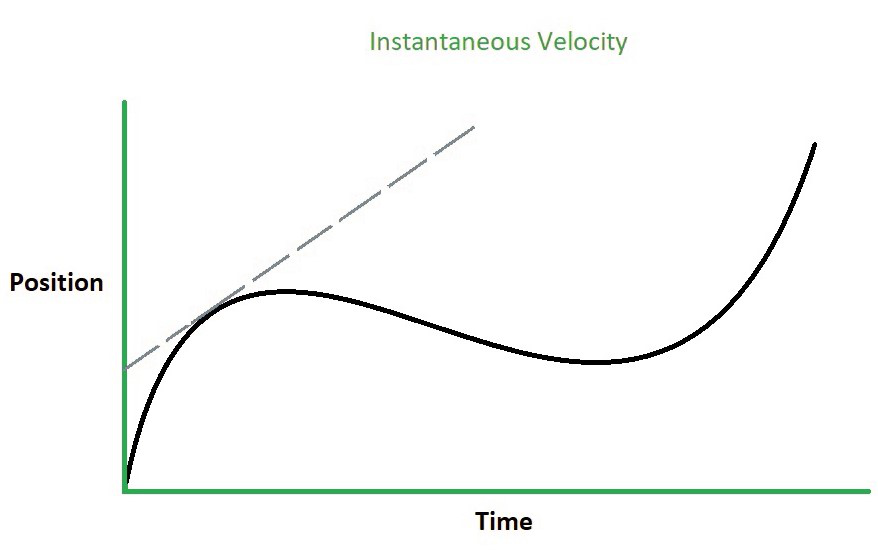
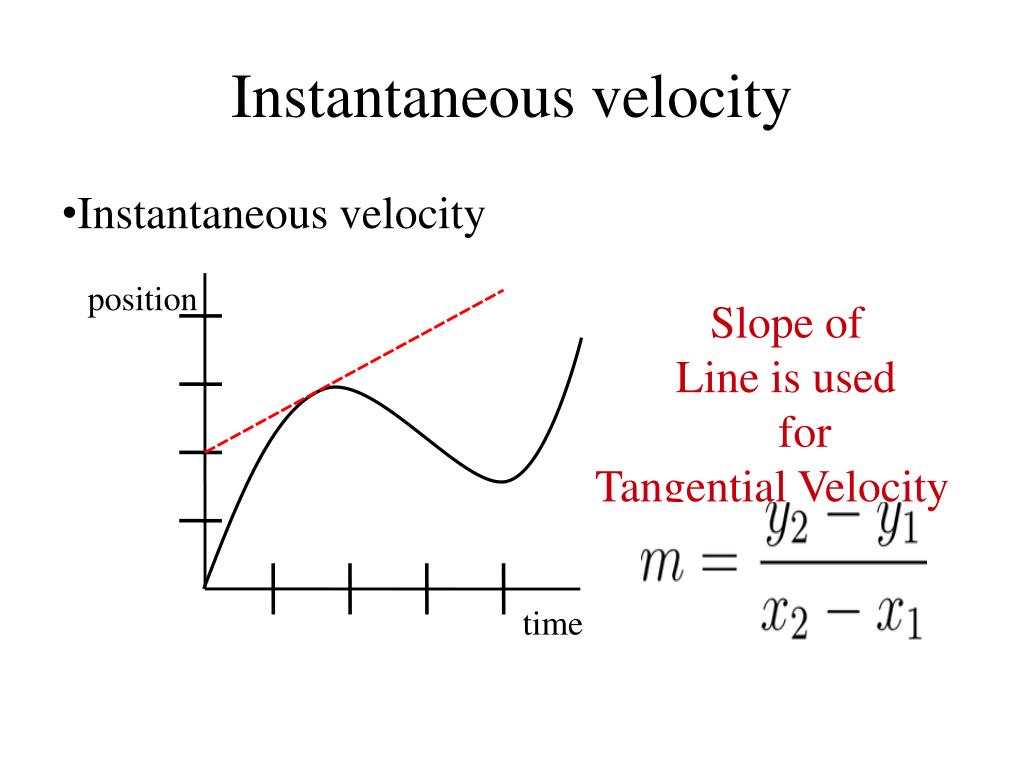
The mathematical tool that allows us to precisely define and calculate instantaneous velocity is the derivative from calculus. If we consider the position of an object as a function of time, denoted as $x(t)$, then its instantaneous velocity, $v(t)$, is the derivative of this position function with respect to time:
$v(t) = frac{dx}{dt}$
This equation signifies that instantaneous velocity is the instantaneous rate of change of position. In the context of discrete digital systems, this is often approximated by calculating the change in position over extremely small time intervals. For example, in a physics engine for a game, the position of an object might be updated every frame. The velocity is then calculated based on the position change between consecutive frames, divided by the time elapsed between those frames, which is typically very short.
Instantaneous Velocity in Action: Examples in Tech
The practical applications of instantaneous velocity in technology are vast and ever-expanding.
Autonomous Navigation and Robotics
Consider an autonomous vehicle. To safely navigate complex environments, it needs to know its precise velocity at every millisecond. This includes not only its speed but also its direction of travel. Algorithms for path planning, obstacle avoidance, and adaptive cruise control rely heavily on accurate instantaneous velocity data to make split-second decisions. Similarly, in industrial robotics, a robotic arm performing intricate assembly tasks requires precise control over its instantaneous velocity to avoid collisions with other components or to smoothly execute movements.
Real-time Simulations and Gaming
In the realm of video games and realistic simulations, instantaneous velocity is critical for creating believable motion. The physics engine of a game uses instantaneous velocity to calculate how objects will interact, how they will respond to forces like gravity or wind, and how they will collide. This allows for dynamic and responsive gameplay. For instance, a projectile’s trajectory is determined by its initial instantaneous velocity and the ongoing forces acting upon it.
Data Visualization and Analytics
Beyond physical systems, instantaneous velocity can also be applied to the analysis of data streams. In financial trading platforms, for example, the “velocity” of a stock price’s movement at a given moment can be a crucial indicator for traders. Similarly, in network monitoring, understanding the instantaneous rate of data transfer can help identify performance bottlenecks or security threats.
Challenges and Implementations in Digital Systems
While the concept of instantaneous velocity is mathematically elegant, its implementation in digital technologies presents unique challenges. Real-world systems are not perfectly continuous, and achieving true instantaneous measurements requires careful design and approximation.
The Digital Discretization Problem
Computers operate on discrete time steps. This means that rather than having a continuous flow of time, operations happen in distinct, albeit very short, intervals. This digital discretization inherently means that we are often dealing with approximations of instantaneous velocity. The smaller the time interval (or the higher the sampling rate), the closer our approximation will be to the true instantaneous velocity. This is a fundamental trade-off between computational resources and accuracy.
Sensor Accuracy and Noise
In systems that rely on physical sensors (like GPS, accelerometers, or gyroscopes in a drone), the accuracy and reliability of these sensors directly impact the calculation of instantaneous velocity. Sensor data can be noisy, meaning it contains random fluctuations that can skew velocity calculations. Sophisticated filtering algorithms are often employed to mitigate this noise and provide a more stable and accurate estimation of instantaneous velocity. Techniques like Kalman filters are commonly used in robotics and autonomous systems for this purpose.
Computational Demands
Calculating instantaneous velocity, especially in complex systems with many moving parts, can be computationally intensive. Each object’s position needs to be tracked, and its rate of change calculated, often many times per second. This requires significant processing power and efficient algorithms. The design of such systems often involves balancing the need for high-accuracy instantaneous velocity data with the available computational resources.
The Importance of Instantaneous Velocity for Future Technologies
As technology continues to evolve, the demand for precise real-time motion understanding will only increase. Instantaneous velocity is not just a concept for engineers; it’s a foundational element for many of the advanced technologies shaping our future.
Advancements in AI and Machine Learning
AI systems, particularly those involved in physical interaction with the world, rely heavily on accurate velocity data. For instance, reinforcement learning agents trained to control robotic manipulators will learn faster and more effectively if they can precisely understand and predict the instantaneous velocity of their actions and their environment. Machine learning models used for predictive maintenance might analyze the velocity of machine parts to detect anomalies before they lead to failure.
Enhanced User Experiences
Even in seemingly simpler applications, the underlying understanding of instantaneous velocity contributes to smoother and more intuitive user experiences. The responsiveness of a touch interface, the fluid animation of graphical elements, or the precise control of a virtual camera are all subtly influenced by the accurate estimation of motion at the micro-level, which is directly tied to instantaneous velocity.
The Frontier of Innovation: From Drones to VR
The development of advanced drone capabilities, from aerial photography to delivery services, is intrinsically linked to precise control over their instantaneous velocity. Similarly, the immersive experiences promised by virtual and augmented reality depend on accurately tracking user movements and rendering them with an appropriate sense of motion, which again, is heavily influenced by instantaneous velocity calculations.
In conclusion, instantaneous velocity is far more than a theoretical physics concept; it’s a critical operational parameter in the design and functionality of a vast array of modern technologies. Its precise understanding and implementation are fundamental to the progress and innovation we see across diverse fields, from artificial intelligence and robotics to immersive digital experiences. As our technological ambitions grow, so too will the importance of mastering this nuanced measure of motion.
aViewFromTheCave is a participant in the Amazon Services LLC Associates Program, an affiliate advertising program designed to provide a means for sites to earn advertising fees by advertising and linking to Amazon.com. Amazon, the Amazon logo, AmazonSupply, and the AmazonSupply logo are trademarks of Amazon.com, Inc. or its affiliates. As an Amazon Associate we earn affiliate commissions from qualifying purchases.