
Inertial Measurement Units (IMUs) are the unsung heroes of modern technology, quietly powering everything from the smartphones in our pockets to the sophisticated navigation systems of aircraft and spacecraft. While the term “IMU” might sound technical and perhaps even arcane, its underlying principles and applications are fundamental to how we interact with and understand the physical world through our devices. At its core, an IMU is a sensor package that measures and reports a body’s specific force, angular rate, and sometimes the magnetic field surrounding it. This seemingly simple function unlocks a vast array of possibilities across numerous technological domains, fundamentally altering how machines perceive and respond to motion.
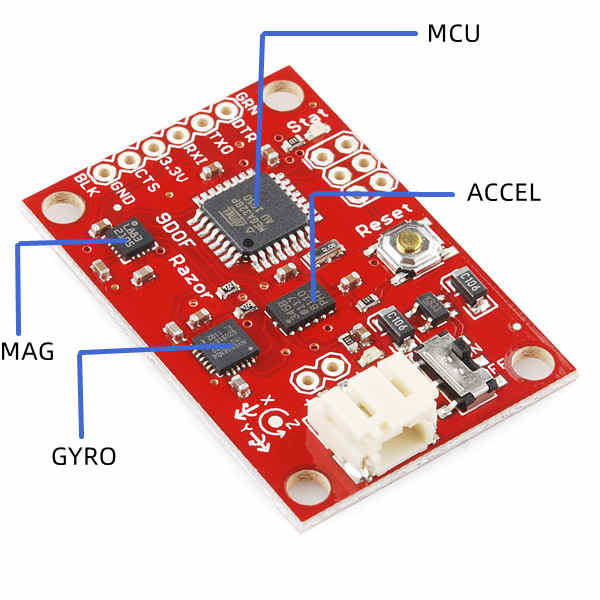
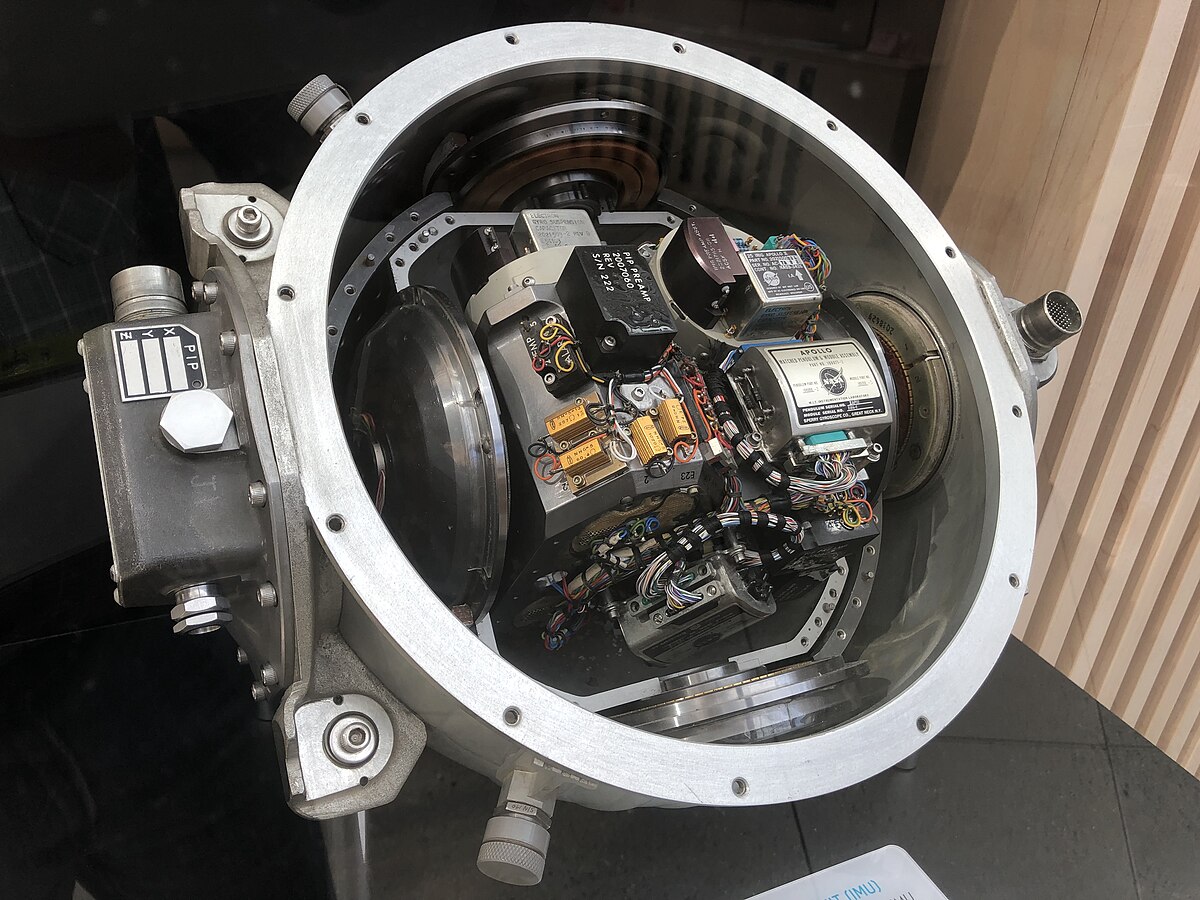
The proliferation of IMUs has been driven by advancements in microelectromechanical systems (MEMS) technology, which has allowed for the miniaturization and cost-effective production of these complex sensors. This has led to their integration into an ever-expanding list of devices, making them indispensable components in the modern tech ecosystem. Understanding what an IMU is, how it works, and its diverse applications is crucial for anyone seeking to grasp the inner workings of contemporary technology. This article will delve into the fundamental components of an IMU, explore its operational principles, and highlight the extensive range of its technological applications.
The Core Components: Accelerometers and Gyroscopes
At the heart of every IMU lie its primary sensing elements: accelerometers and gyroscopes. These two types of sensors, working in concert, provide the raw data that an IMU processes to determine an object’s motion. While they serve related purposes, their individual functions are distinct and complementary.
Accelerometers: Measuring Linear Motion and Gravity
Accelerometers are designed to detect linear acceleration. In simpler terms, they measure how an object’s velocity changes over time along a particular axis. Most IMUs incorporate three accelerometers, each oriented along a different spatial axis (typically X, Y, and Z). This tri-axial configuration allows the IMU to measure acceleration in all three dimensions of space.
The fundamental principle behind MEMS accelerometers often involves a proof mass suspended by tiny springs. When the device experiences acceleration, the proof mass tends to resist this change in motion due to inertia. This displacement of the proof mass is then measured, typically through capacitive or piezoelectric effects, and converted into an electrical signal proportional to the acceleration.
Beyond just measuring imposed accelerations, accelerometers are also adept at detecting the constant acceleration due to gravity. When an IMU is at rest, its accelerometers will register the pull of gravity. By analyzing the orientation of this gravitational vector, accelerometers can provide information about the device’s tilt and orientation relative to the Earth’s surface. This capability is foundational for applications like screen rotation on smartphones and leveling in various industrial equipment.
Gyroscopes: Detecting Rotational Velocity
While accelerometers measure changes in linear velocity, gyroscopes are responsible for measuring angular velocity – how fast an object is rotating around an axis. Similar to accelerometers, IMUs typically include three gyroscopes, each aligned with one of the three spatial axes (pitch, roll, and yaw).
MEMS gyroscopes, particularly vibratory gyroscopes, are the most common type found in IMUs. These devices work on the principle of the Coriolis effect. A vibrating element within the gyroscope experiences a force perpendicular to its vibration and perpendicular to the axis of rotation when the device itself begins to rotate. This Coriolis force causes a secondary displacement of the vibrating element, which is then measured and translated into a signal representing the angular rate.
The data from gyroscopes is crucial for understanding changes in orientation and for tracking rotational movements with high precision. For example, when you tilt your phone, the gyroscopes detect the rate at which this tilt is occurring, allowing the software to adjust the display orientation. In more complex systems, gyroscopes are vital for maintaining stability and for precisely controlling rotational movements.
The Synergy: Sensor Fusion and Data Processing
The true power of an IMU lies not just in its individual components but in their ability to work together through a process known as sensor fusion. Accelerometers and gyroscopes, while providing critical motion data, each have limitations. Accelerometers are susceptible to noise and are also affected by vibrations and non-gravitational forces, making it challenging to isolate pure gravitational readings for orientation. Gyroscopes, on the other hand, are excellent at measuring rapid changes in orientation but suffer from drift over time – a gradual accumulation of errors that leads to inaccurate readings if not corrected.
Sensor Fusion Algorithms: Combining Strengths, Mitigating Weaknesses
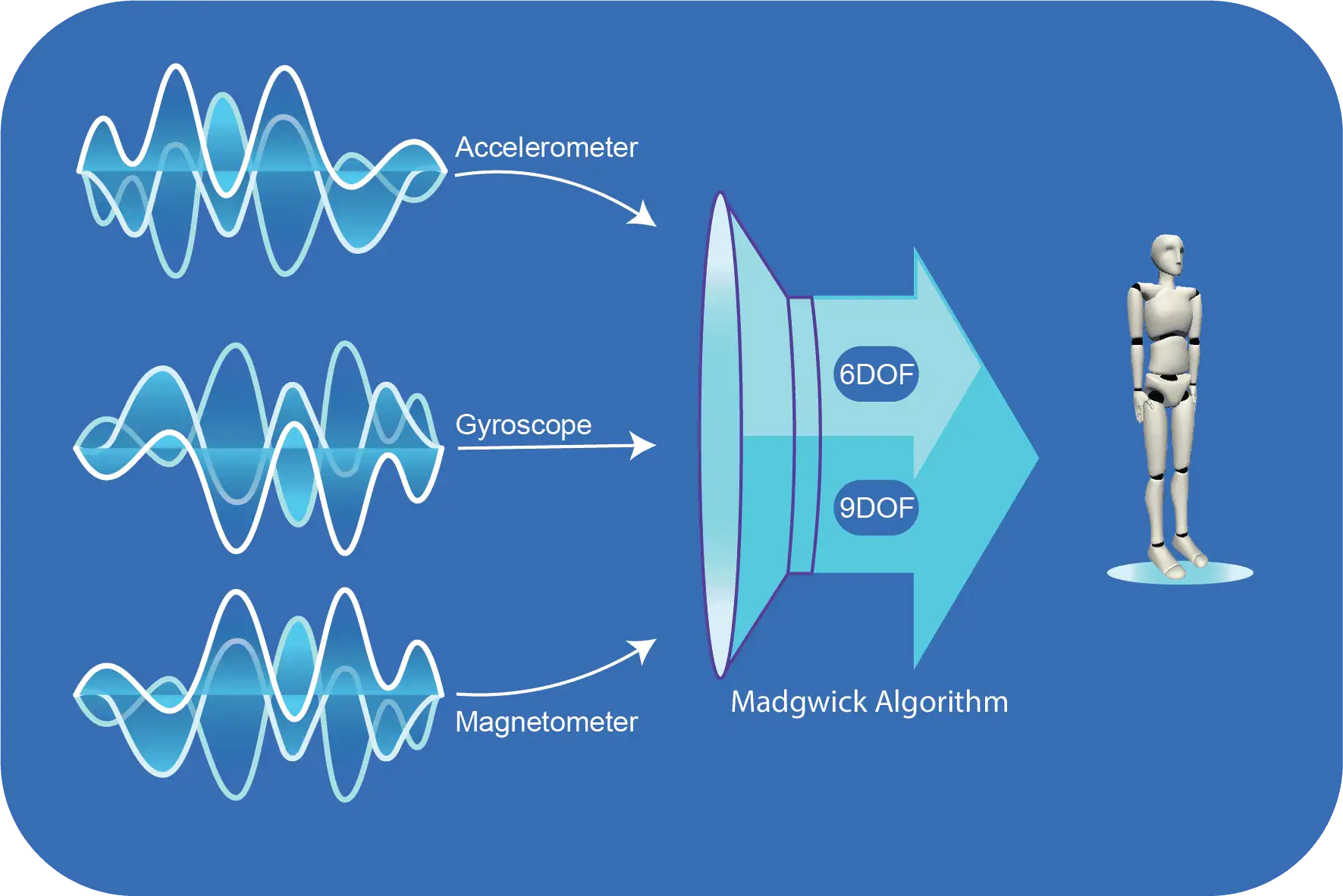
Sensor fusion is the technique of combining data from multiple sensors to produce a more accurate, reliable, and comprehensive understanding of the environment or the object’s state. In the context of IMUs, sophisticated algorithms are employed to integrate the data from accelerometers and gyroscopes.
These algorithms typically use techniques like Kalman filtering or complementary filtering. A Kalman filter, for instance, is a recursive algorithm that estimates the state of a dynamic system from a series of measurements observed over time. It uses a prediction step, where it forecasts the next state of the system, and an update step, where it corrects this prediction based on new sensor measurements. By intelligently weighing the data from accelerometers and gyroscopes, a Kalman filter can leverage the accelerometer’s stable long-term orientation reference (due to gravity) and the gyroscope’s high-frequency responsiveness to rotational motion.
The outcome of effective sensor fusion is a more robust estimation of the device’s orientation (often represented as Euler angles or quaternions) and its linear acceleration, free from the debilitating drift of gyroscopes alone and the noise and external force interference that can plague accelerometers.
The Role of Magnetometers and Barometers
While accelerometers and gyroscopes are the foundational sensors, many advanced IMUs also incorporate additional sensing elements to further enhance their accuracy and utility.
- Magnetometers: These sensors measure the Earth’s magnetic field. By providing a stable reference direction (magnetic north), magnetometers can help to correct for yaw drift in gyroscopes, especially in applications where a consistent heading is critical, such as in navigation. However, magnetometers are susceptible to magnetic interference from nearby electronic devices or metallic objects.
- Barometers: Barometric pressure sensors measure atmospheric pressure, which can be used to estimate altitude. This is particularly useful in applications like drones or wearable fitness trackers to provide altitude information or detect changes in elevation.
The integration of these additional sensors, combined with advanced fusion algorithms, leads to what are sometimes referred to as “9-axis IMUs” (3 axes for accelerometer, 3 for gyroscope, and 3 for magnetometer) or even more comprehensive sensor suites.
Ubiquitous Applications: Transforming the Tech Landscape
The miniaturization and cost-effectiveness of IMUs have led to their integration into an astonishingly broad spectrum of technological applications, fundamentally reshaping how we interact with our devices and the world around us. From everyday consumer electronics to highly specialized industrial and scientific equipment, IMUs are playing a pivotal role.
Consumer Electronics: Enhancing User Experience
Perhaps the most visible impact of IMUs is within consumer electronics. Smartphones and tablets rely heavily on IMUs for a multitude of features:
- Screen Orientation: The automatic rotation of the screen when you turn your device is a direct result of accelerometer data, detecting gravity’s pull.
- Gaming: IMUs enable intuitive motion-controlled gaming, allowing users to steer vehicles or aim weapons by tilting and moving their devices.
- Augmented Reality (AR) and Virtual Reality (VR): AR and VR experiences are heavily dependent on precise tracking of head and hand movements. IMUs, often combined with other sensors like cameras, provide the critical motion data that makes these immersive environments feel realistic.
- Fitness Trackers and Smartwatches: These wearables use IMUs to count steps, track running cadence, estimate distance covered, and detect different types of physical activity. The accuracy of these measurements is directly tied to the quality of the IMU within.
- Camera Stabilization: Many digital cameras and even smartphone cameras employ IMUs to detect hand-shake and compensate for it, resulting in sharper, clearer images and smoother video footage.
Automotive and Transportation: Driving Safety and Autonomy
The automotive industry is a significant consumer of IMUs, with applications spanning from basic vehicle systems to the cutting edge of autonomous driving.
- Electronic Stability Control (ESC) and Anti-lock Braking Systems (ABS): IMUs are crucial for these safety systems. They monitor the vehicle’s orientation and rotational motion, helping to detect potential skids or loss of control and actively intervene to correct the vehicle’s trajectory.
- Navigation Systems: While GPS is the primary navigation tool, IMUs provide a backup and enhancement, especially in areas with poor GPS reception (e.g., tunnels, urban canyons). They track the vehicle’s movement and orientation between GPS fixes, ensuring continuous and accurate positioning.
- Airbag Deployment: In the event of a collision, IMUs can help determine the severity and type of impact, providing critical data to the airbag control module to ensure optimal deployment.
- Autonomous Vehicles: For self-driving cars, IMUs are absolutely essential. They provide the core sensing for understanding the vehicle’s motion, orientation, and position in real-time, forming a critical part of the perception system that allows the vehicle to navigate its environment safely.
Robotics and Industrial Automation: Enabling Intelligent Machines
Robotics, by its very nature, is an application domain where motion sensing is paramount. IMUs are integral to creating robots that can interact intelligently with their surroundings.
- Robot Navigation and Localization: IMUs allow robots to map their environment, determine their position within that map, and navigate autonomously from one point to another.
- Balance and Stability: For robots designed to walk or maintain balance, IMUs are indispensable for detecting and counteracting any deviations from a stable posture.
- Object Manipulation: In pick-and-place operations or assembly tasks, IMUs can help robots to precisely orient their end-effectors and understand the forces they are applying.
- Industrial Drones and Inspection: Drones used for infrastructure inspection, surveying, or monitoring heavily rely on IMUs for stable flight, precise maneuvering, and accurate data acquisition.
Aerospace and Defense: Precision in Extreme Environments
The demanding environments of aerospace and defense have long been key drivers of IMU development, pushing the boundaries of accuracy, reliability, and ruggedness.
- Aircraft Navigation and Flight Control: From commercial airliners to fighter jets, IMUs are fundamental to Inertial Navigation Systems (INS), which provide precise positional and directional information essential for flight control, navigation, and autopilot systems.
- Satellite and Spacecraft Orientation: Maintaining the correct orientation of satellites and spacecraft for communication, power generation, or scientific observation is critically dependent on highly accurate IMUs.
- Missile Guidance: The guidance systems of missiles rely on IMUs to track their trajectory and make necessary course corrections to reach their intended target.
- Unmanned Aerial Vehicles (UAVs): Military and civilian UAVs, from reconnaissance drones to advanced aerial platforms, leverage IMUs for stable flight, autonomous operation, and precise payload deployment.
The Future of IMUs: Continuous Innovation
The journey of the IMU is far from over. Ongoing research and development are continuously pushing the envelope in terms of accuracy, size, power consumption, and cost. As the demand for smarter, more responsive devices grows across all sectors, the role of IMUs will only become more pronounced.
Future advancements are likely to focus on several key areas:
- Improved Accuracy and Reduced Drift: The quest for ever-greater precision will continue, with innovations in sensor design and signal processing aiming to minimize noise and drift.
- Enhanced Miniaturization and Integration: MEMS technology will continue to shrink IMU components, allowing for their integration into even smaller and more diverse form factors, such as in advanced bio-integrated sensors or microscopic robotic systems.
- Lower Power Consumption: For battery-powered devices, reducing the power draw of IMUs is a constant goal, enabling longer operational times.
- New Sensing Modalities: Research may lead to IMUs incorporating novel sensing principles, potentially enabling the measurement of additional physical parameters relevant to motion and environment interaction.
- AI-Powered IMUs: The integration of on-chip AI and machine learning capabilities within IMUs could enable them to perform more sophisticated data processing and decision-making locally, reducing the reliance on external processors and further enhancing real-time responsiveness.
In conclusion, Inertial Measurement Units are fundamental building blocks of modern technology. By diligently measuring the subtle nuances of motion through accelerometers and gyroscopes, and often enhanced by magnetometers and barometers, IMUs provide the essential data that allows our devices to perceive, understand, and interact with the physical world. Their ubiquitous presence across consumer electronics, automotive, robotics, and aerospace underscores their profound impact and their indispensable role in shaping the future of technology.
aViewFromTheCave is a participant in the Amazon Services LLC Associates Program, an affiliate advertising program designed to provide a means for sites to earn advertising fees by advertising and linking to Amazon.com. Amazon, the Amazon logo, AmazonSupply, and the AmazonSupply logo are trademarks of Amazon.com, Inc. or its affiliates. As an Amazon Associate we earn affiliate commissions from qualifying purchases.