
Purchasing a home is arguably the most significant financial commitment an individual will make in their lifetime. While the aesthetic appeal of a property and its location often dominate the initial search, the underlying financial structure—specifically the home loan interest rate—is what ultimately determines the long-term affordability of the investment. Understanding what a home loan interest rate is, how it is calculated, and the factors that influence it is essential for any prospective homeowner looking to navigate the complex world of personal finance.
An interest rate is essentially the cost of borrowing money. In the context of a home loan, it is the percentage of the principal amount charged by a lender to the borrower for the use of their funds over a specified period. Because home loans are typically high-value and long-term (ranging from 15 to 30 years), even a fractional difference in the interest rate can result in a difference of tens of thousands of dollars over the life of the loan.

Understanding the Fundamentals of Home Loan Interest Rates
To grasp the impact of interest rates, one must first understand how they function within the mechanics of a mortgage. The interest rate is not merely a static fee; it is a dynamic component of an “amortization” schedule.
The Cost of Borrowing Capital
When a bank or financial institution lends money for a mortgage, they are taking on risk and deferring the use of their own capital. The interest rate serves as their compensation. From the borrower’s perspective, this rate is the “price” paid for the liquidity required to purchase real estate today rather than waiting decades to save the full purchase price in cash.
How Amortization Works
Most home loans are structured through a process called amortization. In the early years of a home loan, a larger portion of your monthly payment (Equated Monthly Installment or EMI) goes toward paying off the interest, while a smaller portion reduces the principal balance. As the loan matures, this ratio shifts, with more of the payment being applied to the principal. Because interest is calculated based on the remaining principal balance, the interest rate dictates the speed at which you build equity in your home.
The Impact of Compounding
Home loan interest is typically calculated on a reducing balance basis. This means that as you pay down the principal, the amount of interest you owe each month decreases. However, because the loan term is so long, the cumulative interest paid can sometimes equal or even exceed the original loan amount if the interest rate is high. This makes the “annual percentage rate” (APR) a crucial metric to watch, as it includes both the interest rate and other finance charges.
Fixed vs. Floating Interest Rates: Which Should You Choose?
One of the most critical decisions a borrower must make is choosing between a fixed and a floating (or variable) interest rate. Both structures have unique advantages and risks, and the right choice depends heavily on the borrower’s risk appetite and the current economic climate.
Fixed Interest Rates: Stability and Predictability
A fixed interest rate remains constant throughout the entire tenure of the loan, or for a specific agreed-upon period. The primary benefit here is certainty. Borrowers know exactly what their monthly payments will be for the next 20 or 30 years, regardless of how the economy or inflation fluctuates.
Fixed rates are particularly attractive when market interest rates are at historic lows. By “locking in” a low rate, homeowners protect themselves against future rate hikes. However, the downside is that fixed rates are usually set slightly higher than the prevailing floating rates at the time of inception, and borrowers do not benefit if market rates drop later.
Floating (Variable) Interest Rates: Market-Linked Flexibility
Floating interest rates are linked to a market benchmark, such as a central bank’s repo rate or a LIBOR/SOFR index. As the benchmark moves up or down, the interest rate on the loan adjusts accordingly.
The main draw of a floating rate is that it is often lower than a fixed rate initially. If the central bank enters a period of monetary easing and lowers rates, the borrower’s EMI or loan tenure may decrease automatically. Conversely, if inflation rises and the central bank hikes rates, the cost of the loan increases. Floating rates are ideal for those who believe interest rates will remain stable or decline in the future.
Hybrid Models: The Best of Both Worlds?
Some lenders offer hybrid loans, where the interest rate remains fixed for the first few years (e.g., 3 to 5 years) and then transitions into a floating rate for the remainder of the term. This provides initial budget stability while allowing the borrower to eventually participate in market fluctuations.
Key Factors That Influence Your Home Loan Interest Rate
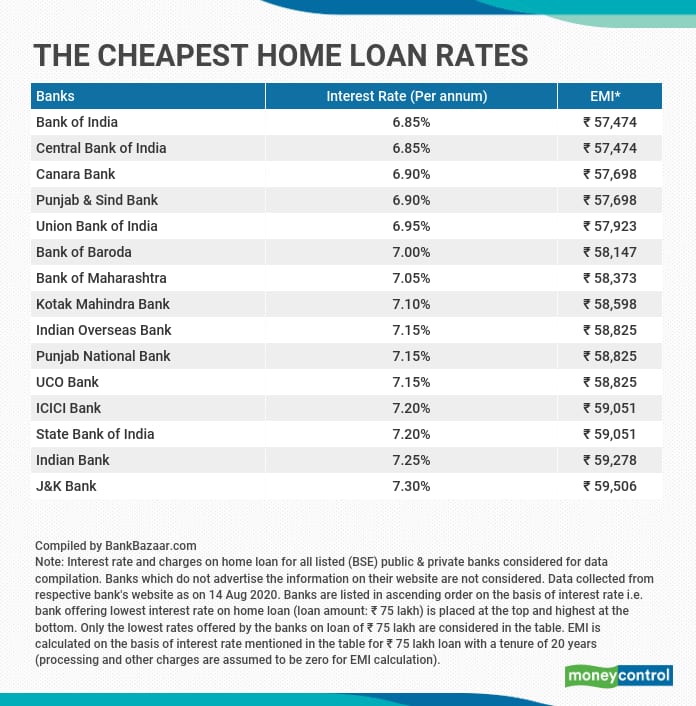
Not every borrower is offered the same interest rate. Lenders use a risk-based pricing model to determine the rate for a specific individual. Understanding these variables can help you position yourself for the lowest possible rate.
The Role of Central Bank Policies
On a macro level, home loan rates are heavily influenced by the country’s central bank (such as the Federal Reserve in the U.S. or the RBI in India). When the central bank changes the “repo rate” (the rate at which it lends money to commercial banks), it creates a ripple effect. If it costs banks more to borrow money, they pass those costs on to consumers in the form of higher home loan interest rates.
Credit Scores and Borrower Risk Profiles
Your credit score is perhaps the most significant individual factor influencing your rate. A high credit score (typically 750 or above) signals to the lender that you are a disciplined borrower with a history of timely repayments. Lenders reward this lower risk with “prime” interest rates. Conversely, a lower credit score indicates higher risk, prompting the lender to charge a higher interest rate to compensate for the possibility of default.
Loan-to-Value (LTV) Ratio and Down Payments
The LTV ratio represents the percentage of the property’s value that is being financed through the loan. If you provide a larger down payment (e.g., 20% or more), your LTV is lower. Lenders view a lower LTV as less risky because the borrower has more “skin in the game.” Consequently, borrowers with substantial down payments often secure better interest rates than those seeking to finance 90% or more of the property value.
Employment Status and Income Stability
Lenders prefer borrowers with stable, predictable income streams. Salaried individuals working for reputable corporations or government entities are often viewed more favorably than self-employed individuals or freelancers, whose income may fluctuate. A steady employment history can sometimes serve as leverage to negotiate a finer rate.
Strategic Ways to Reduce Your Home Loan Interest Burden
Over a 20-year period, a homeowner can save a small fortune by implementing specific financial strategies. Managing a home loan is not a “set it and forget it” task; it requires active monitoring.
Opting for a Shorter Loan Tenure
While a longer tenure (e.g., 30 years) results in lower monthly EMIs, it dramatically increases the total interest paid. By opting for a 15-year or 20-year tenure, you will have higher monthly outgoings, but the total interest saved over the life of the loan can be staggering. For those whose income allows it, a shorter tenure is the most effective way to minimize interest costs.
Making Regular Prepayments
Most floating-rate loans allow for “prepayments” or “part-payments” without penalty. Whenever you receive a bonus, a tax refund, or an inheritance, applying that lump sum toward your loan principal can have a massive impact. Because interest is calculated on the remaining principal, reducing the principal early in the loan cycle saves you from years of future interest compounding.
The Balance Transfer Strategy
If you have been paying off a home loan for several years and notice that other lenders are offering significantly lower rates than your current bank, you might consider a “Home Loan Balance Transfer.” This involves moving your outstanding principal to a new lender with a lower interest rate. While this involves processing fees and paperwork, the long-term savings often far outweigh the switching costs.
Common Pitfalls and Hidden Costs in Home Financing
When evaluating a home loan interest rate, it is vital to look beyond the “headline rate” advertised by the bank. Financial literacy involves understanding the total cost of credit.
Processing Fees and Administrative Charges
A bank might offer an incredibly low interest rate but compensate for it by charging high processing fees, documentation charges, or legal valuation fees. Always ask for a “Truth in Lending” statement or an itemized breakdown of all upfront costs to ensure that the low rate isn’t an illusion created by high closing costs.
Understanding the “Fine Print” on Reset Periods
For floating-rate loans, understand how often the rate is “reset.” Some loans adjust monthly, while others adjust quarterly or annually. If the market is in an upward trend, a more frequent reset period will increase your costs faster. Additionally, be aware of the “spread” or “margin”—the fixed percentage the bank adds to the benchmark rate. While the benchmark changes, the spread usually remains constant for the duration of the loan, unless otherwise specified.

The Danger of “Teaser” Rates
Occasionally, lenders offer “teaser” rates—exceptionally low interest rates for the first year or two that significantly jump after the introductory period. Borrowers must ensure they can afford the payments once the rate normalizes to market levels to avoid financial distress down the road.
In conclusion, a home loan interest rate is more than just a number; it is a fundamental driver of your long-term financial health. By understanding the difference between fixed and floating rates, maintaining a stellar credit profile, and actively managing your loan through prepayments or balance transfers, you can turn a daunting debt into a manageable path toward total homeownership. In the world of personal finance, knowledge is the most effective tool for saving money and building lasting wealth.
aViewFromTheCave is a participant in the Amazon Services LLC Associates Program, an affiliate advertising program designed to provide a means for sites to earn advertising fees by advertising and linking to Amazon.com. Amazon, the Amazon logo, AmazonSupply, and the AmazonSupply logo are trademarks of Amazon.com, Inc. or its affiliates. As an Amazon Associate we earn affiliate commissions from qualifying purchases.