
The Hidden Markov Model (HMM) stands as a foundational statistical model within the realms of artificial intelligence, machine learning, and signal processing. It offers a powerful framework for modeling systems where the observed data is believed to be generated by an underlying, unobservable (hidden) sequence of states. HMMs are particularly adept at handling sequential data, making them indispensable tools in areas ranging from speech recognition to bioinformatics. At its core, an HMM postulates that the world we observe is a probabilistic manifestation of internal, hidden processes, and that the state of these processes evolves according to specific probabilistic rules.
Understanding the Core Concept
An HMM is a probabilistic automaton that provides a statistical framework for modeling time-series data. Unlike a simple Markov chain where all states are directly observable, an HMM introduces the concept of “hidden” states. This means we don’t directly see the states of the system; instead, we only observe outputs that are probabilistically related to these hidden states. The model then allows us to infer the most likely sequence of hidden states given a sequence of observations, or to predict future observations based on the current understanding of the hidden state.
The “Hidden” Aspect
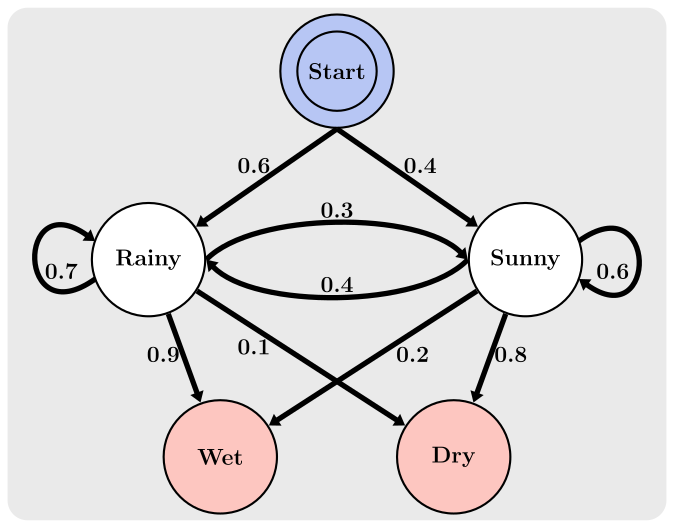
The distinguishing feature of the HMM is the invisibility of its underlying states. Imagine a scenario where you can only perceive the weather conditions (e.g., sunny, rainy, cloudy) but not the actual climate regime (e.g., tropical, temperate, arid) that generates these weather patterns. In this analogy, the climate regimes would be the hidden states, and the daily weather observations would be the observable outputs. We can infer the most probable climate regime sequence over a period based on the observed weather, even though we never directly ‘see’ the climate regime. This abstraction allows HMMs to model complex systems where direct measurement of the generative process is impossible or impractical.
The “Markov” Aspect
The “Markov” component refers to the Markov property, a crucial assumption simplifying the model’s complexity. Specifically, it implies that the probability of transitioning to any future state depends only on the current state and not on the sequence of events that preceded it. This is often referred to as a “first-order Markov assumption” because the dependency is only on the immediate prior state. For instance, if a system is in state A, the probability of moving to state B next depends solely on being in state A, not on how the system arrived at state A. This simplifying assumption, while not always perfectly true in real-world scenarios, makes the mathematical treatment of HMMs tractable and effective for a wide range of applications.
Key Components of an HMM
To formally define an HMM, five core components are required. These parameters collectively determine the behavior and predictive power of the model:
States (S)
This is a finite set of unobservable (hidden) states that the system can be in. For example, in a model for speech, these might represent different phonemes or parts of a word. In a biological sequence analysis, they could represent gene-coding regions or non-coding regions. The number of states is typically predetermined by the model designer based on domain knowledge.
Observations (V)
This is a finite set of observable symbols or events that can be emitted by each hidden state. For instance, in speech recognition, observations might be acoustic features extracted from audio signals. In gesture recognition, they could be sensor readings from an accelerometer or gyroscope. The observations are the only part of the system that we can directly measure.
Transition Probabilities (A)
Also known as the state transition probability matrix, A defines the likelihood of moving from one hidden state to another. A_ij = P(s_t+1 = j | s_t = i) represents the probability of transitioning from hidden state i at time t to hidden state j at time t+1. These probabilities govern the dynamic evolution of the hidden states over time.
Emission Probabilities (B)
Sometimes called the observation likelihoods or output probabilities, B describes the probability of observing a particular symbol k from the set V when the system is in a specific hidden state j. B_jk = P(o_t = k | s_t = j) signifies the probability of emitting observation k while in hidden state j. This matrix links the hidden states to the observable data.
Initial State Probabilities (π)
This is a probability distribution over the initial hidden states. π_i = P(s_1 = i) denotes the probability that the HMM starts in hidden state i at time t=1. This vector establishes the starting point for the hidden state sequence.
Together, these five components (S, V, A, B, π) completely define an HMM, allowing for computation and inference about the underlying processes.
The Three Fundamental Problems of HMMs
The practical application of HMMs revolves around solving three core problems, each addressed by specific algorithms:
The Evaluation Problem (Forward Algorithm)
Problem: Given an HMM model (i.e., known A, B, π) and a sequence of observations O = (o1, o2, ..., oT), what is the probability P(O | model) that this particular sequence of observations was generated by the given model?
Application: This problem is crucial for tasks like pattern recognition and classification. For instance, in a speech recognition system, if we have two HMMs, one trained for the word “hello” and another for “hallo,” we can use the Forward Algorithm to calculate which model has a higher probability of generating a newly observed acoustic sequence, thereby classifying the spoken word. The Forward Algorithm efficiently computes this probability by summing up the probabilities of all possible hidden state sequences that could have generated the observation sequence.
The Decoding Problem (Viterbi Algorithm)
Problem: Given an HMM model and a sequence of observations O = (o1, o2, ..., oT), what is the single most likely sequence of hidden states S = (s1, s2, ..., sT) that generated this observation sequence?
Application: This is often the most intuitive application of HMMs, used for inferring the hidden causes behind observed events. In speech recognition, after an utterance is observed, the Viterbi Algorithm can be used to determine the most probable sequence of phonemes (hidden states) that correspond to the acoustic signal. In bioinformatics, it can find the most likely sequence of gene-coding and non-coding regions given a DNA sequence. The Viterbi Algorithm achieves this by dynamically finding the single path through the state lattice that maximizes the probability of the observed sequence.
The Learning Problem (Baum-Welch Algorithm)
Problem: Given an observation sequence O = (o1, o2, ..., oT) (and potentially an initial guess for the number of hidden states), how do we learn or estimate the HMM parameters (A, B, π) that best describe or generate this observation sequence?
Application: This is the training phase of an HMM. When we don’t have pre-defined probabilities, the Baum-Welch Algorithm (a variant of the Expectation-Maximization algorithm) is used to iteratively refine the model parameters. It starts with an initial, often random, set of parameters and then repeatedly adjusts them to maximize the likelihood of the training observation sequence. This algorithm enables HMMs to adapt and learn from data, making them powerful for modeling complex, unknown systems.
Real-World Applications in Technology
HMMs have a rich history of successful application across various technological domains, showcasing their versatility for sequential data analysis.
Speech Recognition
Perhaps the most famous application, HMMs were the backbone of virtually all commercial speech recognition systems for decades. Phonemes (the basic units of sound in a language) are treated as hidden states, and the acoustic features extracted from an audio signal are the observations. HMMs could model the probabilistic transitions between phonemes and the varying acoustic manifestations of each phoneme, enabling computers to convert spoken language into text. While modern systems often use deep neural networks, the fundamental sequential modeling principles laid by HMMs remain relevant.
Natural Language Processing (NLP)
In NLP, HMMs have been extensively used for tasks like Part-of-Speech (POS) tagging, where the goal is to label each word in a sentence with its grammatical category (e.g., noun, verb, adjective). The hidden states represent the POS tags, and the observations are the words themselves. HMMs are also applied in named entity recognition, shallow parsing, and even in earlier forms of machine translation, demonstrating their utility in understanding the structure and meaning of human language.
Bioinformatics
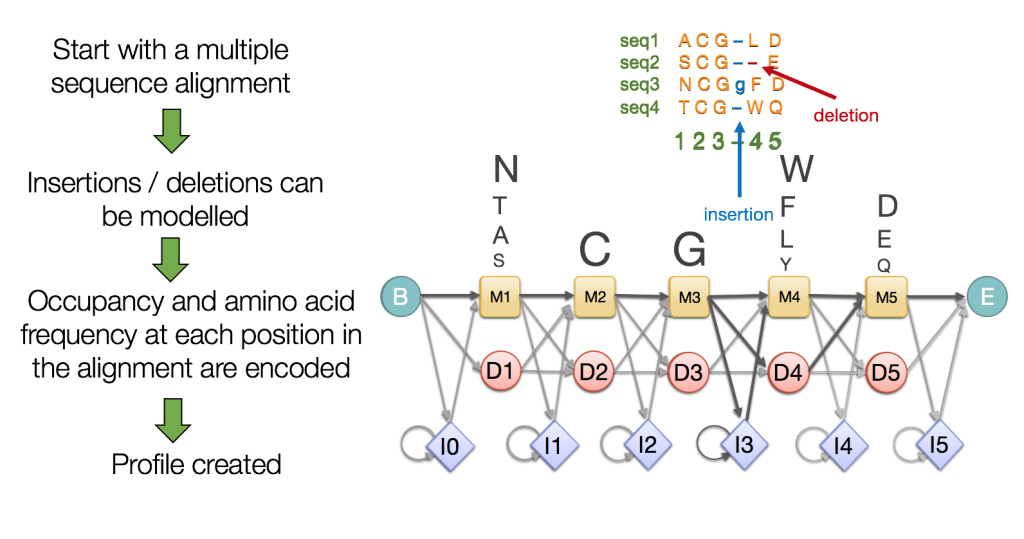
HMMs are incredibly useful in computational biology for analyzing biological sequences. They are employed for gene finding (identifying coding regions within a DNA sequence), protein family modeling, sequence alignment, and predicting secondary structures of proteins. In these applications, hidden states might represent different functional regions of a genome (e.g., exon, intron, intergenic) or different structural motifs within a protein, with observations being the individual nucleotides or amino acids.
Gesture Recognition and Human Activity Modeling
HMMs can process sequences of sensor data (e.g., from accelerometers, gyroscopes, or depth cameras) to recognize dynamic gestures (like waving a hand) or categorize human activities (like walking, running, standing). Each phase of a gesture or activity can be represented as a hidden state, and the sensor readings constitute the observations. The model learns to transition between these phases and emit characteristic sensor patterns, allowing for robust recognition in real-time.
Anomaly Detection
HMMs are deployed in various tech security and monitoring systems for anomaly detection. For instance, in network intrusion detection, an HMM can be trained on typical network traffic patterns. Any observed sequence of network events that has a very low probability under the trained HMM can be flagged as a potential anomaly or intrusion. Similarly, in industrial control systems, HMMs can monitor sensor readings to detect unusual operational sequences that might indicate equipment malfunction or security breaches.
Advantages and Limitations
While powerful, HMMs, like any model, come with their own set of strengths and weaknesses that dictate their suitability for different problems.
Strengths of HMMs
HMMs are mathematically well-founded, providing a rigorous probabilistic framework. The algorithms for solving the three fundamental problems (Forward, Viterbi, Baum-Welch) are computationally efficient and robust, making them practical for real-world deployment. They are particularly well-suited for modeling sequential data where the underlying generative process is unknown but exhibits Markovian properties. Furthermore, compared to some deep learning models, HMMs can be more interpretable, as the states and transition probabilities often have a clearer physical or conceptual meaning. They also perform well with smaller datasets where deep learning models might overfit.

Weaknesses and Modern Alternatives
One of the primary limitations of HMMs stems from their core assumptions: the Markov property and the independence of observations. The assumption that the next state depends only on the current one, and not on a longer history, might not hold true for all complex real-world sequences, which often exhibit long-range dependencies. Similarly, the assumption that observations are independent given the hidden state can be restrictive.
For tasks requiring the capture of long-term dependencies and complex, hierarchical features, HMMs have largely been superseded by advanced neural network architectures. Recurrent Neural Networks (RNNs), Long Short-Term Memory (LSTM) networks, Gated Recurrent Units (GRUs), and especially Transformer models, excel at processing sequential data by maintaining a more sophisticated internal memory and processing information across much longer time spans. These models can automatically learn highly abstract features from raw data, often outperforming HMMs on large datasets.
Nevertheless, HMMs remain valuable. They are often a good starting point for sequence modeling, can be effective for simpler problems, and sometimes serve as components within hybrid systems or as benchmarks against which more complex models are measured. Their clear probabilistic foundation continues to offer insights into the structure of sequential data.
aViewFromTheCave is a participant in the Amazon Services LLC Associates Program, an affiliate advertising program designed to provide a means for sites to earn advertising fees by advertising and linking to Amazon.com. Amazon, the Amazon logo, AmazonSupply, and the AmazonSupply logo are trademarks of Amazon.com, Inc. or its affiliates. As an Amazon Associate we earn affiliate commissions from qualifying purchases.