
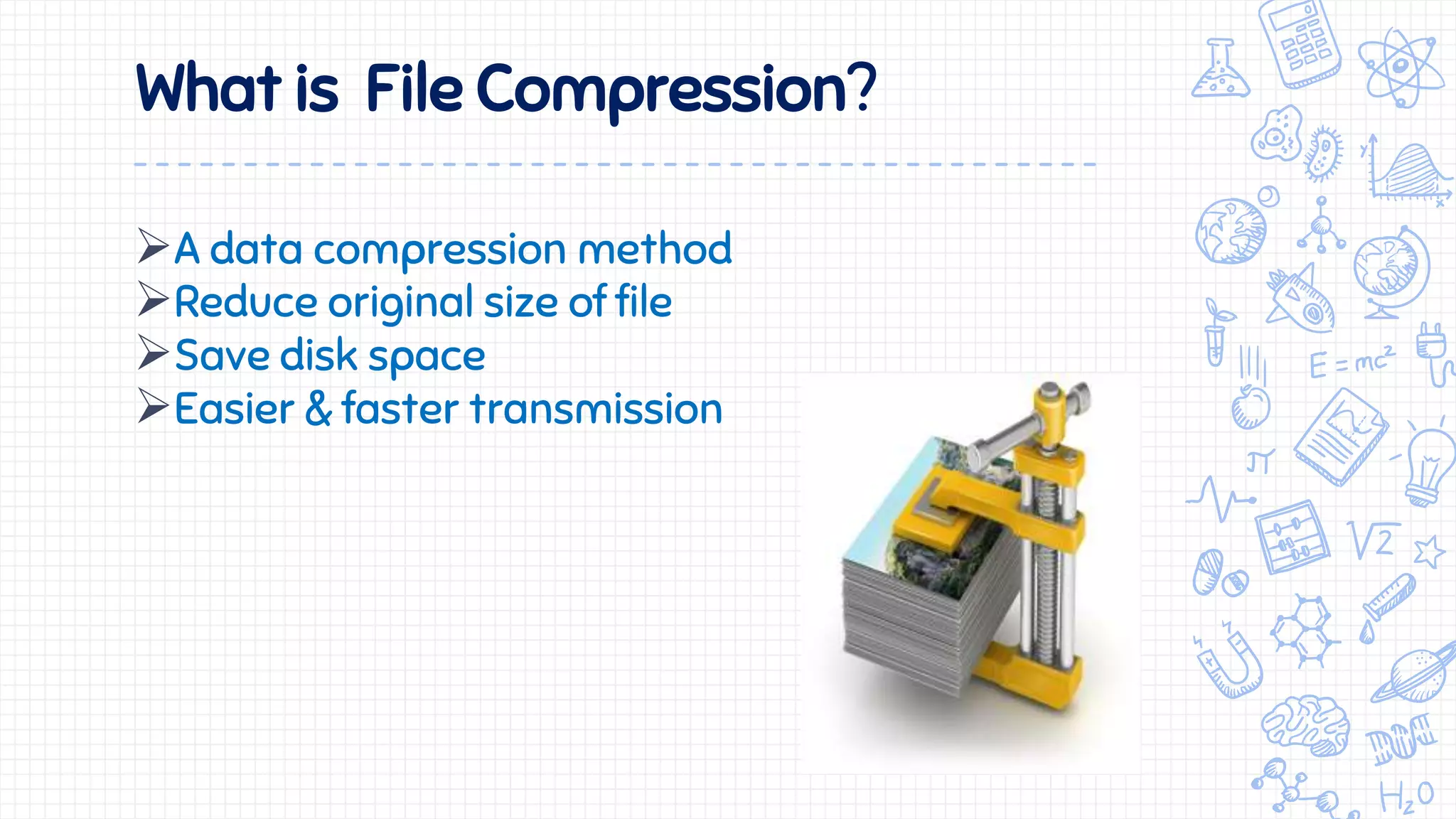
In an increasingly digital world, where data is generated, stored, and transmitted at unprecedented rates, the concept of file compression has evolved from a niche technicality into a fundamental pillar of modern computing. At its core, file compression is the art and science of reducing the size of a data file, making it more efficient to store, transfer, and manage. This seemingly simple act unlocks a cascade of benefits, from mitigating storage constraints on our devices to accelerating the flow of information across global networks. Without compression, our digital lives would be far clunkier, slower, and significantly more expensive. Understanding what file compression is, how it works, and its pervasive applications offers critical insight into the invisible forces shaping our digital experience.

Understanding the Core Concept of File Compression
The fundamental premise of file compression stems from a simple observation: most digital data contains redundancy. Whether it’s the repeating pixels in a blue sky, the common words and phrases in a text document, or the silent gaps in an audio recording, information is rarely stored in its most compact form by default. File compression aims to identify and eliminate this redundancy, representing the same information using fewer bits or bytes.
The Problem of Data Bloat
Imagine a document that repeatedly uses the phrase “the quick brown fox jumps over the lazy dog.” Without compression, each instance of this phrase is stored character by character, consuming significant space. Multiply this by millions of files, images, videos, and applications, and the sheer volume of data becomes astronomical. This “data bloat” leads to several issues:
-
Increased Storage Costs: More data requires larger hard drives, more server space, and more expensive cloud storage solutions.
-
Slower Transmission Speeds: Larger files take longer to upload, download, and stream, consuming more bandwidth and delaying access.
-
Inefficient Processing: Managing and backing up large, uncompressed datasets can be time-consuming and resource-intensive for computer systems.
File compression directly addresses these challenges by making data lean and efficient.
The Goal: Efficiency and Economy
The primary goal of file compression is to achieve maximum data reduction with minimal impact on usability or data integrity. It’s a trade-off, balancing the desire for smaller files against the resources (CPU cycles, memory) required to compress and decompress them. The ideal scenario is to drastically reduce file size, enabling faster transfers and more economical storage, without noticeable loss in quality or excessive processing overhead. This pursuit of efficiency and economy drives the continuous evolution of compression algorithms and techniques, shaping how we interact with digital content every day.
The Mechanics Behind the Magic: How Compression Algorithms Work
At the heart of file compression are sophisticated algorithms designed to systematically identify and exploit patterns and redundancies within data. These algorithms transform the original data into a more compact representation, which can then be reverted to its original or near-original state when needed.
Identifying Redundancy: The Key to Smaller Files
Compression algorithms are essentially pattern detectors. They look for:
-
Repetitive Sequences: The most common form of redundancy. Instead of storing “AAAAA” five times, a compressor might store “5A”.
-
Predictable Patterns: In an image, if one pixel is red, there’s a high probability its immediate neighbors are also red, especially in large blocks of uniform color.
-
Statistical Probabilities: Certain characters or symbols appear more frequently than others in a given dataset (e.g., ‘e’ is more common than ‘z’ in English text). Algorithms can assign shorter codes to frequently occurring items and longer codes to less common ones.
-
Zero-Suppression: Many files, especially sparse databases or some image formats, contain large blocks of zeros or empty space. Compressors can efficiently represent these blocks.
Encoding Techniques: From Run-Length to Huffman and Lempel-Ziv
Various encoding techniques are employed to achieve compression, each suited to different types of data and objectives:
-
Run-Length Encoding (RLE): A very simple form of compression ideal for data with long sequences of identical values. For example, “AAABBCDDDD” becomes “3A2B1C4D”. It’s often used in simple image formats or as a preliminary step in more complex compression schemes.
-
Huffman Coding: A variable-length encoding scheme that assigns shorter bit codes to characters or symbols that appear frequently and longer codes to those that appear rarely. This technique is highly effective for text and other data with varying symbol frequencies and is a component of many widely used compression formats (e.g., JPEG, MP3, ZIP).
-
Lempel-Ziv (LZ) Algorithms (e.g., LZ77, LZ78, LZW): These are dictionary-based compression algorithms. They work by identifying repeating sequences of data and replacing them with references to a dictionary of previously encountered sequences. For instance, if the phrase “the quick brown fox” appears multiple times, the algorithm stores it once in a dictionary and then simply points to that dictionary entry whenever the phrase reappears. This is the foundation of popular formats like ZIP, GZIP, and GIF.
-
Discrete Cosine Transform (DCT): Primarily used for image and audio compression (e.g., JPEG, MPEG). DCT transforms a signal or image into elementary frequency components. This allows for the removal of high-frequency components that are less perceptible to the human eye or ear, leading to significant compression with minimal perceived quality loss.
These techniques, often combined and optimized, are what allow a massive high-resolution image to be squeezed into a manageable JPEG, or a lengthy document into a small ZIP file.
Navigating the Landscape: Lossless vs. Lossy Compression
One of the most crucial distinctions in the world of file compression is the trade-off between fidelity and file size, giving rise to two primary categories: lossless and lossy compression. The choice between them depends entirely on the nature of the data and the application’s requirements.
Lossless Compression: Perfect Reconstruction
Lossless compression, as the name suggests, allows the original data to be perfectly reconstructed from the compressed version. Not a single bit of information is lost during the compression and decompression process. This makes it indispensable for applications where data integrity is paramount.
-
How it works: Lossless algorithms achieve reduction by identifying and removing statistical redundancy without discarding any actual data. They use techniques like Run-Length Encoding, Huffman Coding, and Lempel-Ziv algorithms to find patterns and represent them more efficiently.
-
Use Cases:
-
Text documents: Losing even a single character would alter the meaning.
-
Executable files and software: Any data loss would render the program inoperable.
-
Medical images: Precision is critical; no diagnostic information can be sacrificed.
-
Archival purposes: Ensuring future generations can access the exact original data.
-
-
Examples of Formats: ZIP, GZIP, PNG (for images), FLAC (for audio), ALAC (Apple Lossless Audio Codec).
-
Compression Ratio: Generally lower than lossy compression, as there are limits to how much redundancy can be removed without discarding information.
Lossy Compression: Sacrificing Fidelity for Size
Lossy compression, conversely, achieves higher compression ratios by permanently discarding some of the original data. The algorithms identify information that is least perceptible to human senses (eyes and ears) or least critical to the data’s core purpose and remove it. While some data is lost, the goal is for the human observer or listener to perceive little to no difference from the original.
-
How it works: These algorithms leverage psychoacoustic or psychovisual models to determine which data can be safely discarded without significantly impacting perceived quality. For example, in an image, very subtle color variations might be averaged out, or in audio, very high or low frequencies beyond human hearing range might be removed.
-
Use Cases:
-
Images: Where minor detail loss is acceptable for significantly smaller file sizes (e.g., web photos).
-
Audio: For music and spoken word where minor degradation is traded for portability (e.g., streaming).
-
Video: Essential for streaming and broadcasting due to the immense size of uncompressed video data.
-
-
Examples of Formats: JPEG (for images), MP3 (for audio), MPEG (for video), AAC (Advanced Audio Coding).
-
Compression Ratio: Significantly higher than lossless compression, allowing for massive reductions in file size. The degree of “loss” can often be adjusted, with higher compression leading to greater data loss and potentially noticeable quality degradation.
Common File Formats and Their Compression Types
It’s helpful to recognize common file formats and the compression strategies they employ:
-
.zip,.rar,.7z: Generally lossless archival formats for bundling and compressing multiple files. -
.jpg,.jpeg: Lossy image compression, ubiquitous for photos. -
.png,.gif: Lossless image compression, suitable for graphics, logos, and images with sharp lines or transparency. -
.mp3,.aac,.ogg: Lossy audio compression formats for music and podcasts. -
.flac,.alac,.wav: Lossless audio formats, often preferred by audiophiles or for professional use. -
.mp4,.mov,.avi,.mkv: Container formats for video and audio. The actual video/audio streams within them are usually lossily compressed (e.g., using H.264 or H.265 codecs).
The Ubiquitous Impact: Benefits and Real-World Applications
File compression is not merely a theoretical concept; it’s an invisible workhorse that underpins countless aspects of our digital existence. Its benefits are far-reaching, enabling more efficient storage, faster transmission, and better management of our ever-growing data footprint.
Saving Storage Space
This is perhaps the most immediate and tangible benefit. By reducing file sizes, compression allows users to store more data on their devices, whether it’s a smartphone, laptop, or server farm. For individuals, this means more photos, videos, and apps. For businesses, it translates to lower infrastructure costs for data centers and cloud storage providers, leading to more economical services for end-users. Without compression, the cost of storing the world’s digital information would be astronomical, and personal devices would reach their storage limits far more quickly.
Accelerating Data Transmission
The internet and global communication networks operate on the principle of bandwidth – the amount of data that can be transferred over a connection in a given time. Smaller file sizes mean that more data can be squeezed through the same pipeline in the same amount of time.
-
Faster Downloads and Uploads: Websites load quicker, software updates complete faster, and sending large attachments becomes feasible.
-
Efficient Streaming: Services like Netflix, YouTube, and Spotify rely heavily on video and audio compression to deliver high-quality content over varying internet speeds without constant buffering.
-
Reduced Bandwidth Costs: For both consumers (especially those with data caps) and internet service providers, compressed data consumes less bandwidth, leading to more efficient network usage and potentially lower costs.
Enhancing Data Management and Backup
Large, uncompressed datasets are cumbersome to manage. Compression simplifies these tasks significantly.
-
Quicker Backups: Backing up compressed data to external drives or cloud services takes less time, reducing the window of vulnerability for data loss.
-
Easier Archiving: Organizations can efficiently archive vast amounts of historical data, making it more cost-effective to store and retrieve when needed.
-
Improved System Performance: Less data being moved around means less strain on system resources (CPU, RAM), which can lead to smoother overall performance, particularly during intensive operations.
Everyday Examples: From Photos to Software Downloads
File compression is so integrated into our daily tech use that we often take it for granted:
-
Digital Photography: Every photo you take with your smartphone or digital camera is likely saved as a JPEG, a highly compressed lossy format that makes sharing and storing thousands of images feasible.
-
Web Browsing: Images, videos, and even text on websites are compressed to ensure pages load quickly, improving user experience and reducing server load.
-
Software Distribution: When you download an operating system, a large game, or any application, it’s almost always provided as a compressed archive (e.g.,
.zip,.exeinstallers often contain compressed data) to speed up download times. -
Video Conferencing: Real-time video and audio streams in applications like Zoom or Microsoft Teams are heavily compressed to work effectively over typical home internet connections.
Considerations and the Evolving Landscape of Compression
While file compression offers immense benefits, it’s not without its trade-offs and evolving challenges. Understanding these aspects is key to appreciating its ongoing development.
The Trade-offs: Speed vs. Ratio
The primary trade-off in compression lies between the compression ratio (how much the file size is reduced) and the speed/computational resources required for compression and decompression.
-
Higher Compression Ratios: Generally require more complex algorithms, which consume more CPU cycles and time to compress data. Decompression might also take longer.
-
Faster Compression/Decompression: Often means using simpler algorithms, which might yield a lower compression ratio.
The optimal balance depends on the application. For archival purposes, a high compression ratio might be prioritized, even if it takes hours. For real-time video streaming, fast decompression is paramount, even if it means a slightly lower quality stream. This balance is continuously refined with advancements in hardware and algorithms.
The Rise of Cloud Computing and Its Influence
Cloud computing has significantly influenced the role of compression. While vast cloud storage can seem limitless, the costs associated with storing and, crucially, transferring data (egress fees) make compression even more critical for cloud-native applications.
-
Reduced Cloud Storage Costs: Storing compressed data directly lowers the bill for cloud storage.
-
Lower Data Transfer Costs: As data moves between cloud regions, to edge devices, or to end-users, compressed data significantly reduces bandwidth usage and associated egress charges.
-
Improved Cloud Application Performance: Faster data loading times for web applications and services hosted in the cloud, enhancing user experience.
The cloud environment has pushed for even more sophisticated compression tailored for streaming and real-time data access.

Future Trends: Smarter Algorithms and Specialized Compression
The field of file compression is far from stagnant. Ongoing research and development are focusing on several key areas:
-
Machine Learning and AI-driven Compression: AI could potentially analyze data patterns more intelligently, leading to even more efficient algorithms that adapt dynamically to different data types.
-
Perceptually Optimized Compression: Further refinement of lossy algorithms to discard data even more effectively based on advanced models of human perception, particularly for VR/AR and ultra-high-definition content.
-
Specialized Codecs for New Data Types: As new forms of data emerge (e.g., genomic data, complex scientific simulations, metaverse assets), there’s a need for highly specialized compression techniques tailored to their unique structures.
-
Hardware Acceleration: Dedicated hardware components for compression and decompression, similar to how GPUs accelerate graphics, can offload the processing burden from the main CPU, leading to faster and more energy-efficient operations.
In conclusion, file compression is a silent, yet immensely powerful, technology. From allowing us to fit thousands of photos on our phones to enabling seamless streaming of 4K video across continents, it is an indispensable component of the digital infrastructure. As data volumes continue to explode and our digital interactions become ever more complex, the principles and practices of file compression will only grow in importance, continuing to shape the efficiency and accessibility of our technological world.
aViewFromTheCave is a participant in the Amazon Services LLC Associates Program, an affiliate advertising program designed to provide a means for sites to earn advertising fees by advertising and linking to Amazon.com. Amazon, the Amazon logo, AmazonSupply, and the AmazonSupply logo are trademarks of Amazon.com, Inc. or its affiliates. As an Amazon Associate we earn affiliate commissions from qualifying purchases.