
Subaru’s Eyesight Driver Assist Technology stands as a cornerstone of the brand’s commitment to safety and innovation. Far more than just a single feature, Eyesight is a comprehensive suite of advanced driver-assistance systems (ADAS) that utilizes proprietary stereo camera technology to monitor the road ahead, identify potential hazards, and intervene to help prevent collisions or mitigate their severity. It represents a significant technological leap in making driving safer and more intuitive, positioning Subaru at the forefront of automotive safety solutions.
The Genesis of Subaru Eyesight Technology
The development of Eyesight was not an overnight endeavor but rather the culmination of decades of research and a steadfast dedication to occupant safety. Subaru recognized early on the potential of computer vision and sensor technology to create a more proactive safety system, moving beyond passive crash protection to active crash prevention.

A Vision for Safety
Subaru’s journey into advanced safety began with a fundamental premise: if a driver can see, react, and avoid an accident, the system should be able to assist. This philosophy led to exploring technologies that could mimic or augment human perception. The primary goal was to reduce the frequency and impact of common accidents, such as rear-end collisions and lane departures, which are often attributed to driver distraction or momentary lapses in judgment.
Stereoscopic Camera Advantage
Unlike many competitor systems that rely on radar, lidar, or monocular cameras, Subaru’s Eyesight system is unique for its use of dual, forward-facing stereo cameras. These cameras are mounted high on the windshield, near the rearview mirror, providing a perception similar to human eyes. This stereoscopic vision allows Eyesight to accurately measure distances, shapes, and speeds of objects in its field of view, creating a detailed, three-dimensional map of the road ahead. This distinct advantage enables a higher degree of precision and reliability in object detection, classifying everything from vehicles and pedestrians to cyclists and lane markings. The redundancy of two cameras also enhances robustness, as the system can often continue to function even if one camera’s view is temporarily obscured.
Core Features and Functionality
Eyesight integrates several key functions that work in concert to enhance safety and driver convenience. These features are designed to either warn the driver of impending danger or, in critical situations, take corrective action autonomously.
Pre-Collision Braking System
Perhaps the most critical feature, the Pre-Collision Braking System, monitors the traffic conditions ahead. If it detects a high probability of a frontal collision with another vehicle, pedestrian, or cyclist, it first alerts the driver with visual and audible warnings. If the driver fails to react, the system can automatically apply the brakes to help avoid the collision entirely or reduce the impact speed, thereby mitigating injury and damage. This proactive intervention is a hallmark of Eyesight’s preventative safety capabilities.
Adaptive Cruise Control
Adaptive Cruise Control (ACC) significantly reduces driver fatigue on long journeys or in stop-and-go traffic. Using its stereo cameras, Eyesight can detect the speed and distance of the vehicle ahead and automatically adjust Subaru’s speed to maintain a pre-set following distance. The system can bring the vehicle to a complete stop and resume acceleration when traffic moves, providing a more relaxed and safer driving experience in varying traffic conditions.
Lane Keep Assist and Sway Warning
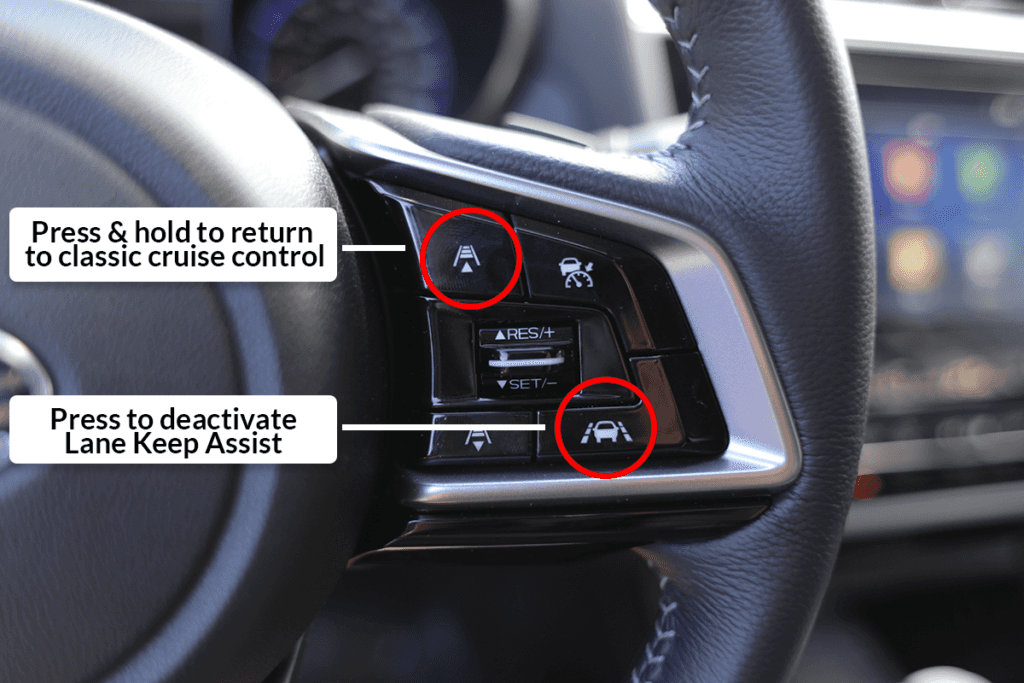
These features are designed to prevent unintentional lane departures. Lane Keep Assist actively helps keep the vehicle centered within its lane by providing gentle steering input if it detects the car drifting too close to lane markings. Complementing this, the Lane Departure Warning alerts the driver with an audible tone and visual warning if the vehicle begins to stray from its lane without the turn signal being activated. The Lane Sway Warning monitors for signs of fatigued or distracted driving, such as inconsistent steering or weaving, and prompts the driver to take a break.
Pre-Collision Throttle Management
This feature is designed to prevent accidental acceleration into an obstacle. If Eyesight detects an obstacle directly in front of the vehicle and the driver inadvertently presses the accelerator pedal instead of the brake, the system will cut power from the engine and alert the driver. This functionality is particularly useful in parking lots or slow-moving traffic, where pedal misapplication can occur.
Lead Vehicle Start Alert
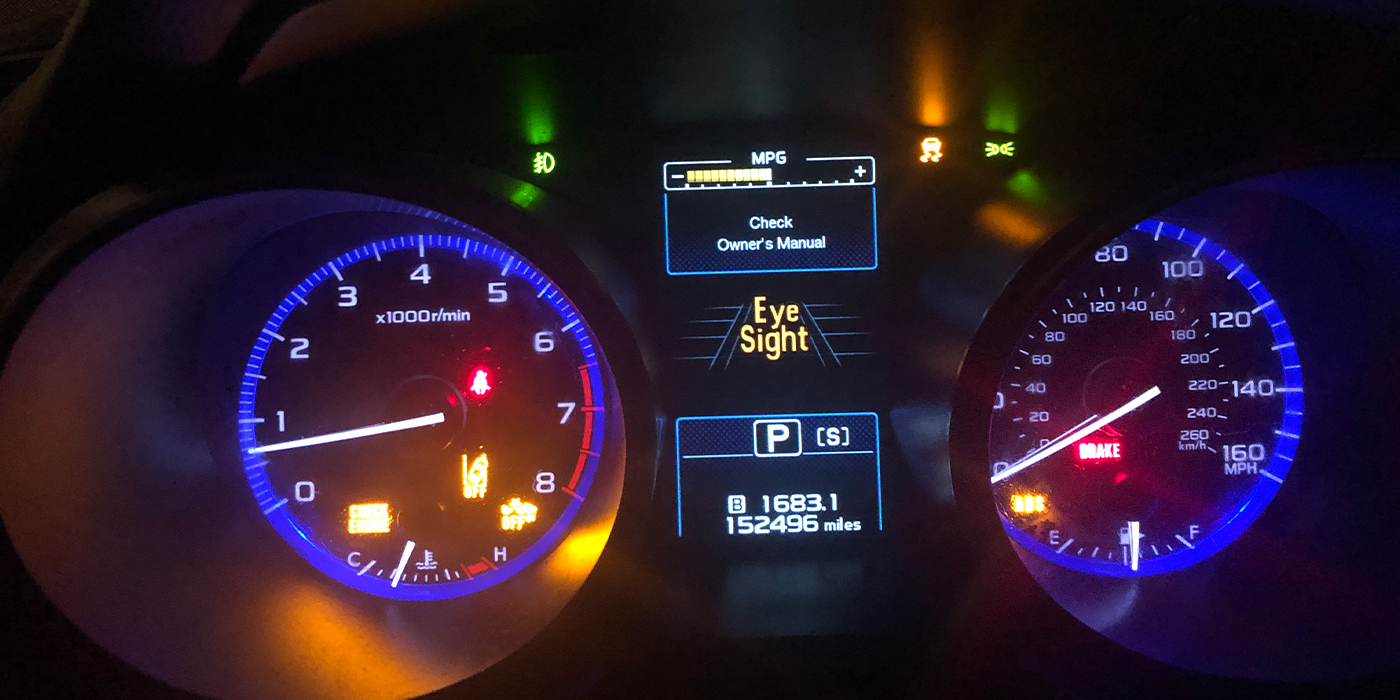
A convenience feature, the Lead Vehicle Start Alert, notifies the driver when the traffic ahead has started moving, and the driver has not yet responded. This is especially helpful in stop-and-go traffic, preventing delays and improving the flow of traffic by reminding the driver to proceed.
How Eyesight Works: The Technical Backbone
The efficacy of Subaru Eyesight lies in its sophisticated integration of hardware and software, leveraging advanced computer vision algorithms to interpret its surroundings.
Advanced Computer Vision
At the core of Eyesight is its pair of high-resolution color cameras. These cameras capture continuous video streams of the road ahead, feeding data to a dedicated image processing unit. This unit, equipped with specialized processors and algorithms, performs real-time analysis of the visual information. It identifies and categorizes objects (vehicles, pedestrians, cyclists, road signs), measures their distance, speed, and trajectory, and constantly compares this information against a vast database of scenarios to predict potential conflicts. The system’s ability to create a stereoscopic, 3D understanding of the environment is crucial for its precise distance measurement and object differentiation, allowing it to function reliably even in conditions where radar-based systems might struggle, such as distinguishing a stationary object from an overhead sign.
Integration with Vehicle Systems
Eyesight is not an isolated system; it is deeply integrated with the vehicle’s other critical components. It communicates seamlessly with the engine control unit (ECU), transmission control unit (TCU), steering system, and brake system. When Eyesight determines that an intervention is necessary, it sends commands to these systems to execute actions like applying brakes, adjusting throttle, or initiating steering corrections. This seamless integration ensures that the vehicle responds cohesively and effectively to potential threats, enhancing overall safety without sacrificing the natural feel of driving. The system also takes into account driver inputs, ensuring that its interventions are harmonized with the driver’s intentions, providing assistance rather than overriding control.
Limitations and Driver Responsibility
While Eyesight is a remarkably advanced system, it is crucial to understand its limitations. It is an assist system, not an autonomous driving system. Factors such as severe weather (heavy rain, snow, fog), direct sunlight glaring into the cameras, dirty or damaged windshields, and certain road conditions (poor lane markings, complex intersections) can reduce its effectiveness. Subaru emphatically states that Eyesight does not replace the need for an attentive and responsible driver. Drivers are ultimately responsible for maintaining control of their vehicle, monitoring their surroundings, and being prepared to take evasive action. Eyesight is an additional layer of protection, a vigilant co-pilot, designed to enhance safety but not to take over the primary role of the human driver.
Evolution and Future of Eyesight
Since its introduction, Subaru Eyesight has continuously evolved, incorporating new technologies and expanding its capabilities. Its future trajectory points towards even more sophisticated assistance and integration.
Enhancements Over Generations
Each generation of Eyesight has brought significant improvements in sensor accuracy, processing speed, and feature sets. Newer versions have introduced wider viewing angles, enhanced low-light performance, and the ability to detect a broader range of objects. Features such as Reverse Automatic Braking (utilizing rear sensors) and DriverFocus Distraction Mitigation System (using an infrared camera to monitor driver alertness) have been added to complement the core Eyesight suite, providing a more holistic safety umbrella. The computing power behind Eyesight has also increased dramatically, allowing for faster decision-making and more nuanced interventions.
Towards Autonomous Driving
While Subaru remains committed to the driver-centric approach, the technological foundation laid by Eyesight is a clear step towards higher levels of driving automation. The stereo camera technology, with its robust object detection and spatial mapping capabilities, is a strong basis for future autonomous functions. As regulations evolve and technology matures, Eyesight’s architecture could support features that offer even greater hands-on or hands-off driving capabilities in specific conditions, gradually moving towards a future where the vehicle can take on more driving tasks.
Integration with Connected Car Technologies
The future of Eyesight will also likely see deeper integration with connected car technologies. This could involve V2X (Vehicle-to-Everything) communication, allowing the car to communicate with other vehicles, infrastructure, and even pedestrian devices. Such integration could provide Eyesight with predictive data beyond its line of sight, anticipating hazards even before they are visually detectable. This collaborative approach would further enhance the system’s ability to prevent accidents and optimize traffic flow, transforming not just individual vehicle safety but the safety of the entire road ecosystem.
Subaru’s Eyesight technology is a testament to the power of advanced driver assistance systems in enhancing road safety. By leveraging sophisticated stereo camera technology and intelligent algorithms, it acts as a silent guardian, constantly scanning the road, anticipating dangers, and providing crucial assistance to the driver. As technology continues to advance, Eyesight will undoubtedly remain a cornerstone of Subaru’s commitment to building safer, more confident driving experiences.
aViewFromTheCave is a participant in the Amazon Services LLC Associates Program, an affiliate advertising program designed to provide a means for sites to earn advertising fees by advertising and linking to Amazon.com. Amazon, the Amazon logo, AmazonSupply, and the AmazonSupply logo are trademarks of Amazon.com, Inc. or its affiliates. As an Amazon Associate we earn affiliate commissions from qualifying purchases.