
Encumbrance is a fundamental concept in accounting that plays a crucial role in managing and reporting a company’s financial obligations and commitments. While often associated with legal liens or property claims, in accounting, an encumbrance refers to a restriction on the use of specific assets or a commitment to future expenditure. Understanding encumbrances is vital for businesses to maintain accurate financial records, forecast cash flows effectively, and make informed strategic decisions. This article will delve into the intricacies of encumbrances in accounting, exploring their nature, purpose, types, and implications for financial reporting.
The Essence of Encumbrance: More Than Just a Lien
At its core, an encumbrance in accounting signifies a reservation of funds or a restriction on how certain assets can be utilized. It’s not necessarily a direct liability in the traditional sense, where an immediate payment is due. Instead, it represents a future obligation or a limitation imposed on available resources. This distinction is critical because it impacts how financial statements are prepared and interpreted.

Distinguishing Encumbrance from Liability
The primary difference between an encumbrance and a liability lies in the timing and certainty of the obligation. A liability is a definite obligation to pay a specific amount at a future date, or upon the occurrence of a specified event. Think of accounts payable, salaries payable, or loans. These are all recognized liabilities because the obligation is certain and the amount is known.
An encumbrance, on the other hand, often represents a commitment to incur an expense or a potential future obligation. For instance, a company might enter into a contract to purchase a significant piece of equipment. While the contract is signed and the intention is firm, the actual liability doesn’t arise until the equipment is delivered or services are rendered. Before that point, the commitment to purchase can be recognized as an encumbrance, reserving the necessary funds and alerting management to the future expenditure. This proactive approach prevents the over-commitment of resources.
The Importance of Tracking Encumbrances
Accurate tracking of encumbrances is essential for several reasons:
- Budgetary Control: Encumbrances are a cornerstone of effective budgetary control, particularly in governmental and non-profit accounting. They ensure that departments or projects do not overspend their allocated budgets. When a purchase order is issued, for example, the estimated cost is encumbered, reducing the available budget for that specific item. This prevents a situation where all funds are committed before the fiscal period ends, leaving no room for essential ongoing expenses.
- Cash Flow Management: By recognizing commitments in advance, businesses can better forecast their future cash outflows. This allows for more effective cash flow management, ensuring sufficient liquidity to meet both immediate and anticipated obligations. Without tracking encumbrances, a company might be surprised by a large upcoming payment it hadn’t adequately planned for.
- Financial Statement Accuracy: While encumbrances are typically not reported as liabilities on the balance sheet, they are often disclosed in the notes to the financial statements. This provides transparency to stakeholders about the company’s future financial commitments and helps them assess the true financial health and risk profile of the organization. For governmental entities, proper encumbrance accounting is crucial for demonstrating compliance with legal budgetary limitations.
- Strategic Planning: Understanding future commitments allows for better long-term strategic planning. If a significant portion of a future budget is already encumbered, it might influence decisions about new projects, investments, or expansion plans.
Types of Encumbrances in Business Finance
Encumbrances can manifest in various forms within a business’s financial operations. Their specific treatment and reporting might differ slightly depending on the accounting standards applicable to the entity (e.g., GAAP for private companies, GASB for governmental entities). However, the underlying principle of reserving funds or restricting asset use remains consistent.
Purchase Orders and Contracts
One of the most common forms of encumbrance arises from purchase orders (POs) and contracts. When a company issues a PO for goods or services, it signifies a commitment to purchase those items at an agreed-upon price. The estimated cost of the PO is then recorded as an encumbrance against the relevant budget. This reduces the unencumbered balance of that budget, making it clear how much funding is still available for discretionary spending.
Similarly, signing a long-term contract for services, such as a software license agreement or a lease agreement, creates an encumbrance. The future payments stipulated in the contract are committed funds, and while not yet a liability, they represent a restriction on future cash availability.
Capital Expenditure Commitments
Capital expenditures involve the acquisition of long-term assets, such as buildings, machinery, or vehicles. When a company decides to invest in a significant capital project, such as constructing a new facility or purchasing a large piece of equipment, the commitment to do so is often recognized as an encumbrance. This ensures that the necessary funds are reserved and that the project is appropriately accounted for from the commitment stage through to the actual expenditure. This is particularly important in capital budgeting, where funds are often allocated for multi-year projects.
Grants and Donations with Restrictions
For non-profit organizations and governmental entities, encumbrances can also arise from grants and donations that come with specific restrictions on their use. For example, a donor might provide funds designated for a particular program or capital project. While the funds may be received, they are considered encumbered until they are used in accordance with the donor’s stipulations. This ensures that restricted funds are not diverted to other purposes without proper authorization and compliance.
Unfilled Purchase Requisitions
In some systems, even an approved purchase requisition (a request to initiate a purchase) can be treated as an encumbrance. This signifies an intent to purchase, and the estimated cost is reserved. This is a more proactive step to control spending by reserving funds even before a formal purchase order is issued.
Accounting Treatment and Reporting of Encumbrances
The accounting treatment of encumbrances is designed to provide transparency and maintain budgetary control without misrepresenting current liabilities.
Recording Encumbrances
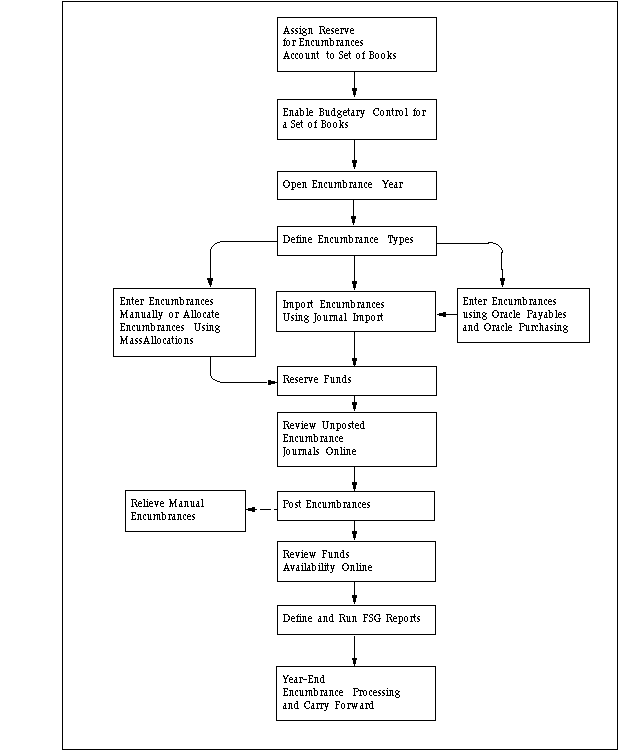
When an encumbrance is recognized, it is typically recorded through a journal entry that debits an “Encumbrance” account and credits an “Unencumbered Appropriation” or a similar budgetary fund balance account.

For example, if a company issues a purchase order for $10,000 worth of inventory:
Debit: Encumbrance (e.g., Encumbrances Outstanding) $10,000
Credit: Budgetary Fund Balance (e.g., Unreserved Fund Balance) $10,000
This entry does not affect the company’s operating accounts (revenue, expense, asset, liability) but rather impacts its budgetary accounts. It effectively reduces the amount of budget that is available for other commitments.
Reversing Encumbrances
When the actual expenditure occurs or the commitment is fulfilled, the encumbrance is reversed. This is done through another journal entry that debits the budgetary fund balance account and credits the Encumbrance account. Simultaneously, the actual expense or asset purchase is recorded in the regular accounting system.
Continuing the inventory example, when the inventory is received and the invoice is processed:
First, reverse the encumbrance:
Debit: Budgetary Fund Balance (e.g., Unreserved Fund Balance) $10,000
Credit: Encumbrance (e.g., Encumbrances Outstanding) $10,000
Second, record the actual expense/asset:
Debit: Inventory (Asset) $10,000
Credit: Accounts Payable (Liability) $10,000
(Or directly debiting an expense account if it’s not inventory)
This two-step process ensures that the reserved funds are released and that the actual financial transaction is properly recorded.
Disclosure of Encumbrances
While encumbrances are not reported as liabilities on the balance sheet, they are a critical piece of information for financial statement users. Generally accepted accounting principles (GAAP) and other relevant accounting standards often require disclosure of significant encumbrances. This disclosure can take several forms:
- Notes to the Financial Statements: The most common method is through footnotes. Companies will detail significant outstanding encumbrances, their nature, and their estimated amounts. This provides users with a clear understanding of the company’s future financial commitments beyond its recognized liabilities.
- Budgetary Comparison Schedules: For governmental and non-profit organizations, budgetary comparison schedules are often presented alongside the financial statements. These schedules clearly show the original budget, amendments, actual amounts, and the difference between budgeted and actual amounts, often highlighting the impact of encumbrances on budget availability.
- Management Discussion and Analysis (MD&A): Management may also discuss significant encumbrances in the MD&A section of their financial reports, providing qualitative insights into the strategic implications of these commitments.
The purpose of these disclosures is to offer a more complete picture of the entity’s financial position and its future obligations, enabling stakeholders to make more informed decisions.
Implications and Best Practices for Managing Encumbrances
Effectively managing encumbrances is not merely an accounting exercise; it is a critical component of sound financial management and strategic execution.
Impact on Financial Planning and Decision-Making
The presence and nature of encumbrances directly influence financial planning and decision-making processes.
- Resource Allocation: By clearly showing committed funds, encumbrances help in allocating remaining resources effectively. If a significant portion of a department’s budget is encumbered for a long-term project, management will know that less funding is available for new, uncommitted initiatives.
- Risk Assessment: For external stakeholders like investors or creditors, understanding encumbrances provides insight into potential future cash outflows, which is crucial for assessing the company’s financial risk and its ability to meet its obligations. High levels of encumbrances, especially if not tied to profitable future activities, could signal potential cash flow challenges.
- Operational Efficiency: Proper encumbrance management can highlight inefficiencies. For example, if encumbrances are consistently made and then reversed due to changes in plans or overestimations, it suggests a lack of rigorous planning or procurement processes.
Ensuring Accuracy and Timeliness
The value of encumbrance accounting is diminished if it is not performed accurately and in a timely manner.
- Regular Review: Encumbrances should be reviewed regularly to ensure they are still valid and that the estimated amounts are accurate. This prevents the carrying of outdated or incorrect commitments on the books.
- Clear Policies and Procedures: Establishing clear policies and procedures for initiating, approving, and reversing encumbrances is essential. This ensures consistency across the organization and reduces the likelihood of errors or omissions.
- Integration with Procurement Systems: Ideally, encumbrance accounting should be integrated with the company’s procurement and accounting systems. This automation can significantly improve accuracy and reduce the manual effort involved, allowing for real-time updates and better control.
Compliance and Governance
For many organizations, particularly those in the public sector or receiving government funding, compliance with encumbrance accounting rules is a matter of legal and regulatory obligation.
- Auditing and Oversight: Encumbrance records are often subject to audits by internal and external auditors. Demonstrating proper management and reporting of encumbrances is crucial for maintaining financial integrity and accountability.
- Preventing Unauthorized Spending: By acting as a control mechanism, encumbrances help prevent unauthorized spending and ensure that expenditures align with approved budgets and organizational objectives. This is a fundamental aspect of good governance.
In conclusion, encumbrance in accounting is a vital concept that goes beyond simply restricting the use of assets. It represents a forward-looking financial commitment, crucial for effective budgetary control, transparent financial reporting, and sound financial planning. By understanding its nuances and implementing robust management practices, businesses can harness the power of encumbrance accounting to enhance their financial discipline and strategic decision-making.
aViewFromTheCave is a participant in the Amazon Services LLC Associates Program, an affiliate advertising program designed to provide a means for sites to earn advertising fees by advertising and linking to Amazon.com. Amazon, the Amazon logo, AmazonSupply, and the AmazonSupply logo are trademarks of Amazon.com, Inc. or its affiliates. As an Amazon Associate we earn affiliate commissions from qualifying purchases.