
For decades, artificial intelligence was largely confined to the digital realm. It lived in servers, processed datasets, and communicated through text or pixels. This era of “disembodied AI” gave us powerful tools like search engines, recommendation algorithms, and, more recently, Large Language Models (LLMs). However, these systems lacked a fundamental component of natural intelligence: the ability to interact with and learn from the physical world.
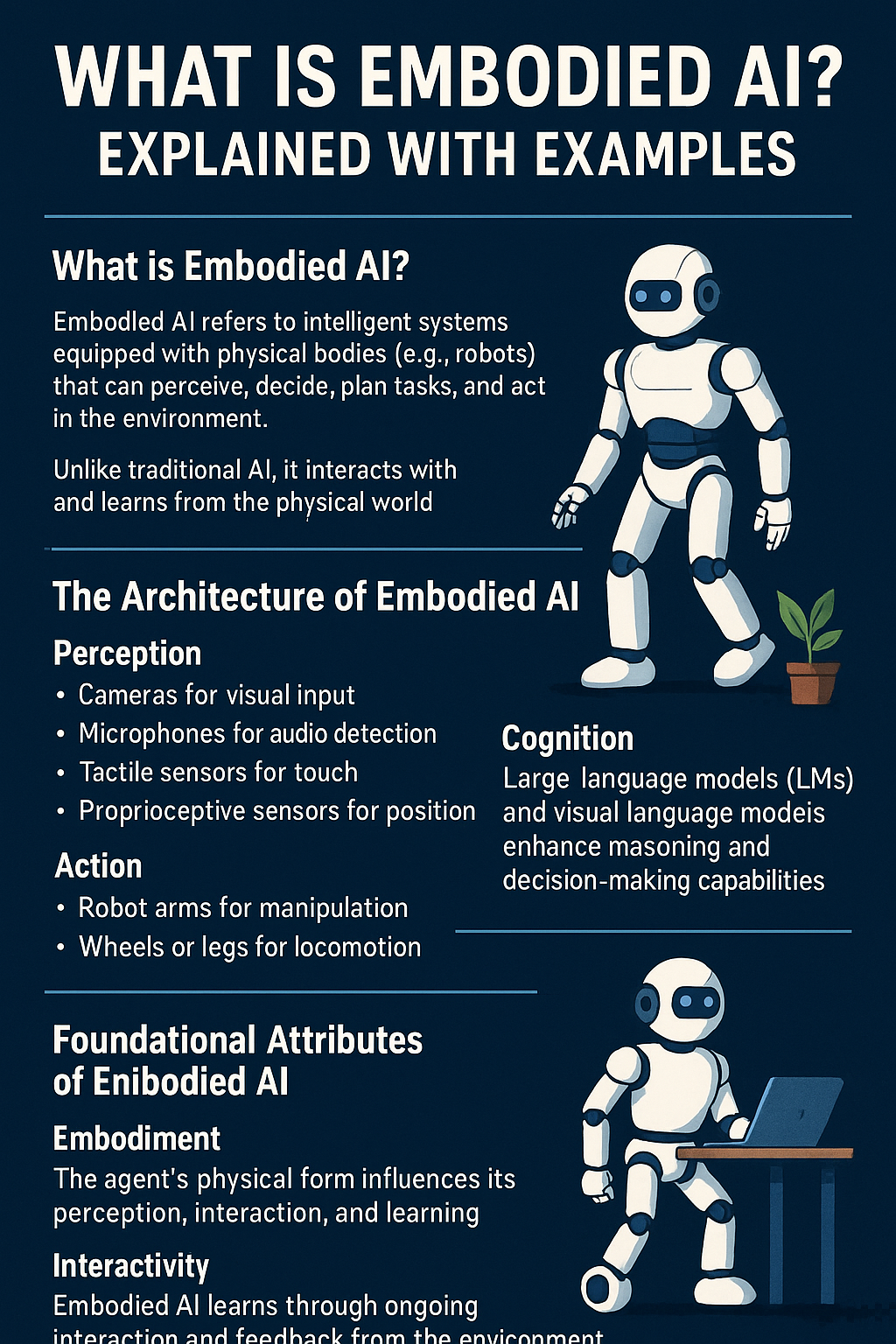
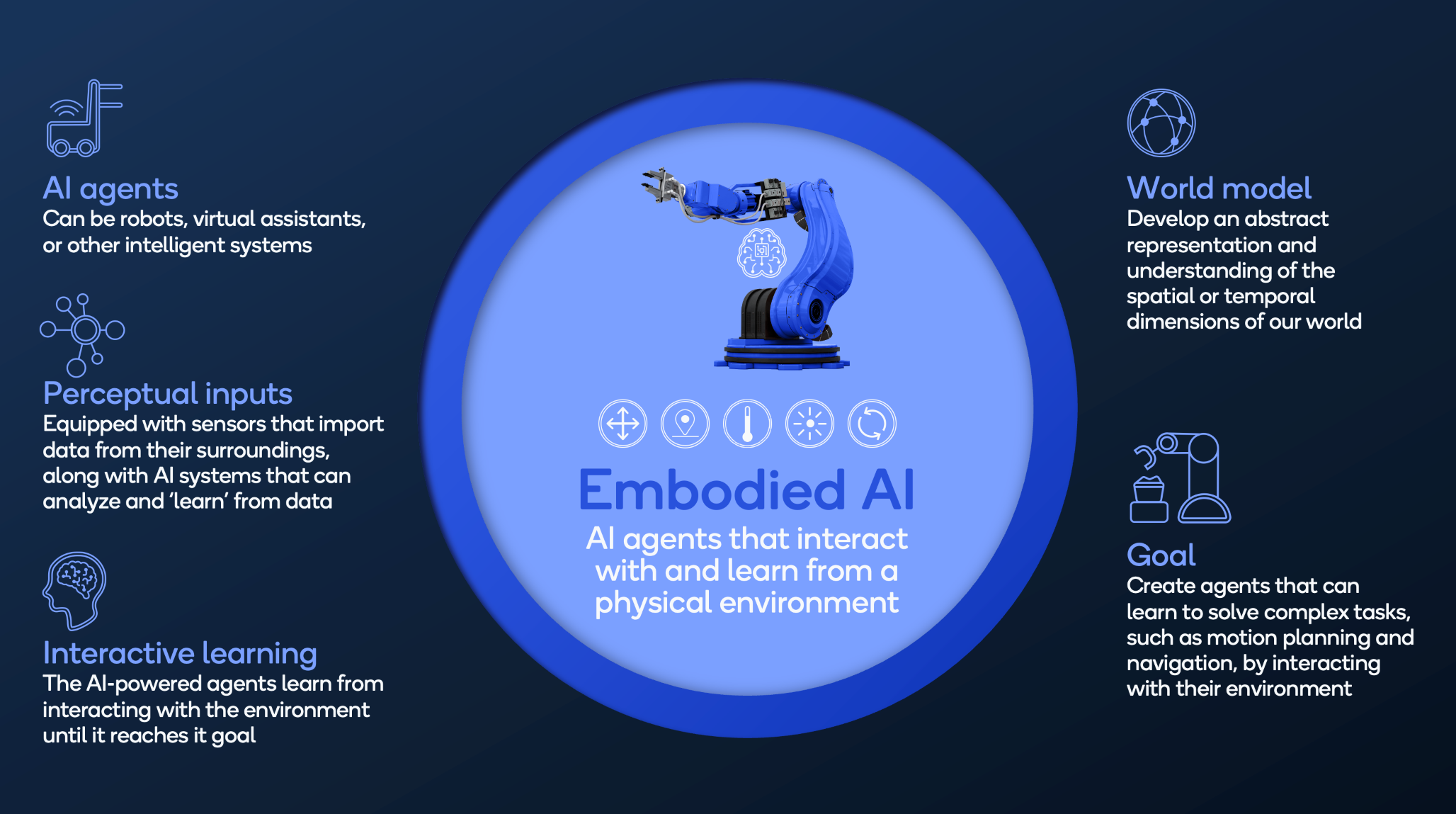
Embodied AI represents the monumental shift from “brains in a vat” to intelligent agents with physical forms. It is the integration of advanced machine learning with robotics, enabling AI to perceive its surroundings, navigate complex environments, and manipulate physical objects. This evolution marks the transition from AI that simply “knows” to AI that can “do.”
The Shift from Passive to Active Intelligence
To understand embodied AI, one must first look at the limitations of traditional AI. Disembodied systems are passive observers. An LLM might be able to describe the steps to bake a cake or explain the laws of physics, but it has no inherent understanding of gravity, friction, or the tactile resistance of dough. Its knowledge is derived from patterns in human language, not from lived experience.
Embodied AI changes this dynamic through active perception. Instead of processing a static dataset, an embodied agent gathers its own data by moving through an environment. If a robot encounters an obstacle, it doesn’t just see a collection of pixels; it learns the physical consequences of that obstacle through trial, error, and sensorimotor feedback. This creates a closed-loop system where perception informs action, and action, in turn, informs perception.
The Role of Physical Interaction
Intelligence is not just a product of neurological complexity; it is deeply rooted in physical interaction. This concept, known as the “embodied cognition” hypothesis, suggests that the nature of the human mind is largely determined by the form of the human body. By giving AI a body—whether it is a humanoid robot, a drone, or an autonomous vehicle—we provide it with a frame of reference.
In this context, the body serves as a filter and a catalyst for learning. An AI with sensors can understand depth, heat, and pressure. It learns that some objects are fragile while others are robust. This physical grounding allows for a much more robust form of intelligence that can handle the unpredictability of the real world, a feat that remains the “holy grail” of modern computer science.
The Core Components of an Embodied System
Building an embodied AI is significantly more complex than training a standard software-based model. It requires a seamless orchestration between high-level reasoning and low-level mechanical control. This is achieved through a combination of cutting-edge hardware and sophisticated neural architectures.
Perception and Sensory Fusion
The “senses” of an embodied AI go far beyond simple camera feeds. To navigate the three-dimensional world, these agents rely on sensory fusion—the integration of data from multiple sources to create a unified world model. This typically includes:
- Computer Vision: Using deep learning to identify objects, estimate distances, and track movement.
- LiDAR and Depth Sensors: Providing precise geometric data about the environment to prevent collisions.
- Proprioception: Internal sensors that tell the AI where its own “limbs” are in space, much like the human sense of body position.
- Tactile Sensing: High-resolution pressure sensors that allow a robot to pick up a grape without crushing it or turn a doorknob with the correct amount of torque.
By fusing these inputs, the AI can build a dynamic “digital twin” of its immediate surroundings, allowing it to plan several steps ahead.
Actuation and Control Loops
Once the AI perceives its environment, it must decide how to move. This is where actuation comes in. In disembodied AI, the “output” is a string of text or a predicted value. In embodied AI, the output is a series of motor commands sent to joints, wheels, or grippers.
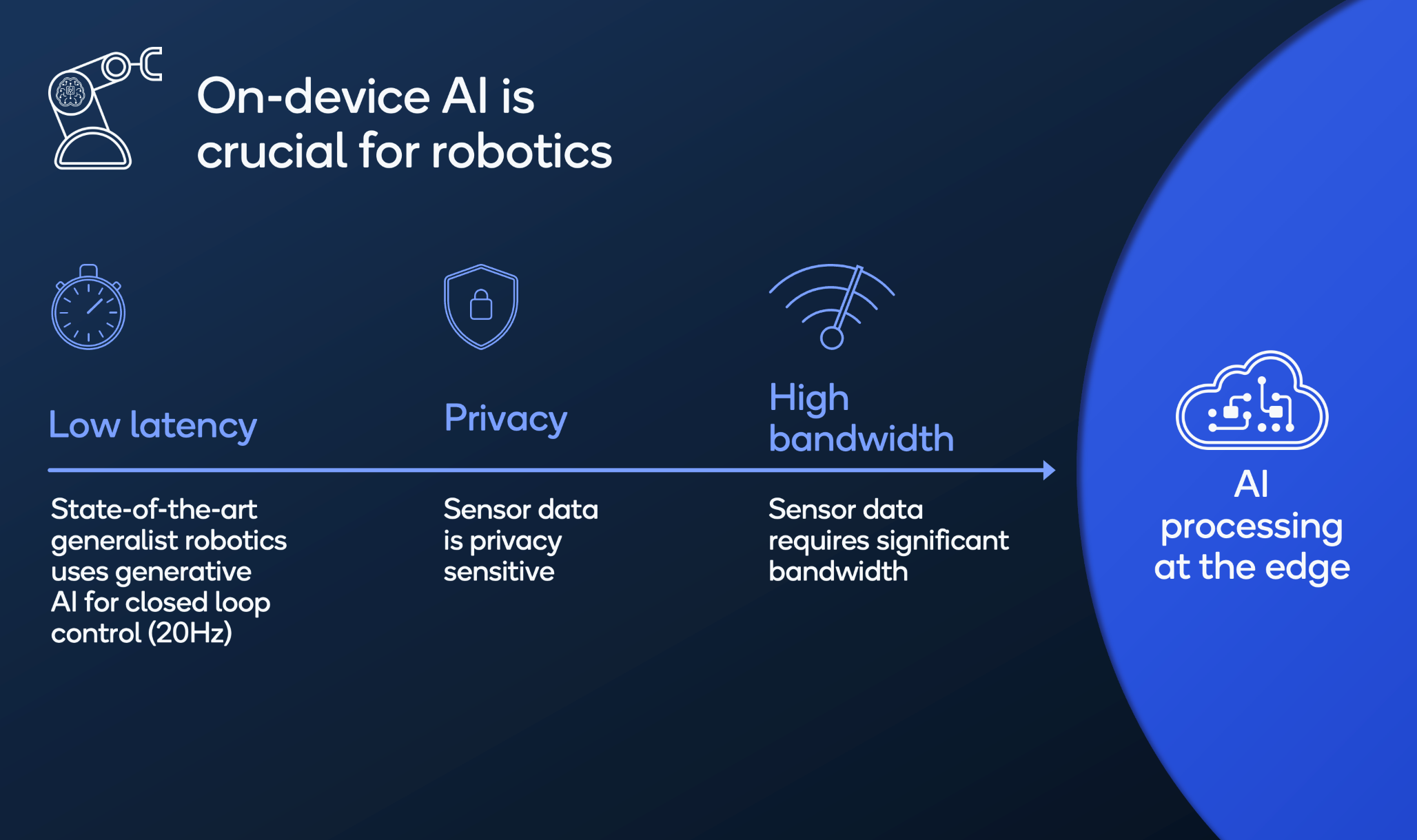
The challenge here is the “control loop.” In a digital environment, latency is a minor inconvenience. In the physical world, a delay of a few milliseconds in a control loop can cause a robot to fall or damage its surroundings. Embodied AI requires real-time processing speeds to constantly adjust its balance and trajectory based on the feedback it receives from its sensors.
Multimodal Large Language Models (VLA)
The most recent breakthrough in this field is the development of Vision-Language-Action (VLA) models. These are the descendants of the LLMs we use today, but they are trained on more than just text. They are trained on video data and robotic trajectories.
VLA models allow a human to give a high-level command like “find the spilled milk and clean it up.” The AI uses its language capabilities to understand the intent, its vision capabilities to locate the spill and the cleaning supplies, and its action capabilities to coordinate the physical movements required to execute the task. This bridge between high-level reasoning and low-level motor control is what makes general-purpose robotics possible.
Why Embodied AI Matters Now: The Convergence of Tech
The idea of embodied AI isn’t new, but several technological trends have converged to move it from the lab into the real world. We are currently witnessing a “perfect storm” of hardware and software advancements.
Advances in Computer Vision and Robotics
For years, robots were “blind” and “dumb,” following rigid, pre-programmed paths in controlled environments like factory floors. However, the explosion of deep learning has revolutionized computer vision. Today’s AI can segment images in real-time, identifying every individual object in a room with high precision.
On the hardware side, the cost of high-quality actuators and sensors has plummeted. We now have access to “human-grade” robotic hands and high-torque electric motors that are light enough for mobile robots. The result is a generation of hardware that is finally capable of executing the complex instructions generated by modern AI models.
The Sim-to-Real Revolution
One of the biggest hurdles in embodied AI is the “data problem.” While an LLM can be trained on billions of words from the internet, a robot cannot spend a hundred years practicing how to walk. To solve this, researchers use “Sim-to-Real” pipelines.
AI agents are trained in hyper-realistic physics simulators—digital playgrounds where they can practice a task millions of times in a matter of hours. These simulators use advanced physics engines to mimic gravity, friction, and fluid dynamics. Once the AI masters the task in simulation, the learned neural weights are transferred to the physical robot. Recent breakthroughs in “domain randomization” ensure that the AI can handle the slight differences between the simulation and the messy, unpredictable real world.
Real-World Applications Transforming Industries
As embodied AI matures, its impact will be felt across every sector of the economy. We are moving away from specialized machines toward versatile agents that can adapt to various roles.
Smart Manufacturing and Logistics
In the past, industrial robots were kept in cages for safety reasons. Embodied AI is enabling the rise of “cobots” (collaborative robots). These agents can work alongside humans, recognizing human presence and adjusting their movements to avoid accidents. In logistics, embodied AI is powering autonomous mobile robots (AMRs) that don’t just follow lines on a floor but navigate dynamic warehouse environments, picking and packing items with human-like dexterity.
Personalized Healthcare and Assistive Robotics
One of the most promising applications is in the field of healthcare. Embodied AI can power assistive robots that help elderly or disabled individuals with daily tasks, such as getting out of bed, preparing meals, or monitoring vital signs. Unlike a static monitoring system, an embodied agent can take action in an emergency, providing a physical presence when human caregivers are unavailable.
Autonomous Exploration
Embodied AI is also the key to exploring environments that are too dangerous for humans. From repairing underwater cables to exploring the surface of Mars, intelligent agents can operate autonomously in environments where communication lag makes direct human control impossible. These agents must be able to make split-second decisions based on their physical surroundings to ensure the success of the mission.
Challenges and the Path Toward General Purpose Robots
Despite the rapid progress, several significant challenges remain before embodied AI becomes a ubiquitous part of our daily lives.
Safety, Ethics, and Human Interaction
When AI has a physical body, the stakes of an error are much higher. A hallucination in a chatbot results in a wrong answer; a hallucination in an embodied AI could result in physical injury or property damage. Developing “safety-critical” AI architectures that can guarantee certain behaviors in unpredictable environments is a primary focus of current research.
Furthermore, there are profound ethical questions regarding how these robots should interact with humans. How should a robot prioritize tasks? How does it handle the privacy concerns of having cameras and sensors moving through private spaces? These are not just technical hurdles but societal ones.
The Scalability of Data
While Sim-to-Real has helped, we still face a “data bottleneck.” To create a truly general-purpose robot—one that can cook, clean, and fix a leaky faucet—we need massive amounts of diverse physical data. This has led to the rise of “foundation models for robotics,” where data from thousands of different robots across the world is pooled together to create a universal understanding of physical interaction.
The goal is to reach a “scaling law” for robotics, similar to what we saw with LLMs. If we can provide enough diverse data, the AI may develop an emergent understanding of physics and manipulation that allows it to perform tasks it was never specifically trained for.
Embodied AI is more than just a tech trend; it is the inevitable conclusion of the quest for artificial intelligence. By breaking out of the digital screen and entering our physical reality, AI is poised to become an active participant in our world, fundamentally changing how we live, work, and interact with technology. The journey from “thinking” to “doing” is well underway, and the implications are nothing short of revolutionary.
aViewFromTheCave is a participant in the Amazon Services LLC Associates Program, an affiliate advertising program designed to provide a means for sites to earn advertising fees by advertising and linking to Amazon.com. Amazon, the Amazon logo, AmazonSupply, and the AmazonSupply logo are trademarks of Amazon.com, Inc. or its affiliates. As an Amazon Associate we earn affiliate commissions from qualifying purchases.