
In the landscape of personal finance, few tools are as pivotal for young adults as those that bridge the gap between compulsory schooling and higher education. The Educational Maintenance Allowance, commonly known as EMA, is a cornerstone of financial aid designed to support students from lower-income households. While often viewed through an academic lens, the EMA is fundamentally a financial instrument—a targeted grant intended to mitigate the “opportunity cost” of staying in school rather than entering the full-time workforce. For families navigating the complexities of budgeting, social mobility, and long-term fiscal planning, understanding the nuances of the EMA is essential.

Understanding the EMA: Financial Foundations for Students
At its core, the Educational Maintenance Allowance is a government-funded financial scheme that provides a weekly payment to eligible students aged 16 to 19. Unlike a student loan, which accrues interest and requires repayment, the EMA is a non-repayable grant. This distinction is critical in the context of personal finance; it represents a “net gain” for the household budget, providing liquidity to cover the immediate costs of education.
The Core Purpose of EMA
The primary objective of the EMA is to incentivize continued education. From an economic perspective, this is an investment in human capital. By providing a consistent cash flow, the allowance helps cover essential costs such as transport, textbooks, stationery, and meals. For many families, these peripheral costs of education can become a significant financial burden. The EMA acts as a buffer, ensuring that a student’s socio-economic background does not prematurely dictate their exit from the educational system.
Regional Variations and Financial Structures
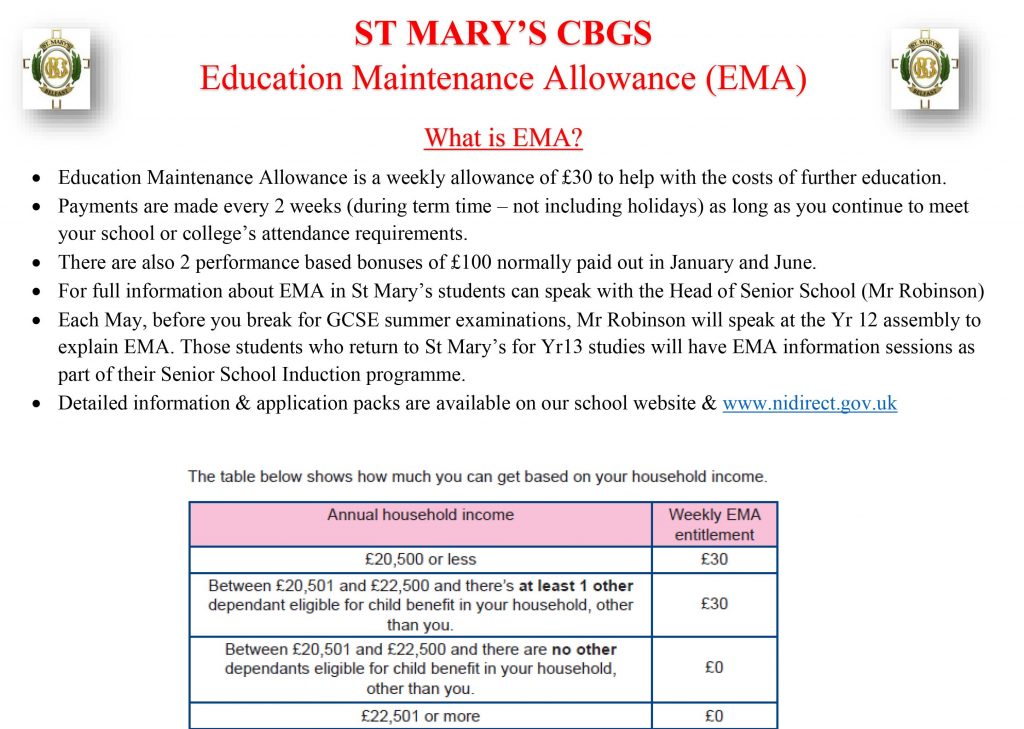
It is important to note that the EMA is not a uniform global entity. In the United Kingdom, for example, the scheme’s availability varies by region. While it was discontinued in England in 2011 (replaced by the 16-19 Bursary Fund), it remains a vital financial tool in Scotland, Wales, and Northern Ireland. Each region has its own specific payment structures—typically ranging from £30 per week—and distinct eligibility windows. Understanding these regional variations is the first step in effective financial planning for the academic year.
The Role of Means-Testing
The EMA is a “means-tested” benefit, meaning the amount of support provided is directly linked to the household’s total income. In the world of finance, means-testing ensures that resources are allocated to those with the greatest fiscal need. By setting specific income thresholds, the government ensures that the EMA serves as a progressive financial tool, narrowing the wealth gap in educational attainment.
Eligibility and Financial Assessment: Who Qualifies?
Navigating the eligibility criteria for the EMA requires a thorough understanding of household finance. Because the allowance is a targeted intervention, the criteria are strict, focusing on age, residency, the type of course being studied, and, most importantly, the financial status of the parents or guardians.
Income Thresholds and Household Assessment
The most significant barrier to entry for the EMA is the household income limit. Generally, the threshold is determined by the number of dependent children in the household. For example, a household with one dependent child may have a lower income ceiling than a household with multiple children. When applying, families must provide proof of income, which often includes P60 documents, tax credit awards, or self-assessment tax returns. This process requires a high level of financial organization, as accurate reporting is paramount to securing the funding.
Age and Course Requirements
The EMA is specifically designed for the transition period between the ages of 16 and 19. To qualify, a student must be enrolled in an “eligible” course. Usually, this includes full-time non-advanced education at a school or college, or certain types of unpaid training. From a financial planning perspective, it is vital to verify that the chosen path meets the “full-time” definition, which typically involves a minimum number of guided learning hours per week.
The Link Between Performance and Payment
One of the unique aspects of the EMA is that it is a “conditional” financial asset. Unlike a standard benefit, payments are often contingent upon a signed “Learning Agreement.” This agreement acts as a performance contract. If a student fails to meet attendance requirements or does not adhere to the standards of the course, the payment for that week can be withheld. This introduces young adults to the concept of financial accountability—linking their “income” to their “output” and professional conduct.
Maximizing the Value: How to Apply and Manage the Funds
Securing the EMA is only the beginning. To truly benefit from this financial tool, students and their families must understand the administrative processes and develop a strategy for managing the influx of cash.

The Application Process: A Step-by-Step Tutorial
Applying for the EMA is a formal financial process that should be handled with the same diligence as a loan or credit application.
-
Documentation Gathering: Collect all proof of identity (passports or birth certificates) and comprehensive proof of household income for the previous tax year.
-
Form Completion: Ensure that both the student and the financial providers (parents/guardians) complete their respective sections.
-
Submission Windows: Pay close attention to deadlines. Applications submitted late may result in the loss of backdated payments, which can amount to hundreds of pounds of missed capital.
-
Bank Account Setup: Payments are made via BACS (Bankers’ Automated Clearing System). This requires the student to have a personal bank account in their own name, often serving as their first real interaction with the formal banking system.
Budgeting and Financial Management
For a 16-year-old, receiving £30 a week can be a significant introduction to liquidity management. Insightful financial planning suggests that this money should be categorized. A portion should be allocated to fixed costs (commuter passes), another to variable educational costs (printing, materials), and a small percentage should be directed toward a high-interest savings account. By treating the EMA as “salary,” students can build the foundational habits of budgeting that are essential for adult life and future side hustles.
Avoiding Common Pitfalls
One common mistake is the failure to report changes in circumstances. If a household’s income changes or if a student changes their course load, the EMA office must be notified. Failure to do so can lead to overpayments, which the government will eventually seek to recoup. In the context of personal finance, an unexpected debt to a government body is a significant risk that can disrupt a family’s financial stability.
The Economic Impact of EMA on Personal Finance
The Educational Maintenance Allowance is more than just a weekly stipend; it is a catalyst for long-term financial health. By enabling students to remain in education, the EMA significantly alters their future earning potential.
Long-term ROI of Staying in Education
In the world of investing, we look for high returns. Education is arguably the investment with the highest Return on Investment (ROI). Statistically, individuals with A-levels or vocational qualifications earn significantly more over their lifetime than those who leave education at 16. The EMA provides the “seed capital” necessary to stay in the game. By lowering the immediate financial pressure to work a low-skill job, it allows the student to focus on acquiring the skills necessary for high-value career paths.
Reducing the Burden of Student Debt
While the EMA covers the 16–19 period, its effects ripple into the university years. Students who have utilized the EMA are often better prepared for the financial realities of higher education. Furthermore, because the EMA is a grant, it does not add to the debt ceiling of the individual. In an era where student debt is a major concern in personal finance, having a period of education supported by non-debt capital is a major strategic advantage.
Alternatives and Supplemental Income Streams
For those who do not qualify for the EMA, or for those who find the allowance insufficient, there are other financial tools available. The modern student must be savvy in identifying all possible revenue streams.
Bursaries and Hardship Funds
In regions where the EMA is not available, such as England, the 16-19 Bursary Fund serves a similar purpose. Furthermore, many colleges offer their own internal hardship funds or scholarships for high-achieving students from low-income backgrounds. These are “hidden” financial assets that require proactive research and application.
Balancing EMA with Part-time Work and Side Hustles
Can you work and receive the EMA? The answer is generally yes. Most EMA schemes do not count the student’s own part-time earnings toward the household income threshold. This creates a unique opportunity for “income stacking.” A student could receive their EMA, work a part-time retail job, and perhaps launch a digital side hustle (such as freelance graphic design or tutoring). This multi-stream approach to income not only provides financial security but also builds a robust professional portfolio.
Conclusion: The Strategic Importance of EMA
The Educational Maintenance Allowance is a vital component of the financial ecosystem for young people. It represents a commitment to social mobility and an acknowledgment that financial barriers should not impede intellectual growth. For the recipient, the EMA is more than just a series of weekly payments; it is an introduction to the principles of personal finance: means-testing, conditional contracts, banking, and budgeting.
By understanding the eligibility requirements, managing the application process diligently, and viewing the allowance as a strategic investment in their future, students can use the EMA as a springboard to financial independence. In the broader context of money and business, the EMA is a prime example of how targeted financial support can yield massive dividends for the individual and the economy at large. For those eligible, it is a financial tool that should be wielded with precision, responsibility, and an eye toward long-term prosperity.
aViewFromTheCave is a participant in the Amazon Services LLC Associates Program, an affiliate advertising program designed to provide a means for sites to earn advertising fees by advertising and linking to Amazon.com. Amazon, the Amazon logo, AmazonSupply, and the AmazonSupply logo are trademarks of Amazon.com, Inc. or its affiliates. As an Amazon Associate we earn affiliate commissions from qualifying purchases.