
In the landscape of modern architectural engineering and sustainable building technology, few innovations have had as profound an impact on residential and commercial infrastructure as double glazing. Often referred to in technical circles as an Insulated Glass Unit (IGU), double glazing represents a sophisticated leap from traditional single-pane windows. By utilizing the principles of thermal dynamics and advanced material science, double glazing has transitioned from a luxury addition to a fundamental component of high-performance building envelopes.
To understand what double glazed windows are is to understand the intersection of physics and industrial design. At its core, the technology is designed to minimize the transfer of heat through the transparent surfaces of a building—traditionally the weakest link in a structure’s thermal defense. As we move toward a future defined by smart cities and energy-efficient “green” tech, the engineering behind these windows continues to evolve, incorporating noble gases, microscopic coatings, and smart-glass integration.
The Engineering Behind the Glass: How Double Glazing Functions
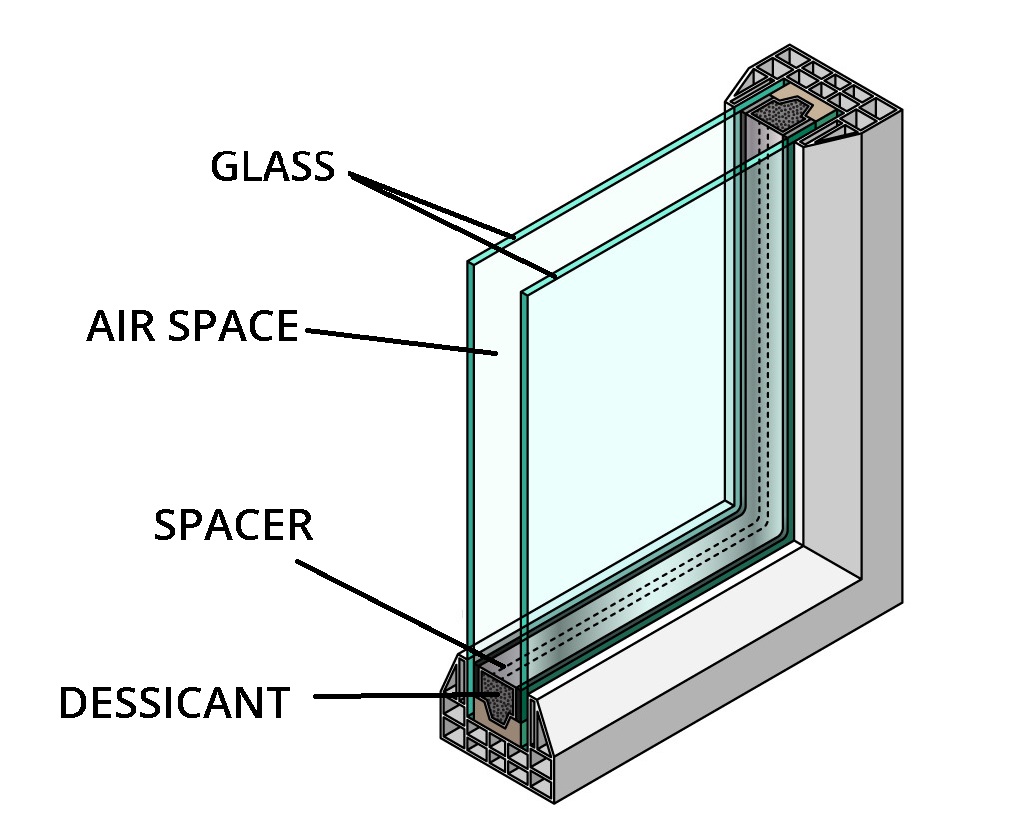
The technical brilliance of a double-glazed window lies not just in having two panes of glass, but in the precisely engineered “dead air” space between them. This gap acts as a thermal break, significantly reducing the rate of heat conduction. In a standard single-pane window, heat moves relatively freely; in the winter, heat escapes, and in the summer, it penetrates. Double glazing interrupts this flow through several mechanical layers.
The Insulating Gap and Noble Gases
The space between the two glass panes, typically ranging from 6mm to 20mm, is the primary functional element. While early iterations of this technology used dry air, modern high-tech variants utilize noble gases like Argon, Krypton, or Xenon. These gases are denser than air and have lower thermal conductivity, meaning they are much less efficient at transferring heat. Argon is the industry standard due to its excellent performance-to-cost ratio, while Krypton is used in ultra-high-performance tech where the gap must be narrower.
The Role of the Spacer Bar and Desiccants
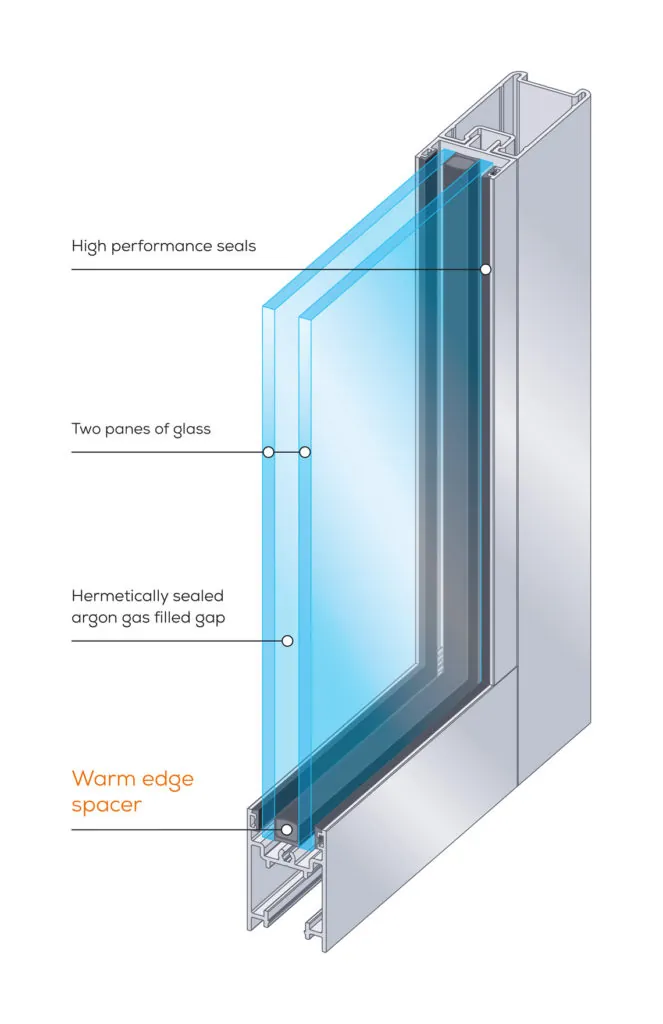
Maintaining the structural integrity of the gap is the spacer bar. Historically made of aluminum, modern “warm edge” spacers are now crafted from fiber-reinforced plastics or structural foams. These materials reduce “thermal bridging”—the process where heat travels through the solid frame parts of the window. Inside these spacer bars are desiccants, highly porous materials (like silica gel) that absorb any residual moisture within the unit during the manufacturing process, preventing internal condensation and ensuring the long-term clarity of the unit.
Pressure Management and Hermetic Sealing
A double-glazed unit is a hermetically sealed system. To ensure the tech lasts for decades, manufacturers use dual-seal systems. A primary seal (usually polyisobutylene) provides the moisture vapor barrier, while a secondary seal (silicone or polyurethane) provides structural strength. This engineering ensures that the gas fill remains trapped and the external atmosphere stays out, maintaining the unit’s R-value (thermal resistance) over its lifecycle.
Low-Emissivity (Low-E) Coatings: The Microscopic Tech
While the gas-filled gap handles conduction and convection, the glass itself must address radiant heat. This is achieved through the application of Low-Emissivity (Low-E) coatings. These are microscopically thin, transparent layers of metal or metallic oxide—usually silver—deposited onto the glass surface.
Sputtered vs. Pyrolytic Coatings
There are two primary technological methods for applying these coatings. “Hard coat” (pyrolytic) glass is created by fusing the coating to the glass while it is still hot on the float line. This results in a durable, though slightly less efficient, layer. “Soft coat” (sputtered) glass involves vacuum-depositing the silver layer onto the glass after it has cooled. This “off-line” tech is significantly more efficient at reflecting infrared energy, making it the preferred choice for high-tech, energy-neutral buildings.
Spectrally Selective Performance
The true “intelligence” of Low-E tech is its ability to be spectrally selective. It allows short-wave solar radiation (visible light) to pass through, illuminating the interior, while reflecting long-wave infrared radiation (heat). In a tech-heavy home, this means the windows can “choose” to keep heat inside during the winter and reflect solar heat away during the summer, all without compromising the aesthetic of the building.
Advanced Materials and Manufacturing Standards

The technology of the frame is just as critical as the glass. The housing for double-glazed units has evolved from simple timber to high-performance polymers and thermal-break alloys.
uPVC and Thermal Multi-Chambering
Unplasticized Polyvinyl Chloride (uPVC) is a staple in the tech of window framing. Modern uPVC frames are designed with a series of internal chambers. These chambers trap air, much like the double-glazed unit itself, providing an extra layer of insulation. The chemical composition of uPVC is engineered to resist UV degradation, ensuring that the structural integrity of the window doesn’t fail under intense solar exposure.
Aluminum with Polyamide Thermal Breaks
In contemporary architecture, aluminum is favored for its strength and slim profiles. However, aluminum is a natural conductor. To solve this, engineers use “thermal break” technology—a reinforced polyamide strip (a high-performance plastic) is inserted between the inside and outside aluminum profiles. This creates a barrier that prevents the transfer of heat through the metal, allowing for the sleek “industrial” look without the energy loss.
Vacuum Glazing: The Next Frontier
Looking toward future trends, vacuum glazing is emerging as a disruptive technology. Instead of a gas-filled gap, the air is completely evacuated from between the panes, creating a vacuum. Because heat cannot travel through a vacuum, these units can be much thinner (as thin as 6mm total) while providing the insulation of a triple-glazed unit. This technology involves tiny “micro-spacers” to keep the glass from imploding under atmospheric pressure, representing the pinnacle of current glass engineering.
Digital Performance Monitoring and Smart Home Integration
As we move into the era of the Internet of Things (IoT), double glazing is no longer a passive component of a building; it is becoming part of the digital ecosystem.
Integrated Thermal Sensors
High-end tech-integrated windows now feature embedded sensors that monitor the temperature differential between the internal and external glass surfaces. This data can be fed into a Smart Home Hub, which then adjusts the building’s HVAC system in real-time. If the windows are losing more heat than the system is programmed for, the smart home can automatically lower automated thermal blinds or adjust the furnace to optimize energy consumption.
Electrochromic “Smart” Glass
Perhaps the most exciting tech trend in this niche is the integration of electrochromic layers within double-glazed units. By applying a small electrical voltage, the ions in the glass shift, causing the window to tint on demand. This can be controlled via a smartphone app or programmed to react to sunlight levels. This eliminates the need for mechanical blinds and allows the window to dynamically manage solar heat gain, representing a massive leap in active building technology.
Sustainable Tech: The Environmental Impact of High-Tech Glazing
In the context of the global push for carbon neutrality, double-glazed windows are a critical piece of “Green Tech.” Buildings are responsible for a significant portion of global energy consumption, and high-performance glazing is the most effective way to reduce the energy load of a structure.
Embodied Carbon vs. Operational Energy
While the manufacturing of double-glazed units—specifically the production of glass and the extraction of Argon—requires energy, the “operational energy” saved over the window’s 25-year lifespan far outweighs the initial carbon footprint. Engineers are currently working on “circular” glass tech, where the components of an IGU can be easily separated and recycled at the end of their life, further enhancing the sustainability credentials of the product.
Energy Performance Ratings (U-Values and SHGC)
The efficacy of this technology is measured through specific technical metrics: the U-Value and the Solar Heat Gain Coefficient (SHGC). The U-Value measures the rate of heat loss; the lower the number, the better the tech. The SHGC measures how much solar radiation is admitted. Modern double-glazing tech has allowed for U-values as low as 1.0 to 1.2 W/m²K, a staggering improvement over the 5.0+ ratings of older single-pane technology.
Conclusion
Double glazed windows are much more than “two panes of glass.” They are a complex assembly of materials science, gas-phase physics, and precision manufacturing. From the microscopic silver layers of Low-E coatings to the potential of vacuum insulation and IoT integration, this technology is at the forefront of making our living and working spaces more efficient, comfortable, and sustainable. As technology continues to advance, the window will cease to be a simple hole in the wall and will instead become a dynamic, intelligent skin that manages the energy flow of our entire world.
aViewFromTheCave is a participant in the Amazon Services LLC Associates Program, an affiliate advertising program designed to provide a means for sites to earn advertising fees by advertising and linking to Amazon.com. Amazon, the Amazon logo, AmazonSupply, and the AmazonSupply logo are trademarks of Amazon.com, Inc. or its affiliates. As an Amazon Associate we earn affiliate commissions from qualifying purchases.