
In the sprawling digital landscape, where information proliferates at an astonishing rate, the challenge of consistently locating and referencing specific pieces of content remains paramount. Websites change, URLs break, and digital objects can seemingly vanish into the ether, creating what is colloquially known as “link rot.” Addressing this fundamental technical hurdle, the Digital Object Identifier (DOI) emerges as a robust and enduring solution, offering a persistent, actionable identifier for intellectual property in the digital environment. Far more than just a hyperlink, a DOI is a commitment to the permanence and retrievability of digital assets, playing a critical role in the integrity of digital scholarship, data management, and content delivery systems across various technical domains.

The Foundation of Digital Object Identification
The concept of a persistent identifier for digital content is rooted in the necessity for reliable access and citation in an increasingly digital world. Without a stable anchor, the vast amount of online information would be prone to disarray, hindering academic progress, technological development, and reliable information exchange. The DOI system was conceived precisely to provide this anchor.
What Exactly is a DOI?
A DOI, or Digital Object Identifier, is a string of characters used to uniquely identify an electronic document or other digital content. Developed by the International Organization for Standardization (ISO) as ISO 26324, it functions as a unique, non-proprietary identifier that points to the location of a digital object on the internet. Unlike a URL (Uniform Resource Locator), which specifies where an item is located and can change if the item moves, a DOI identifies what the item is. This fundamental distinction is key to its utility. When a DOI is assigned to an object, it remains fixed, even if the object’s location on the internet changes. The DOI system ensures that users can always find the most current information about that object, including its URL, through a resolution service.
The primary purpose of a DOI is to manage intellectual content, linking users to content through a persistent identifier. It facilitates consistent citation and ensures that a specific version of an article, dataset, or other digital output can always be located, regardless of publisher changes, website migrations, or other technical shifts. The system is designed to be interoperable, working across different platforms and publishers, thus enhancing the global discoverability and accessibility of digital objects.
How DOIs Work: Structure and Resolving
A DOI consists of two main parts: a prefix and a suffix, separated by a forward slash.
- Prefix: This identifies the registrant (e.g., a publisher, an organization) and is unique to that registrant. For example,
10.1000is a common prefix for CrossRef, a major DOI registration agency. - Suffix: This identifies the specific digital object assigned by the registrant and must be unique within that registrant’s prefix.
A full DOI might look something like 10.1016/j.physletb.2017.03.012. The 10.1016 is the prefix for Elsevier (a registrant), and j.physletb.2017.03.012 is the unique suffix for a particular journal article.
To resolve a DOI and access the associated digital object, users typically append the DOI to the base URL https://doi.org/. For instance, typing https://doi.org/10.1016/j.physletb.2017.03.012 into a web browser will redirect to the current URL where that specific article is hosted. This redirection mechanism is powered by a central resolution service, primarily operated by the International DOI Foundation (IDF) and its designated registration agencies. When a user requests a DOI, the system looks up the metadata associated with that DOI, including its current URL, and redirects the user to the appropriate content. If the content’s location changes, the registrant simply updates the URL linked to the DOI in the registration agency’s database, ensuring uninterrupted access without requiring users to update their citations or links. This dynamic linking capability is a cornerstone of the DOI’s technical resilience.
Why DOIs are Indispensable in the Digital Age
The proliferation of digital content brings with it significant challenges related to longevity, discoverability, and integrity. DOIs address these issues head-on, providing a critical piece of infrastructure for managing digital assets in an ever-evolving technical landscape.
Persistence and Reliability: Counteracting Link Rot
The internet is dynamic. Websites are redesigned, content is migrated, and URLs frequently become obsolete, leading to broken links – a phenomenon known as “link rot.” For academic researchers, legal professionals, or anyone relying on specific digital sources, a broken link can be catastrophic, making it impossible to verify information or build upon existing work. The DOI system directly confronts link rot by decoupling the identifier from the location. As long as the registrant updates the metadata associated with the DOI whenever the object’s location changes, the DOI remains a stable and reliable pointer to the content. This technical decoupling ensures the long-term accessibility and integrity of digital scholarship and data, guaranteeing that references made today will remain valid years or even decades into the future. It’s a foundational element of digital preservation and reliable information retrieval.
Enhanced Discoverability and Access
Beyond mere persistence, DOIs significantly enhance the discoverability of digital objects. Because DOIs are standardized and machine-readable, they facilitate advanced search and indexing across diverse databases and platforms. When a research paper, dataset, or software component is assigned a DOI, it becomes part of a global, interconnected system of identifiable digital assets. Search engines, academic databases, and reference managers can leverage DOIs to precisely locate specific items, irrespective of where they are published or hosted. This technical capability streamlines the research process, allowing scientists, engineers, and developers to more efficiently find relevant information, contributing to faster innovation cycles and more robust knowledge building. Moreover, the metadata associated with DOIs often includes critical information like author, title, publication date, and keywords, further enriching search capabilities.
Facilitating Citation and Scholarly Communication
In academic and professional settings, precise citation is paramount for acknowledging intellectual contributions, ensuring reproducibility, and tracing the lineage of ideas. DOIs have become the de facto standard for citing digital materials because they offer unparalleled specificity and reliability. A citation that includes a DOI provides an unambiguous reference point, eliminating the confusion that can arise from generic URLs or ambiguous publication details. This consistency is vital for peer review processes, bibliometric analysis, and the overall integrity of scholarly communication. Researchers can confidently cite work knowing that their readers will be directed to the exact source material, fostering greater transparency and trust in scientific and technical literature. Many reference management software tools automatically recognize and utilize DOIs, simplifying the citation process for users.

Practical Applications Across Industries
While most commonly associated with scientific and academic publishing, the underlying principles and technical advantages of the DOI system have found applications in various sectors requiring robust digital object management.
Academia and Research: The Primary Domain
The single largest application of DOIs is within academia and scholarly publishing. Nearly every major journal article, conference proceeding, and research paper published electronically today carries a DOI. This ubiquity reflects the system’s effectiveness in managing the vast output of global research. Beyond articles, DOIs are increasingly being assigned to other research outputs, including:
- Research Datasets: Enabling precise citation and access to the raw data underpinning studies, crucial for reproducibility and data sharing initiatives.
- Theses and Dissertations: Providing persistent links to graduate research.
- Preprints: Assigning identifiers to research before formal peer review, facilitating early sharing and feedback.
- Book Chapters and Entire Books: Ensuring individual components or entire digital monographs are persistently identifiable.
The technical infrastructure provided by DOI registration agencies like CrossRef, DataCite, and mEDRA plays a crucial role in maintaining this ecosystem, processing millions of DOI registrations and resolutions daily.
Beyond Academia: Data Sets, Software, and More
The utility of DOIs extends beyond traditional textual publications into other forms of digital content that require stable identification and citation.
- Software and Code Repositories: Developers can assign DOIs to specific versions of software, ensuring that researchers or practitioners can always access the exact code used in a particular study or application, which is vital for reproducibility in computational science and engineering.
- Technical Reports and Standards: Government agencies and standards organizations use DOIs to provide persistent access to their official documents, ensuring that industry professionals and policymakers can always find the correct versions of regulations and technical guidelines.
- Media Assets: While less common, DOIs can theoretically be used for multimedia objects like videos, images, or audio files, especially in contexts where precise citation and version control are critical, such as digital humanities or archival science.
- Educational Materials: Online learning platforms and open educational resource initiatives can leverage DOIs to provide stable links to curricula, lecture notes, and digital textbooks, enhancing their long-term value and accessibility.
The adaptability of the DOI standard allows it to be applied to any “object” that can be digitally identified and managed, making it a versatile tool for digital content management across a wide spectrum of technical and professional fields.
Implementing and Interacting with DOIs
For anyone navigating the digital information landscape, understanding how to interact with DOIs is a valuable skill. For content creators and publishers, implementing DOIs requires engaging with the specific technical infrastructure.
Finding and Using DOIs Effectively
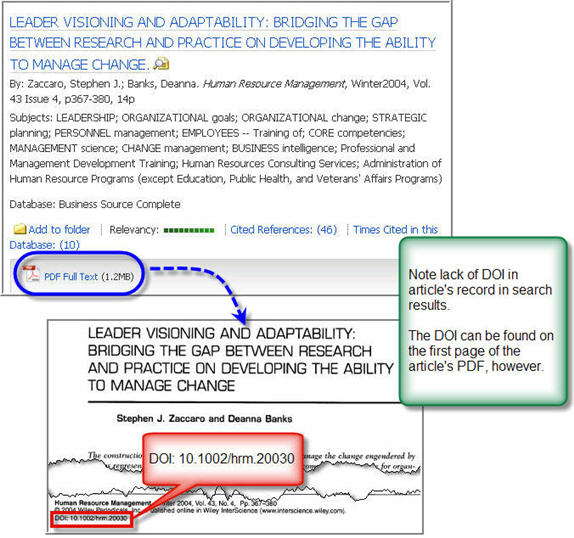
Most digital articles and documents clearly display their DOI, often near the abstract, copyright information, or in the header/footer of the PDF. When citing a source, if a DOI is available, it should always be included in the citation. To access the content associated with a DOI, simply prepend https://doi.org/ to the DOI string and paste it into your web browser. This directs you to the persistent location of the content. Many reference management tools (e.g., Zotero, Mendeley, EndNote) can automatically retrieve metadata using a DOI, simplifying the process of building bibliographies. Furthermore, if you have bibliographic information but no DOI, services like CrossRef’s “Simple Text Query” can often help you find the corresponding DOI.
The Role of Registration Agencies
The International DOI Foundation (IDF) oversees the DOI system, but the actual assignment and management of DOIs are handled by designated “Registration Agencies” (RAs). These RAs are responsible for:
- Assigning Prefixes: Granting unique prefixes to organizations that wish to register DOIs.
- Maintaining Metadata: Storing the metadata associated with each DOI, including the current URL of the digital object.
- Resolution Services: Providing the technical infrastructure that resolves DOIs to their current web locations.
- Setting Policies: Developing and enforcing policies for DOI registration and use.
Key RAs include CrossRef (specializing in scholarly journal articles and books), DataCite (focused on research data), and mEDRA (primarily for European publishing). Organizations wishing to assign DOIs to their digital content must become members of one of these RAs, adhering to their technical specifications and guidelines.
Future of Digital Identifiers and Related Technologies
While DOIs have firmly established themselves as a cornerstone of persistent digital identification, the landscape of digital identifiers continues to evolve. Emerging technologies like blockchain could offer new paradigms for immutable record-keeping and content verification, potentially augmenting or integrating with existing identifier systems. Additionally, efforts to improve the interoperability between different types of identifiers (e.g., ORCID for researchers, ROR for organizations, and DOIs for objects) are ongoing, aiming to create a more integrated and robust ecosystem for tracking and linking all aspects of research and digital content. The continued development of APIs and linked data principles further enhances the technical capabilities of these systems, promising even greater efficiency and discoverability for the vast ocean of digital information. The DOI, as a mature and widely adopted standard, is well-positioned to continue its vital role as a fundamental component of this expanding digital infrastructure.
aViewFromTheCave is a participant in the Amazon Services LLC Associates Program, an affiliate advertising program designed to provide a means for sites to earn advertising fees by advertising and linking to Amazon.com. Amazon, the Amazon logo, AmazonSupply, and the AmazonSupply logo are trademarks of Amazon.com, Inc. or its affiliates. As an Amazon Associate we earn affiliate commissions from qualifying purchases.