
In the vast, interconnected landscape of the internet, email remains a cornerstone of communication, both personal and professional. Yet, its ubiquity also makes it a prime target for malicious actors, from spammers and phishers to sophisticated state-sponsored groups. Ensuring the authenticity and integrity of email messages has become a critical challenge, one that protocols like DomainKeys Identified Mail, or DKIM, are designed to address. DKIM is not just a technical acronym; it’s a fundamental component of modern email security infrastructure, working silently behind the scenes to verify sender identity and prevent message tampering.
The Imperative for Email Security
The digital communication highway is fraught with potential hazards. Email, despite its age, remains surprisingly vulnerable to various forms of abuse if not properly secured. Understanding the underlying threats illuminates why mechanisms like DKIM are not merely beneficial but essential.
The Growing Threat Landscape of Email
Every day, billions of emails are exchanged globally, and a significant portion of these are unsolicited, fraudulent, or malicious. Phishing attacks, where adversaries attempt to trick recipients into divulging sensitive information, often rely on email spoofing—making an email appear to come from a legitimate source when it does not. Spam, while often less dangerous, clogs inboxes and wastes valuable time and resources. Business Email Compromise (BEC) schemes, which can lead to significant financial losses, frequently leverage impersonation tactics to trick employees into making unauthorized payments or divulging confidential data. The sheer volume and sophistication of these threats necessitate robust defense mechanisms.
Traditional Email Vulnerabilities
Historically, email protocols like SMTP (Simple Mail Transfer Protocol) were designed for simplicity and speed, not security. They lacked native mechanisms to verify the sender’s identity beyond what was declared in the “From” address, which is trivially forgeable. This open nature meant that anyone could send an email claiming to be anyone else, much like sending a physical letter without a verified return address. While some basic spam filters emerged, they primarily relied on content analysis and blacklists, which are easily circumvented by determined attackers. The need for a more cryptographic, verifiable method to assert email origin became paramount.
Decoding DKIM: The Core Mechanism
DKIM addresses these vulnerabilities by providing a method for an organization to digitally “sign” outgoing email messages, allowing receiving mail servers to verify that an email was indeed sent by an authorized server and that its content has not been altered in transit.
How DKIM Works: Digital Signatures and Public Keys
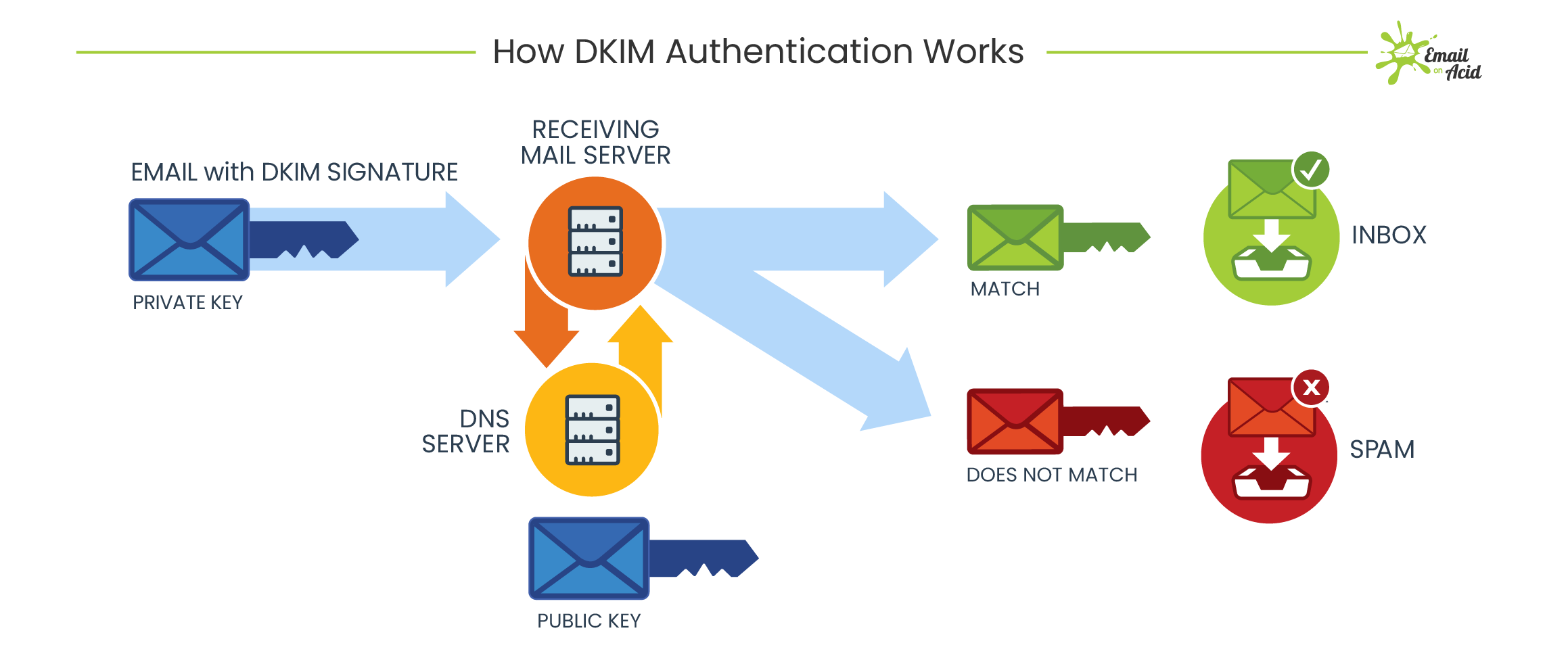
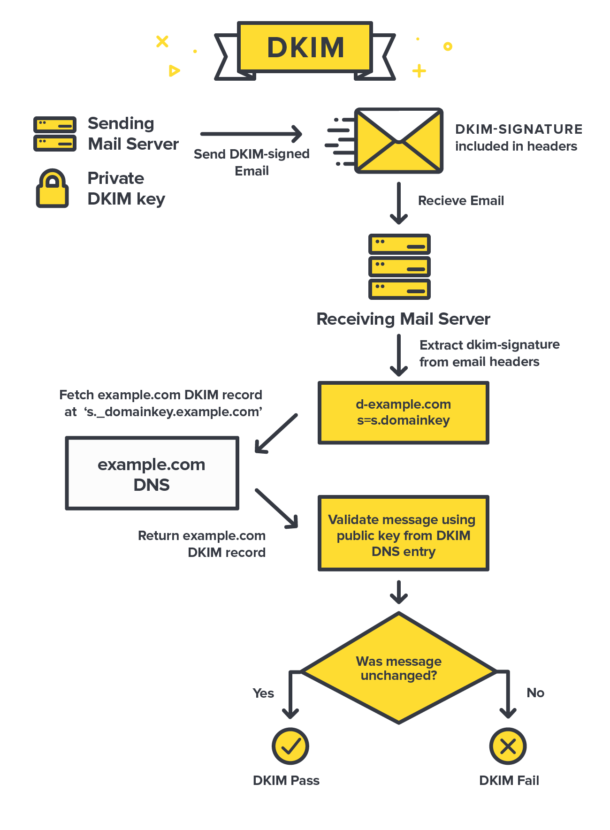
At its heart, DKIM leverages standard public-key cryptography. When a sending mail server processes an outgoing email, it generates a unique cryptographic hash of specific parts of the email—typically the header fields (like “From,” “To,” “Subject,” “Date”) and a portion of the message body. This hash is then encrypted using the sender’s private key. The result of this encryption is the “DKIM signature,” which is added as a new header field to the email.
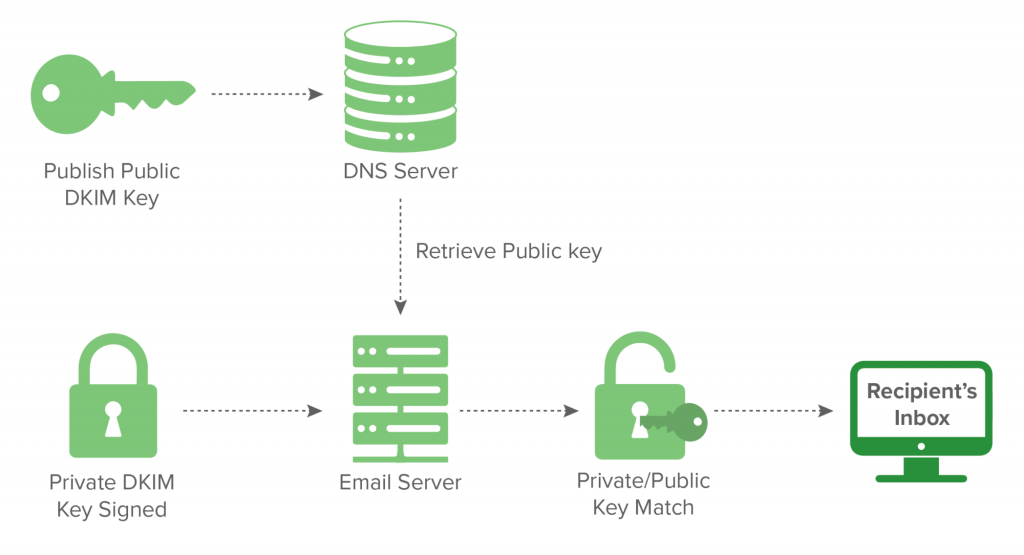
Crucially, the corresponding public key is published in the sender’s Domain Name System (DNS) records. When a receiving mail server gets an email with a DKIM signature, it looks up the sender’s DNS records to retrieve the public key. It then uses this public key to decrypt the signature and re-compute the hash of the email’s relevant parts. If the decrypted hash matches the re-computed hash, the signature is valid, confirming that the email originated from an authorized server for that domain and that its signed content has not been tampered with since it left the sending server.
The Role of the Sending Server
For DKIM to function, the sending mail server (or the email service provider acting on behalf of the domain owner) must be configured to generate and attach the DKIM signature. This involves:
- Selecting elements to sign: Deciding which header fields and how much of the body to include in the hash.
- Hashing: Computing a cryptographic hash (e.g., SHA-256) of these selected elements.
- Signing: Encrypting the hash using the domain’s unique private key.
- Adding the signature header: Inserting the encrypted hash, along with other parameters like the signing domain (
d=), the selector (s=), and the signing algorithm, into aDKIM-Signatureheader in the email.
The private key is a secret, securely stored by the sender, and never published.
The Role of the Receiving Server
Upon receiving an email with a DKIM-Signature header, the receiving mail server performs a series of validation steps:
- Extracting information: It parses the
DKIM-Signatureheader to identify the signing domain, the selector, and the signature itself. - DNS lookup: It queries the DNS for the sending domain, specifically looking for a TXT record associated with the selector specified in the signature (e.g.,
selector._domainkey.example.com). This record contains the public key. - Verification: It uses the retrieved public key to decrypt the signature from the email header, yielding the original hash. Simultaneously, it re-computes the hash of the relevant parts of the received email, using the same algorithm and parts specified in the DKIM header.
- Comparison: If the decrypted hash matches the re-computed hash, the DKIM signature is considered valid. If they do not match, or if the public key cannot be found, the signature fails validation.
The result of this validation is typically recorded, influencing how the email is handled (e.g., delivered to the inbox, marked as spam, or rejected).
Cryptography at Its Core
DKIM’s effectiveness hinges on the principles of public-key cryptography. The secure pairing of a private key (known only to the sender) and a public key (published in DNS) ensures that only an authorized entity possessing the private key can create a valid signature. Any alteration to the signed parts of the email during transit would cause the re-computed hash to mismatch the decrypted hash, thereby invalidating the signature. This cryptographic integrity provides a strong assurance of both authenticity and message integrity.
The Benefits of DKIM Implementation
Implementing DKIM offers substantial advantages, fortifying email communications against a spectrum of digital threats and improving the overall reliability of email delivery.
Enhanced Spam and Phishing Prevention
One of DKIM’s primary benefits is its role in combating spam and phishing. By providing a verifiable link between an email and the domain it claims to originate from, DKIM makes it significantly harder for attackers to impersonate legitimate organizations. Email servers can be configured to flag or reject messages that fail DKIM validation, especially if they claim to be from well-known domains. This drastically reduces the effectiveness of spoofed emails, which are a cornerstone of many phishing and BEC attacks.
Improved Email Deliverability and Sender Reputation
Email providers and internet service providers (ISPs) increasingly rely on authentication protocols like DKIM (alongside SPF and DMARC) to assess the trustworthiness of incoming mail. A domain that consistently signs its outgoing mail with valid DKIM signatures demonstrates a commitment to security and responsible email practices. This positive signal contributes to a better sender reputation, which in turn leads to improved email deliverability. Emails from domains with strong authentication are more likely to reach the recipient’s inbox rather than being shunted to the spam folder or rejected outright.
Ensuring Message Integrity
Beyond authenticating the sender, DKIM guarantees the integrity of the signed portions of an email. If an attacker intercepts an email and alters its subject line, sender address, or body content, the DKIM signature will fail verification. This allows receiving systems to detect tampering, providing assurance that the message content received is precisely what the sender intended to send, at least for the signed parts. This is particularly crucial for sensitive communications where even minor alterations could have significant consequences.
Complementing Other Email Authentication Protocols
DKIM is rarely used in isolation. It forms a crucial part of a layered email authentication strategy, working in conjunction with Sender Policy Framework (SPF) and Domain-based Message Authentication, Reporting, and Conformance (DMARC).
- SPF specifies which mail servers are authorized to send email on behalf of a domain.
- DKIM provides a cryptographic signature to verify sender identity and message integrity.
- DMARC builds upon SPF and DKIM by instructing receiving mail servers on how to handle emails that fail SPF or DKIM checks, and it provides reporting mechanisms for domain owners to monitor their email traffic.
Together, these protocols create a robust defense, with DMARC orchestrating the enforcement and reporting based on SPF and DKIM results.
Implementing and Managing DKIM
Setting up DKIM involves a few key technical steps that require access to your domain’s DNS settings. While the underlying cryptography is complex, the implementation process is standardized.
Generating DKIM Records
The first step is to generate the DKIM key pair (private and public keys). Many email service providers (ESPs) or mail server software (e.g., Postfix, Exchange) offer tools to do this. The private key is configured on the sending mail server, while the public key needs to be published in DNS. The public key is typically provided in a specific format suitable for a DNS TXT record. This record also includes a “selector,” which is an arbitrary name (e.g., s1, mail) used to distinguish between multiple DKIM keys for a single domain.
Publishing DKIM Records in DNS
Once the public key and selector are generated, you must add them as a TXT record to your domain’s DNS. The record name will typically be selector._domainkey.yourdomain.com, and the value will be the public key string (e.g., v=DKIM1; p=MIGfMA0G...). This step makes the public key discoverable by any receiving mail server that queries your domain’s DNS. DNS changes can take some time to propagate globally (up to 48 hours), so patience is key.
Verifying DKIM Setup
After publishing the DNS record, it’s essential to verify that DKIM is correctly configured. You can send a test email to a service that checks DKIM validity (many online tools exist, or you can send to specific email addresses provided by DMARC reporting services). Additionally, inspecting the headers of an email received from your domain should show a DKIM-Signature header, and the validation status will often be indicated by the receiving server (e.g., Authentication-Results: dkim=pass). DMARC reports, once enabled, will also provide comprehensive data on DKIM authentication successes and failures for your domain’s outgoing mail.
Common Pitfalls and Troubleshooting
Common issues during DKIM implementation include incorrect DNS record syntax, typos in the public key, the private key not being correctly configured on the sending server, or DNS propagation delays. Ensure the selector in the DKIM-Signature header matches the selector used in the DNS record. Also, be mindful of length limits for TXT records; some long public keys might need to be split into multiple strings within the same TXT record, adhering to DNS standards.
DKIM’s Broader Impact on Digital Trust
The adoption of DKIM, particularly in conjunction with SPF and DMARC, signifies a broader shift towards a more trustworthy and verifiable email ecosystem. It’s not just about stopping spam; it’s about rebuilding digital trust.
Combating Impersonation and Brand Abuse
For businesses, DKIM is an indispensable tool in protecting their brand reputation. By making it difficult for malicious actors to send emails impersonating the company, DKIM helps prevent fraud that could erode customer trust and lead to financial damage. When customers receive emails that appear to be from a trusted brand but lack valid authentication, they are rightly skeptical. DKIM, by providing that verification, reinforces confidence in legitimate communications.
The Future of Email Authentication
As email continues to evolve and cyber threats become more sophisticated, authentication protocols like DKIM will remain foundational. The continuous refinement of these standards, along with increasing enforcement by major email providers, underscores their importance. Future developments may include stronger cryptographic algorithms, more streamlined deployment processes, and deeper integration with other security layers, all aimed at fostering an environment where email can be trusted as a secure and authentic communication channel. DKIM stands as a testament to the ongoing efforts to secure the digital backbone of our modern world.
aViewFromTheCave is a participant in the Amazon Services LLC Associates Program, an affiliate advertising program designed to provide a means for sites to earn advertising fees by advertising and linking to Amazon.com. Amazon, the Amazon logo, AmazonSupply, and the AmazonSupply logo are trademarks of Amazon.com, Inc. or its affiliates. As an Amazon Associate we earn affiliate commissions from qualifying purchases.