
In the realm of automotive engineering, few specifications are as fundamental yet frequently misunderstood as engine displacement. Whether you are browsing the technical datasheet of a high-performance supercar or evaluating the efficiency of a compact commuter vehicle, the displacement figure—usually expressed in liters (L) or cubic centimeters (cc)—serves as a primary indicator of a vehicle’s potential. As the automotive industry undergoes a massive technological shift from traditional internal combustion to electrification, understanding the mechanical technology of displacement remains essential for any tech enthusiast or professional.
At its core, displacement is a measurement of volume. It represents the total volume of all the cylinders in an engine as the pistons move through their full range of motion. This technical metric is the bedrock upon which engine power, fuel consumption, and performance characteristics are built.

The Mechanics of Displacement: Engineering the Internal Combustion Engine
To understand displacement, one must first understand the internal architecture of the reciprocating engine. The engine is essentially a sophisticated air pump; it draws in a mixture of air and fuel, compresses it, ignites it to create energy, and then expels the waste gases. Displacement is the physical measurement of that “pumping” capacity.
Defining Cubic Capacity and Cylinder Volume
Displacement is defined as the volume swept by all the pistons inside the cylinders from their lowest point (Bottom Dead Center, or BDC) to their highest point (Top Dead Center, or TDC). It is important to note that displacement does not include the volume of the combustion chamber itself when the piston is at the top; it only measures the space “displaced” by the movement of the piston.
In technical terms, if a four-cylinder engine has a displacement of 2.0 liters, it means each individual cylinder has a volume of 0.5 liters. When you see a “2,000cc” badge, it is simply the metric conversion of that volume (1,000cc = 1 liter).
Bore and Stroke: The Geometry of Power
The volume of a cylinder is determined by two critical dimensions: the bore and the stroke. The bore is the diameter of the cylinder hole, while the stroke is the distance the piston travels up and down.
Engineers use these measurements to “tune” the personality of an engine through geometry:
- Oversquare (Short-Stroke) Engines: These have a larger bore than stroke. This configuration is common in high-tech racing engines and motorcycles because it allows for higher revolutions per minute (RPM), as the piston travels a shorter distance.
- Undersquare (Long-Stroke) Engines: These have a larger stroke than bore. This design typically favors torque and efficiency at lower RPMs, making it ideal for heavy-duty trucks and fuel-efficient daily drivers.
- Square Engines: These have equal bore and stroke measurements, providing a balance between high-end power and low-end torque.
The Mathematical Formula Behind the Numbers
For those interested in the precise engineering, displacement is calculated using the formula for the volume of a cylinder:
V = π × (bore/2)² × stroke × number of cylinders
This formula highlights why adding cylinders or increasing the size of existing cylinders exponentially increases the engine’s capacity to process air and fuel. In the “Golden Age” of mechanical engineering, increasing displacement was the only reliable way to increase power—a philosophy famously summarized by the phrase, “There is no substitute for cubic inches.”
How Displacement Dictates Performance and Efficiency
The relationship between displacement and performance is governed by the laws of thermodynamics. Because internal combustion relies on burning fuel with oxygen, a larger displacement engine can ingest more air. More air allows for more fuel to be burned, which results in a larger explosion and more force applied to the crankshaft.
Torque vs. Horsepower: The Displacement Dilemma
Displacement has a direct correlation with torque, which is the rotational force produced by the engine. Generally, “big-block” engines with high displacement produce high torque at low engine speeds. This is why a 6.0L V8 feels powerful the moment you touch the gas pedal.
Horsepower, however, is a function of torque multiplied by RPM. This is where modern technology begins to complicate the displacement rule. A small, high-tech 2.0L engine spinning at 9,000 RPM can produce the same horsepower as a 5.0L engine spinning at 3,000 RPM. The difference lies in how that power is delivered and the technological sophistication required to maintain those high speeds without mechanical failure.
Volumetric Efficiency and Air-Fuel Mixture
A key metric for tech-minded automotive enthusiasts is Volumetric Efficiency (VE). This is a ratio of the mass of air and fuel that actually enters the cylinder compared to the theoretical capacity of the cylinder. A standard naturally aspirated engine (one that breathes air at atmospheric pressure) usually has a VE of about 80% to 90%.
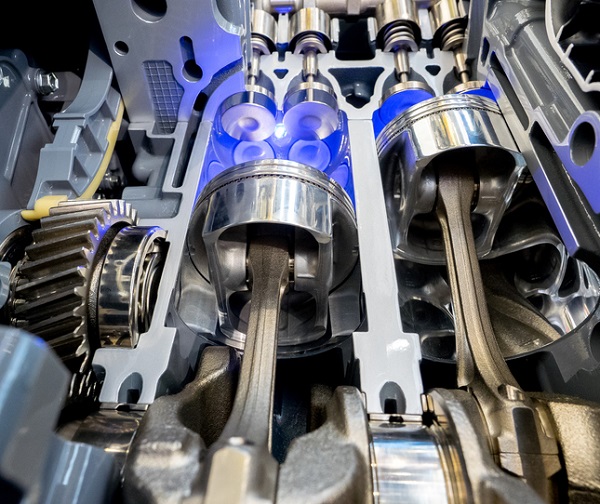
Modern technological advancements, such as multi-valve cylinder heads and variable valve timing, are designed to push this efficiency as close to 100% as possible, ensuring that every cubic centimeter of displacement is utilized to its maximum potential.
Thermal Dynamics and Power Strokes
Displacement also affects how an engine manages heat. Larger displacement engines have more surface area, which can lead to greater thermal losses. Conversely, they often operate at lower stresses than small engines pushed to their limits. Engineering a high-displacement engine requires robust cooling systems and advanced metallurgy to handle the massive kinetic energy generated by heavy pistons moving at high speeds.
Technological Evolution: From “Cubic Inches” to Forced Induction
In the last two decades, the automotive industry has undergone a “downsizing” revolution. The goal has been to achieve the power of a large-displacement engine with the fuel economy of a small-displacement engine. This shift has been made possible by “Forced Induction” technology.
Turbocharging and Supercharging: Artificial Displacement
Turbochargers and superchargers are essentially air compressors. By forcing more air into the cylinders than atmospheric pressure would allow, they effectively make a small engine behave like a much larger one.
For example, a 1.5-liter turbocharged engine can often produce the same power as a 2.5-liter naturally aspirated engine. In technical circles, this is sometimes referred to as “virtual displacement.” The turbocharger uses waste energy from exhaust gases to spin a turbine, which packs the intake air tighter, allowing for a more potent combustion stroke without the weight and size of a larger engine block.
Downsizing Trends in Modern Engine Design
The tech trend of “downsizing” is driven by the need to reduce pumping losses. Large engines are less efficient at partial throttle because they have to work harder to “breathe” through a restricted opening. By using a smaller displacement engine equipped with a turbocharger, engineers can maintain high power levels when needed (under boost) while reaping the efficiency benefits of a small displacement during cruising.
Variable Valve Timing and Direct Injection Integration
Displacement is no longer a static figure in terms of performance. Technologies like Variable Valve Timing (VVT) and Gasoline Direct Injection (GDI) allow the engine’s computer to optimize how the displacement is used in real-time. By precisely controlling when valves open and how much fuel is sprayed directly into the combustion chamber, modern 2.0L engines are now producing power figures that were reserved for 4.0L racing engines just thirty years ago.
The Digital Shift: Software’s Role in Managing Physical Displacement
As we move deeper into the digital age, the physical displacement of an engine is increasingly managed by complex software. The hardware provides the capacity, but the software provides the intelligence.
Electronic Control Units (ECUs) and Performance Mapping
The ECU is the “brain” of the vehicle. It monitors dozens of sensors—measuring air intake, exhaust oxygen, engine temperature, and throttle position—to calculate the exact requirements for each combustion cycle. In modern tech-heavy vehicles, the “mapping” of the ECU can fundamentally change how displacement feels to the driver. High-performance software can sharpen throttle response, making a small engine feel incredibly punchy, or it can prioritize smooth power delivery for luxury applications.
Cylinder Deactivation: Software-Defined Displacement
Perhaps the most impressive use of software in this field is Cylinder Deactivation (also known as Variable Displacement). This technology allows a large displacement engine (like a V8) to “turn off” half of its cylinders when they aren’t needed, such as during highway cruising.
Through sophisticated solenoid control and software algorithms, the engine effectively transforms from a 5.0L V8 into a 2.5L V4 on the fly. This gives the consumer the “big displacement” power for towing or acceleration, while maintaining “small displacement” fuel economy for the majority of the drive. It is a perfect marriage of mechanical hardware and digital control.
Hybrid Systems and the Transition to “Virtual” Displacement
In the modern tech landscape, the conversation around displacement is shifting toward hybridization. In a hybrid powertrain, an electric motor supplements a small-displacement internal combustion engine.
The electric motor provides “instant torque”—a characteristic usually associated with massive displacement engines—while the small gasoline engine handles the sustained power. This combination has led to the “Total System Output” metric, where the physical displacement of the engine becomes just one component of a much larger, more complex energy management system.

Conclusion
While the automotive world is rapidly evolving toward a future dominated by solid-state batteries and electric drive units, displacement remains a cornerstone of current automotive technology. It is the physical dimension that defines an engine’s character, potential, and efficiency. From the raw geometry of bore and stroke to the sophisticated software-driven cylinder deactivation of today, displacement is a testament to over a century of mechanical refinement. Understanding it is not just about knowing the size of an engine; it is about understanding how engineers leverage the laws of physics and the precision of digital technology to move the world.
aViewFromTheCave is a participant in the Amazon Services LLC Associates Program, an affiliate advertising program designed to provide a means for sites to earn advertising fees by advertising and linking to Amazon.com. Amazon, the Amazon logo, AmazonSupply, and the AmazonSupply logo are trademarks of Amazon.com, Inc. or its affiliates. As an Amazon Associate we earn affiliate commissions from qualifying purchases.