
While the terms “matter” and “energy” are often used interchangeably in everyday conversation, particularly when discussing technological advancements or financial transactions, understanding their fundamental distinctions is crucial for appreciating the underlying principles that govern our universe and, by extension, the tools and systems we build within it. In the realm of technology, where innovation is constantly pushing the boundaries of what’s possible, a clear grasp of these concepts illuminates the very foundations upon which our digital world is constructed.
The modern technological landscape is a testament to our ability to manipulate both matter and energy. From the microprocessors powering our devices, crafted from carefully organized atoms, to the electricity that flows through them, enabling instantaneous communication and complex computations, we are constantly interacting with and transforming these two fundamental entities. To truly comprehend the intricacies of AI development, the design of advanced hardware, or the security protocols that protect our digital lives, a foundational understanding of matter and energy is not just beneficial, it’s essential.

The Ubiquitous Nature of Matter: The Building Blocks of Technology
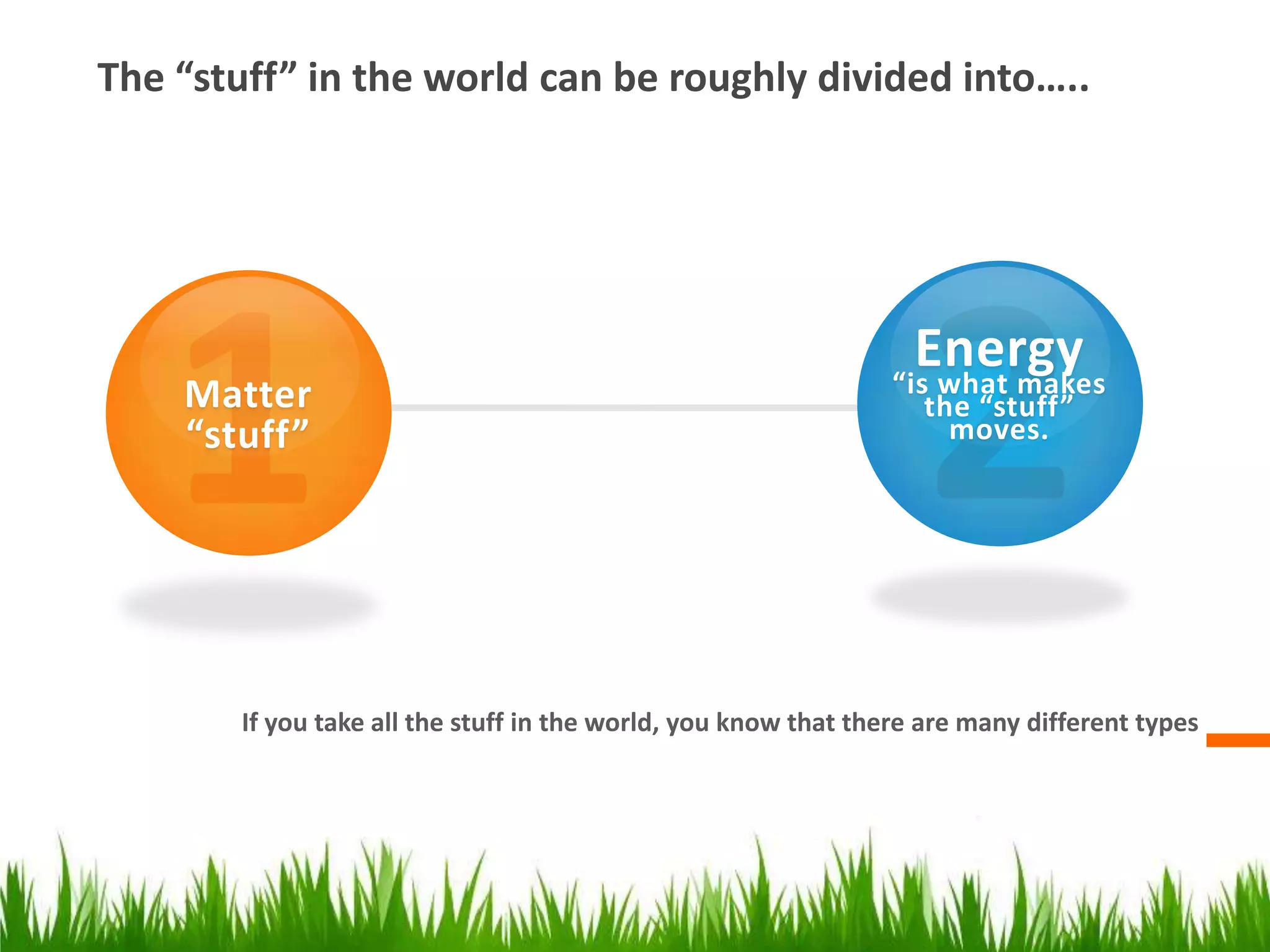
Matter, in its simplest definition, is anything that has mass and occupies space. It is the tangible stuff of the universe, the raw material from which all physical objects are made. In the context of technology, matter is not just an abstract concept; it’s the very bedrock upon which our digital infrastructure is built. Every circuit board, every silicon chip, every piece of hardware that enables our digital experiences is composed of meticulously arranged atoms and molecules – the fundamental units of matter.
From Atoms to Advanced Materials: The Foundation of Hardware
At the most fundamental level, matter is composed of atoms, which in turn are made up of protons, neutrons, and electrons. The arrangement and interaction of these subatomic particles dictate the properties of different elements. In the technological sphere, understanding atomic structure is paramount. For instance, the conductivity of materials used in electronics – whether they are conductors, insulators, or semiconductors – is directly related to the behavior of their electrons. Silicon, a semiconductor, is the cornerstone of modern computing precisely because its electrons can be manipulated to control electrical flow.
Beyond individual atoms, matter exists in various forms, each with unique properties relevant to technological applications. Solids, liquids, and gases all play roles. In the design of intricate microchips, the solid-state physics of semiconductors is crucial. The development of advanced cooling systems for high-performance servers relies on the principles of thermodynamics and the behavior of heat transfer in gaseous and liquid mediums. Furthermore, the exploration of novel materials, such as graphene and nanomaterials, opens up new frontiers in electronics, promising faster, more efficient, and more durable devices. The ability to synthesize and engineer these materials at the atomic and molecular level is a direct application of our understanding of matter.
The Role of Mass in Technological Design and Operation
The mass of matter is a critical consideration in many technological designs. In aerospace engineering, minimizing the mass of spacecraft and aircraft is paramount for fuel efficiency and performance. The development of lightweight yet strong alloys and composite materials directly addresses this need. Even in consumer electronics, while the mass of a smartphone might seem insignificant, cumulative mass across billions of devices, and the resources required for their production and disposal, are important considerations for sustainability and logistics. The physical presence of matter, its weight and volume, dictates form factors, portability, and the structural integrity of countless technological solutions.
The Dynamic Nature of Energy: The Driving Force of Digital Processes
Energy, on the other hand, is the capacity to do work. It is not a physical substance in the same way that matter is, but rather a property that matter possesses. Energy exists in various forms, such as kinetic energy (energy of motion), potential energy (stored energy), thermal energy (heat), electrical energy, and electromagnetic energy. In the context of technology, energy is the lifeblood that powers our devices, enables communication, and drives complex computational processes. Without energy, matter would be inert, and our technological marvels would be mere collections of inactive components.
Electrical Energy: The Power Behind the Digital Revolution
The most prevalent form of energy utilized in modern technology is electrical energy. It is the flow of charged particles, typically electrons, through a conductive medium. The generation, transmission, and consumption of electrical energy are fundamental to the operation of virtually every electronic device. From the power grid that supplies our homes and offices to the batteries that fuel our portable gadgets, our reliance on electricity is absolute. Understanding electrical circuits, voltage, current, and resistance is essential for designing efficient and safe electronic systems. The constant pursuit of energy efficiency in technological design is driven by the need to reduce power consumption, minimize heat generation, and extend battery life.
Information Transfer and Processing: Energy in Motion and Transformation
Beyond simply powering devices, energy plays a crucial role in the very transfer and processing of information. Data is transmitted through the manipulation of energy. For example, Wi-Fi signals, cellular networks, and fiber optic cables all rely on the propagation of electromagnetic waves, a form of energy. When you send an email or stream a video, you are essentially encoding information into energy signals that travel across vast networks.

Furthermore, the intricate computations performed by processors involve the controlled movement and transformation of electrical energy. Transistors, the fundamental building blocks of modern microprocessors, act as electronic switches that control the flow of current, representing the binary states of 0 and 1. This manipulation of energy at a microscopic level is what enables the complex algorithms and artificial intelligence applications that are shaping our world. The efficiency of these computations is directly linked to how effectively energy can be managed and utilized.
The Interplay Between Matter and Energy: Einstein’s Revelation
The seemingly distinct concepts of matter and energy are, in fact, profoundly interconnected. Albert Einstein’s groundbreaking theory of special relativity, famously encapsulated in the equation E=mc², revealed that matter and energy are interchangeable – two different manifestations of the same fundamental underlying reality. Mass (m) can be converted into energy (E), and vice versa, with the speed of light (c) squared acting as the conversion factor.
From Mass Defect to Nuclear Power: Harnessing the Conversion
This principle has had profound implications for technology, particularly in the development of nuclear energy. In nuclear reactions, such as fission and fusion, a small amount of mass is converted into a tremendous amount of energy. Nuclear power plants harness this energy to generate electricity, providing a significant source of power for many nations. While controversial, the underlying scientific principle of mass-energy conversion is undeniable. Even in less dramatic applications, understanding this relationship helps us appreciate the energy contained within even the smallest amounts of matter, influencing how we design power systems and manage resources.
The Quantum Realm: Where the Lines Blur Further
At the quantum level, the distinction between matter and energy becomes even more nuanced. Particles like photons are considered quanta of electromagnetic energy and exhibit wave-particle duality, meaning they can behave as both waves and particles. Similarly, electrons, traditionally viewed as particles of matter, also exhibit wave-like properties. This quantum mechanical perspective blurs the classical distinction, suggesting a deeper unity between what we perceive as matter and energy. For technologists working at the forefront of quantum computing and quantum communication, this deeper understanding is not just academic; it’s the very basis of their innovation.
Technological Innovations Fueled by Understanding Matter and Energy
The continuous evolution of technology is intrinsically linked to our deepening comprehension of matter and energy. From the miniaturization of electronic components to the development of entirely new forms of energy generation, these fundamental concepts serve as the bedrock of innovation.
Miniaturization and Nanotechnology: Manipulating Matter at its Smallest Scale
The relentless drive towards miniaturization in electronics, leading to smaller, faster, and more powerful devices, is a direct result of our ability to manipulate matter at the atomic and molecular level. Nanotechnology, which deals with structures and devices on the scale of nanometers, has opened up unprecedented possibilities. Creating transistors billions of times smaller than those of early computers, developing new materials with tailored properties, and engineering microscopic sensors all rely on an intimate understanding of how atoms and molecules behave. This manipulation of matter allows for greater density of components, leading to the compact and powerful devices we use daily.
Renewable Energy and Energy Storage: Optimizing Energy Utilization
The global shift towards renewable energy sources like solar, wind, and geothermal power is fundamentally about harnessing and converting different forms of energy more efficiently and sustainably. The development of advanced solar cells relies on understanding the photoelectric effect, a phenomenon where light (energy) causes electrons (matter) to be emitted from a material. Similarly, battery technology, crucial for storing energy from intermittent renewable sources, involves complex electrochemical processes. Research into next-generation batteries, solid-state batteries, and hydrogen fuel cells is all driven by the need to store and deliver energy more effectively, demonstrating the critical link between matter (the materials used in storage) and energy.
Advanced Computing and Artificial Intelligence: The Fusion of Logic and Power
The development of artificial intelligence and advanced computing systems represents a sophisticated interplay between matter and energy. The hardware that powers AI – powerful processors, massive data centers – is a testament to the engineering of matter to facilitate complex energy flows. The algorithms themselves, while abstract, are executed by manipulating electrical energy within these physical structures. The pursuit of more energy-efficient AI models, the development of neuromorphic computing that mimics the brain’s structure, and the exploration of quantum computing all highlight how our understanding of both matter and energy is essential for pushing the boundaries of computational power and intelligence.
In conclusion, the distinction between matter and energy, while conceptually clear at a macroscopic level, reveals itself as a profound and intricate relationship at deeper scientific and technological levels. Matter provides the physical substance, the building blocks, while energy provides the dynamic force, the means of operation and transformation. As our knowledge of their interplay grows, so too does our capacity to innovate, shaping a future where technology continues to redefine our interaction with the physical world and unlock new possibilities.
aViewFromTheCave is a participant in the Amazon Services LLC Associates Program, an affiliate advertising program designed to provide a means for sites to earn advertising fees by advertising and linking to Amazon.com. Amazon, the Amazon logo, AmazonSupply, and the AmazonSupply logo are trademarks of Amazon.com, Inc. or its affiliates. As an Amazon Associate we earn affiliate commissions from qualifying purchases.