
In the traditional sense, a dental crown is often viewed through a purely medical lens—a simple prosthetic designed to restore a damaged tooth. However, in the modern landscape of health technology, the “dental crown” has evolved into a marvel of precision engineering, material science, and high-tech manufacturing. The transition from manual craftsmanship to digital workflows represents one of the most significant shifts in medical technology over the last decade.
To understand what a dental crown is today is to understand the convergence of CAD/CAM software, 3D printing, and artificial intelligence. We are no longer just looking at a piece of porcelain; we are looking at a data-driven technological solution designed to integrate seamlessly with human biology.

Beyond the Porcelain: Redefining the Dental Crown Through Advanced Material Science
The “tech” of a dental crown begins at the molecular level. For decades, the industry standard involved Porcelain-Fused-to-Metal (PFM), which required significant manual labor and often resulted in aesthetic compromises. Today, material science has introduced high-performance ceramics and polymers that are engineered using sophisticated chemical processes.
Zirconia and the Shift Toward Biocompatible Tech
Zirconia (zirconium dioxide) has emerged as the “titanium of ceramics.” This material is a ceramic oxide that is processed using high-tech sintering techniques. Unlike traditional ceramics, zirconia is extremely fracture-resistant and exhibits “transformation toughening”—a property where the material actually works to arrest the spread of cracks. From a tech perspective, this material is selected for its high radiopacity and its ability to be milled by high-precision CNC machines to within microns of accuracy.
The Role of Nano-Ceramics in Structural Integrity
Nano-ceramics represent the next frontier in restorative materials. These are resin-matrix ceramics that utilize nanotechnology to embed ceramic particles into a polymer base. The result is a material that mimics the elastic modulus of human dentin. By utilizing nano-filler technology, manufacturers can create crowns that are not only durable but also possess “smart” properties, such as high polish retention and wear resistance that adjusts based on the force of the patient’s bite.
CAD/CAM and the Rise of Digital Impression Technology
The most visible technological leap in the creation of a dental crown is the replacement of physical molds with digital impressions. The “Computer-Aided Design and Computer-Aided Manufacturing” (CAD/CAM) workflow has streamlined the restorative process, turning a multi-week laboratory endeavor into a precise digital operation.
Intraoral Scanners: Replacing Physical Molds with Precision Data
At the heart of the modern dental crown is the intraoral scanner. These devices use structured light or laser technology to capture thousands of data points per second. The scanner creates a “point cloud” that is then rendered into a 3D mesh. This tech eliminates the margin of error associated with traditional alginate impressions, which are prone to warping and temperature sensitivity. Today’s scanners can capture sub-50-micron detail, ensuring that the digital “twin” of the patient’s mouth is a perfect replica.
Blue-Light and Laser Scanning: The Hardware Powering the Perfect Fit
Different scanning hardwares utilize various spectrums of light to achieve accuracy. Blue-light LED technology is currently the gold standard, providing a higher resolution and better contrast for the software to interpret margins. This hardware feeds directly into specialized CAD software (such as exocad or 3Shape), where the dental crown is digitally “sculpted.” The software calculates the ideal occlusion (how the teeth meet) by analyzing the digital data of the opposing teeth, a process that used to require manual articulation.
3D Printing and Additive Manufacturing in Prototyping Crowns
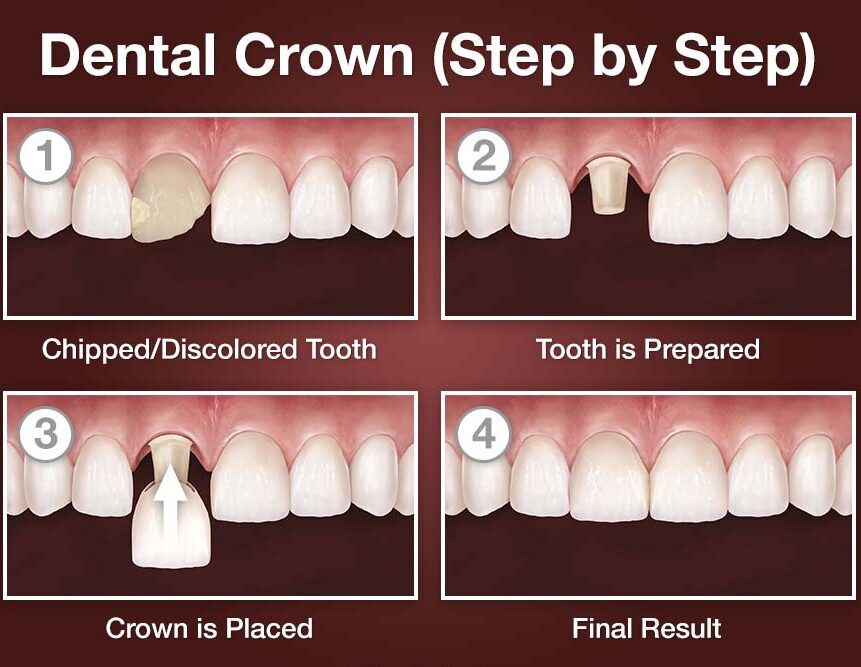
While milling (subtractive manufacturing) remains the dominant force for permanent crowns, additive manufacturing (3D printing) has revolutionized the prototyping and temporary phase of dental restoration.
Selective Laser Sintering (SLS) vs. Stereolithography (SLA)
3D printing technology allows for the creation of dental crowns with complex geometries that would be impossible to mill. SLA (Stereolithography) uses a UV laser to cure liquid resin into a solid shape, layer by layer. This is frequently used for surgical guides and temporary crowns. On the higher end of the tech spectrum, Selective Laser Sintering (SLS) can fuse metal or ceramic powders to create the internal structures of complex dental prosthetics. This additive approach reduces material waste—a key efficiency metric in modern tech-driven labs.
The Shift to Same-Day Dentistry: Chairside Milling Machines
The most disruptive gadget in the modern dental office is the chairside milling unit (e.g., CEREC). These are essentially compact, high-speed CNC machines. Once the CAD software has designed the crown, the data is sent to the mill, which uses diamond-coated burs to carve the crown out of a solid block of ceramic or zirconia in under 15 minutes. This “Just-In-Time” manufacturing model eliminates the need for a secondary appointment, showcasing how hardware miniaturization is changing consumer expectations.
The AI Integration: Smart Diagnostics and Generative Design
Artificial Intelligence is the latest layer of technology to be integrated into the dental crown workflow. AI isn’t just a buzzword here; it is a functional tool used to improve the success rate of the restoration.
Algorithmic Design: How AI Predicts Occlusion and Wear
Designing a dental crown requires a deep understanding of bio-mechanics. Modern CAD software now utilizes AI algorithms trained on hundreds of thousands of successful dental cases. When a technician designs a crown, the AI “suggests” the optimal tooth morphology based on the patient’s age, gender, and existing tooth wear patterns. This generative design ensures that the crown doesn’t just look like a tooth, but functions like one within the specific ecosystem of that patient’s mouth.
Machine Learning in Material Selection
AI tools are now being used to analyze X-rays and 3D scans to recommend the specific material type for a crown. By analyzing the “bite force” data and the thickness of the remaining tooth structure, machine learning models can predict which material—zirconia, lithium disilicate, or a hybrid—will have the longest lifespan for that specific user. This shift toward predictive analytics moves the “dental crown” from a reactive repair to a data-backed health optimization.
Future Frontiers: IoT and the “Smart” Dental Crown
As we look toward the future, the dental crown is set to become a “smart” device, potentially joining the Internet of Things (IoT) ecosystem.
Embedding Sensors for Real-Time Health Monitoring
Research is currently underway to embed micro-sensors within the layers of a dental crown. These sensors could monitor the pH levels of the mouth, detect early signs of infection, or even track glucose levels for diabetic patients. In this context, a dental crown becomes a wearable tech device, providing a constant stream of biometric data to a smartphone app or a cloud-based health platform.
Tele-dentistry and Remote Diagnostic Data
The digitalization of the dental crown allows for a globalized tech workflow. A scan taken in a rural clinic can be sent instantly to a high-end design hub across the world, where an expert uses AI-driven tools to finalize the design before sending the file back to a local 3D printer. This “distributed manufacturing” model is a hallmark of the modern tech economy, ensuring that high-quality dental tech is no longer limited by geography.
In conclusion, when we ask “what is a dental crown” in the 21st century, the answer is no longer found in a biology textbook. It is found in the intersection of software engineering, robotics, and advanced material science. The dental crown has become a testament to how technology can perfectly replicate—and in some cases, improve upon—the natural human form. As AI and 3D printing continue to advance, the crown will only become more integrated, more precise, and more vital to the digital health revolution.
aViewFromTheCave is a participant in the Amazon Services LLC Associates Program, an affiliate advertising program designed to provide a means for sites to earn advertising fees by advertising and linking to Amazon.com. Amazon, the Amazon logo, AmazonSupply, and the AmazonSupply logo are trademarks of Amazon.com, Inc. or its affiliates. As an Amazon Associate we earn affiliate commissions from qualifying purchases.