
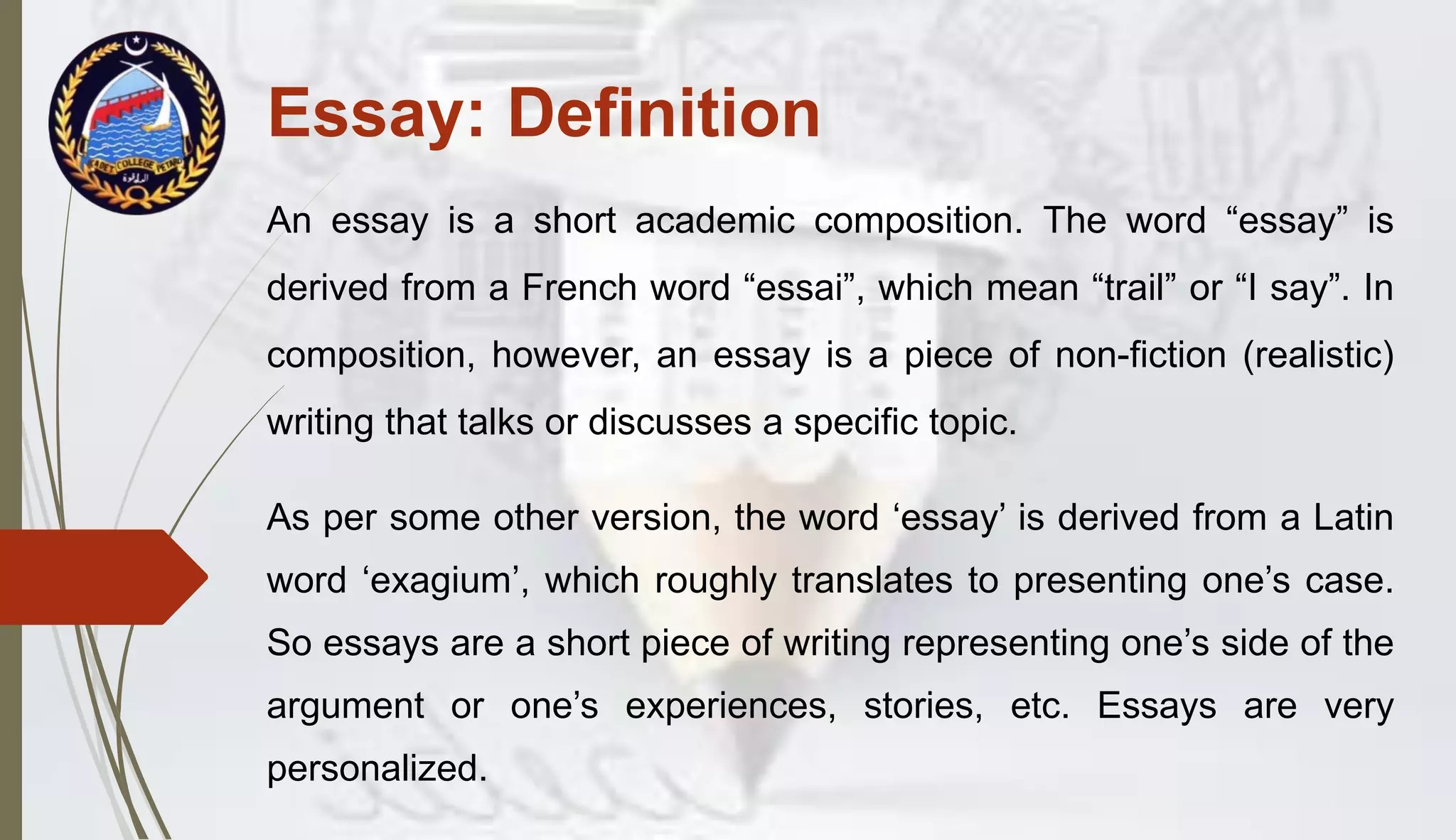
The term “essay” is ubiquitous in academic circles, a staple of assignments and a cornerstone of intellectual development. However, pinning down a precise, universally accepted definition can be surprisingly elusive. While often associated with written prose, the essence of an essay transcends mere word count or formatting. At its core, an essay is a focused exploration of a particular subject, presented from a specific perspective, and characterized by a reasoned argument or a systematic investigation. It’s a tool for articulating thoughts, synthesizing information, and engaging in critical discourse.
The Foundational Pillars of an Essay
To truly understand the definition of an essay, it’s crucial to dissect its fundamental components. These elements, when harmoniously integrated, transform a collection of ideas into a coherent and impactful piece of writing.

The Subject Matter: Focus and Scope
An essay is inherently about something. This “something” is the subject matter, and its definition is crucial. A well-defined essay subject is neither too broad nor too narrow. A topic like “history” is impossibly vast for an essay, whereas a topic like “the specific grammatical error in page 47 of a particular edition of a textbook” might be too granular to sustain sustained analysis. The ideal subject allows for sufficient depth of exploration without becoming unmanageable.
This focus dictates the scope of the essay. The scope defines the boundaries of the discussion – what will be included and, importantly, what will be excluded. A history essay on the French Revolution, for instance, might focus on its economic causes, its social impact, or its political ramifications. Each of these choices narrows the scope and directs the author’s attention. Without a clear focus and a defined scope, an essay risks becoming rambling and unfocused, failing to deliver a clear message.
The Author’s Perspective: Voice and Stance
Every essay, by its very nature, is filtered through the author’s unique perspective. This is not to say that essays are purely subjective opinion pieces, though some forms might lean more in that direction. Rather, it signifies that the author adopts a specific stance or viewpoint from which they will examine the subject. This perspective is shaped by the author’s knowledge, experience, and interpretative framework.
The author’s “voice” is the distinctive style and tone they employ. This voice can be formal and objective, as in a research essay, or more personal and reflective, as in a personal essay. Regardless of the chosen voice, it must be consistent and appropriate for the essay’s purpose and audience. The author’s stance is their position on the issue being discussed. Are they arguing for a particular interpretation? Are they defending a thesis? Are they simply exploring different facets of a complex problem? This stance guides the entire argumentative or analytical trajectory of the essay.
The Argumentative or Analytical Core: Reason and Evidence
At the heart of most essays lies a core purpose: to present an argument or to conduct an analysis. This is what elevates an essay from a simple descriptive piece to a piece of intellectual engagement.
The Argument: Persuasion Through Logic
When an essay aims to persuade, it constructs an argument. This involves presenting a claim or thesis – the main point the author wants to convey – and then supporting it with logical reasoning and credible evidence. The argument must be coherent, with each point building upon the previous one to create a compelling case. Evidence can take many forms: statistical data, historical facts, expert opinions, literary examples, or logical deductions. The strength of the argument is directly proportional to the quality and relevance of the evidence presented.
The Analysis: Deconstruction and Interpretation
Alternatively, an essay might focus on analysis. This involves breaking down a complex subject into its constituent parts, examining their relationships, and interpreting their meaning or significance. Analysis doesn’t necessarily aim to persuade the reader to adopt a specific viewpoint, but rather to illuminate the subject in a new light. For example, an analytical essay might dissect the themes of a novel, examine the causes of a historical event, or explain the workings of a scientific phenomenon. The author’s interpretation and the way they present their findings are paramount in an analytical essay.
The Diverse Forms of the Essay
The definition of an essay is not monolithic. Over time, various forms have emerged, each with its own conventions and purposes. Understanding these different types helps to appreciate the breadth and adaptability of the essay format.
The Expository Essay: Clarification Through Explanation
The expository essay’s primary goal is to explain or inform the reader about a particular topic. It aims to present facts, define terms, and clarify concepts in a clear, concise, and objective manner. The author does not typically try to persuade the reader to adopt a particular viewpoint but rather to provide them with a thorough understanding of the subject matter. Examples include essays that explain how a particular technology works, define a complex scientific theory, or describe the historical development of an event.
The Persuasive/Argumentative Essay: Convincing Through Logic and Evidence
As the name suggests, the persuasive or argumentative essay aims to convince the reader to accept a particular point of view or to take a specific action. This requires the author to present a clear thesis statement and then support it with strong evidence and logical reasoning. Counterarguments are often addressed and refuted to strengthen the author’s position. This form is common in academic settings where students are encouraged to develop and defend their own interpretations and conclusions.
The Narrative Essay: Sharing Experience Through Storytelling
The narrative essay uses storytelling to explore a theme or convey a particular insight. While it involves recounting events, its purpose is not merely to entertain but to offer a deeper understanding of a person, place, event, or idea. These essays often draw on personal experiences, but they are carefully crafted to highlight a specific meaning or lesson learned. The narrative essay can be a powerful tool for fostering empathy and connecting with the reader on an emotional level.
The Descriptive Essay: Evoking Sensory Experience
The descriptive essay aims to paint a vivid picture for the reader through the use of sensory details and evocative language. The goal is to allow the reader to experience something – a place, a person, an object, or a feeling – as if they were there themselves. While descriptive essays can be part of other essay types, a standalone descriptive essay focuses on creating a rich and immersive experience for the reader, often appealing to sight, sound, smell, taste, and touch.
The Essay in the Modern Context: Beyond the Classroom
While the essay has deep roots in academia, its definition and application extend far beyond the traditional classroom setting. The skills honed through essay writing – critical thinking, clear communication, research, and argumentation – are invaluable in a multitude of professional and personal spheres.
The Role of the Essay in Critical Thinking and Intellectual Development
The process of writing an essay is inherently a process of thinking. It requires the author to grapple with complex ideas, to evaluate information, to formulate their own conclusions, and to articulate them coherently. This iterative process of reading, researching, reflecting, drafting, and revising cultivates critical thinking skills. Students learn to question assumptions, to identify biases, to analyze evidence, and to construct logical arguments. These are not just academic skills; they are essential for navigating an increasingly complex world.
The Essay as a Tool for Communication and Influence
In the professional world, the ability to communicate complex ideas clearly and persuasively is paramount. Whether it’s a business proposal, a policy brief, a technical report, or a marketing campaign, the underlying principles of essay writing are often at play. The ability to define a problem, present evidence, and articulate a solution is a direct application of essayistic skills. Furthermore, in an era of information overload, the ability to craft a compelling and well-reasoned piece of writing can be a significant advantage in influencing opinions and driving action.

The Evolving Landscape of Digital Essays and Online Content
The digital age has witnessed the evolution of the essay in new forms. Blogs, online articles, and even well-crafted social media posts can embody the spirit of the essay. They often present a specific perspective, explore a topic, and aim to inform or persuade an audience. While the format might differ, the core principles of focus, perspective, and reasoned discourse remain relevant. The digital essay often needs to be more concise and engaging to capture the attention of an online audience, but the underlying commitment to clear communication and intellectual exploration endures.
In conclusion, the definition of an essay is multifaceted, encompassing a focused exploration of a subject from a specific perspective, supported by reasoned argument or analysis. It is a dynamic form that has evolved to meet diverse communicative needs, serving as a powerful tool for intellectual development, critical thinking, and persuasive communication in both academic and professional realms.
aViewFromTheCave is a participant in the Amazon Services LLC Associates Program, an affiliate advertising program designed to provide a means for sites to earn advertising fees by advertising and linking to Amazon.com. Amazon, the Amazon logo, AmazonSupply, and the AmazonSupply logo are trademarks of Amazon.com, Inc. or its affiliates. As an Amazon Associate we earn affiliate commissions from qualifying purchases.