
In the vast ecosystem of modern computing, where trillions of gigabytes of data are transmitted across networks and stored on physical media every second, the integrity of that data is paramount. Every time you download a file, stream a video, or send an email, there is a risk that “noise” or interference could flip a single bit from a zero to a one, or vice versa. To combat this, computer scientists developed several error-detection codes, the most prominent and efficient of which is the Cyclic Redundancy Check (CRC).
A Cyclic Redundancy Check is a mathematical algorithm used to detect accidental changes to raw data. It is a non-secure hash function designed specifically to detect errors in digital networks and storage devices. While it does not provide security against intentional tampering (like a cryptographic hash would), it is incredibly effective at identifying the random errors caused by thermal noise, cross-talk, or hardware glitches.
Understanding the Mechanics of CRC: How It Works
At its core, CRC is based on the concept of polynomial division. To understand how it functions, one must look at data not as text or images, but as a long string of binary digits (bits). These bits are treated as the coefficients of a large polynomial. For example, the binary sequence 1011 can be represented as (1x^3 + 0x^2 + 1x^1 + 1x^0).
The Mathematical Foundation
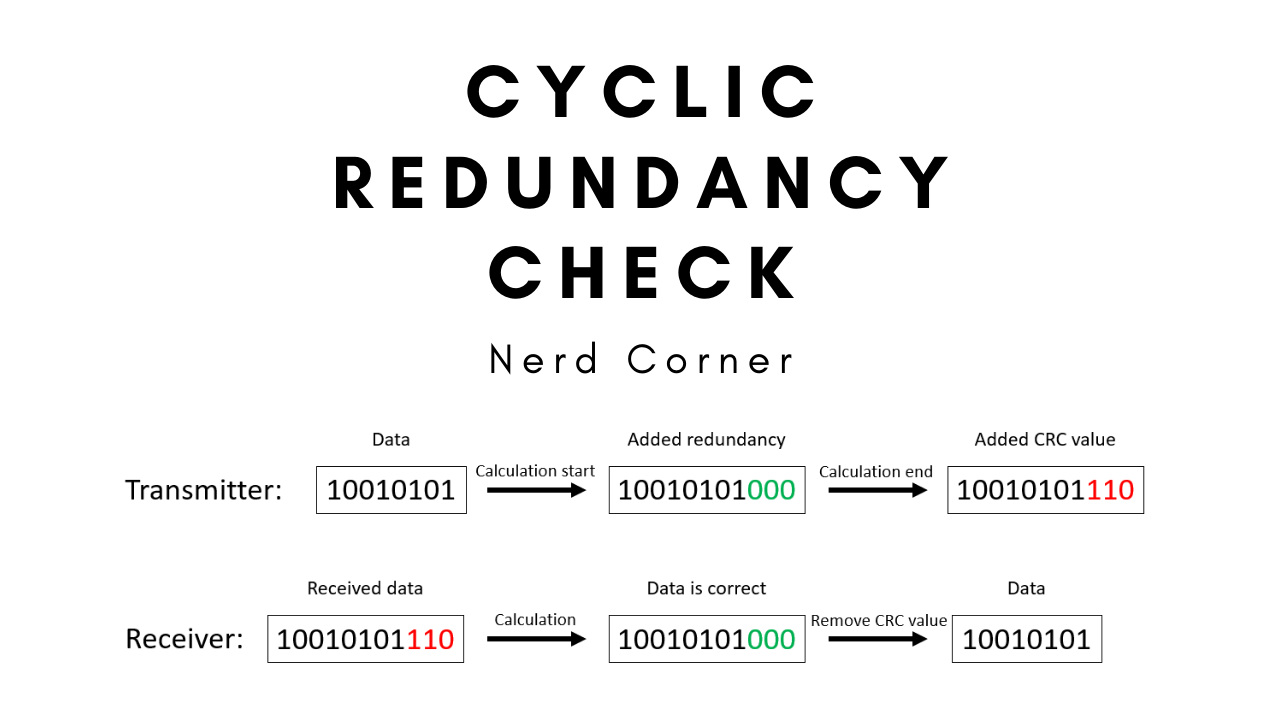
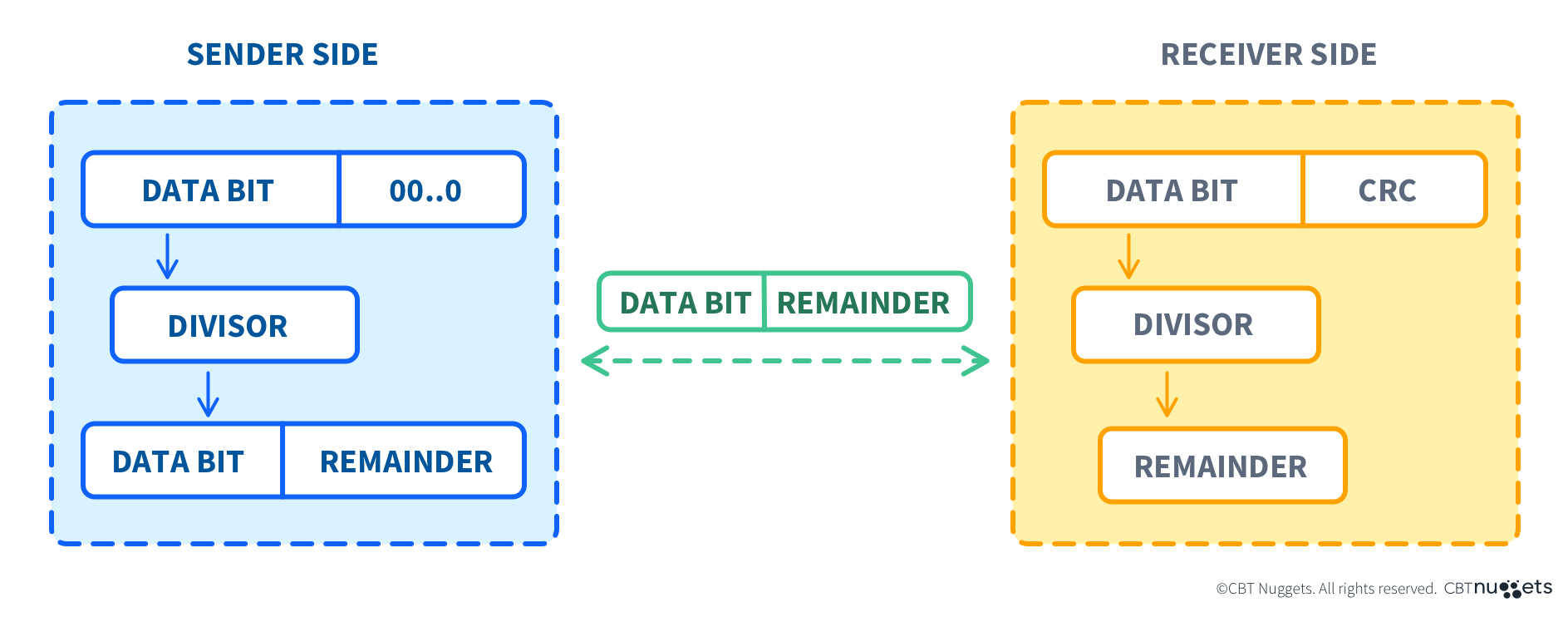
The CRC process involves a fixed “generator polynomial,” which acts as a divisor. Both the sender and the receiver agree on this polynomial beforehand. When data is sent, the sender performs a division of the data’s polynomial by the generator polynomial using modulo-2 arithmetic. The remainder of this division is the “check value” or the CRC code itself. This small, fixed-size sequence of bits is then appended to the end of the original data packet.
The Checksum Generation Process
Before transmission, the sender takes the data block and appends a number of zeros equal to the degree of the generator polynomial. After performing the division, the resulting remainder replaces those zeros. The beauty of this system lies in its mathematical elegance: the resulting “augmented” data packet is now exactly divisible by the generator polynomial with a remainder of zero.
Verification at the Receiver End
When the data reaches its destination, the receiver performs the same polynomial division using the same generator polynomial. If the data arrived perfectly, the remainder of this division will be zero. If the remainder is non-zero, the receiver knows that the data has been corrupted during transit. At this point, the system typically discards the corrupted packet and requests a retransmission, ensuring that only “clean” data is processed by the higher layers of the software stack.
Why CRC is Critical in Modern Digital Security and Networking
While it might seem like a background process, CRC is one of the pillars of digital reliability. Without it, our digital world would be riddled with corrupted files, crashing applications, and unreliable communications.
Error Detection vs. Error Correction
It is important to distinguish CRC from Error Correcting Codes (ECC). While ECC can both detect and fix a small number of bit errors, it requires significantly more overhead (more bits) and more computational power. CRC is designed strictly for detection. Its goal is to be as fast and lightweight as possible. In high-speed networking, it is often more efficient to detect an error and ask for the data again than it is to spend the processing power necessary to repair the data on the fly.
Resilience Against Burst Errors
One of the primary reasons CRC is favored over simpler methods, like parity bits or simple additive checksums, is its ability to detect “burst errors.” A burst error occurs when a sudden spike of interference flips several consecutive bits. Simple checksums often fail to detect these because the sum of the errors might mathematically cancel each other out. Because CRC is based on division rather than addition, it is mathematically guaranteed to detect any single burst error that is shorter than the length of the generator polynomial itself.
Efficiency in Real-Time Applications
In the world of hardware, CRC is incredibly efficient to implement. It can be executed using simple shift registers and XOR gates, which are foundational components of digital circuitry. This allows CRC checks to be performed at the hardware level—on network interface cards (NICs) or hard drive controllers—at the speed of the data transfer itself, without taxing the system’s main CPU.
Common Applications of Cyclic Redundancy Checks

CRC is so ubiquitous that almost every piece of digital technology you interact with uses it multiple times per second. It functions as a silent guardian across various layers of technology.
Ethernet and Network Protocols
The most famous application of CRC is in Ethernet frames. Every Ethernet packet includes a 32-bit CRC (often called a Frame Check Sequence or FCS) at the end. This ensures that if a packet is distorted by electrical interference while traveling over a copper wire or through the air via Wi-Fi, the receiving router or switch will drop it immediately. This prevents corrupted data from ever reaching your browser or application.
Storage Media: HDDs and SSDs
When data is written to a hard drive or a solid-state drive, it isn’t just the raw data that gets stored. The drive controller calculates a CRC for each sector of data. When you later read that file, the controller recalculates the CRC and compares it to the stored value. If they don’t match, you receive a “Cyclic Redundancy Check Error”—a common sight for anyone who has dealt with a failing hard drive or a scratched DVD.
File Compression and Archiving
Popular file formats like ZIP, RAR, and GZIP rely heavily on CRC-32. When you compress a folder, the software calculates a CRC for each file. During the extraction process, the software recalculates these values. If the CRCs do not match, the software alerts you that the archive is “corrupt.” This is vital because even a single bit out of place in a compressed file can make the entire file unreadable or unusable.
Comparing CRC to Other Error Detection Methods
To appreciate why CRC is the industry standard, it helps to compare it against other methods of ensuring data integrity.
CRC vs. Simple Parity Bits
The simplest form of error detection is the parity bit, which simply tracks whether the number of set bits (1s) in a string is even or odd. While parity bits are extremely low-overhead, they are incredibly weak; they cannot detect an even number of bit flips. If two bits are flipped, the parity remains the same, and the error goes unnoticed. CRC, by contrast, provides a much higher statistical probability of detecting multi-bit errors.
CRC vs. Additive Checksums
Simple checksums, such as those used in IPv4 headers, involve adding up the values of the data units. While better than parity, they are still vulnerable to specific patterns of errors where the sum remains unchanged despite the data being different. CRC’s use of polynomial division ensures that the “signature” of the data is much more unique and harder to accidentally replicate through random noise.
CRC vs. Cryptographic Hash Functions
It is vital to note that CRC is not a security tool. In a security context, an attacker can easily craft a malicious file that has the exact same CRC as a legitimate file (a collision). For security-sensitive tasks, such as verifying the authenticity of a software update, developers use cryptographic hashes like SHA-256. These are much more complex and computationally expensive but are designed to be “collision-resistant.” CRC is the “fast and light” alternative meant for physics-based errors, not human-led attacks.
Implementing CRC: Polynomials and Standards
The effectiveness of a CRC depends entirely on the choice of the generator polynomial. Over decades of computer science research, several “standard” polynomials have been refined to maximize the probability of detecting errors while minimizing the length of the check value.
CRC-32 and CRC-64
The most common standard today is CRC-32, used in everything from PNG images to Ethernet. It produces a 32-bit (4-byte) remainder. For high-capacity storage systems and modern 64-bit architectures, CRC-64 is becoming more frequent, providing an even lower probability of an undetected error (the “undetected error rate”).
Choosing the Right Generator Polynomial
Selecting a polynomial is a rigorous mathematical exercise. A poorly chosen polynomial might fail to detect specific, common patterns of interference. Standards organizations, such as the IEEE and the ITU-T, have established specific polynomials (like the “Castagnoli” polynomial) that have been mathematically proven to provide the best protection against the types of errors found in specific environments, such as fiber-optic cables or satellite transmissions.
As we move toward a future of 5G, 6G, and massive data centers, the role of the Cyclic Redundancy Check remains as vital as ever. It is the fundamental protocol that ensures our digital infrastructure remains stable, reliable, and trustworthy, acting as the invisible gatekeeper of the world’s information.
aViewFromTheCave is a participant in the Amazon Services LLC Associates Program, an affiliate advertising program designed to provide a means for sites to earn advertising fees by advertising and linking to Amazon.com. Amazon, the Amazon logo, AmazonSupply, and the AmazonSupply logo are trademarks of Amazon.com, Inc. or its affiliates. As an Amazon Associate we earn affiliate commissions from qualifying purchases.