
CyberArk stands as a preeminent leader in the realm of cybersecurity, specifically recognized for its foundational work and continued innovation in Privileged Access Management (PAM). In an increasingly complex digital landscape, where identities and access permissions represent the new security perimeter, CyberArk provides a critical defense layer, safeguarding the most sensitive assets of an organization from both external threats and insider risks. At its core, CyberArk delivers a comprehensive platform designed to secure, manage, and monitor all forms of privileged access, which, if compromised, can lead to devastating data breaches and operational disruptions.
Unveiling CyberArk: The Core of Privileged Access Management
To understand CyberArk, one must first grasp the concept of Privileged Access Management. Privileged access refers to the elevated permissions granted to human users, applications, and machines that allow them to perform critical functions within IT systems. This includes, but is not limited to, administrative accounts, root accounts, service accounts, SSH keys, API keys, and cloud console access. These privileges are the keys to the kingdom, providing access to sensitive data, critical infrastructure, and core business applications.
Historically, the management of these powerful accounts was often ad hoc, leading to significant security vulnerabilities. Passwords were hardcoded, shared, or rarely changed, creating gaping holes for attackers to exploit. PAM emerged as a specialized cybersecurity discipline focused on securing these super-user accounts. CyberArk pioneered many of the core technologies and best practices in this space, developing solutions that automate the discovery, protection, and monitoring of all privileged credentials across an enterprise’s hybrid IT environment.
The necessity for robust PAM solutions stems directly from the escalating threat landscape. Malicious actors, whether external nation-state groups or internal disgruntled employees, frequently target privileged credentials as their primary vector for lateral movement within a compromised network. Once a privileged account is breached, attackers can disable security controls, exfiltrate data, deploy ransomware, or create persistent backdoors, often without detection. CyberArk’s platform directly addresses these risks by establishing stringent controls around who can access what, when, and how, ensuring every privileged action is authenticated, authorized, and audited.
Key Solutions and Components of the CyberArk Platform
CyberArk’s strength lies in its modular yet integrated platform approach, offering a suite of solutions that collectively establish a comprehensive identity security posture. While it began with PAM, its offerings have evolved to address the broader challenges of securing all identities – human and machine – across modern enterprises.
Privileged Access Security (PAS) Solution
The cornerstone of CyberArk’s offerings, the Privileged Access Security (PAS) solution, focuses on securing and managing the lifecycle of privileged accounts. This solution comprises several critical components:
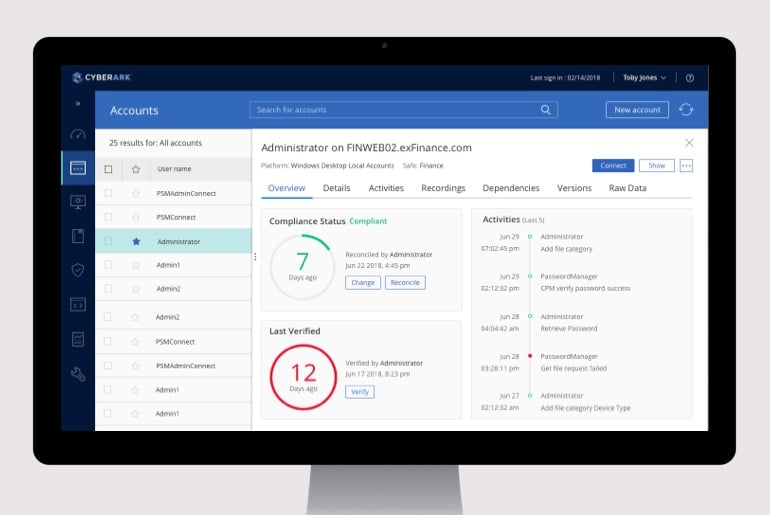
- Enterprise Password Vault (EPV): This central component securely stores and manages all privileged credentials, including passwords, SSH keys, and application secrets. It enforces strict policies around password rotation, complexity, and unique usage, eliminating hardcoded or shared credentials. Access to the vault itself is highly restricted and audited.
- Privileged Session Manager (PSM): The PSM creates an isolated, secure gateway through which users connect to target systems. Instead of directly accessing the system, users connect to the PSM, which then establishes a proxy connection to the target. This allows for continuous monitoring, recording, and control of all privileged sessions. Organizations can enforce granular access policies, block suspicious commands, and terminate sessions in real-time. This “just-in-time” access model significantly reduces the attack surface.
- Privileged Threat Analytics (PTA): Leveraging behavioral analytics and machine learning, PTA continuously monitors privileged activity for anomalous behavior that might indicate a compromise. It builds a baseline of normal activity and flags deviations, such as access at unusual times, from unusual locations, or attempts to access unauthorized resources. This proactive threat detection capability is vital for identifying and responding to breaches before significant damage occurs.
- Endpoint Privilege Manager (EPM): EPM extends the principle of least privilege to endpoints (workstations and servers). It prevents non-administrative users from running applications with elevated privileges unless explicitly authorized. This significantly reduces the risk of malware and ransomware attacks, as most malicious software requires administrative rights to install and execute effectively. EPM allows users to perform necessary tasks without granting them full admin access, thereby minimizing the attack surface on individual machines.
Identity Security Platform
Recognizing that privileged access is just one facet of the broader identity security challenge, CyberArk has expanded its vision to encompass a comprehensive Identity Security Platform. This platform aims to secure all identities – human, machine, and application – across the entire enterprise, including on-premises, hybrid, and multi-cloud environments. Key components within this expanded vision include:
- Secrets Management: Essential for modern DevOps and cloud-native application development, secrets management focuses on securing application secrets (e.g., API keys, database credentials, tokens) that applications use to authenticate and access other services. CyberArk provides solutions that enable developers to retrieve secrets programmatically without embedding them directly into code, rotating them automatically, and ensuring they are never exposed in plain text.
- Cloud Infrastructure Entitlement Management (CIEM): With the rapid adoption of multi-cloud environments, managing and securing entitlements across AWS, Azure, GCP, and other cloud platforms has become paramount. CIEM solutions identify and remediate excessive or unused cloud permissions, ensuring that human and machine identities only have the necessary access to cloud resources, minimizing the risk of misconfigurations and unauthorized access.
- Identity Governance: While CyberArk is not traditionally an Identity Governance and Administration (IGA) vendor, its platform integrates with IGA solutions to ensure that access rights are appropriately assigned, reviewed, and revoked across the organization. This provides a holistic view of an identity’s access posture, from standard user accounts to highly privileged ones.
Why CyberArk is Indispensable in Today’s Threat Landscape
The complexities of modern IT infrastructure, coupled with the sophistication of cyber adversaries, make solutions like CyberArk not just beneficial, but indispensable for organizations seeking to establish a resilient security posture.

Mitigating Advanced Threats
CyberArk’s platform is designed to be a critical line of defense against the most prevalent and damaging cyber threats:
- Ransomware and Malware Protection: By enforcing least privilege and isolating privileged sessions, CyberArk significantly limits the ability of ransomware and other malware to spread laterally, elevate privileges, or access critical data. If an endpoint is compromised, the malware is less likely to gain the admin rights needed to cause widespread damage.
- Lateral Movement Prevention: Attackers often gain initial access through a low-privilege account and then attempt to move deeper into the network by compromising privileged credentials. CyberArk’s PAM solutions disrupt this kill chain by securing these credentials, making it exceedingly difficult for attackers to escalate privileges or move between systems undetected.
- Insider Threat Mitigation: Whether malicious or accidental, insider actions can pose significant risks. By closely monitoring and recording all privileged sessions, CyberArk provides complete visibility into internal activities, enabling organizations to detect and respond to suspicious behavior from authorized users.
- Nation-State Attacks and APTs: Advanced Persistent Threats (APTs) often involve sophisticated tactics aimed at maintaining long-term access to target networks. CyberArk’s continuous monitoring and real-time threat detection capabilities are crucial for identifying and neutralizing these stealthy adversaries.
Achieving Compliance and Auditability
In an era of stringent regulatory requirements, demonstrating control over sensitive data and systems is non-negotiable. CyberArk’s platform provides the necessary tools for organizations to meet compliance mandates:
- Regulatory Compliance: Frameworks like GDPR, HIPAA, PCI DSS, ISO 27001, and SOX all have provisions related to access control and the protection of sensitive information. CyberArk’s robust logging, session recording, and granular access policies help organizations demonstrate adherence to these regulations, simplifying audits and reducing the risk of penalties.
- Comprehensive Audit Trails: Every privileged access request, session, and action performed through the CyberArk platform is meticulously logged and recorded. These detailed audit trails are invaluable for forensic investigations, providing clear evidence of who did what, where, and when, making it easier to pinpoint the source of a breach or a compliance violation.
Enabling Digital Transformation Securely
The drive towards digital transformation – embracing cloud computing, DevOps, and remote work – introduces new security challenges. CyberArk helps organizations navigate these changes securely:
- Securing Hybrid and Multi-Cloud Environments: As workloads shift to the cloud, traditional perimeter-based security models become inadequate. CyberArk’s solutions extend PAM and identity security controls across on-premises and multi-cloud environments, ensuring consistent policy enforcement and protection wherever critical assets reside.
- Empowering DevOps and Automation: Automation and rapid development cycles in DevOps require secure ways for applications and services to access resources. CyberArk’s secrets management solutions enable developers to integrate security seamlessly into their CI/CD pipelines without sacrificing agility or speed.
- Secure Remote Workforces: With the proliferation of remote work, secure remote access to privileged accounts is paramount. CyberArk’s PSM ensures that even remote access to sensitive systems is proxied, monitored, and controlled, minimizing the risk associated with accessing corporate resources from less secure environments.
The Evolution of Identity Security and CyberArk’s Vision
The cybersecurity landscape is in constant flux, and so too is the approach to securing identities. The industry is moving beyond traditional PAM to a more holistic “Identity Security” paradigm, recognizing that every human, machine, and application identity poses a potential entry point for attackers. CyberArk is at the forefront of this evolution, continuously expanding its platform to address this broader scope.
Future Trends in Digital Security
CyberArk’s strategic direction aligns with several emerging trends that are shaping the future of digital security:
- Zero Trust Architecture: The principle of “never trust, always verify” is central to modern security strategies. CyberArk’s emphasis on least privilege, continuous verification, and comprehensive monitoring directly supports the implementation of Zero Trust, ensuring that access is granted only after rigorous authentication and authorization, regardless of location or identity.
- AI/ML in Threat Detection and Adaptive Access: The volume and sophistication of threats necessitate automated and intelligent security controls. CyberArk’s continued investment in AI and machine learning for privileged threat analytics enables more accurate and timely detection of anomalies, and paves the way for adaptive access policies that can dynamically adjust permissions based on real-time risk assessment.
- Cloud-Native Security and Serverless Environments: As organizations increasingly adopt containerization, microservices, and serverless computing, securing the underlying infrastructure and the identities interacting with it becomes critical. CyberArk is innovating to provide solutions that protect secrets and access in these dynamic, ephemeral environments.
CyberArk’s Strategic Position
With decades of experience and a deep understanding of the challenges associated with privileged access, CyberArk has cemented its position as a market leader. Its comprehensive platform provides organizations with the tools necessary to protect their most valuable digital assets from the ground up. By continuously innovating and expanding its offerings from core PAM to a broader Identity Security Platform, CyberArk remains a pivotal partner for enterprises building robust, future-proof security postures against the ever-evolving threat landscape. Its focus on securing all identities, across all environments, ensures that organizations can pursue digital transformation with confidence, knowing their critical access points are protected.
aViewFromTheCave is a participant in the Amazon Services LLC Associates Program, an affiliate advertising program designed to provide a means for sites to earn advertising fees by advertising and linking to Amazon.com. Amazon, the Amazon logo, AmazonSupply, and the AmazonSupply logo are trademarks of Amazon.com, Inc. or its affiliates. As an Amazon Associate we earn affiliate commissions from qualifying purchases.