
Maintaining a swimming pool, whether a residential backyard oasis or a commercial amenity, represents a significant financial investment. Beyond the initial construction or purchase, ongoing operational expenses, chemical costs, and potential repair bills can quickly accumulate. In this economic landscape, understanding and strategically managing every component of pool care becomes critical. Among the various chemicals vital for a healthy and cost-effective pool, cyanuric acid (CYA) often stands out as a deceptively simple yet profoundly impactful financial tool. Far from being just another chemical additive, CYA plays a pivotal role in protecting your chlorine investment, optimizing operational budgets, and safeguarding the long-term value of your aquatic asset.

The Financial Imperative of Pool Chemical Balance
A swimming pool is more than just a recreational feature; it’s a valuable asset that requires diligent management to preserve its value and minimize ownership costs. The delicate balance of pool chemistry is not merely about water clarity; it directly impacts the longevity of equipment, the health of swimmers, and, crucially, your financial outlay. Ignoring proper chemical balance can quickly lead to a cascade of expensive problems, turning a potential source of enjoyment or revenue into a budgetary drain.
Safeguarding Your Pool Investment
The very structure of your pool, from its plaster or liner to its sophisticated filtration and heating systems, represents a substantial capital expenditure. Unbalanced water chemistry is a silent destructor, eroding the lifespan of these costly components. For instance, corrosive water, often a symptom of improper pH or sanitizer levels, can prematurely degrade heaters, pumps, and even the pool’s surface materials. Conversely, scaling issues, caused by high calcium hardness or alkalinity, can clog filters and plumbing, reducing efficiency and demanding expensive repairs or replacements. Cyanuric acid, by enabling stable and effective sanitization, contributes indirectly but powerfully to preventing these issues. By allowing chlorine to function optimally, CYA helps maintain an environment where other chemical parameters are easier to control, thereby extending the life of your pool’s physical infrastructure and protecting your initial investment from unnecessary depreciation and unexpected capital outlays.
The Cost of Neglect
The financial consequences of neglecting pool chemistry are stark and immediate. One of the most common and costly manifestations of neglect is an algae bloom. A green pool isn’t just unsightly; it’s a financial burden. Eradicating algae requires significant expenditure on aggressive shock treatments, algaecides, and increased filter run times, all consuming more electricity and chemicals than routine maintenance. For commercial pools, downtime due to algae can mean lost revenue, reputational damage, and even potential health code violations incurring fines.
Beyond visible algae, imbalanced water can lead to microscopic issues that are equally expensive. Ineffective sanitization, often a result of rapidly degrading chlorine, can foster the growth of bacteria and pathogens, posing health risks to swimmers. Addressing these issues can require emergency chemical treatments, draining and refilling the pool (a significant water and heating cost), or even professional remediation services, each carrying a substantial price tag. These reactive expenses are almost always higher than the proactive costs associated with consistent, balanced chemical management, including the judicious use of cyanuric acid.
Cyanuric Acid: A Strategic Financial Tool for Chlorine Management
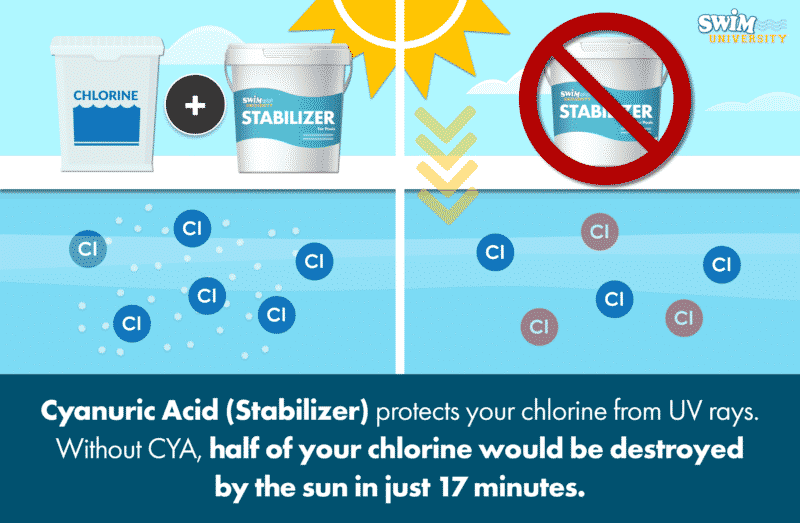
At its core, cyanuric acid (CYA) acts as a sunblock for chlorine. Without it, the sun’s ultraviolet (UV) rays rapidly break down chlorine, rendering it ineffective within a few hours. This rapid degradation translates directly into increased chlorine consumption and, consequently, higher operational costs. By stabilizing chlorine, CYA emerges as a critical financial tool, enabling pool owners to maximize their chemical budget and optimize ongoing expenses.
Maximizing Your Chlorine Budget
Chlorine is the primary sanitizing agent in most swimming pools, and it represents a significant recurring expense. Without CYA, a substantial portion of the chlorine added to a pool is lost to UV radiation before it has a chance to sanitize the water effectively. This “chlorine burn-off” is essentially throwing money down the drain. By adding cyanuric acid, pool owners can dramatically reduce the rate at which chlorine is consumed. This means less frequent chlorine additions and a lower overall volume of chlorine purchased over time. For a typical residential pool, this can translate to hundreds of dollars in annual savings. For large commercial facilities, these savings can easily reach into the thousands, making CYA an indispensable component of a cost-effective chemical program. It transforms chlorine from a volatile, rapidly expended commodity into a more stable, long-lasting investment, yielding greater returns on your sanitization spend.
Optimizing Operational Expenses (OpEx)
Beyond direct chemical savings, CYA contributes to a leaner operational budget in other ways. When chlorine levels are consistently stable due to CYA, the need for reactive interventions decreases. This reduces the labor costs associated with frequent testing and dosing, whether that labor is paid to a professional service or represents the valuable time investment of the homeowner. Fewer instances of algae or cloudy water mean less time spent scrubbing, vacuuming, and performing intensive backwashes, which in turn saves on water, electricity, and the wear and tear on pool equipment.
Furthermore, a well-managed chemical regimen enabled by CYA minimizes the need for drastic, expensive treatments. Avoiding situations that require super-chlorination (shocking) or, worse, partial or full water changes, directly impacts utility bills (water and heating costs) and the expense of additional chemicals. By proactively maintaining stable chlorine with CYA, pool managers can achieve predictable and lower OpEx, allowing for better budget forecasting and resource allocation, enhancing the overall financial efficiency of the pool operation.

Navigating the Financial Risks and Rewards of CYA Levels
The effectiveness and financial benefits of cyanuric acid are entirely dependent on maintaining appropriate levels. Both too little and too much CYA can lead to significant financial penalties, underscoring the importance of precise management. Understanding the “sweet spot” for CYA is not just a matter of good chemistry; it’s a critical financial decision.
The Perils of Low CYA: Unbudgeted Chlorine Expenditure
Operating a pool with insufficient cyanuric acid is akin to trying to heat a house with open windows. The valuable resource (chlorine) you’re constantly adding quickly dissipates, forcing you to continuously replenish it. This rapid chlorine loss directly inflates your recurring chemical budget. Homeowners will find themselves buying more chlorine more often, while businesses will see their chemical purchasing costs escalate unexpectedly. This isn’t just an inefficiency; it’s an unbudgeted and often substantial recurring expense.
Beyond the direct cost of chlorine, low CYA levels carry an increased risk of sanitation failure. When chlorine vanishes quickly, the pool becomes vulnerable to pathogens and algae. The financial repercussions are swift: the need for expensive “catch-up” treatments, potential pool closures for commercial entities (resulting in lost revenue or customer dissatisfaction), and even the risk of health-related liability claims if water quality standards are compromised. These unforeseen costs can dwarf any perceived savings from not using CYA, making adequate levels a critical financial safeguard.
The Trap of High CYA: Hidden Costs and Diminished Returns
While a little CYA is good, more is not necessarily better. Excessively high levels of cyanuric acid can lead to a phenomenon often termed “chlorine lock.” At high concentrations (typically above 80-100 ppm), CYA binds too strongly to the chlorine, making it largely ineffective as a sanitizer. The pool may test positive for chlorine, but that chlorine is chemically unavailable to kill bacteria and algae. This creates a paradox where you’re buying and adding chlorine, yet the pool remains vulnerable to contamination. The financial implication is clear: you’re paying for a product that isn’t delivering its intended value, effectively wasting your chlorine budget.
To combat chlorine lock, pool operators often resort to adding even more chlorine, exacerbating the problem and escalating costs without solving the core issue. The ultimate and most expensive solution to excessively high CYA is a partial or full drain and refill of the pool. This incurs substantial expenses: the cost of water itself, the energy required to reheat the new water, and the cost of the chemicals needed to re-establish proper balance. For commercial pools, draining means downtime, representing lost revenue and potential customer dissatisfaction. This “reset” is a significant, avoidable capital outlay that directly results from mismanaging CYA levels, proving that over-application is just as financially detrimental as under-application.
Implementing a Financially Sound CYA Strategy
Effective management of cyanuric acid is not an arbitrary chemical process; it’s an integral part of a financially responsible pool ownership strategy. By integrating careful monitoring and informed decision-making regarding CYA, pool owners can protect their investment, minimize recurring expenses, and optimize the overall economic efficiency of their pool.
Regular Testing as a Cost-Saving Measure
The adage “an ounce of prevention is worth a pound of cure” holds particular financial weight in pool maintenance. Regular testing of CYA levels, along with other key parameters, is a modest investment that yields significant returns by preventing costly problems. A high-quality test kit, costing perhaps tens of dollars, can save hundreds or thousands in chemical overspending, repairs, or remediation efforts. By knowing the precise CYA level, owners can add exactly what’s needed, avoiding both the under-dosing that leads to rampant chlorine loss and the over-dosing that necessitates expensive water changes. Testing is not merely a task; it’s an information-gathering process that empowers financially astute decisions regarding chemical purchases and application.
Budgeting for Pool Chemicals and Maintenance
Integrating cyanuric acid into a comprehensive pool maintenance budget allows for predictable and controlled expenses. Recognizing CYA as a key component means allocating funds for its purchase and ensuring sufficient stock. Savvy pool owners and businesses often explore bulk purchasing options for essential chemicals, including CYA, to achieve economies of scale and reduce per-unit costs. Furthermore, understanding the interplay between CYA and chlorine allows for more accurate forecasting of chlorine consumption, leading to more efficient purchasing and inventory management. This proactive budgeting approach prevents unexpected spikes in chemical expenditures and ensures resources are allocated effectively, supporting long-term financial stability for the pool operation.
The Value of Professional Expertise
For individuals or businesses managing a substantial pool asset, the cost of professional pool service can often be an excellent financial investment. Expert technicians bring specialized knowledge in chemistry and equipment, including the nuances of cyanuric acid management. They can accurately diagnose issues, precisely adjust chemical levels, and offer tailored advice to optimize chemical usage, thereby preventing costly mistakes and ensuring the highest level of efficiency. While it represents an upfront expense, professional service can lead to significant savings in the long run by extending equipment life, reducing chemical waste, avoiding expensive emergency treatments, and ensuring compliance with health regulations (for commercial pools, avoiding fines). For those whose time has a high financial value, or for multi-million-dollar commercial assets, outsourcing this complex chemical management, including CYA, is often the most financially prudent decision, guaranteeing consistent performance and protecting the investment.
aViewFromTheCave is a participant in the Amazon Services LLC Associates Program, an affiliate advertising program designed to provide a means for sites to earn advertising fees by advertising and linking to Amazon.com. Amazon, the Amazon logo, AmazonSupply, and the AmazonSupply logo are trademarks of Amazon.com, Inc. or its affiliates. As an Amazon Associate we earn affiliate commissions from qualifying purchases.