
The prime rate of interest serves as the foundational benchmark for the American credit market. Often referred to as the “Prime Lending Rate,” it is the base interest rate that commercial banks charge their most creditworthy corporate customers. While it may seem like a figure reserved for Wall Street boardrooms, the prime rate is a critical metric that dictates the cost of borrowing for millions of average consumers and small business owners across the country.
As of the current economic cycle, the prime rate is intrinsically tied to the Federal Funds Rate, which is set by the Federal Reserve’s Federal Open Market Committee (FOMC). Understanding the current rate—which currently stands at 8.50% in the United States—requires a deep dive into how monetary policy, inflation, and bank profit margins intersect. When the Fed moves, the prime rate follows, creating a ripple effect that touches everything from your monthly credit card statement to the viability of a new business venture.
The Mechanics of the Prime Rate: How It Is Determined
To understand where the prime rate stands today, one must understand its relationship with the Federal Reserve. Although the Federal Reserve does not “set” the prime rate directly, it controls the Federal Funds Rate—the interest rate banks charge each other for overnight loans.
The 3% Rule of Thumb
In the modern financial era, the prime rate is generally calculated as the Federal Funds Target Rate plus 3%. For instance, with the Federal Funds Rate currently held in the range of 5.25% to 5.50%, the prime rate sits at 8.50%. This 300-basis-point spread represents the margin banks require to cover operational costs, manage risk, and generate profit while lending to their highest-quality borrowers.
The Wall Street Journal Prime Rate
While individual banks technically set their own prime rates, the industry looks to the “Wall Street Journal (WSJ) Prime Rate” as the official consensus. The WSJ polls the 10 largest banks in the United States; when at least seven of them change their prime rate, the WSJ updates its published rate. This creates a synchronized movement across the financial sector, ensuring that lending costs remain competitive and uniform across major institutions.
The Role of the FOMC
The Federal Open Market Committee meets eight times a year to assess the state of the economy. If inflation is high, the FOMC typically raises rates to cool down spending. If the economy is sluggish, they lower rates to encourage borrowing. Because the prime rate is pegged to these decisions, it serves as the primary mechanism through which the Fed’s “macro” decisions become “micro” realities for the general public.
How the Prime Rate Impacts Your Personal Finances
The prime rate is more than just an abstract economic indicator; it is a direct driver of the interest rates on variable-rate financial products. When the prime rate increases, the cost of carrying debt rises almost immediately for millions of households.
Credit Cards and Variable APRs
Most credit cards utilize a variable Annual Percentage Rate (APR) that is calculated by taking the prime rate and adding a specific margin based on the borrower’s creditworthiness. For example, if your credit card agreement states your APR is “Prime + 15%,” and the prime rate is 8.50%, your actual interest rate is 23.50%. Because these rates are “variable,” banks are not required to give advance notice before raising your APR in response to a prime rate hike; the change usually appears on the next billing cycle.
Home Equity Lines of Credit (HELOCs)
Unlike traditional fixed-rate mortgages, Home Equity Lines of Credit (HELOCs) are almost always tied directly to the prime rate. For homeowners using their equity to fund renovations or consolidate debt, a rising prime rate can significantly increase monthly interest-only payments. This makes HELOCs a double-edged sword: they offer flexibility and lower initial rates than personal loans, but they expose the borrower to “interest rate risk” if the Federal Reserve continues an aggressive tightening cycle.
Personal and Auto Loans
While many auto loans are fixed-rate, the initial offers provided by lenders are influenced by the prevailing prime rate. When the prime rate is high, lenders must pay more to acquire capital, and they pass those costs onto the consumer. Similarly, unsecured personal loans often track with the prime rate, meaning that timing your borrowing can result in saving thousands of dollars over the life of a loan.
The Prime Rate and Business Finance

For entrepreneurs and corporate treasurers, the prime rate is a vital component of the “cost of capital.” It influences everything from daily operational liquidity to long-term infrastructure investments.
Small Business Administration (SBA) Loans
Many SBA loans—the lifeblood of American small businesses—are structured with interest rates based on the prime rate. The SBA sets maximum “spreads” that lenders can charge above the prime rate. When the prime rate sits at 8.50%, an SBA 7(a) loan might carry an interest rate of 11% or higher. For a small business operating on thin margins, a 2% or 3% increase in the prime rate over a year can be the difference between expansion and stagnation.
Commercial Lines of Credit
Businesses often rely on revolving lines of credit to manage cash flow fluctuations. These lines are almost exclusively tied to the prime rate. When the rate rises, the cost of maintaining inventory or bridging the gap between accounts receivable and accounts payable increases. This often leads to “cost-push inflation,” where businesses raise their own prices to offset the higher cost of borrowing, further complicating the economic landscape.
Impact on Capital Expenditure (CapEx)
High prime rates act as a natural brake on the economy. When borrowing is expensive, companies are less likely to finance new machinery, technology upgrades, or real estate acquisitions. CFOs utilize the prime rate to calculate the “hurdle rate”—the minimum return an investment must generate to be considered viable. As the prime rate climbs, fewer projects meet that criteria, leading to a slowdown in corporate investment.
Historical Context: Navigating High and Low Rate Environments
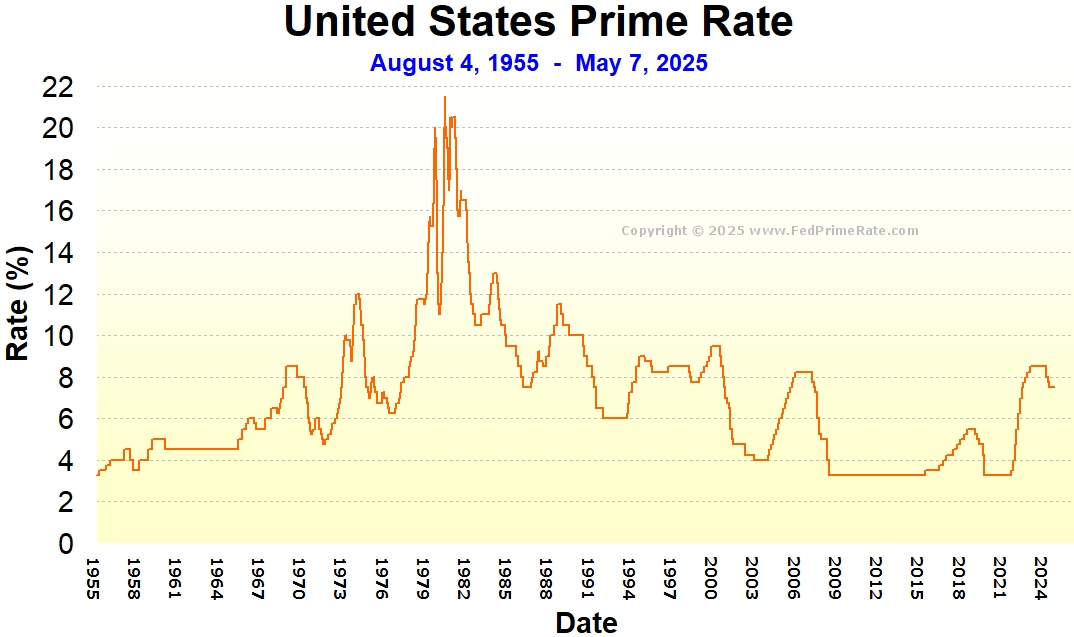
To understand the current prime rate of 8.50%, it is helpful to look at where we have been. The prime rate is a reflection of the era’s broader economic challenges, from the stagflation of the 1980s to the “easy money” era following the 2008 financial crisis.
The Extremes: From 21% to 3.25%
The highest prime rate in U.S. history occurred in December 1980, when it reached a staggering 21.50%. At the time, Federal Reserve Chair Paul Volcker was determined to break the back of runaway inflation. Conversely, for much of the period between 2008 and 2015, and again during the 2020 pandemic, the prime rate sat at a floor of 3.25%. These “near-zero” environments were designed to stimulate the economy by making borrowing as cheap as possible.
The Current Cycle of Tightening
The jump from 3.25% in early 2022 to the current 8.50% represents one of the fastest tightening cycles in modern financial history. This rapid ascent was a direct response to the post-pandemic inflation surge. For consumers and businesses that grew accustomed to a decade of ultra-low rates, this transition has been a significant “sticker shock,” requiring a total recalibration of debt management strategies.
Strategies for Managing Finances in a High Prime Rate Environment
When the prime rate is elevated, the strategy for both individuals and businesses must shift from growth and leverage to efficiency and debt reduction.
Debt Consolidation and Refinancing
In a high-rate environment, the priority should be moving away from variable-rate debt. Consumers should look into “balance transfer” credit cards that offer 0% introductory APRs or consider consolidating high-interest variable debt into a fixed-rate personal loan. Even if the fixed rate feels high compared to historical norms, it provides protection against future rate hikes.
Improving Credit Scores
Since the prime rate is the base for “the most creditworthy” customers, those with lower credit scores often pay a much higher margin (e.g., Prime + 10% vs. Prime + 20%). By focusing on credit score improvement—paying down balances, ensuring on-time payments, and correcting credit report errors—borrowers can effectively “lower” their own interest rate even if the national prime rate remains high.
Cash Reserves and High-Yield Savings
There is a silver lining to a high prime rate: it generally correlates with higher yields on savings accounts and Certificates of Deposit (CDs). While the prime rate dictates what you pay to borrow, the same economic forces dictate what you earn on your deposits. Investors should look toward High-Yield Savings Accounts (HYSAs) or “CD ladders” to capitalize on the current rate environment, ensuring their cash reserves are working as hard as possible.

Fixed vs. Floating Rate Business Loans
Business owners should evaluate their existing debt portfolios. If a business holds significant floating-rate debt, it may be prudent to negotiate a “swap” to a fixed rate or prioritize the accelerated repayment of those obligations. Reducing leverage becomes essential when the cost of servicing that debt begins to consume a larger portion of the company’s gross profit.
The current prime rate of 8.50% is a powerful indicator of a stabilizing yet restrictive economic policy. Whether you are a homebuyer, a credit card holder, or a business owner, the prime rate is the pulse of your financial life. By monitoring the Federal Reserve’s signals and understanding how the 3% spread functions, you can make informed decisions that protect your assets and minimize your liabilities in any interest rate climate.
aViewFromTheCave is a participant in the Amazon Services LLC Associates Program, an affiliate advertising program designed to provide a means for sites to earn advertising fees by advertising and linking to Amazon.com. Amazon, the Amazon logo, AmazonSupply, and the AmazonSupply logo are trademarks of Amazon.com, Inc. or its affiliates. As an Amazon Associate we earn affiliate commissions from qualifying purchases.