
C++ is a powerful, general-purpose programming language that has stood the test of time, evolving from its roots in the C language to become a cornerstone of modern software development. Its versatility, performance, and extensive feature set have cemented its position in a vast array of applications, from operating systems and game engines to high-frequency trading platforms and embedded systems. Understanding C++ is crucial for anyone aspiring to delve deep into the world of software engineering, systems programming, or performance-critical application development. This article will demystify C++, exploring its origins, core concepts, key features, and its enduring relevance in today’s technological landscape.
The Genesis and Evolution of C++
C++ didn’t appear out of thin air; it emerged as a thoughtful extension of an already robust language, C. Its development was driven by the need for object-oriented programming capabilities without sacrificing the performance and low-level control that C provided.
From C to “C with Classes”
The story of C++ begins in the early 1980s at Bell Labs, where Bjarne Stroustrup sought to add object-oriented features to the C programming language. His initial project, dubbed “C with Classes,” aimed to improve the organization and reusability of code by introducing concepts like classes, inheritance, and virtual functions. This allowed programmers to model real-world entities more effectively, leading to more modular and maintainable software. The intention was not to create an entirely new language, but rather to enhance C with these powerful new paradigms.
The Birth of C++ and Standardization
In 1983, “C with Classes” was renamed C++. The “++” symbol, borrowed from the C increment operator, aptly suggested that it was an enhanced version of C. The language continued to evolve rapidly, incorporating more features and gaining popularity. Recognizing the need for consistency and interoperability, the first official ANSI C++ standard was published in 1998. This was followed by subsequent standards, including C++03, C++11, C++14, C++17, and most recently, C++20, each introducing new features, improvements, and refinements that keep the language competitive and relevant in the face of evolving technological demands. These standards are crucial for ensuring that code written on one platform or by one compiler can be compiled and run on others.
Core Concepts and Paradigm Shifts
C++ is a multi-paradigm programming language, meaning it supports different programming styles. Its strength lies in its ability to seamlessly integrate procedural, object-oriented, and generic programming.
Object-Oriented Programming (OOP) in C++
Object-Oriented Programming is a central pillar of C++. It organizes software design around data, or objects, rather than functions and logic. Key OOP concepts supported by C++ include:
- Classes and Objects: A class is a blueprint for creating objects, defining their properties (data members) and behaviors (member functions). An object is an instance of a class. For example, a
Carclass could define properties likecolorandspeed, and behaviors likestartEngine()andaccelerate(). An individual car object, likemyRedFerrari, would be an instance of theCarclass with specific values for its properties. - Encapsulation: This principle bundles data (attributes) and methods (functions) that operate on the data within a single unit, the class. It hides the internal implementation details of an object, exposing only what is necessary to the outside world. This promotes data integrity and modularity.
- Inheritance: This mechanism allows a new class (derived class or subclass) to inherit properties and behaviors from an existing class (base class or superclass). This promotes code reusability and establishes a hierarchical relationship between classes. For example, a
SportsCarclass could inherit from theCarclass, adding specific features like a spoiler and a turbocharger. - Polymorphism: This means “many forms.” In C++, polymorphism allows objects of different classes to be treated as objects of a common base class. This is typically achieved through virtual functions and enables code to be more flexible and extensible. For instance, a
drive()function could work with any object derived from aVehicleclass, whether it’s aCar,Motorcycle, orTruck.
Generic Programming with Templates
C++’s template feature enables generic programming, allowing you to write code that can work with different data types without needing to rewrite the same logic for each type. This is achieved through:
- Function Templates: These allow you to define a single function that can operate on various data types. For example, a
swapfunction template can swap the values of two integers, two floats, or two strings, all with the same code definition. - Class Templates: These allow you to define a class that can operate on different data types. The Standard Template Library (STL), a collection of C++ template classes and functions, heavily relies on class templates for data structures like vectors, lists, maps, and algorithms. This greatly reduces redundancy and enhances code maintainability.
Memory Management and Performance
One of C++’s defining characteristics is its direct control over memory management. Unlike languages with automatic garbage collection, C++ provides manual memory control using pointers and references, along with operators like new and delete (or malloc and free).
- Pointers and References: Pointers store memory addresses, allowing for direct manipulation of data in memory. References provide an alias to an existing variable. While powerful, they require careful handling to avoid issues like memory leaks or segmentation faults.
- RAII (Resource Acquisition Is Initialization): This is a fundamental C++ idiom that links resource management (like memory or file handles) to object lifetimes. When an object is created, its constructor acquires the resource. When the object goes out of scope, its destructor automatically releases the resource. This significantly improves safety and robustness, especially in exception-handling scenarios. Smart pointers, such as
std::unique_ptrandstd::shared_ptr, are modern manifestations of RAII, automating memory management and preventing leaks.
Key Features and Advantages of C++
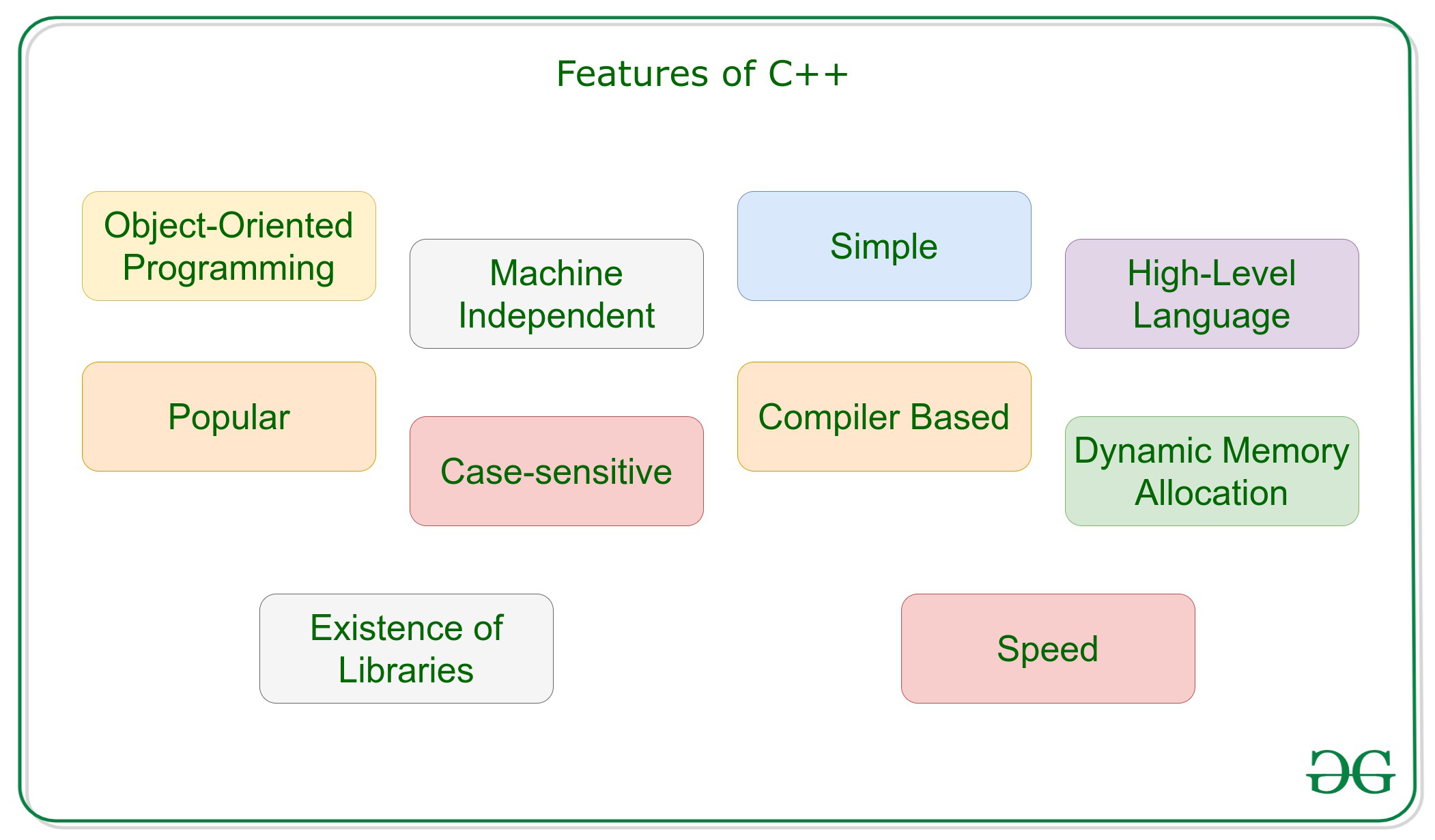
C++ offers a rich set of features that contribute to its power, flexibility, and widespread adoption.
Performance and Efficiency
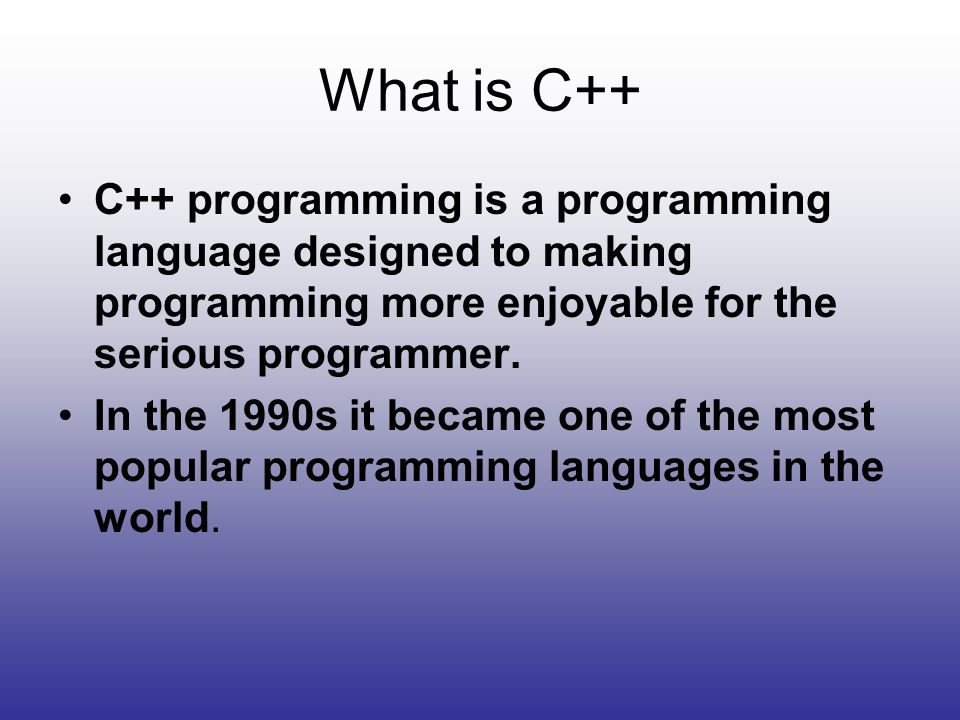
C++ is renowned for its performance. It compiles directly to machine code, enabling it to execute with near-native speed. This makes it the language of choice for applications where performance is paramount.
- Low-Level Memory Manipulation: The ability to directly manage memory allows developers to optimize resource usage to an extreme degree, crucial for performance-critical applications.
- Direct Hardware Access: C++ provides features that allow for close interaction with hardware, making it suitable for embedded systems and operating system development.
- Optimized Compilers: Modern C++ compilers are highly sophisticated and perform extensive optimizations during the compilation process, further enhancing the performance of C++ code.
Portability and Cross-Platform Development
While C++ code can be platform-specific in its low-level implementations, its core language features and the standardization process promote portability.
- Standardization: Adherence to ANSI/ISO standards ensures that C++ code written on one system can generally be compiled and run on another with minimal modifications, provided the necessary compilers and libraries are available.
- Abstraction Layers: Libraries and frameworks abstract away platform-specific details, allowing developers to write code that can be deployed across various operating systems (Windows, macOS, Linux) and hardware architectures.
Vast Ecosystem and Community Support
C++ benefits from a mature and extensive ecosystem.
- Extensive Libraries: The Standard Template Library (STL) provides a wide range of pre-built data structures and algorithms. Beyond the STL, numerous third-party libraries exist for virtually any task, from graphics and networking to scientific computing and game development.
- Powerful Tooling: A wide array of integrated development environments (IDEs) like Visual Studio, CLion, and VS Code, along with compilers (GCC, Clang, MSVC) and debugging tools, support C++ development.
- Large and Active Community: C++ has a massive global community of developers who contribute to its evolution, provide support through forums and online resources, and develop open-source projects. This strong community ensures that help is readily available for even the most complex problems.
Applications and Enduring Relevance
C++’s combination of performance, control, and expressiveness makes it indispensable across a broad spectrum of industries and applications.
Systems Programming and Operating Systems
Operating systems like Windows, macOS, and Linux are largely built using C++. This is because C++ provides the necessary low-level control, memory management, and performance required to build the foundational software that manages a computer’s hardware and resources.
Game Development
The gaming industry heavily relies on C++. Game engines like Unreal Engine and Unity (which uses C# but has C++ as its underlying engine for many functionalities) are often built with C++ to achieve the high frame rates and complex visual rendering demanded by modern games. Performance is paramount for delivering immersive and responsive gaming experiences.
High-Frequency Trading and Financial Systems
In the financial sector, particularly in high-frequency trading (HFT), every nanosecond counts. C++’s ability to execute code with extreme speed and low latency makes it the language of choice for developing trading platforms, algorithms, and risk management systems where milliseconds can translate into millions of dollars.
Embedded Systems and IoT
From automotive control units and industrial automation to smart appliances and medical devices, embedded systems are increasingly prevalent. C++’s efficiency and ability to interface directly with hardware make it an ideal language for programming these resource-constrained devices. The Internet of Things (IoT) also leverages C++ for developing the firmware that powers connected devices.
Performance-Critical Applications
Any application where performance is a critical factor often turns to C++. This includes scientific simulations, data analysis tools, complex graphics rendering software, and high-performance computing (HPC) applications.
Modern C++ Trends
Even with the emergence of newer languages, C++ continues to evolve. Modern C++ (C++11 and later) has embraced features that improve safety, readability, and productivity, such as smart pointers, lambda expressions, and concepts, making it more accessible and less error-prone than its predecessors. This continuous evolution ensures its continued relevance in the face of new technological challenges.
In conclusion, C++ is far more than just a programming language; it’s a powerful and versatile tool that empowers developers to build some of the most complex and performance-intensive software in existence. Its enduring legacy, coupled with its ongoing evolution, guarantees its place at the forefront of technological innovation for years to come.
aViewFromTheCave is a participant in the Amazon Services LLC Associates Program, an affiliate advertising program designed to provide a means for sites to earn advertising fees by advertising and linking to Amazon.com. Amazon, the Amazon logo, AmazonSupply, and the AmazonSupply logo are trademarks of Amazon.com, Inc. or its affiliates. As an Amazon Associate we earn affiliate commissions from qualifying purchases.