
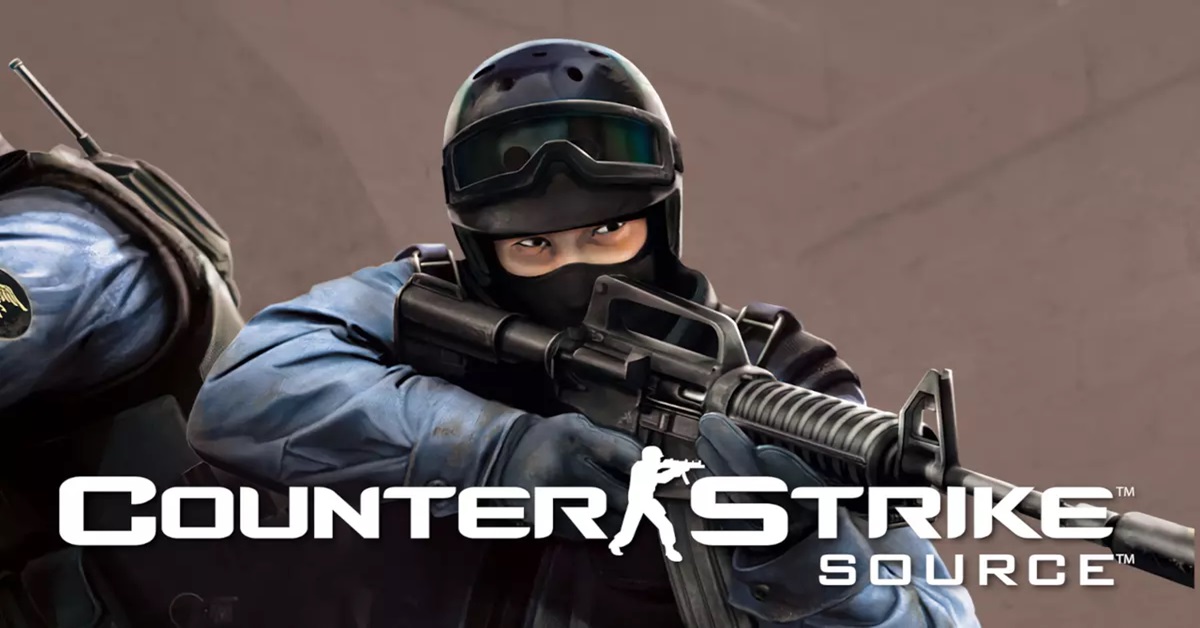
Counter-Strike: Source (CS: Source or CSS) is not merely a video game; it’s a pivotal moment in the evolution of the first-person shooter (FPS) genre, a technological showcase for its era, and a testament to the enduring appeal of competitive tactical gameplay. Released in 2004 by Valve Corporation, CS: Source served as a modernized remake of the original Counter-Strike 1.6, rebuilding the beloved classic from the ground up on Valve’s then-revolutionary Source engine. More than just a graphical overhaul, it introduced a new era of physics, visual fidelity, and online multiplayer technology that profoundly shaped the gaming landscape for years to come.

At its core, CS: Source is a team-based tactical FPS where two opposing teams—Terrorists and Counter-Terrorists—face off in rounds, aiming to complete objective-based missions or eliminate the opposing team. Common objectives include bomb defusal, hostage rescue, or assassination. The game demands precision aim, strategic thinking, map knowledge, and seamless team coordination. However, what truly set CS: Source apart was the technology underpinning these familiar mechanics, pushing the boundaries of what players expected from a multiplayer shooter. It was a bridge between the foundational FPS experiences of the late 90s and early 2000s and the sophisticated, physics-driven worlds that would define subsequent generations of gaming.
The Legacy of a Groundbreaking FPS
Counter-Strike: Source emerged at a time when PC gaming was rapidly advancing, grappling with the transition from fixed-function pipelines to programmable shaders and the increasing demand for realistic in-game physics. Its arrival marked a significant turning point, not just for the Counter-Strike franchise but for the broader FPS genre, largely due to its foundational engine and refined gameplay.
Origins and Evolution from 1.6
The original Counter-Strike, initially a mod for Half-Life, had solidified its place as a competitive esports titan with its 1.6 iteration. It was a game defined by its raw simplicity, precise gunplay, and demanding skill ceiling. However, by the early 2000s, its GoldSrc engine, while revolutionary in its time, was showing its age. Graphics were dated, physics were rudimentary, and many systems felt clunky by emerging standards.
Counter-Strike: Source was Valve’s answer to this technological stagnation. It wasn’t a complete reinvention of the wheel but rather a meticulous re-engineering of the classic formula. The core gameplay loop—buy weapons, engage in tactical skirmishes, complete objectives—remained largely intact. Crucially, the fundamental gunplay, weapon recoil patterns, and movement mechanics were carefully adapted to preserve the skill and feel that millions of players had come to love in 1.6. This careful balance of preservation and innovation was key to its acceptance, aiming to modernize the experience without alienating the loyal fanbase. Familiar maps like dedust2, csitaly, and de_nuke were painstakingly recreated with enhanced detail, textures, and new interactive elements, all while maintaining their strategic integrity.
The Source Engine Revolution
The heart of CS: Source’s innovation lay in the Source engine. Introduced alongside Half-Life 2, the Source engine was a colossal leap forward in game development technology. For CS: Source, it meant a radical overhaul of virtually every technical aspect. Gone were the blocky models and simplistic environments of GoldSrc, replaced by highly detailed character models, weapons, and environments with advanced shader effects.
Perhaps the most immediately striking feature was the integration of the Havok physics engine. This brought a new level of interactivity and realism to the game world. Ragdoll physics for fallen enemies, destructible environmental elements (like breaking glass, exploding barrels, or collapsing shelves), and dynamic object manipulation (e.g., throwing grenades to bounce realistically) were unprecedented in a competitive multiplayer shooter. This wasn’t just cosmetic; it added new layers of tactical possibility, allowing players to manipulate the environment in ways previously unimaginable. The Source engine also enabled much more sophisticated sound design, with spatial audio that allowed players to more accurately pinpoint enemy locations based on footsteps and gunshots, adding another crucial layer to competitive play.
Core Gameplay Mechanics
Despite the technological upgrade, the essence of Counter-Strike’s gameplay remained paramount. CS: Source preserved the high lethality and tactical depth that defined its predecessor. Headshots were instantly fatal, weapon spray patterns required mastery, and managing your economy—earning money from kills and round wins to buy better weapons and utility—was a strategic cornerstone. The game continued to emphasize precise mouse control and quick reflexes, rewarding players who could consistently land shots and execute complex movement techniques like bunny hopping and strafing.
The objective-based gameplay further reinforced its tactical nature. Whether it was the intense pressure of defusing a bomb with seconds left, the careful coordination required to rescue hostages, or the methodical elimination of all opponents, each round presented a distinct challenge. The round-based format meant that every decision, every successful or failed push, and every economic choice had repercussions for subsequent rounds, fostering a deep strategic meta-game that transcended individual firefights. This blend of classic, refined mechanics with a powerful new engine created a unique and compelling competitive experience.
Unpacking the Game’s Technological Backbone
Counter-Strike: Source wasn’t just a prettier version of its predecessor; it was a demonstration of cutting-edge technology applied to a beloved franchise. The underlying Source engine provided a robust framework that allowed for significant advancements in graphics, physics, and network performance, profoundly impacting the player experience and setting new benchmarks for the industry.
Graphics and Physics: A Leap Forward
The graphical capabilities of the Source engine were a revelation for Counter-Strike. High Dynamic Range (HDR) lighting brought unprecedented realism to maps, with dynamic light sources casting realistic shadows and illuminating environments with nuanced gradients. Textures were dramatically more detailed, enhancing the visual fidelity of everything from weapon models to environmental surfaces. Character models featured more polygons, leading to more lifelike animations and distinct visual cues. The addition of reflective surfaces, advanced water shaders, and particles effects like smoke and explosions further immersed players in the game world.
Beyond mere aesthetics, the integrated Havok physics engine transformed the game’s interactivity. Ragdoll physics provided realistic death animations, making each kill feel more impactful and unique. Environmental destructibility, while not universally pervasive, allowed for breaking glass, splintering wood, and dynamic object movement, which could occasionally be exploited for tactical advantage or simply added to the immersion. This dynamic environment encouraged players to think beyond static cover and react to a more fluid battlefield. The physics also affected projectile trajectories and grenade bounces, requiring a deeper understanding of environmental interaction for effective utility usage.
Networking and Latency Management
For a fast-paced competitive shooter, netcode and network performance are paramount. CS: Source inherited Valve’s expertise in online multiplayer infrastructure, featuring a robust client-server model designed to minimize latency and ensure fair play. Dedicated servers, hosted by both official providers and community members, were the backbone of the multiplayer experience, offering reliable connections and customizable gameplay rules.
Valve implemented sophisticated netcode features, including client-side prediction and interpolation, to smooth out player movement and actions, making the game feel responsive even with moderate ping. Hit registration, a perennial concern in online shooters, was a major focus, aiming to accurately reflect a player’s shot given their latency and server state. The game also featured Valve Anti-Cheat (VAC), a proprietary system designed to detect and ban cheaters, though like all anti-cheat solutions, it waged a continuous battle against malicious software. The overall network architecture was engineered to support a high number of concurrent players per server without significant performance degradation, ensuring a fluid and competitive environment.
Modding and Community Content

A defining characteristic of Valve games, particularly those built on the GoldSrc and Source engines, has always been their robust support for modding. Counter-Strike: Source was no exception. Valve released a comprehensive Source SDK (Software Development Kit), empowering the community to create an astonishing array of custom content.
This included new maps, weapon skins, character models, and even entirely new gameplay modes. The SDK provided tools for mapping (Hammer Editor), modeling, animation, and scripting, allowing hobbyists and aspiring developers to dive deep into the game’s architecture. The ability to host custom servers with unique rule sets, plugins, and modifications fostered an incredibly diverse and vibrant community. Players could find servers running “surf” maps, “bhop” maps, “deathrun” maps, zombie survival modes, and countless other creative variations. This community-driven content significantly extended the game’s longevity and appeal, offering endless hours of entertainment beyond the core competitive experience and demonstrating the power of an open development ecosystem.
The Enduring Impact and Community
Counter-Strike: Source, while eventually overshadowed by its successor, Counter-Strike: Global Offensive, left an indelible mark on the gaming world. Its innovations, particularly in the realm of physics and graphical fidelity for a competitive shooter, resonated deeply and continued to influence game design long after its prime.
Competitive Play and Esports Roots
While CS 1.6 remained the dominant competitive force for many years after Source’s release, CSS gradually carved out its own niche in the burgeoning esports scene. Leagues like CAL (Cyberathlete Amateur League) and CEVO began to host CSS tournaments, and professional teams emerged to compete for prize money. The game’s enhanced visuals and physics made it more spectator-friendly, attracting new audiences to competitive Counter-Strike.
The tactical depth, precise gunplay, and intense team coordination translated well into an esports format. Teams developed intricate strategies for map control, entry fragging, and post-plant scenarios. Although CS:GO ultimately absorbed much of the competitive scene, CS: Source played a vital role in keeping the competitive Counter-Strike spirit alive during a period of transition and demonstrating the viability of a modernized version of the game on a grand stage. Its competitive history, while perhaps less storied than 1.6 or CS:GO, is nonetheless significant in the lineage of modern esports.
Map Design and Strategic Depth
The Source engine allowed map designers, both official and community-driven, to create environments with unprecedented detail and strategic complexity. While many classic maps were faithfully recreated, the new engine enabled more intricate level geometry, subtle cover placements, and dynamic elements that impacted gameplay. The enhanced visual clarity also made it easier for players to distinguish enemies from the environment, improving overall readability in intense firefights.
Strategic depth was baked into every map. Each bombsite or hostage location required careful planning for attack and defense, often involving complex rotations, coordinated pushes, and precise grenade usage. The balance between open areas for long-range engagements and tighter corridors for close-quarters combat forced players to adapt their weapon choices and tactics constantly. The physics engine even allowed for subtle strategic plays, like using explosive barrels to create new lines of sight or dislodge entrenched enemies, adding another layer to the strategic calculus.
Server Browsing and Player Experience
The traditional server browser, a staple of PC multiplayer gaming, was a core component of the CS: Source experience. Instead of a matchmaking queue, players navigated a list of community-hosted servers, each with its unique name, map rotation, player count, and custom rules. This provided an incredible degree of freedom and choice, allowing players to find exactly the kind of game they wanted, whether it was a hardcore competitive match, a casual fun server, or a specialized modded experience.
This direct interaction with the server browser fostered a strong sense of community. Players often frequented the same servers, getting to know the regulars, the admins, and the unique quirks of each server. This personal touch contributed to a more engaging and lasting player experience compared to the often anonymous nature of modern matchmaking systems. The ability to filter by ping, map, or game mode ensured players could tailor their online experience to their preferences, a level of control that many nostalgic PC gamers still value today.
Why Counter-Strike: Source Still Matters (and Where it Stands Today)
While Counter-Strike: Global Offensive (and now Counter-Strike 2) has largely taken the reins of the franchise, CS: Source remains a significant title. It represents a crucial evolutionary step for Valve and the FPS genre, a benchmark of mid-2000s gaming technology, and a beloved classic for a dedicated segment of the gaming community.
Influence on Modern FPS Titles
The Source engine’s impact, first showcased prominently in Half-Life 2 and CS: Source, reverberated throughout the industry. The realistic physics, detailed graphics, and robust modding capabilities it offered became aspirational standards for other game engines and developers. Many subsequent FPS titles adopted similar physics systems, dynamic environments, and advanced lighting models. The concept of a modern, yet familiar, remake of a classic title, driven by a powerful new engine, set a precedent that others would follow. Games built on the Source engine itself, such as Team Fortress 2, Left 4 Dead, and Garry’s Mod, directly benefited from and further explored its technological capabilities, demonstrating its versatility beyond just tactical shooters. CS: Source proved that a competitive shooter could embrace advanced technology without sacrificing its core strategic depth.
A Niche, Yet Active Player Base
Even with the advent of CS:GO and CS2, Counter-Strike: Source maintains a surprising, albeit smaller, active player base. Thousands of players still launch the game daily, populating hundreds of community servers around the globe. Many are veterans who prefer the specific feel, physics, and aesthetic of CSS, finding it a unique blend between the raw simplicity of 1.6 and the more complex systems of CS:GO. Others are drawn to the vast array of modded servers—surf, bhop, zombie escape, deathrun—that offer unique and often hilarious experiences not readily available in newer titles.
The ease of access (it’s often on sale for a low price or bundled with other Valve games) and relatively low system requirements compared to modern games also contribute to its continued playability. For a certain segment of the PC gaming community, CS: Source isn’t just a relic; it’s a living, breathing part of their gaming routine.
Troubleshooting and Legacy Support
As an older title, CS: Source does face some challenges. While Valve still technically supports the game, major updates are rare. Players occasionally encounter compatibility issues with newer operating systems or hardware, although the community often provides solutions and workarounds. Common issues might include frame rate drops, crashes, or networking problems that require specific configuration tweaks.
The community forums and dedicated CS: Source websites are invaluable resources for troubleshooting these legacy issues, demonstrating the enduring passion for the game. Despite these minor hurdles, the game’s robust core code and the dedication of its player base ensure that it remains playable and enjoyable for those who wish to revisit or discover this pivotal chapter in FPS history. Counter-Strike: Source stands as a testament to the power of technological innovation paired with timeless gameplay, securing its place not just in the annals of gaming history, but as an active and cherished experience for many.
aViewFromTheCave is a participant in the Amazon Services LLC Associates Program, an affiliate advertising program designed to provide a means for sites to earn advertising fees by advertising and linking to Amazon.com. Amazon, the Amazon logo, AmazonSupply, and the AmazonSupply logo are trademarks of Amazon.com, Inc. or its affiliates. As an Amazon Associate we earn affiliate commissions from qualifying purchases.